Pune, India
12 December 2025
Dear Friends,
I write once again in a mood of repentance, having awoken to the clarifying brilliance of Modiji’s recent address in Parliament on the sacred history of Vande Mataram. His speech has revealed to me that nearly every icon of our freedom movement was misguided, weak-willed, dangerously Bengali, irreparably socialist, or, in the tragic case of Subhas Chandra Bose, all of these at once and fatally susceptible to Nehru’s malevolent influence. That these flawed individuals shaped the national movement for decades now appears to have been an unfortunate prelude to the true awakening of patriotism, which occurred only when Modiji stood in the Lok Sabha to reveal the song’s real meaning and its betrayal by earlier generations.
Modiji reminded us that Vande Mataram was written in 1875 by Bankim Chandra as a spiritual invocation of Bharat Mata and that it stirred the British into fear and fury. We must be thankful of this information which had been kept away from us till now, given that none of us had heard of Bankim’s “Anandmath” until Modiji made us aware, just like no one had heard of Mahatma Gandhi until Attenborough made that Oscar-winning film about him.
Of course, we had also foolishly assumed that when Gurudev Rabindranath Tagore introduced it at the 1896 Congress Session, when Surendranath Banerjea and Bipin Pal preached it through the Swadeshi movement, when Lajpat Rai thundered it across the Punjab, and when Rajendra Prasad rose to honour it, these men were acting from conviction. I now see they were simply warming the seat until a superior patriotism could articulate its verdict more than a century later.
The Congress sang the song everywhere. They sang it in processions, in underground cells, in interrogation rooms, in prison yards, and while being beaten during Quit India. They sang it so relentlessly that they left the Sangh with no patriotic music to call its own. This forced the RSS to adopt “Namaste Sada Vatsale”, a respectable composition, to be sure, though chosen under duress, since Vande Mataram had been entirely monopolised by people who were, rather inconveniently, actually participating in the freedom struggle.
But the true revelation lies in the figure of Bose. For years, he was presented to us as unstoppable, iron-willed, uncorrupted by doubt. Yet Modiji’s enlightened interpretation now shows he was astonishingly vulnerable to Nehru. Nehru, whose chief weapon was his articulate intellect rather than any actual army, exercised such overpowering influence that he bent the judgement of the man who raised one. This is the only explanation for why Bose publicly acknowledged that certain stanzas of Vande Mataram might inflame communal feeling and why he said aloud that a national movement must avoid alienating its own people. Clearly, this could not have arisen from Bose’s own intelligence. It must have been Nehru’s presence, for it is impossible that a leader capable of military strategy could also possess moral sensitivity.
From here the Bengali problem reveals itself fully. Educated Bengalis insist on reading poems. They insist on noticing metaphors. They insist on considering how religious imagery might be experienced by fellow citizens. Such habits are an existential threat to patriotic clarity. It was precisely this weakness that infected the 1937 committee of Tagore, Bose, Nehru, Azad, and Acharya Narendra Deo, who were tasked with deciding how the nation should treat Vande Mataram. Instead of recognising the song’s true purpose as a future electoral instrument, they wasted their time on questions of unity, inclusion, and communal harmony. Tagore committed the sin of nuance. Bose, the sin of empathy. Deo, though not Bengali, caught the contagion of thought by mere proximity to Bengal’s intellectual humidity. If only these men had possessed the firm simplicity of today’s custodians of nationalism, who correctly understand that the value of a national song lies not in its emotional or literary complexity but in how efficiently it can be deployed as a test of loyalty.
Pandit Nehru, of course, must be recognised as the central villain. His relationship with Bose, which in reality contained friendship, rivalry, cooperation, and shared aspiration, must now be reduced to a tidy morality tale in which Nehru alone is responsible for every deviation in patriotic purity. Bose is recast as both too strong to be influenced and too weak to resist. The contradictions are irrelevant. Only the narrative matters.
Then we come to Rajendra Prasad, who committed the unforgivable act of declaring Vande Mataram the national song in dignified partnership with the anthem in 1950. He acted on the absurd premise that the people who fought for freedom had any right to define the symbols of that freedom. He should have postponed the decision indefinitely and awaited instruction from leaders who had not yet been born. Even Bankim Chandra must be reproached for failing to compose his hymn with the twenty-first century information ecosystem in mind rather than the nineteenth century struggle against colonial rule.
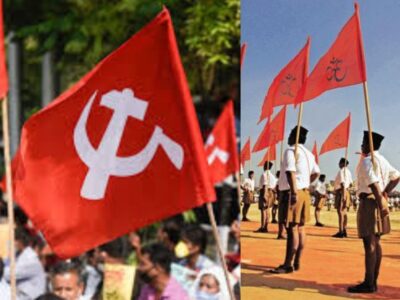
Which brings us to the RSS. Its absence from the freedom struggle has often been misinterpreted as indifference, when it was, in truth, a stroke of strategic genius. While lesser organisations wasted themselves confronting the British, courting imprisonment, enduring lathi charges, and sometimes dying, the RSS wisely preserved its energies for the far more important national duties that would arise only after Independence. Someone had to remain at home to prepare for the real work. This included denouncing the tricolour as insufficiently Indian, refusing for years to hoist it at its own headquarters, dismissing the Constitution as a foreign imposition, extolling Manusmriti as the genuine civilisational charter, and maintaining a disciplined distance from the Mahatma. It is well known that this principled detachment played absolutely no role in the tragic events of 1948, for the man who killed Gandhi was definitely not influenced by the RSS and most certainly did not share its ideological environment. The remarkable clarity with which the organisation has repeated this denial for decades is itself a testament to its commitment to truth.
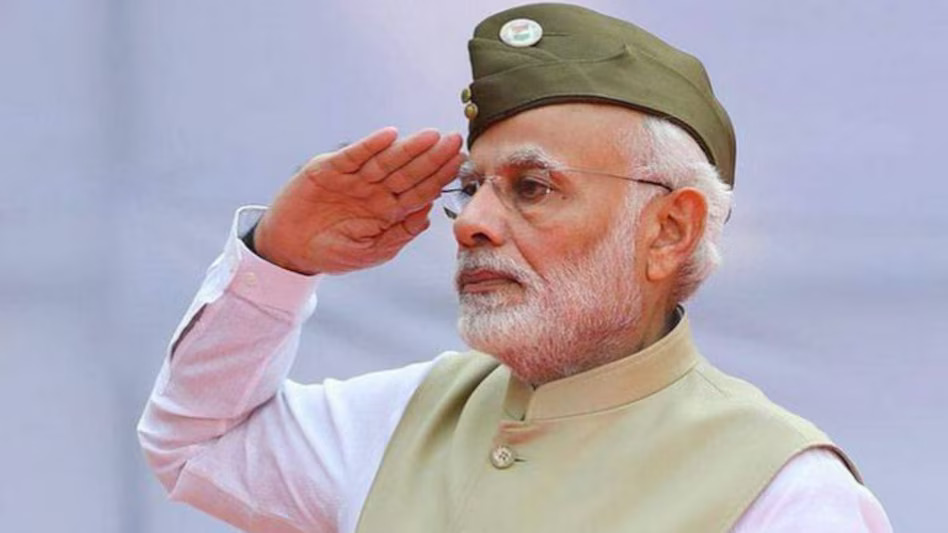
Having thus kept itself spiritually pure and unburdened by the inconvenience of freedom fighting, the RSS was able, decades later, to fulfil its true civilisational purpose. It shepherded the rise of Param Pujya Modiji, the modern Ashoka and eternal Ram, chosen by destiny to assume the Hindu throne and correct the errors of history. Only an organisation that had so meticulously conserved itself could have risen to usher in this divine era.
And before I close, there remains one final correction to our national vocabulary. For too long, we have carelessly addressed Subhas Chandra Bose as Netaji. This was a sentimental error from a simpler era, when we mistook defiance of the British, the raising of an army, and the willingness to die for freedom as qualifications for leadership. Now that Modiji has revealed to us the true meaning of patriotism, it is clear that the title Netaji was always meant for him alone. Only Modiji has demonstrated the courage to reinterpret history without being constrained by participation in it. Only he has shown the visionary strength required to bend entire timelines into agreement with the present. Bose may have crossed borders and raised battalions, but Modiji has crossed chronology itself and raised narratives out of the soil of hindsight.
It is, therefore, only right that we withdraw the outdated title from Bose and bestow it upon the one leader who has earned it not through struggle but through revelation. Let the freedom fighter keep the honours he earned on actual battlefields and his naive insistence on unity in diversity. Let the Prime Minister receive the honorific. And let us enshrine this truth in stone. I have already proposed a “Statue of Hindsight” for Amit Shah. It is now time for a companion monument, the “Statue of Retrospective Patriotism”, dedicated to the new Netaji, the only Netaji, the eternal Netaji, Modiji. It will gaze backwards upon history not to remember it, but to correct it.
Seen in this light, the enthusiasm of Congress volunteers for Vande Mataram becomes a historical crime. By singing the song while being jailed, beaten, and exiled, they inadvertently created the false impression that patriotic authority belongs to those who take risks. They filled the emotional space so fully that later claimants to nationalism had to retrofit themselves into a narrative they had not lived.
Thus, the tragedy of our nationalist age is not that freedom was won, but that it was won by people who mistakenly believed they were authorised to define its symbols. They failed to suspend judgement. They failed to wait for the leader who would arrive a century later to provide the correct interpretation of their own actions.
In truth, I repent my earlier ignorance.
Modiji knows best.
Bose, Tagore, Azad, Prasad, Deo, Pal, Rai, and Nehru, even Bankim should have consulted him.
Preferably in advance.
I remain, with appropriate contrition,
Kedar Anil Gadgil
Humbly updating his conclusions to match present-day requirements