My dearest Kym,
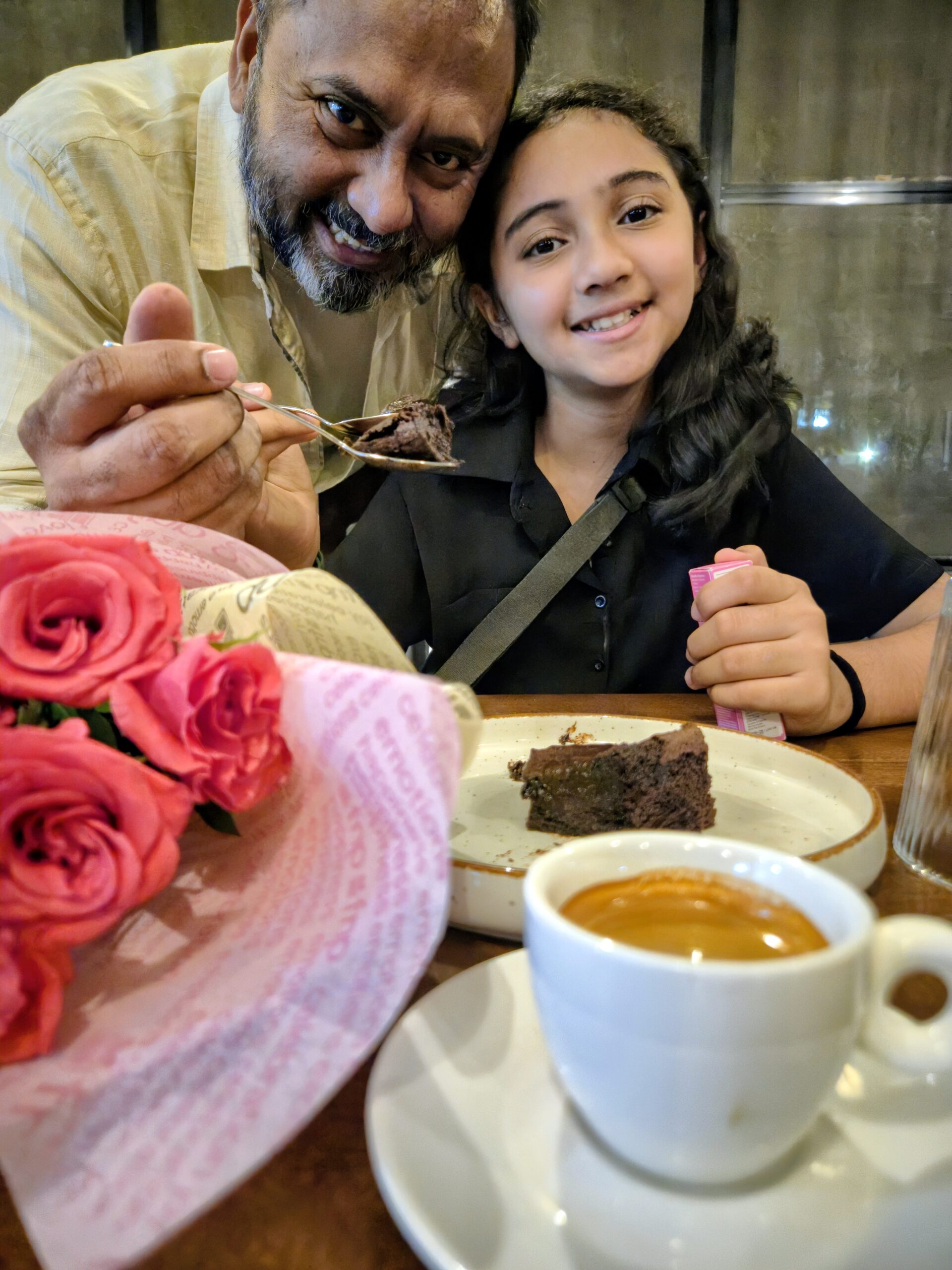
I don’t know whether roses are standard protocol for first periods in Baby Bears, but as you could see, Baba Bear decided they should be. And honestly, that evening was lovely. Coffee for me, chocolate cake and fries for you, roses on the table, and you talking nineteen to the dozen about life, school, friends, dreams, and all the things crowding your beautiful mind these days.
And when, in all that chatter, you informed me that you want to become a criminal lawyer, I must admit I was a bit relieved. There was always the dangerous possibility that you were going to say “influencer”, which, if you know me at all, you will know I do not think is a bad thing to be. We discussed influencers in decision-making too that evening. But not in the way the word is usually meant today.
Now here’s the interesting thing. When I asked why you wanted to become a criminal lawyer, your immediate response was that you would put bad people in jail. Fair enough. Most children, and quite a few adults, think the law works like a superhero film where good people catch bad people and everybody claps in the end.
But then we spoke about prosecutors and defence lawyers. As I explained, the world, especially the world of law, is complicated.
If you become a lawyer for the prosecution, you will be serving the state and one of the most powerful arms of the state, the police. Do you know what the Constitution, not just ours, but every democratic constitution, is partly meant to protect citizens from? The State. Do you know who must be watched, limited, questioned, and constantly held accountable? The State. In almost every oppressor-oppressed conflict, who is more likely to be allied with power? Again, the State.
And the less said about the police, not just ours but across time and space, the better. The police can protect the innocent, catch the cruel, and help victims get justice. They are also known to incriminate innocent people, fabricate evidence, twist the law, and act from bias rather than truth. Both things can be true. They are often our first line of defence against evil, cruelty, and crime. They are also one of the institutions most capable of becoming evil, cruel, and criminal when left unchecked.
So yes, as a prosecutor, you could help put away dangerous people. You could help victims get justice. You could help make society safer.
But what if the police are wrong? What if the government is wrong? What if witnesses lie? What if evidence is planted? What if a frightened person confesses to something they never did?
And on the other side, what if somebody actually committed a terrible crime? Does that person still deserve a lawyer?
Yes. They do.
Because every person deserves their day in court. Every person has the right to legal representation and to be defended properly. People should be punished because they committed a crime, not because they had a bad lawyer. Remember the principle on which our justice system rests: every person is innocent until proven guilty.
And then there are the harder cases. What about someone falsely accused? What about someone who is a victim of bad policing, misunderstanding, caste, class, religion, prejudice, being in the wrong place at the wrong time, or being too powerless to defend themselves against someone more powerful? What about someone who injured another person while defending herself? What about a man who hits someone trying to hurt his children? What about a thief who steals because his family is hungry?
Would you not want to defend such a person?
On the other hand, if you become a lawyer for the defence, you may also end up defending people who are exactly the sort of people you want to put away. People who have committed heinous crimes. People who lie not only to the world but also to their own lawyer. People from whom society must be protected.
And sometimes you will have no easy way to distinguish one from the other. Innocent from guilty. Criminals from framed people. Corrupt cops from honest detectives. Fair judges from compromised benches.
And that is the thing, you see, Kym. You take your chances. You think. You observe. You prepare. You listen. You ask better questions. And you hope your moral compass serves you well.
We spoke of all this in that quaint coffee shop sitting in the middle of a chikoo orchard near the house where you were born in Sopanbaug. And you realised something that I think is one of the first signs of genuinely growing up: the world is rarely divided neatly into heroes and villains.
That is not bad news, by the way. It is important news. Because once you understand that, you begin observing more carefully, thinking more honestly, and becoming a little less arrogant about your own certainty, or about whatever moral compass you believe only you uniquely possess.
And no, before you ask, getting your first period does not magically make you wise and mature overnight. It is important, yes. It means your body is growing up exactly as it is supposed to. But adulthood is not some magical gate that opens because biology did its job correctly. Otherwise every menstruating person would be wise, and every non-menstruating person would be childish, which is obviously nonsense.
Growing up, I think, has much more to do with learning how to think, how to observe, how to be truthful, how to be brave, and how to allow difficult questions to wander about in your mind without immediately demanding easy answers.
Which brings me to the lawyer we spoke about yesterday.
Before he became “Mahatma” Gandhi, before photographs, statues, currency notes, airports, and endless speeches by politicians who would probably have irritated him enormously, he was simply a lawyer.
A rather shy, awkward, uncertain lawyer, actually.
And there is a story about him refusing to continue a case because he realised his client was lying to him. Think about how strange that is. Most people believe success means winning. Gandhi slowly began believing that success without truth was failure in disguise.
But what is truth? Is it The Truth? Or does everyone’s truth differ? Funnily enough, even Gandhi did not present life as if he had captured Truth and kept it in his pocket. He called his life an experiment with truth. Through life, he learnt, erred, corrected himself, failed again, tried again, and kept going. That, to me, is what makes him a great soul, a Maha Atma, a Mahatma.
Now I do not want to turn him into some sort of divine superhero. In fact, one of the things we are going to learn together over the next few months is that great people are still people. Gandhi was flawed. Deeply flawed in some ways. You are going to be shocked. Nehru was vain. Bose shook hands with Hitler. Ambedkar, for all his brilliance, did not participate in the freedom movement in the way many others did. Patel could be stern to the point of ruthlessness. Periyar fought superstition and caste with extraordinary courage, but could also be harsh, abrasive, and deliberately provocative. Martin Luther King Jr. preached love, justice, and moral courage, but his personal life was not as clean as the sermons suggest. Mandela became one of the world’s great symbols of reconciliation, yet he too made political compromises and difficult choices that remain debated to this day. Tolstoy preached moral purity while making life very difficult for the woman who copied his manuscripts, ran his household, bore his children, and helped make his genius possible.
The point is not to worship them.
The point is to observe how they tried.
That, I think, is what makes somebody truly great.
So here is Baba Bear’s proposal.
From now until November, you and I are going to write to each other once every week. Twenty-five letters in all, including one on our birthday. We are going to talk about truth, courage, persuasion, philosophy, history, law, mathematics, politics, films, kindness, power, discipline, aviation, grief, humour, and all the other strange and wonderful things that make up human life generally, and yours in particular.
But before we begin, a confession: no, Baba Bear does not have all the answers. If anything, fifty-three years of life, and fifty-four this year, have mostly taught Baba Bear how complicated people are, including himself.
But perhaps we can think together.
Now your task for this week: observe adults.

Not what they say. Everybody says things. Observe what they do. Observe how people behave when they want something. Observe how they persuade. Observe how they argue. Observe how they become unfair. Observe how they become generous. Observe when somebody is technically correct but morally uncertain. Observe how they operate in the greys, when things are not black and white. Don’t speak. Just observe. Think. And write to me.
But most importantly, observe yourself. This is part of the whole discussion about Gandhi, because the hardest person in the world to observe truthfully is oneself. It is much, much harder than it looks, Tukul. You will understand once you start. Remove yourself from your image, from your body, from your idea of yourself, and watch.
But don’t be disheartened if you fail to be impartial while doing it. Or even if you fail to do it altogether. That is part of the process. That just means you are doing it right.
Next week, we shall speak about truth. Not truth in the grand patriotic movie sense, with songs and speeches. No. Not that sort of truth.
Small truth. Daily truth. The sort that changes human beings. The sort that will change you. Slowly. Without you realising it.
All my love, always,
Baba Bear 🐻
P.S.: I can’t wait for you to tell me what you feel. Take your time reading this letter. There is no hurry to respond to all of it. You can just tell me what you felt about some parts now and perhaps some other parts later. Don’t treat this as a test. It is. But it isn’t. You’ll know what I mean later. At this point, just read. And think. And think again.