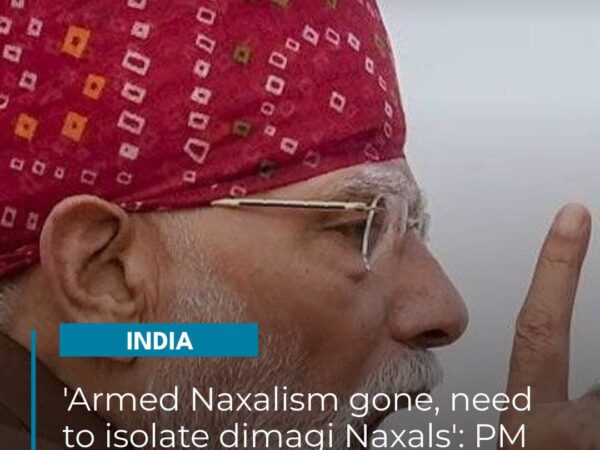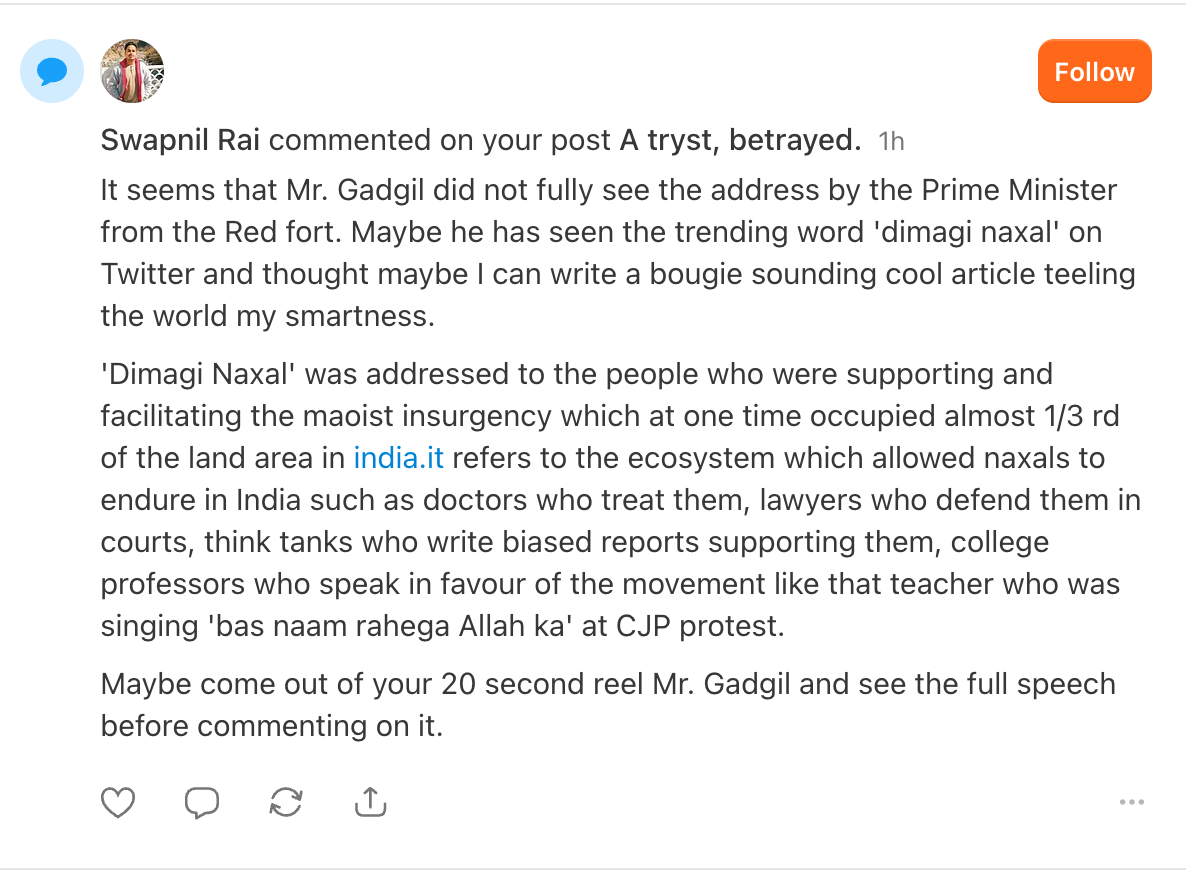
A gentleman responding to my recent piece on the Prime Minister’s Independence Day speech suggested that I had probably watched a twenty-second reel, noticed the phrase “dimagi Naxal” trending on Twitter, and rushed off to write something “bougie sounding cool” without bothering to understand what the Prime Minister had actually meant. He then very helpfully explained what he believed the term meant, by identifying the ecosystem that supposedly allowed Naxalism to survive as including “doctors who treat them, lawyers who defend them in courts, think tanks who write biased reports supporting them, college professors who speak in favour of the movement”, adding, as an example of this last category, a teacher who had apparently sung “bas naam rahega Allah ka” at a protest.
Despite the fact that my article was not about the phrase “dimagi Naxal” but more about how the standards for the prime ministerial Independence Day address have fallen, I am grateful for the clarification, because if this is indeed the defence of the phrase, my problem with it has become considerably larger.
Let us leave the think tanks and professors aside for a moment, because advocacy, propaganda, incitement, scholarship, ideological sympathy, and material assistance are different things and deserve to be distinguished before anyone begins prosecuting people for belonging to an “ecosystem”. I am fascinated by the first two categories. One, doctors who treat Naxals. And two, lawyers who defend them.
Let’s take the lawyers first. What, precisely, does he imagine a lawyer is supposed to do?
A lawyer appearing for someone accused of terrorism, murder, sedition, insurgency, or waging war against the state is not endorsing the offence alleged against his client. He is performing a function which is at the heart of the criminal justice system (notice the word in the middle there? Yes, “justice”). You see, Article 22(1) of the Constitution specifically recognises the right of an arrested person to consult and be defended by a legal practitioner, Article 39A commits the state to equal justice and legal aid, and the Supreme Court has repeatedly treated access to legal representation as integral to a fair criminal process. If representing an unpopular accused becomes evidence that the lawyer shares the accused’s politics, sympathies, or crimes, we won’t have lawyers, or indeed justice left by the end of the year.
To see our record on this, we don’t have to go far. This principle on which our country stands has been tested under circumstances in which there was considerably less room for moral ambiguity than most cases involving any ideology. Nathuram Godse assassinated Gandhi and was still defended before an Indian court. Those prosecuted for Indira Gandhi’s assassination were represented, tried, and permitted to challenge their convictions through the judicial system. Ajmal Kasab arrived from Pakistan as part of a terrorist operation that murdered 166 people in Mumbai, was captured alive after participating in that attack, and was nevertheless given counsel, tried, permitted appellate scrutiny, allowed the constitutional mercy process, and eventually executed according to law.
Kasab is particularly useful here because nobody (not even those who defend Nathuram) need perform intellectual callisthenics about whether he was our enemy. He was. He demonstrated it. And he said it himself.
And yet, what did we do? We gave him his day in court.
I regard that as one of the more patriotic things this Republic has done. We had a man in custody who had crossed an international border as part of a terrorist squad to murder Indians, with overwhelming evidence against him and an understandably furious country demanding punishment, and we still required the state to produce its evidence, establish guilt before a court, allow him representation, permit appellate scrutiny, and exhaust the constitutional process before taking his life. The lawyer defending Kasab was not supporting Lashkar-e-Taiba. He was participating in the Indian constitutional system. India defeated its enemy without requiring India to stop being India.
Now, to the doctors. They are easier still to explain. The modern physician’s pledge expressly says that nationality, political affiliation, creed, race, social standing, and other such considerations must not intervene between a doctor’s duty and the patient. A doctor who treats a wounded Maoist is therefore doing exactly what a doctor is supposed to do. If treating a Naxal makes the physician part of the Naxal ecosystem, presumably an emergency ward must first establish whether the bleeding man brought through its doors is a terrorist, murderer, rapist, enemy soldier, political extremist, or merely an ordinary criminal before deciding how much medicine his politics entitle him to receive. I am not sure at what stage of medical education this ideological triage is taught, but it certainly does not resemble any conception of medical ethics with which I am familiar. Indeed, if such is the case that one’s crimes are contagious enough for the treating physician to be infected by them, isn’t every doctor and nurse treating a corrupt politician guilty of corruption? What about an adulterer? A kleptomaniac? A bully? Someone who cheats at golf? I mean, what are the limits of this argument?
Representation is not endorsement, treatment is not allegiance, research is not participation, and speech is not insurgency. A lawyer who knowingly assists a terrorist operation, a doctor who deliberately shelters armed insurgents from the police, a professor who recruits cadres for an illegal armed organisation, or an institution that knowingly finances violence presents an entirely different legal question. By all means, investigate the conduct, gather evidence, charge the person under an applicable law, prove the allegation before a court, and, if you have understood absolutely anything about this country and its ethos, give that accused person a lawyer too.
With that, let us turn to the remark about the professor singing “bas naam rahega Allah ka.” It reveals another problem altogether, because before advising somebody else to watch more than twenty seconds of a speech, it is occasionally useful to have read more than one line of a poem.
The line comes from Faiz Ahmed Faiz’s Hum Dekhenge, one of the most famous revolutionary poems of modern South Asia, written in 1979 in the shadow of General Zia-ul-Haq’s military dictatorship in Pakistan and subsequently made iconic by Iqbal Bano’s performance in Lahore. Faiz, a communist and a lifelong critic of authoritarianism, deliberately borrowed Islamic imagery and turned the theological vocabulary of Zia’s own regime against earthly tyranny. The same passage that contains “bas naam rahega Allah ka” moves towards “an-al-Haq”, the Sufi declaration associated with the idea of divine truth residing beyond the authority arrogated to itself by rulers, and ends with power belonging to the people, “jo main bhi hoon aur tum bhi ho”. Ali Sethi has explained the disputed line particularly well as a characteristic Faizian double meaning, capable of sounding theological while simultaneously stripping earthly rulers of their claim to ultimate authority. Reading “bas naam rahega Allah ka” as evidence that a professor singing Hum Dekhenge therefore belongs to some Maoist ecosystem is rather like discovering Animal Farm, noticing that the characters are pigs, and concluding that Orwell was writing a manual on animal husbandry.
There is a difference between literacy and education, and increasingly I find myself bothered by the uneducated literates, because the people making these arguments are very often not people who lack degrees. They are graduates, post-graduates, even PhDs, they have professional qualifications, corporate jobs, and access to more information than any previous generation of human beings could have imagined. And yet, somehow they arrive into adulthood believing that a lawyer defending an accused person shares his crime, that a doctor treating a wounded insurgent shares his ideology, that a think tank producing an inconvenient report is assisting an insurrection, and that one line lifted from one of South Asia’s best-known poems can be understood without knowing who wrote it, why he wrote it, what surrounded that line, or what political order the poem was written to oppose. A degree certifies that an institution examined you in a subject. Education is supposed to leave you with some understanding of how law, medicine, science, literature, evidence, disagreement, justice, and other human beings and institutions work.
This is also where my disagreement with this conception of Rashtravaad (nationalism) becomes fundamental. Once loyalty to the nation becomes the test before which every other professional or constitutional obligation must justify itself, the lawyer must prove his patriotism before defending their client, the doctor before treating their patient, the professor before teaching or speaking, the researcher before publishing an inconvenient conclusion, the journalist before reporting something damaging to the government, and eventually the judge before acquitting somebody whom the public has already pronounced an enemy. Every independent institution is reduced to answering the same question: whose side are you on (with ‘side’ being narrowly defined as the government of the day and not really a location anchored in morality)?
My understanding of patriotism is very different. For me, the principles that this country, its people, and its Constitution stands for are greater than the geographical construct that is called India. The idea of India is immortal and takes precedence over the political entity. Loving one’s country, to me, does not mean loving the land within the borders, but loving the people, the shared history and culture, the shared values, and the shared aspirations, all of which are enshrined in the Constitution: equality before law, due process, freedom of conscience and expression, professional independence, institutional restraint, and limits upon the power of the state. I am proud that this country provided legal counsel to the assassin of the Mahatma, to those accused of murdering a Prime Minister in broad daylight, and to a Pakistani terrorist who came here to kill Indians, because constitutional principles that survive only for people we like are not principles at all.
The difficult defendant is why the right to counsel exists.
The hated patient is why medical ethics matters.
The offensive opinion is why freedom of expression needs protection.
The state does not demonstrate confidence in its principles by applying them when nobody objects. It demonstrates confidence when applying them is difficult, unpopular, even revolting, and does so anyway.
So yes, I want the Naxal treated by the doctor. I want the terrorist defended by the lawyer. I want the professor free to sing Faiz without someone who has not read nor understood Faiz accusing him of being an insurgent. I want think tanks to publish conclusions that governments dislike (sometimes, even wrong ones, only to be demolished by other think tanks or data that has an equal opportunity to be heard and published), and of course, I want anyone who actually crosses the line from thought, speech, medicine, law, scholarship, or advocacy into criminal participation as per established law in the BNS and BNSS to be investigated, charged, represented, tried, and convicted if the evidence proves the offence, but only after they have had their day in court.
If nationalism requires us to sacrifice those distinctions, those professions, those rights, and those institutions merely because somebody has decided that the person benefiting from them is an enemy, I am considerably less interested in proving my nationalism than in protecting the Republic from it.
What, exactly, are we being patriotic towards?