00 Prologue
Some time after midnight, in a flat in a city that did not exist five centuries ago, a man gets up for a glass of water.
He is half asleep, and so he does none of the things he is in fact doing.
He touches a switch, and the room fills with a steady light that does not flicker, does not smoke, and need not be fed or watched; he gives it no more thought than he gives to breathing.
He turns a tap, and clean water runs out, as much as he wants, having reached him through a buried system he has never seen and could not draw.
He opens a tall cold cupboard humming in the dark and finds, in the dead of a winter night, fruit grown on another continent and last night’s dinner held in suspended animation against the morning.
Beside him lies a thin slab of glass that, were he to lift it, would put in his palm the answer to almost any question he could ask, and much of what the species has ever written down.
He drinks while reading from that slab what a stranger has written about something that happened a few minutes ago in another part of the planet, responds to it, turns off the light, and goes back to bed, and the most striking thing about the whole episode is that he found nothing about it striking at all.
I have come to think that this indifference is the strangest thing in the modern world, far stranger than any of the marvels it steps over.
We are fond of saying that we live in an age of wonders, but we do not behave as though we believe it, and a wonder is precisely a thing one notices.
What we actually do with our inheritance is take it for granted, which is the privilege of heirs everywhere.
The same man, later that day, will point his phone at a square of squiggly lines and watch goods become his without a coin changing hands; he will walk through a building stacked to the ceiling with more abundance than a medieval city saw in a year, and find it tedious; he will open a cabinet holding cures for diseases that, within living memory, routinely buried children, and reach past them for the toothpaste.
And yet the fortune is not old.
The thirsty man commands, without thanks, capabilities that would have seemed frank sorcery to the overwhelming majority of human beings who ever drew breath, including a great many reckoned mighty in their own time.
An emperor of India, with the entire subcontinent at his feet, could not call light from a wall with one finger, could not have a cold drink in high summer without men to cut and carry ice down from the mountains, could not reach his generals in the Deccan in under weeks, and could not, for all the physicians he kept, have learnt in an idle moment what any bored adolescent now pulls from a glowing rectangle while waiting for a bus.
The poorest person likely to read this sentence has, in several plain respects, slipped a leash that held every human being who lived before roughly the day before yesterday.
The question that has occupied me for the better part of my life, and that this essay sets out to answer, is a deceptively simple one.
How, exactly, did this happen?
Not in the manner the schoolbooks mean, with their tidy processions of inventions and great names, their neat causality, and their tidy explanations, but in some deeper sense, because the usual answers give way the moment one even gently pushes them.
We are told it was genius; but clever people have been thick on the ground in every age, and most of their cleverness changed nothing for anyone.
We are told it was the work of great heroes, and the chronicles are dutifully stuffed with them, though it is a curious kind of greatness that keeps arriving at the same idea in several places at once, among people who had never met.
We are told, most vaguely of all, that it was progress, as though progress were a sort of weather that simply blows through history and lifts us as it passes.
None of these is an explanation. They are the names we give to the thing we have not explained.
I am an engineer by training, a diarist by choice, and a noticer (is that a word?) of patterns by temperament, which is a courteous way of saying I have spent my working life being paid to stare at complicated arrangements until the dull, repeating logic beneath them reveals itself.
For 20 years, perhaps closer to 30, and largely for my own amusement, I have read my way around this question without much method, through evolution and economics, anthropology and engineering, the histories of religion and technology and money, never quite meaning to arrive anywhere.
I did not expect the reading to resolve into anything.
Then, a couple of weeks ago, the whole untidy heap of it settled, when a friend called me for a radio interview regarding the future, into a single sentence that came to me almost as a joke: that human civilisation looks, on a long enough view, like one very long search for more things to burn.
I assumed the line would wear off by morning. It did not.
The more I thought of it in reference to what I had read, seen, heard, argued, and been argued against, the less it seemed like a joke.
We burn sugar, like almost all living being on Earth. Fire, our first ever ‘discovery’ is literally burning. A field of wheat is last summer’s stored fire from the sun. Coal and oil are that same sunlight banked for 300 million years and dug up to be set alight in an afternoon. An ox is an engine that runs on grass (stored sunlight). A machine is a device for turning one kind of burning into work.
And the computer, and the thing we have lately taught to do a passable imitation of thinking: AI, are only the most expensive fires we have yet learnt to keep lit.
Read from far enough back, the story I thought I had been reading in a dozen separate subjects turns out to be, underneath, the same one told over and over: an animal going about the world looking for more to burn, and getting steadily better at finding it, starting it, controling it, commanding it.
I have been circling that sentence for years. And last week, as I said, it just came to me.
It is not a shape the histories tend to draw, because it runs clean across their usual borders, paying no heed to the lines we set between food and war and money and faith and machinery.
I will not set it out too plainly just yet, partly because half the pleasure lies in watching it surface for oneself, and partly because, stated baldly, it sounds either too obvious or too sweeping to credit, and is in truth neither.
I can say this much, though, by way of a hint.
Almost everything we now take for granted began as something we were wholly at the mercy of, a hard limit set by nature that no amount of wishful thinking could shift.
There was a time, and not a distant one in the life of the species, when light ended with the sun, when food came only in its season and only from close at hand, when a thought travelled no faster than the legs that carried it, when strength meant muscle and memory meant whatever a living mind could be trusted to hold.
Each of these was a wall.
And the history that actually matters, as against the history of who sat on which throne and fought wars, turns out to be the story of how, one wall at a time, we learnt not to climb over these limits but to dissolve them altogether.
How we learnt to take a thing we could once only beg from nature when she chose to offer it, and have it instead deliberately, reliably, in the quantity we wanted and at the place and hour we named.
Every one of those walls, when you look hard at what lay on the far side of it, was in the end a way of laying hold of more to burn, and of burning it when and where we chose rather than when the world happened to permit.
We learnt, in short, to summon these things at will, and the gap between asking the world for something and commanding it is very nearly the gap between every age before ours and our own.
The order in which the walls came down was no accident.
Each breach made the next both possible and unavoidable, so that the sequence carries a logic, a direction, almost a plot; and once you have caught sight of the plot you begin to suspect, uneasily, that we are still inside it, that the newest of our marvels is merely the latest move in a very old game whose rules we have never quite admitted we are playing.
This essay follows that game from its opening move to its most recent, and takes seriously the possibility that the thing we so loosely call civilisation is, underneath, one long campaign waged with a single recurring strategy, by a forgetful and quarrelsome animal that for the most part had no notion it was waging anything at all.
I should warn you that it does not read, in the end, as a story of triumph, because every wall we brought down turned out to have something waiting on the far side, and the bill for our cleverness has a habit of falling due in a later century than the cleverness itself.
And I am no longer sure the last thing waiting is one we can burn our way past at all; but that is for much later, and I have promised myself not to reach for it before its time.
It is, even so, the truest frame I have yet found for the small mystery I began with: how an ordinary man came to stand at his kitchen tap in the dark, holding in two unthinking hands more of the world than any king of any earlier age, and feeling, as he swallowed, precisely nothing.
To understand how he got there, we shall have to go a very long way back, to the first time our ancestors took hold of something they had every reason to fear, and learnt, against the plain instinct of every other creature alive, to make it come when they called and leave when they bade it go.
01 Food. At will.
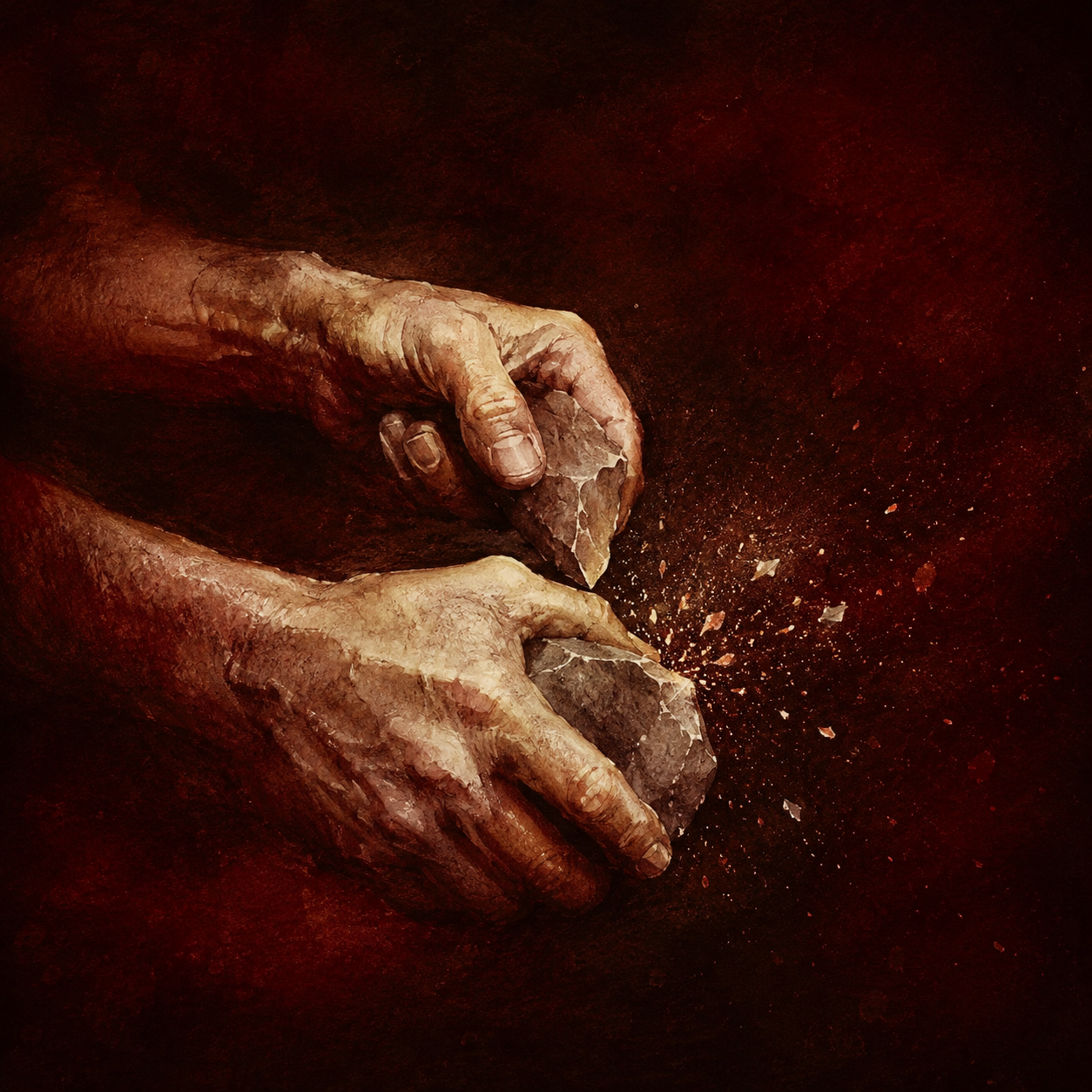
Every other animal runs from fire. We are the exception, the one creature that looked at a burning tree and decided it was worth investigating, and probably using, and so, worth keeping.
That is the telling thing about us, not that we discovered fire (fire needs no discovering; it has been falling out of the sky as lightning for as long as there has been sky), but that we chose to stay beside it, to feed it, to carry an ember from one camp to the next cupped against the wind, and eventually to summon it ourselves from a dry stick and a great deal of patience.
The achievement was never fire. It was fire that came when we called it and went out when we told it to. The achievement was control.
I want to begin here because fire is the obvious first fuel, and this essay is, underneath everything, about fuel.
But there is an older fuel, and we overlook it perhaps because it never leaves the body. A human being is a machine that burns food.
Before we kept any fire outside ourselves, we were already running one inside: metabolism, the slow combustion that turns last week’s meal into heat and movement. Everything in this chapter is really about that inner fire, and about the long problem of keeping it fed.
Nobody can tell you with confidence when we first controlled the outer fire, and the archaeologists are the first to admit it. The strongest anchor we have sits in Wonderwerk Cave in South Africa, where burned bone and ashed plant remains, found in intact sediment roughly thirty metres inside, have been dated to about a million years ago.
The depth matters, because a fire that far from the entrance is hard to explain as a grass fire that wandered in on the wind. Who was tending it stays genuinely open. The likeliest candidate is Homo erectus, with Neanderthals and our own species in secure possession of the trick much later, but the fossil record and the fire record do not line up as neatly as a textbook would like.
The real difficulty is the difference between using fire and controlling it.
A troop of monkeys will happily forage through the aftermath of a wildfire for roasted insects and seeds; that is using fire, and it requires nothing more than opportunism.
Keeping a fire alive through a wet night, banking it, carrying it, rebuilding it the next evening in a new place, that is something else, and the evidence for it is maddeningly ambiguous, because fire leaves only smudges and chemistry behind unless the context is exceptional.
This is why a site like Qesem Cave in Israel matters. There the same central hearth was used again and again, which makes the fire look less like an accident and more like a fixed point in domestic life, a thing the household was organised around. A repeated central hearth is, in a real sense, the first infrastructure.
Gesher Benot Ya’aqov, also in Israel, runs to around seven hundred and ninety thousand years ago. And Zhoukoudian in China, which for most of the twentieth century was the textbook example of early human fire, has spent the last few decades being disputed, which tells you how unstable even the canonical cases are.
What fire did, beyond keeping the dark and the cold and the predators away, was let us extract energy from the world more efficiently than our own bodies could manage unaided.
Here we reach Richard Wrangham, the Harvard primatologist whose 2009 book Catching Fire argued that cooking was not a pleasant refinement layered on top of human evolution but one of its causes.
The logic is clean. Cooked food is softer, safer, and easier to digest; it surrenders more of its calories with less effort; and a creature that cooks can feed a smaller gut and a larger brain on the same raw material.
The human brain burns something like a fifth to a quarter of all the energy we consume while sitting there doing nothing visible, and you cannot run an organ that greedy on raw leaves and uncooked meat. He pins the pivotal moment to the rise of Homo erectus, roughly one and a half to two million years ago.
It is a good story, and like most good stories only partly true.
The mainstream has settled somewhere weaker and more defensible: cooking almost certainly mattered a great deal, but probably did not act alone, and was one item in a larger package that also included more meat, better tools, and the cooperation that lets a band share the work of getting food.
The serious objection is timing. There are hints that brains were already enlarging and diets already shifting before we have any secure evidence of controlled fire, which is awkward, because a cause is generally expected to precede its effect.
We did not start walking on two legs because we learned to cook; we had been walking upright for several million years before the first ember was deliberately kept. Walking came first by an enormous margin, and cooking arrived much later to do something different, which was to move part of digestion outside the body.
That is what cooking is, once you strip the romance off it: pre-digestion performed by fire, the stomach’s slow chemistry outsourced to a quicker and hotter agent. We had found something to burn, and a reason to keep burning it.
Fire did one further thing that is easy to overlook: it travelled.
A fire is a portable climate. With it, a tropical animal could walk into a temperate winter and survive, push into caves and high latitudes that would otherwise have killed it, and keep the large carnivores at bay through the long defenceless hours of sleep.
We did not adapt our bodies to the cold over a hundred thousand patient generations. We carried our own weather with us, in a basket of embers, and went where we pleased. That is migration as an act of will.
For all that, fire gave us energy only in the moment. It could not be stored against next winter; it could not be made to arrive on schedule; it answered the question of tonight, not the question of next year.
The far larger leap was learning to command not the heat of a single evening but the calories of an entire season in advance.
That leap is agriculture, and the first thing to understand about it is that it was not invented. It was discovered, slowly, repeatedly, and independently, by people who had never met and never could have met, in places separated by oceans they did not know existed.
This is the part I find hard to get over.
Wheat, barley, and lentils were domesticated in the Near East, along with goats, sheep, cattle, and pigs, somewhere between about eleven and a half and nine thousand years ago, and that crescent of land gets most of the attention.
But rice and millet were brought under control in China entirely separately. In the highlands of New Guinea, people learned to grow taro, bananas, yams, and sugarcane without the faintest idea that anyone, anywhere, was doing anything comparable. Across Africa, sorghum, millet, and the extraordinary Ethiopian grain teff were domesticated on their own terms. In the Andes it was the potato and quinoa; in Mesoamerica, maize and squash.
Six or more times, in mutual ignorance, our species arrived at the same idea: stop chasing food across the landscape and make it happen where you stay. At will.
When communities separated by oceans arrive at essentially the same solution to the same problem, you begin to suspect the idea was waiting inside the species all along, needing only the right conditions to surface. (Some prefer to credit aliens. I will leave them to it.)
It was almost never sudden.
There was no morning on which a clever woman planted a seed and founded civilisation before lunch. The Near East shows people intensively managing wild plants for a very long time before those plants visibly changed into their domesticated forms, which means agriculture was less an event than a slow ratchet, a centuries-long negotiation in which we gradually bent a species to our purposes and it gradually bent us to its.
The most spectacular case is maize, which began as a scrawny Mexican grass called teosinte, bearing a handful of rock-hard kernels, and which generations of farmers coaxed, over thousands of years, into the great cob that now feeds a substantial fraction of the planet.
Place teosinte and modern maize side by side and you would not guess they were related. It ranks among the most sustained acts of genetic engineering our species has ever performed, and it was carried out without metal, writing, or any notion of what a gene might be.
The Andean farmers did not merely domesticate the potato, somewhere between six and ten thousand years ago; they worked out how to freeze it on the cold nights and dry it in the high sun until it became chuño, which would keep for years. They invented freeze-dried convenience food several millennia before anyone thought to be embarrassed about it.
Beneath the variety of crops and climates, all of this amounts to one thing: agriculture is captured sunlight.
A field is a device for taking the energy that pours down from the sky and funnelling a far larger share of it than wild land ever would into a form a human being can eat and burn.
A hunting and gathering band is limited by what the local ecosystem happens to produce in a year, what ecologists call net primary production, which is simply nature’s annual energy budget spent as nature sees fit.
A farmer overrides that budget, redirects it, intensifies it, and, crucially, stores the result. The land becomes a battery for sunlight, and we became the only creatures that had learned to charge it.
Food at will, at last, not in the heat of a single fire but across the turning of the seasons.
I should not let the triumphalism run away, because there is an uncomfortable counter-argument that deserves its hearing.
In 1987 Jared Diamond called agriculture “the worst mistake in the history of the human race”, and the case is stronger than it first appears.
The skeletons of early farmers are frequently shorter, sicker, and worse-nourished than those of the foragers who preceded them; a diet built on two or three staple grains is a nutritional gamble in a way that a varied wild diet is not; and crowding people together with their animals, their stored grain, and their accumulating filth created, for the first time, the conditions for epidemic disease, for famine when a single crop failed, and for the inequalities that a storable surplus makes almost inevitable.
The verdict is deliberately provocative, and it has been argued with ever since.
The fairer conclusion is that farming was neither blessing nor blunder but a bargain: we traded a measure of health, variety, and freedom for sheer numbers, for permanence, and for everything permanence would eventually make possible.
We have been living inside that bargain, and slowly recovering from it, ever since.
The reason there was no going back comes down to one unglamorous word: surplus.
A granary is not really a building full of grain. A granary is energy that has been saved rather than spent, and saved energy can be counted, lent, sold, taxed, stolen, defended, and fought over, which makes a granary the seed of arithmetic, of the state, of property, of war, of the landowner, the monarch, and the bureaucrat.
Above all, a surplus frees people from the land. If ten families can grow enough to feed twelve, then two families’ worth of effort is suddenly available for something other than the daily pursuit of calories, and into that liberated time pours the priest, the soldier, the artist, the potter, the brewer, the philosopher, the chieftain, and, inevitably, the man whose whole job is to keep track of how much grain there is and to look stern about it.
Civilisation, in this rather deflating light, is what a society does with the time it no longer has to spend eating.
You can see the consequences hardening into stone across the early settlements, though the picture is stranger than the tidy march from village to town to city we like to imagine.
Jericho is very old and was walled startlingly early, for reasons still debated.
Çatalhöyük, in Anatolia, was a honeycomb of mudbrick houses packed so tightly that there were no streets at all; people walked across the rooftops and entered their homes through holes in the ceiling.
Even its population is disputed. Older estimates put it in the thousands, while recent work argues for a peak of perhaps six to eight hundred, a reminder of how shaky our most confident numbers about the deep past really are.
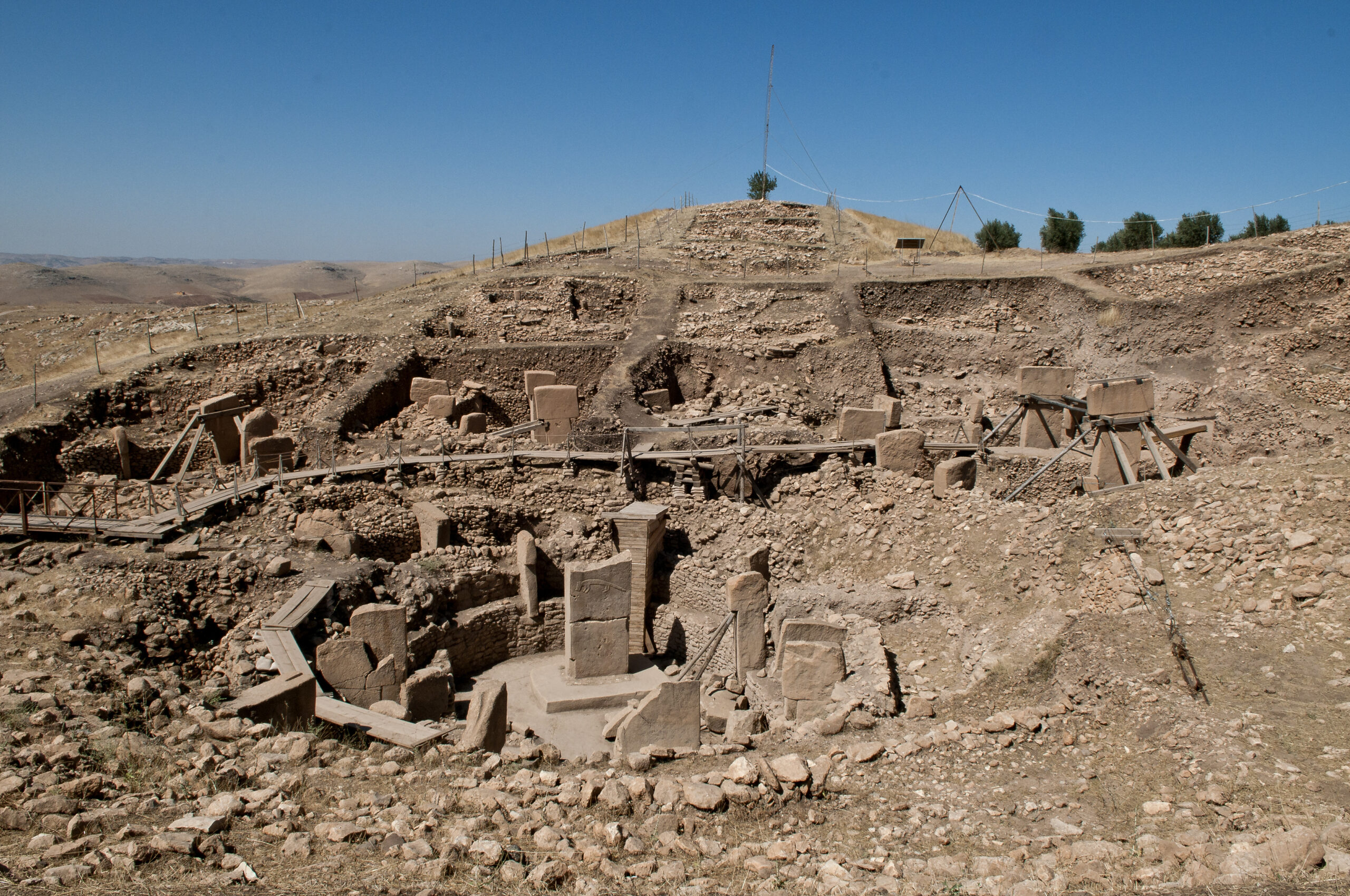
And then there is Göbekli Tepe, in south-eastern Turkey, which spoils the comfortable sequence.
Around eleven thousand years ago, hunter-gatherers who had not yet committed to farming raised enormous carved stone pillars, some weighing many tonnes, into monumental rings, apparently for ritual rather than residence.
A temple before the town; collective meaning before permanent settlement.
It forces a serious and unresolved question: perhaps farming did not produce the surplus that allowed people to gather and build, but rather the desire to gather and build was what drove scattered bands to settle down and farm in order to feed the crowds the monument summoned.
The linear story, fire then cooking then farming then surplus then cities then gods, is too neat to be quite true, even if it remains too useful to abandon.
One figure gives the whole transformation its scale.
Around ten thousand years ago, before agriculture had properly taken hold, the entire species probably numbered somewhere between one and ten million; by the year one, after several thousand years of farming, that figure had climbed into the hundreds of millions.
That is the demographic signature of food at will.
Even here the story refuses to settle, because geneticists suggest that some of our great population expansions may have begun before farming rather than because of it. The honest summary is that we learned to bank sunlight, and the banking changed everything.
What I keep returning to is the granary itself, because it is the first battery humanity ever built, a device for holding energy across time until we needed it.
From the moment we could store more food than we could eat, we stopped being creatures defined by the search for the next meal and became creatures defined by the keeping of what we had.
And keeping things creates new problems.
Grain had to be protected from weather, vermin, and thieves. Fields had to be irrigated. Boundaries had to be marked and defended. Surpluses had to be counted, stored, taxed, and rather too often fought over.
The walls of Jericho did not raise themselves. The terraces of the Andes did not carve themselves into the mountainsides. The canals of Mesopotamia did not dig themselves. The pillars of Göbekli Tepe did not stand themselves upright.
Everywhere that people began storing energy in the form of food, they ran into the same fact: muscle, whether human or animal, was no longer enough.
For hundreds of thousands of years the central problem had been obtaining calories. Now the problem was organising effort.
How do you raise a wall higher than a man can reach, move a stone heavier than a family can lift, dig a canal that runs past the horizon, or build something that will outlast the people building it?
Food at will had solved one problem and revealed another.
Having learned to command energy, we now needed to command force.
The next chapter is not about what we ate. It is about what we could move.
02 Force. At will.
There is a particular helplessness one feels in front of something too heavy to move.
Anyone who has tried to shift a sofa alone, free a car from mud, or pick up a fully loaded ADV by themselves knows the flavour of it: the body at its limit and the object simply declining to care.
For most of our history that was the end of the conversation. A stone too large to lift stayed where it was; a tree too thick to drag remained a tree; a river too wide to cross was a wall.
We are, it is worth remembering, a physically unimpressive animal. We cannot outrun a deer, outclimb a leopard, or out-wrestle much larger than a goat, and the muscle we do have is laughably finite.
Yet within a few thousand years of settling down to farm, the same feeble primate was raising stone pillars that weighed as much as a herd of elephants, hauling blocks across deserts, and digging canals that ran past the horizon.
The question is not that we did these things. It is how a creature so weak came to command force so far beyond what its own body could supply.
We never became stronger. We became cleverer about where strength was applied, and, before that, whose strength it was.
The first move was to borrow muscle that was not ours: the ox, the horse, the mule, animals that ate grass and pulled more than a man could.
But an animal is still muscle, still a body that tires and dies. The deeper move was to stop depending on muscle at all.
That is what the cluster of inventions we rather dismissively call the simple machines did.
The lever, the pulley, the inclined plane, the wedge, the screw, and the wheel share a single trick, and once you grasp it you grasp all of them. None adds so much as a joule of energy to the world.
They take the fixed, finite force a human (or an ox) can produce and rearrange it, trading distance for effort, or time for effort, or direction for effort, until a load that was impossible becomes merely difficult.
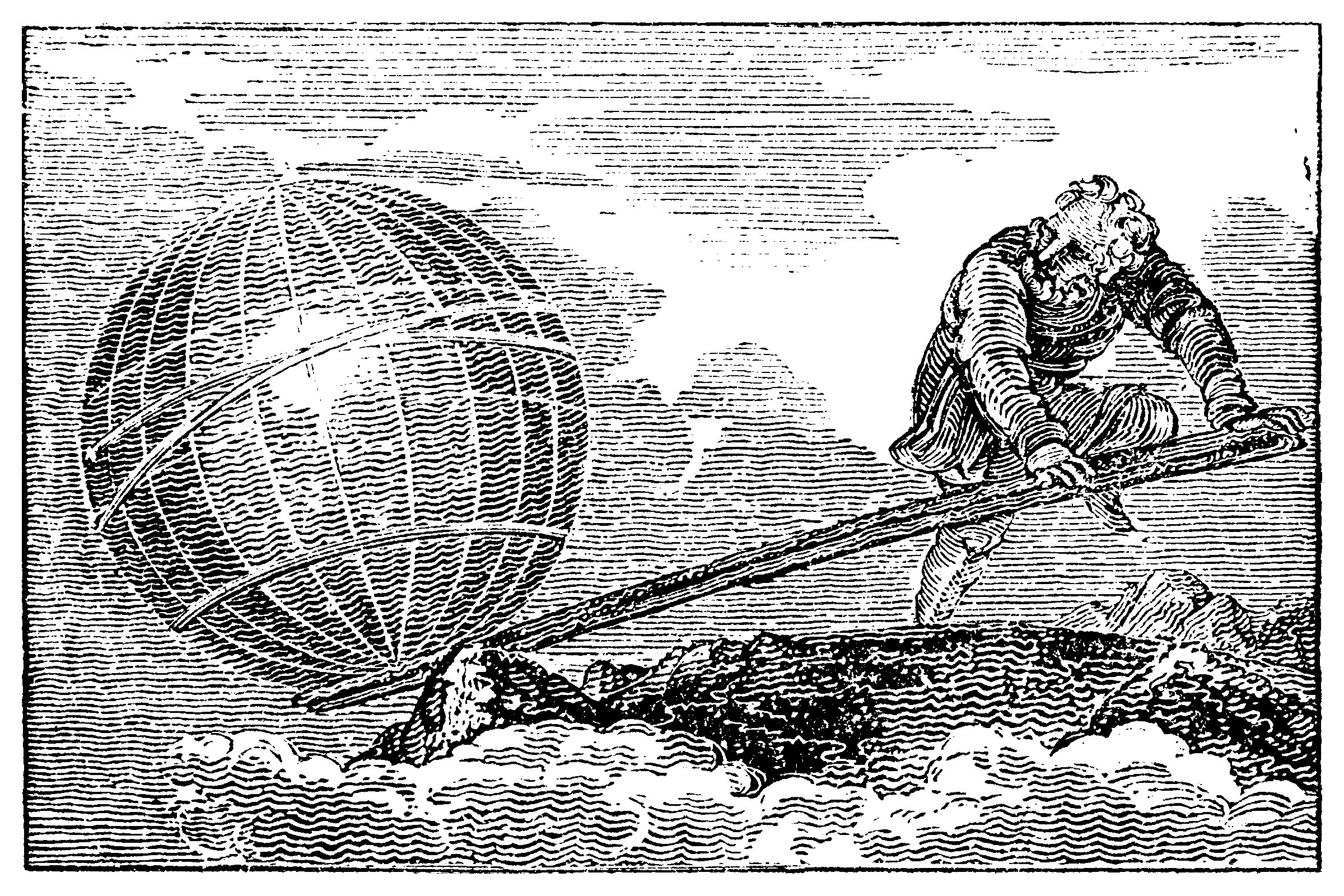
The lever is the purest case, which is why Archimedes is supposed to have made the most arrogant boast in engineering: “give me a place to stand and a lever long enough, and I shall move the earth.”
It is a boast, but not a lie; the mathematics is on his side.
He was not claiming to be strong. He was claiming that strength, properly redirected, has no fixed ceiling.
The rest are variations.
A block and tackle lets you lift a great weight by pulling a long way on a rope, paying for the lift in rope rather than in muscle, an exchange the body is delighted to make.
An inclined plane lets you raise a load by pushing it up a slope instead of lifting it straight up, which is why every ambitious ancient building site was a forest of ramps. The wedge is an inclined plane that moves; the screw is one wrapped around a shaft.
The Egyptians, raising the Great Pyramid around four and a half thousand years ago out of blocks running from a couple of tonnes to fifteen and beyond, did it with sledges, ropes, levers, ramps, and one trick experimental archaeologists have confirmed from the Egyptians’ own tomb paintings: they wetted the sand in front of the sledges, because damp sand is far easier to drag a heavy load across than dry.
No lost technology, no impossible precision, and no need for the more improbable explanations (ALIENS!!!) certain television channels still find profitable.
Rope, timber, water, arithmetic, and an enormous quantity of organised patience. The same modest kit raised heavy things wherever people set out to raise them, in the Americas and across western Europe as much as on the Nile. The genius was never a hidden device.
The wheel, which we treat as the very symbol of ingenuity, is the most humbling of the lot, because it arrived surprisingly late and behaved nothing like the triumphant inevitability we imagine.
It emerged in the fourth millennium before our era, the earliest convincing evidence of wheeled transport scattered across Mesopotamia and the band of country from the Pontic steppe into central Europe, around three and a half thousand years before our era.
One recent study even floats the idea that the first wheelsets were devised not for grand chariots but for hauling ore out of Carpathian copper mines, which would mean the wheel began its career underground, in the dark, doing unglamorous work, rather like the gaming nerds who would later make Nvidia rich.
Wood rots, so most of our evidence comes from models, burials, and pictures.
The deeper surprise is that the wheel was not obviously useful at first. Without a well-fitted axle it is merely a round object, and without maintained roads, suitable draft animals, and the surplus to build and feed all of it, a sledge or a roller often did better on broken ground.
The civilisations of the Americas knew the wheel perfectly well; they put it on children’s toys.
They never adopted it for transport, in all likelihood because they had no horse, no ox, nothing of the right size to pull a cart, and a llama, whatever its other virtues, is not going to haul your harvest to market.
The wheel is not a stroke of genius any clever people would inevitably reach. It is a wheel plus an axle plus roads plus animals plus surplus, and where the rest of that sentence was missing, it stayed a plaything.
Worth noticing early, because it is not the last good idea in this essay whose fate turned less on how good it was than on whether the world around it was ready to carry it.
Taken together, this overturned the helplessness of standing before something too heavy to move.
We could now lift it, pile it, split it, and raise it, not by being strong but by being patient and geometrical, and we could summon it where we needed it and in the quantity we needed, regardless of what our own bodies could manage.
Force had begun to come loose from the body that produced it. At will.
But rope and ramps had a limit, and the limit was the material.
You cannot cut hard stone with soft copper, plough heavy soil with a wooden share for long, or arm a thousand men with tools that bend on first use.
To multiply force reliably, and above all at scale, you needed better stuff to make things from.
So the story of force becomes a story about fire turned to a hotter purpose. Metal is what happens when you learn to burn hot enough to make rock give up the material hidden inside it.
The first great age of this is named after its alloy.
Bronze is copper with a smaller portion of tin, harder than pure copper, low enough in melting point to be cast into moulds, and consistent enough to turn out in standard shapes, which is precisely what you want for equipping an army or running a palace economy.
The difficulty is that while copper is common, tin is scarce and awkwardly distributed, found in quantity in only a handful of places. To make bronze you had to move tin, sometimes across thousands of kilometres.
The archaeologist Eric Cline describes a world in which tin was the strategic commodity of its day, the oil of its age, hauled from as far as Afghanistan to the workshops of the Mediterranean, and he calls the resulting web of palaces, ports, and caravan routes one of history’s most globalised times.
More than three thousand years ago, the great kingdoms were already knotted into a single fragile system of mutual dependence, each needing what the others controlled. No one had yet thought to call it supply chain management.
Fragile is the operative word, because around 1200 BCE that entire system came apart with great speed, in what historians call the Bronze Age Collapse.
Cities burned, palaces fell, trade routes snapped, and in some regions even writing was lost for generations.
Cline’s case, which he has done much to popularise, is that there was no single villain but a perfect storm: drought and famine, earthquakes, internal rebellion, foreign raiders, and the failure of the trade networks themselves, all arriving at once and feeding on one another, one part collapsing and toppling the next in history’s first proper domino effect, until the interdependence that had made the system rich made it lethal.
Suddenly bronze was harder to make, and the states whose power rested on it woke up with a problem.
A superior technology had been undone not by an inferior one, but by its own dependence on things it could not control.
Into the wreckage came iron, and the temptation is to tell it as a simple upgrade, iron the harder, better metal that naturally swept bronze aside.
That is almost exactly wrong.
Early iron was, in many respects, worse than good bronze. The smelting methods of the time produced not a clean pour of molten metal but a spongy, impure mass called a bloom, which had to be heated and hammered and reheated and hammered again, with variable and often inferior results.
Iron’s advantage was not quality. It was that iron was everywhere.
Where tin had to be fetched from the ends of the earth, iron ore lay in the ground almost wherever anyone cared to look, and once the techniques for working it spread, a kingdom no longer needed a thousand-kilometre trade route to arm itself.
Instead of a hundred good soldiers it could field a thousand mediocre ones with slightly worse weapons.
The logic of asymmetric warfare, one side with a hundred accurate, expensive missiles and the other with a million cheap, less accurate drones, runs more or less in a straight line from there.
This is the argument that runs under the whole essay, and under a good deal of history that has nothing to do with metal: accessibility often defeats excellence.
Wise elders have been saying so (possibly in Aramaic) for the better part of three thousand years; it reaches English in the mid-fifteenth century, when John Capgrave, in The Life of St. Katharine of Alexandria (a curious cross between Game of Thrones and The Queen’s Gambit, written in 1450), observed the advantage of a bird in the hand over two in the bush.
The best version of a thing is very often not the one that wins.
The one that wins is the one enough people can get their hands on, repair, and afford, and a passable technology that is everywhere will overrun a superb one that is rare almost every time, a lesson we seem condemned to relearn each century with a faint air of surprise.
None of which belongs only to the Mediterranean, and to leave it there would repeat one of the more persistent mistakes in popular history, the assumption that serious metallurgy was largely a Western achievement.
India was making metal the rest of the world would spend centuries trying to copy.
The crucible steel of southern India and Sri Lanka, wootz, was a high-carbon steel of such quality that the watered-pattern blades forged from it, which Europe called Damascus, became near-mythic across Eurasia: materials science centuries ahead of its time, demanding control of carbon and of furnace conditions no one else could reliably match.
The Iron Pillar near the Qutb complex in Delhi, raised in the Gupta period some sixteen centuries ago, remains remarkably free of corrosion, not by any lost science but through a quirk of its composition and the protective film it forms on its own surface, which metallurgists still find worth their time (and nationalists too, for less scientific reasons).
China, meanwhile, was casting iron far earlier and at a scale the Mediterranean would not approach for a very long time.
And across large parts of Africa, ironworking arose in its own right, at sites such as Nok in what is now Nigeria and Meroë in the Sudan, woven into agriculture and the formation of states, and waiting for no one to bring it from elsewhere.
The conquest of force, like the conquest of food before it, was something our species kept arriving at, on its own terms, all over the map.
But a sharp sword in a workshop and a high wall on a hilltop are only force in potential.
Force does nothing until it is carried to where it is wanted, and carrying it, in bulk and across distance, is a problem of its own. It is the least glamorous part of the business, and also one of the most decisive.
I have spent a fair part of my working life on the unfashionable business of getting things from where they are to where they are wanted, and I can report that no one has ever composed a song about it; the Bronze Age tin merchants, I suspect, felt much the same.
An empire is force made routable.
Rome did not dominate the Mediterranean because its senators were wiser than everyone else’s; it dominated because it could move soldiers, grain, orders, and tax along a road network that recent mapping puts at something close to three hundred thousand kilometres, even if only a small fraction can now be traced on the ground.
Those roads were arteries for supply and taxation, and Roman concrete, which set hard even underwater, threw up harbours, aqueducts, and vaults that have outlasted the empire that poured them.
The principle was not unique to Rome.
The Inca, working in the high Andes without the wheel, without iron, and with no draft animal larger than a llama, nonetheless bound a vast mountain empire together with a road system that carried runners, armies, and tribute across terrain that would trouble a modern engineer, and fitted their colossal stone walls so precisely, without mortar and without iron tools, that the joins remain astonishingly tight even today.
They had simply found other ways to make force routable, which rather settles the question of whether the European package was the only path to power.
So the helplessness with which this chapter began had, by its end, been overturned.
We could lift what we could not lift and move what we could not move; we could cut hard stone, arm whole nations, and push roads, canals, and aqueducts across the face of the world until our strength reached places our bodies never would.
Force, like food before it, had become something we could summon at will, prised loose from the individual body and lodged instead in tools, animals, mechanisms, and the organisation that carried them about.
And, as usual, solving one problem uncovered a larger one. The roads and armies, the granaries and the tin routes, had built societies far larger than any before, and a large society is a complicated one.
When ten families share a valley, everyone knows who owes what to whom, who farms which field, and what was promised at the last harvest, because all of it can be carried in a few heads and settled by argument around a fire.
When ten thousand people, or a million, are bound into a single economy of grain stores, taxes, trade, and obligation stretching across a kingdom, that easy reckoning simply breaks down.
There is too much to know, owed by too many, across too great a distance, for any single memory to hold.
Who owns this land, and by what right? How much grain is owed, by whom, and since when? What did the king decree last spring, and how is a man three weeks’ journey away to know it, let alone to prove it?
Fire, food, and force at will had built something too large to keep in the human mind.
The next thing we would have to command was not energy, and not strength, but memory itself.
03 Memory. At will.
A human brain can remember a village. That, in the end, is the wall the last chapter ran into.
For the whole of our existence as small bands and then as villages, the entire apparatus of who owed what to whom, who owned which field, who had married into which family, and what the elders decided about the disputed goat could be held inside a few hundred skulls and settled, when it came to it, by people who had been there.
Memory of that kind is stronger than we credit. But it lives inside people, and people are few, partial, self-interested, and mortal, and they disagree, because they remember different versions of the same past.
A brain can remember a village. It cannot remember a kingdom.
The deepest problem a swelling civilisation faces, long before it troubles itself with gods or glory, is brutally practical: how does a society keep functioning once it has grown too large for anyone in it to hold in mind?
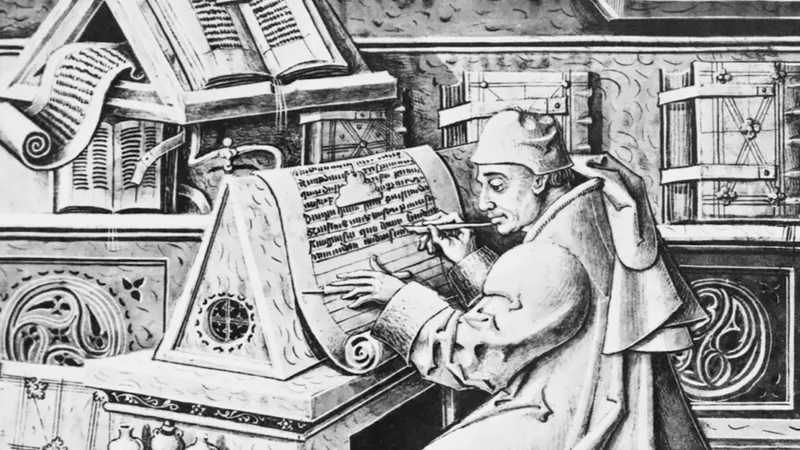
The answer, worked out slowly and independently in many places, was to build a second brain, one that sat outside the skull, held far more than any person, could be handed on and consulted, and did not die when its owner did.
Better still, it could be relied on to say exactly the same thing over time and distance, because it held one version: the one committed to it when the event was recorded.
This is a storage problem, and everything we call writing exists to solve it.
I should declare an interest, having spent a large part of my recent working life in documentation, governance, and compliance, which is to say tending the modern wing of precisely this second brain.
Very few do that work for love. They do it because the alternative, trusting everyone to remember the same thing, falls apart faster than you would believe.
It is worth being exact about why the village mind failed, because the usual explanation, that our ancestors simply could not remember enough, is both wrong and a little insulting.
Oral cultures were not memory-poor.
Some achieved feats of recall no society of readers has matched since, the supreme example being the Indian Vedic tradition, in which enormous bodies of sacred verse were carried by mouth and ear alone across centuries and arguably millennia, with a fidelity so fierce that drills were devised, reciting the words forwards, backwards, and in interlocking patterns, to make a single slipped syllable impossible.
The tradition even drew the distinction itself: Shruti, “that which is heard”, the texts treated as revelation to be transmitted exactly; and Smriti, “that which is remembered”, the law codes, epics, and commentaries that could evolve.
A civilisation that builds separate categories for what must be preserved exactly and what may safely be adapted is not short of memory.
What it is short of is the right kind of memory.
Oral memory is magnificent at the thing a community rehearses together because it wants to keep it: the epic, the genealogy, the hymn, the law remembered as custom.
It is hopeless at the thing a large society most needs to hold, which is the dull, unique, constantly changing particular.
You can chant the deeds of heroes down forty generations; you cannot chant the contents of forty granaries, the debts of four thousand households, and this season’s tax owed by each, and expect any of it to survive a year.
Shared memory scales with rehearsal, and a community can rehearse only so much. Administrative memory scales with the number of distinct facts to be held, and that number, once a society grows, races away to infinity.
The bards could keep the poem; nobody could keep the accounts.
There may even be a rough number attached to the wall.
Some argue that a single person can sustain only a few hundred real relationships before the mind can no longer keep straight who did what to whom; the figure is debated and probably too tidy, but the shape is sound.
Below it, a community runs on acquaintance, because everyone is in effect holding everyone else in mind. Above it, the thing cannot be done, however clever the people, because there are simply too many of them to track.
A village is where the remembering still fits in heads. A city is where it has spilled past them, where you deal daily with people you do not know and cannot vouch for, and the old machinery of reputation stops turning.
The accounts were the first thing that urgently needed keeping, which takes us back to the granary.
A surplus, the moment it exists, is a tangle of claims: this much to the temple, this much owed by that household, this much set aside as seed, this much lent last winter and due back with interest.
Agriculture did not merely produce calories; it produced obligations, and an obligation is simply a thing that must be remembered by somebody or it fades into nothing.
Settlement made it worse by crowding together strangers, who cannot fall back on shared memory or the slow bookkeeping of reputation.
When two people who have never met, and may never meet again, wish to trade or lend, they need something both can point to and neither alone controls.
The clay token pressed with a mark matters far less than what it made possible: two strangers could trust a bargain because the trust had been lifted out of their fallible heads and set down in an object each could appeal to afterward.
The market of strangers, the only kind that can feed a city, stands entirely on remembered promises that no single person remembers.
Look at what large-scale life actually requires a society to hold, and it is almost all of this character.
Ownership, debt, and contract are memory problems before they are anything else: who has the right to this field years later, how much grain comes back at harvest, what exactly was agreed before the future could argue with it.
Trade across distance is the hardest, for a merchant sending goods to a port he will never see, into the hands of agents he will never meet, has nothing holding the arrangement together but records that travel with the cargo and outlast every conversation about it.
In each case the physical object, the tablet, the seal, the marked clay, is the least interesting part.
What matters is the consequence: obligation could now exist between people who did not know one another, which is the precondition for any economy larger than a circle of friends.
Nowhere is this starker than in taxation, which, if we are honest, drove a great deal of the whole development, since nothing concentrates a ruler’s mind like the wish to collect.
A petty chieftain takes his share from people he knows by sight, in a territory he can walk across in a day.
A king cannot. He cannot recognise the hundred thousand households that owe him grain, cannot remember what each promised or paid, cannot tell the man who has settled his dues from the man lying about it.
The tax collector at your door, demanding a precise sum recorded by a clerk you have never seen, on the authority of a sovereign three weeks’ journey away who would not know you from any other subject, is one of the stranger figures our species has produced, because he embodies a power that has slipped free of personal acquaintance.
He is the second brain made flesh and sent to your gate.
This is why states and record-keeping appear together so reliably that the two can hardly be told apart: a large state is, among other things, a machine for remembering its subjects, and most of what its apparatus does all day is build that memory, in the census, the tax roll, the land register, the code of law.
We have a faintly contemptuous word for the result, bureaucracy, but bureaucracy is nothing more sinister than memory operating at a scale no group of humans could manage in their heads.
Empire is the same problem written larger.
To rule a province you will never visit is to issue a command in one place and have it obeyed, identically and in your absence, in a hundred others.
A spoken order dies at the edge of earshot and is mangled by the third man to repeat it.
An order set down, copied, and sent travels intact and is still recognisably your order when it arrives, which is why the reach of a government has always been bounded less by the speed of its messengers than by the trustworthiness of its records.
And law does something stranger again. A rule that lives only in a ruler’s head bends with his mood; a rule fixed in a record others may consult begins, however imperfectly, to stand a little above the man who made it.
The ruled can point to it, hold him to it, notice aloud when he departs from it.
The same technology that let a king tax a stranger he had never met also handed that stranger something to wave back, and much of the long argument we call politics has been conducted ever since over who gets to read, keep, and amend the record.
There is a further power in the external record the spoken word never had: it survives the death of the person who made it.
A custom carried only in the memory of elders drifts when they pass, until in a few lifetimes the rule has changed beyond recognition while everyone insists it has not.
A rule set down binds people who never met the one who made it, and goes on binding them long after he is dust.
Inheritance is barely possible at scale without this, because inheritance requires the dead to keep speaking: this field to that son, this debt forgiven, this boundary exactly as my grandmother agreed it.
Law, inheritance, and scripture are all, looked at without sentiment, arrangements by which the dead continue to rule the living, and not one works at scale until memory has been moved somewhere that does not die with the speaker.
Religion felt the same pressure and reached the same solution.
A faith carried only in living memory splits into a hundred local versions as it travels, until the god worshipped in one valley would not be recognised two valleys away.
A faith with a fixed and guarded canon can aspire to be the same in two cities a thousand miles apart and the same in two centuries, which is to say it can be standardised, exported, and enforced, and a standardised belief is a far more formidable instrument of power than a drifting one.
The holy text is a memory deliberately frozen so that no one may revise it, which is exactly why control over that text, who may copy it, read it, render it into the language people actually speak, has so often been worth killing for.
The advantages of holding the record were obvious early.
There survives from Egypt a whole genre of texts in which a father presses his son to take up the scribe’s profession, and the argument is wonderfully candid: the scribe, unlike the farmer and the soldier and the washerman, does not break his back or get conscripted, but sits in the shade and gives orders and is obeyed.
The oldest recorded perk of literacy was getting out of manual labour.
Ancient India took the link between knowledge and power further.
Elsewhere literacy was a practical advantage enjoyed by an elite; in India, access to certain forms of knowledge became woven into the structure of society itself.
The Vedas were preserved with extraordinary care, but access to their study, recitation, and interpretation was not universal.
Knowledge became hereditary in much the same way land, occupation, and status did.
Whatever one makes of the theology built around it, the social effect is hard to miss: those who controlled the collective memory acquired a powerful claim to authority over those who did not.
As a Brahmin writing this, I would be remiss not to note that some of the most durable inequalities in Indian history were sustained not merely by control over land or force, but by control over who was permitted to know, record, interpret, and remember.
Literacy, then, began as a moat, a line between those who could consult and amend the collective memory and those who could only be governed by it.
The archive that resulted became one of the central instruments of governance there has ever been, because whoever holds the record holds the answer to every dispute it touches: how much you owe, what your father left you, where your land ends, what the king commanded last spring.
When an Assyrian king gathered tens of thousands of tablets into a deliberate royal collection, he was not indulging a love of reading.
He was assembling the memory of an empire, on the entirely correct theory that an empire which remembers more than its rivals can govern more than they can.
A memory kept outside the skull carries a vulnerability the one inside it does not: it can be seized, altered, and destroyed, and because so much that a society treats as settled rests on it, doing any of those things is among the most political acts imaginable.
To burn an archive is not vandalism; it is surgery performed on reality, wiping out debts, dissolving claims, voiding inheritances, and unmaking laws at a stroke, which is why conquerors have gone after the records of the conquered with the diligence they brought to the walls.
Indian history knows the wound well: at Nalanda, Vikramashila, and other great centres of learning, what disappeared in the fires and the centuries of neglect was not only buildings but accumulated memory, annotation, argument, and intellectual lineage.
The friars who burned the books of the Maya were severing a people from their own past, and a people cut off from its records is far easier to rule.
The destruction of memory does not always require burning libraries. Sometimes it is enough to kill the people who carry the knowledge.
As the Pakistan Army withdrew from what became Bangladesh in 1971, it systematically targeted intellectuals, academics, journalists, doctors, and teachers.
The Khmer Rouge pursued the same logic from the opposite end of the ideological spectrum, murdering teachers, professionals, and scholars.
Knowledge creates continuity; continuity creates resilience; and one reliable way to break a society is to destroy the people who remember how it works.
The most sophisticated attacks often leave the books standing.
The Nazis burned books, but authoritarian systems soon learn that controlling memory is more effective than destroying it.
The Cultural Revolution attacked archives, temples, texts, traditions, and scholars to sever the present from its past; other regimes prefer censorship, revision, selective preservation, or the disappearance of inconvenient records.
The point is always the same. Destroy the memory, rewrite the memory, or control access to it, and you gain extraordinary influence over what a society believes happened.
A memory that can be written can always be rewritten, which means the second brain is never the neutral thing it pretends to be.
It is curated, and it is curated by the powerful. The keeper of the memory is also its editor.
For all that, the external memory of the species was never the property of any one people, which is worth saying plainly in an age that still half-believes civilisation was something the West did and everyone else watched.
The record is a relay, passed, copied, and translated from hand to hand and tongue to tongue, gaining and losing at every exchange.
The scholars of the Islamic world, while Europe largely could not read its own inheritance, translated and preserved the philosophy of the Greeks, the medicine of the Persians, and the mathematics of the Indians.
It was through that relay that the Indian place-value number system, complete with a sign for nothing at all, travelled west to become the digits the modern world counts in, which Europe named Arabic and which are, in their bones, Indian.
I mention it not to score a nationalist point, a game I find tedious, but because it shows what the second brain really is: not the achievement of any single civilisation but the slowly accumulating, endlessly handed-on memory of the whole species, with libraries from Baghdad to Timbuktu serving for a time as its custodians.
For most of this story the second brain laboured under one crippling property that silently held the structure of power in place: it was scarce.
Every copy had to be made by hand, slowly, and every copy drifted a little from the one before, an error here, a helpful correction there, a marginal note absorbed by some later and less careful hand, so the further a text travelled the less anyone could be sure what it had first said.
Cheaper writing surfaces helped, and cheap paper out of China helped a great deal, but the true chokepoint was never the paper; it was the copying.
So long as making a copy was slow, costly, and corruptible, access to the collective memory could be rationed, and whoever controlled the rationing controlled a great deal else.
The scarcity of the record was, for five thousand years, one of the foundations of the scarcity of power.
Books existed long before printing.
When Capgrave wrote around 1450, he was not writing for a world without books but for one in which every additional copy required another human being to sit down and reproduce it by hand.
The limitation was never writing. It was reproduction.
What broke that was not a lone genius inventing printing from nothing.
The popular story assigns it to Gutenberg of Mainz around 1450, but printing in the sense of pulling many impressions from a fixed form had existed in China for centuries; the oldest surviving dated printed book, the Diamond Sutra, is from 868, movable type was developed by Bi Sheng around 1040, and metal movable type was used in Korea well before Gutenberg.
Paper itself had travelled west from China through the Islamic world.
Gutenberg invented none of these. What he did was assemble them, combining metal movable type, precision casting, oil-based inks, and the screw press into a commercially viable process that could turn out large numbers of near-identical texts.
History celebrates invention; synthesis is often the greater achievement.
What mattered was the consequence.
By the time the Gutenberg Bible appeared around 1454, Europe possessed a practical method for manufacturing memory.
Once copies became abundant, cheap, and nearly identical, the record could no longer be kept under a single lock, and authority over knowledge, which had rested for five millennia on controlling access to a scarce memory, became suddenly and irreversibly hard to monopolise.
The anecdote everyone repeats is that in 1517 a quarrelsome German monk’s complaints spread across Europe in weeks.
The fact that matters is what it revealed: ordinary people could now hold the record in their own hands, read it themselves, compare one copy against another, and check the gatekeepers against the text they claimed to control.
The institutions most shaken were precisely those whose authority rested on being the sole custodians of a text, and they fought the change with everything they had, and lost.
The pattern should feel familiar.
Fire gave us energy when we wanted it; agriculture, calories across the seasons; the simple machines and the metalworkers, force beyond the reach of muscle.
Writing gave us memory outside the skull, and printing made that memory available. At will.
This, more than any single sermon or war, is how the widening of the second brain remade civilisation.
For almost the whole of human history, authority over what was true, what was owed, and what had been decided rested on controlling the memory.
Widen access to it and you widen the circle of people who can dispute, verify, accumulate upon, and build out of what is stored.
A shared, checkable, ever-growing record that anyone may consult and to which anyone may add is the exact foundation on which the cumulative knowledge we call science stands, because science is, at bottom, a community remembering its mistakes well enough to stop repeating them.
The resistance is worth noticing, because it always wears the same costume of protective concern.
Plato had a character grumble that writing would make men forgetful and give them the appearance of wisdom without its substance; the scholars of the early print age complained that so much was now in circulation that the mind would simply drown; and I notice the identical complaint levelled, almost word for word, at the LLMs that have begun to write back.
The complaint is perennial, and it is reliably loudest among those who had done rather well out of the previous scarcity.
So a civilisation that could never have fitted inside any single head learned, across five thousand quarrelsome years, to build itself a second one.
A kingdom, an empire, a market of strangers, a faith meant to outlast its prophet, a law meant to bind the unborn, all of these had to be stored somewhere other than in a person, and so we taught clay and skin and rag and cheap printed paper, and later bits and bytes in a cloud, to remember on our behalf.
If food was stored sunlight and force was stored muscle, the written and printed record was stored thought: the past made consultable, the absent made present. Memory at will.
We had now learned to command energy in the moment, calories across the seasons, force beyond the reach of muscle, and memory beyond the reach of any skull.
And yet the second brain refused to sit quietly on its shelves. It bred.
It let techniques accumulate instead of dying with their masters, let law and trade and administration knit ever larger populations into ever more demanding cities, and filled its own archives with the designs for mills, pumps, looms, and furnaces, machines that existed first as instructions and waited only to be built.
Every one of those machines, and every swelling city the stored knowledge made possible, made the same mute demand: they had to be driven.
They needed heat and motion and work in quantities the old sources, the straining muscles of humans and animals, the fitful wind, the seasonal rush of falling water, could no longer supply.
We had learned to command what we knew. What we had not yet learned to command, on anything like the scale our own remembered cleverness now demanded, was power.
04 Power. At will.
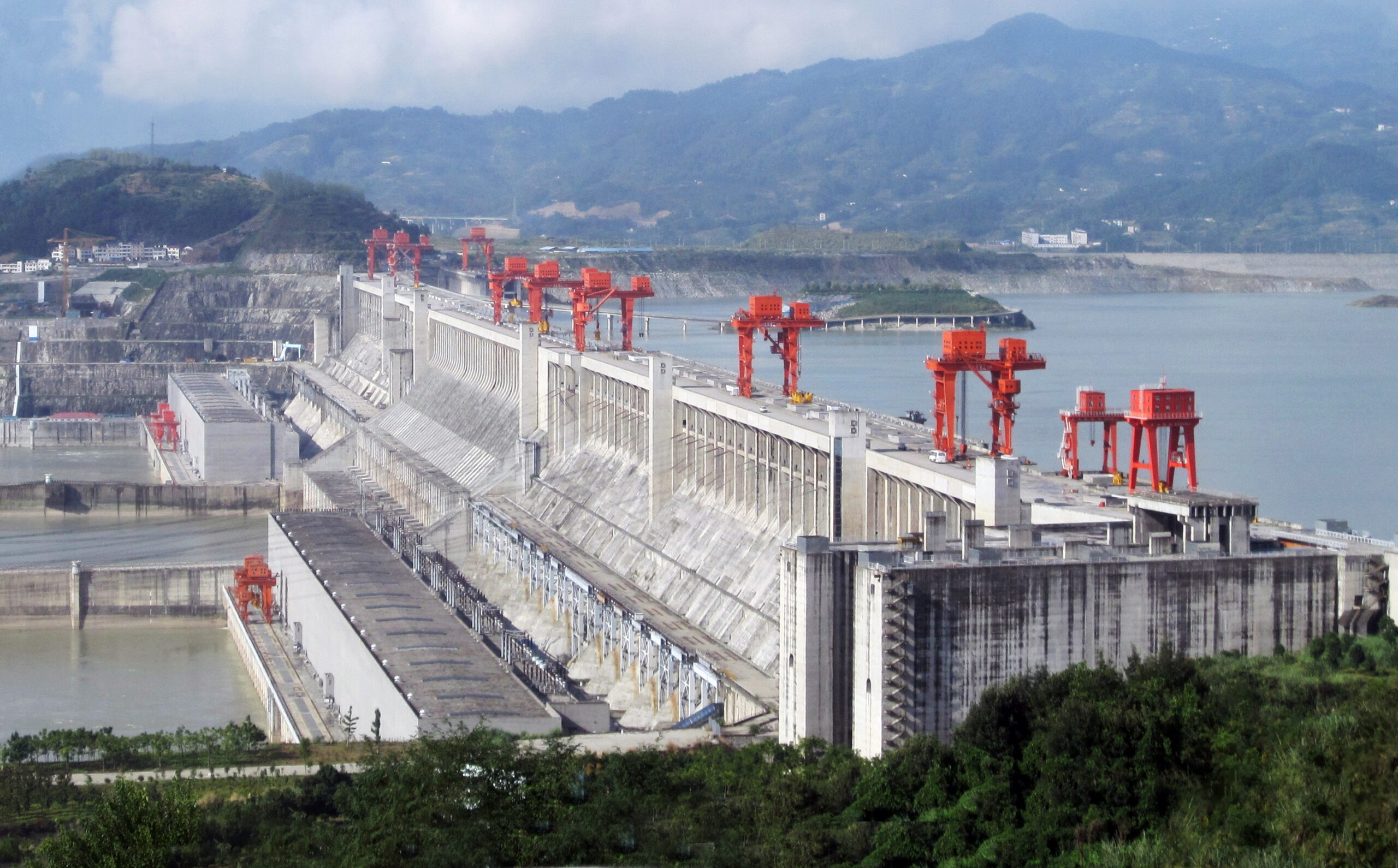
By Gaynor – Three Gorges Dam, CC BY 2.0
For almost the whole of human history, every scrap of power we used was sunlight that had arrived the same year we spent it.
The food that drove a labourer’s muscles was last season’s photosynthesis turned into bread; the grass that drove an ox was the same; the wind that turned a mill was air shoved about by the uneven heating of the planet, which is to say by the sun; and the river that turned a wheel was water the sun had lifted into the sky and dropped again as rain.
A medieval kingdom ran on the same energy budget as a meadow: whatever the sun delivered that year, and not a joule more.
We were living hand to mouth on the planet’s annual income, and the trouble with living that way is that the income arrives when it arrives, not when you want it, and where it falls, not where you need it.
That was the wall the last chapter left us facing.
The archives were full of designs for mills and looms and furnaces, the cities were full of people, and all of it had to be driven.
The sources we had were maddening.
A water wheel works only where there is falling water, which means a factory that needs a river must be built at the river whether or not that is where anyone wants a factory, and the river does not consult you: it floods in spring, runs to a trickle in summer, and freezes in winter.
The wind is worse, unemployed on a calm day and useless in a gale, and it has never once consented to blow because a miller had orders to fill.
These were not feeble engines, but every one of them took the power nature offered, in the place and at the rate nature offered it, and could be neither moved nor turned up on demand.
Animals were a little better, since an ox can be made to work on the day you choose, but an animal is a power source with a metabolism, and that is expensive.
It eats whether or not it works, eats on its day off, eats when it is lame, eats through a whole winter pulling nothing, and has the further inconvenience of eventually dying.
Human muscle was worst of all: feeble, perishable, forever needing to be fed, housed, and very often coerced, since a great deal of the heavy work of the ancient world was done by people who had not volunteered.
Power, in those days, was like memory before the first clay tablet: it lived inside bodies, and could be neither stored, nor relayed, nor shared, nor summoned beyond the one body that happened to hold it.
So the predicament by the seventeenth and eighteenth centuries was not that we had no power.
It was that we had become ravenously power-hungry while remaining at the mercy of sources that were intermittent, immovable, and biological.
You could have a great deal of power, sometimes, in some places, if the season obliged and the river ran and the wind blew.
What you could not have was power on demand: a large quantity, summoned at the moment and the place of your choosing, regardless of weather, season, or geography.
That, and not the mere generating of energy, which we had done since the first hearth, is what this chapter is about.
The escape was not a cleverer way to harvest the annual sunlight. It was the discovery that you could stop living on income and start spending an inheritance.
Beneath the ground lay the compressed remains of forests that grew and fell into the great swamps of the Carboniferous, more than three hundred million years ago.
Coal is sunlight too, but sunlight that fell on a world we would not recognise and was then pressed and cooked under the weight of ages into a rock that burns.
To dig up a ton of coal and set it alight is to release, in an afternoon, the solar savings of a geological epoch.
Wood is this century’s sunlight; coal was the buried capital of a hundred million summers.
If the granary was the first battery humanity built, coal was a battery the planet had been charging since before there were flowers, and we had just worked out how to connect to its terminals.
It is no accident that the people who first spent that inheritance at scale were the British, and the reason is unheroic.
By the seventeenth century Britain had cut down rather too many of its forests, so wood and charcoal were dear; what it had instead was coal, a great deal of it, near the surface and near navigable water, so it could be moved cheaply to where it was wanted.
None of this required the British to be cleverer than anyone else, though the story is often told (mostly by white Anglo-Saxon historians) as a national genius descending on a deserving people.
The awkwardness is worth facing directly.
China had been, by most measures, the most technologically accomplished civilisation on Earth for the better part of a thousand years, with coal, cast iron at scale, gunpowder, the compass, and water-powered machinery, and it had no industrial revolution, while a damp, peripheral island off the western edge of Eurasia did.
Why is a question historians have argued for a century without settling, and anyone who answers it in a sentence is selling something.
The least misleading answer points not at genius but at configuration: Britain happened to have cheap coal sitting next to its manufacturing towns and its navigable water, and unusually dear labour, so it positively paid a manufacturer there to build an expensive machine that burned cheap coal in order to do without costly workers, an arithmetic that did not hold where labour was cheap and coal far away.
Add an empire to supply raw materials and absorb the output, and you have most of it.
We have met the principle before, when iron beat bronze: the thing that wins is rarely the cleverest, but the one whose surrounding circumstances happen to be ready to carry it.
Steam won where coal was cheap, and coal sat in British coalfields by geological chance.
The first job the new power was put to was, with a circularity that ought to make CryptoBros smile, digging up more of the fuel that powered it.
As the British sank their mines deeper they hit water, because below a certain depth a mine is a hole the earth is forever trying to fill, and you cannot mine coal you cannot keep dry.
The first commercially successful steam engine was built to fight exactly that.
Thomas Newcomen, an ironmonger from Devon, put up his first working engine around 1712 to pump water out of a coal mine, and it worked in a thunderous, wasteful fashion, drinking coal at a frightful rate that nobody minded, because it stood on top of a coal mine where the worst coal was practically free.
The engine was born to serve the fuel, and the fuel fed the engine.
Here we reach the most misattributed figure in the popular history of technology.
Ask who invented the steam engine and almost anyone will say James Watt, and they will be wrong.
When Watt came to the problem as a young instrument-maker in Glasgow around 1765, the steam engine had been wheezing away in British mines for over half a century.
What he saw was why Newcomen’s machine wasted so much coal: it heated and then chilled the very same cylinder on every stroke, so most of the fuel went not into work but into reheating a great lump of metal that had just been deliberately cooled.
His answer was to let the steam condense in a separate vessel kept permanently cold, so the working cylinder could stay permanently hot.
A separate condenser. It sounds like nothing. It cut the coal a given engine burned by about two-thirds. Disruptive, as today’s entrepreneurs would say.
It is worth pausing on why efficiency, of all the dull words in engineering, mattered so much, because it is the hinge of the chapter.
So long as an engine burned coal as gluttonously as Newcomen’s, it could only be afforded in the one place where coal was nearly free, on top of a coal mine.
An engine that did the same work on a third of the fuel could be afforded somewhere else, where coal had to be bought and carted in.
And the moment that became true, the decisive property of steam revealed itself: a water wheel must be where the river is, and a windmill where the wind is, but a steam engine can be wherever you can deliver coal, and coal, unlike a river, can be put on a barge and brought to you.
For the first time, you no longer had to take your work to where nature happened to offer power. You could bring the power to where you wanted the work.
Watt’s partner, the Birmingham manufacturer Matthew Boulton, understood exactly what they were selling, and told a visitor he sold “what all the world desired to have: power.” He meant the literal capacity to do work, in quantity, on demand, delivered to your door.
Humans had power. At will.
Once steam turned a wheel rather than merely nodding a pump up and down, the consequences came as a system rather than a parade of inventions.
Factories, freed from the riverbank, could be built where the workers or the coal or the shipping routes were, and clustered into the smoking industrial cities that pulled people off the land into a life governed for the first time not by the seasons but by the indifferent rhythm of a machine and a clock.
Then steam learned to move itself, which is where the real disruption came, for an engine set on wheels and rails could drag a train, and once Stephenson’s Rocket won at the Rainhill trials in 1829 the railway spread across the world with the speed of a fever.
It is tempting to tell this as a tale of great men, but the railway was a system of rails, gauges, surveying, capital, and timetables.
The gauge makes the point: Brunel’s broad gauge was by most measures the better design, smoother and faster and more stable, and it lost to Stephenson’s narrower gauge for the unanswerable reason that there was already more of the narrower kind laid down, and a railway that cannot join the network around it goes nowhere.
Later, countries such as India would convert vast networks to broad gauge at huge cost for capacity and standardisation; but at the moment the decision mattered most, the wider network beat the better design, exactly as the more available metal had beaten the better one.
The world does not reward excellence. It rewards fit.
The steamship did the same to the oceans, shrinking voyages from the gift of the trade winds into something close to a schedule, and distance began to collapse.
And here, because this is not a chapter that means to flatter, it must be said that the same power that knit the world together dismantled large parts of it, nowhere more than in the country I am writing from.
India had been the foremost textile manufacturer on the planet, and the muslins of Dhaka were spoken of as “woven air”.
Coal-fired, steam-driven British mills, fed by Indian raw cotton and shielded by an empire that had made India both supplier and captive market, undercut and broke that ancient industry in a few decades, and the weavers who had clothed the world were ruined.
This is not a morality tale and I will not dress it as one; it is simply what power at will does in the hands of those who have it and at the expense of those who do not.
For all that, steam had solved only half the problem.
It had made power transportable in the sense that you could carry the fuel to the engine and put the engine where you liked, but the power the engine made was still stubbornly local to it.
Inside a steam-powered factory the engine sat in its house and turned a great shaft, and a forest of belts and pulleys carried the rotation to every machine, which meant the power could not simply leave the building and go and do something useful a mile away.
You could move the fuel. You still could not move the power. Yet.
For that you needed electricity, and the cleanest way to understand it is this: steam solved the generation of power, and electricity solved its delivery.
An electric current takes the work an engine does in one place and sends it down a wire to do work somewhere else, so you can burn your coal and spin your generator beside the coalfield and turn the result into light or heat or motion in a workshop a hundred miles away that has never seen a lump of coal.
Held against the earlier chapters, this is the same move made again.
Roads let an empire send its strength wherever it was wanted; writing let a command reach across distance and time without rotting on the way; and electricity now let power itself appear wherever a wire ran, summoned at the flick of a switch.
Each took something that had been chained to one place, or one season, or one body, and made it available at will.
The science was the work of many hands.
Michael Faraday, a bookbinder’s apprentice with almost no mathematics, found in 1831 that moving a magnet near a coil of wire produces a current, the principle on which every generator and motor still runs; a generation later James Clerk Maxwell supplied the equations, revealing that electricity, magnetism, and light were three faces of one thing.
The famous commercial quarrel that followed was settled by physics rather than character.
Edison’s system ran on direct current, whose voltage could not easily be changed, and since electricity bleeds away over distance unless sent at high voltage, a direct-current station could serve customers barely a mile off.
Alternating current, which Westinghouse built around Tesla’s motor, could be stepped up to a punishing voltage for the long haul and stepped back down for safe use at the far end, by means of a transformer, and that single capability is the whole reason it won.
The point was settled when Niagara Falls was harnessed in the 1890s to light Buffalo some twenty miles away: power made in one place, doing its work in another.
What mattered in the end was none of the individual cleverness but the thing it made possible, the grid: the continent-spanning, second-by-second-balanced machine that ties thousands of generators and millions of consumers into a single synchronised whole, so that flicking a switch in a kitchen draws, instantly, on power generated that very moment in a station hundreds of miles away.
The grid is the true monument of this chapter, and almost nobody looks at it, which is the measure of its success, because the deepest mark of a mature technology is that it disappears.
Nobody describes himself as a user of electricity, the way he might a new gadget, because electricity has stopped being a technology and become a condition of existence, like air, noticed only in its absence.
Power on demand, anywhere a wire reaches, at the speed of light.
After a million years of waiting on the river and the wind, this is power at will in close to its purest form. (Whether it gives you goosebumps may depend on whether, like me, you trained as an electrical engineer.)
And yet even the grid left one kind of power-hunger unsatisfied: the wish to put power in your own hands and carry it down a road of your own choosing.
A steam engine is hopeless for this; it needs a boiler, a firebox, water, and time to raise steam, all reasonable aboard a locomotive and absurd in anything one person might drive for the afternoon.
What that wanted was an engine carrying its fire inside itself, burning its fuel within the very cylinder it drove, which is the internal combustion engine that Nikolaus Otto made practical with his four-stroke design in 1876 and Rudolf Diesel improved into a more efficient form in the 1890s, before vanishing over the side of a ship in 1913.
The internal combustion engine wanted a fuel to match, and found it in oil, which is very nearly the perfect portable fuel: liquid, so it can be pumped rather than shovelled; astonishingly dense in energy, packing into one tankful more usable work than any battery of its age or ours could carry for the same weight; and throttled up and down instantly by the pressure of a foot.
A locomotive can carry a ton of coal and a tank of water because it is enormous.
A motor car cannot carry a boiler and a stoker, and this, not any subtlety of thermodynamics, is why oil displaced coal wherever power had to be made small, light, and personal.
Henry Ford did not invent the motor car; Benz and Daimler had built the first practical automobiles in Germany.
What Ford did, from 1908, was drive the cost of the Model T down by mass production until an ordinary working man could buy the very thing he spent his days building, so that personal mechanical power passed from a rich man’s toy into an ordinary expectation, the same democratising turn cheap print had given memory.
I will confess a personal stake, having spent a great many happy hours putting an internal combustion engine to entirely unnecessary use on two wheels, and I can report that the appeal is not transport at all; it is the having of power in one’s own hands, throttle under the wrist, a slug of three-hundred-million-year-old sunlight ready to become speed at the smallest request.
That sensation, banal now, would have been incomprehensible to every human being who lived before about 1900, all of whom had to ask a horse.
Oil did not stay a private convenience for long, and the reason has to do with the very quality that made it satisfying under the wrist.
Coal was adequate for fixed power, the engine bolted to a factory floor, but poor for anything that moved.
A coal-fired warship needed armies of stokers, vast bunkers, hours to raise steam, and announced itself for miles by its smoke.
Oil was denser, took less space, could be pumped aboard, and let a ship accelerate faster, travel farther, and refuel more quickly. For a navy, the advantages were overwhelming.
Winston Churchill, made First Lord of the Admiralty in 1911, grasped this at once, and under him the Royal Navy began the switch from coal to oil, formally adopted in 1913.
The difficulty was obvious: Britain had immense coal and almost no oil, so the fuel that promised naval supremacy had to come from elsewhere.
In 1914 Churchill pushed the government into acquiring a controlling stake in the Anglo-Persian Oil Company, securing Persian oil for the fleet.
The most powerful navy on earth had made its heartbeat depend on a liquid pumped out of someone else’s ground, and every government watching took the lesson: access to oil had become a matter of national life and death.
From there it was a short step to the century we got, in which a great deal of blood and treasure was spent over who controlled the stuff.
This is the point where the chapter has to do what every chapter in this essay does, which is stop admiring the achievement long enough to count its cost, because power at will was a bargain and not a gift.
The most immediate price was filth: the same coal smoke that announced a city’s prosperity blackened its buildings and its lungs, and the bill came due with particular horror in London in December 1952, when a cold, still week trapped the smoke of a million coal fires over the city and killed an estimated four thousand people in days.
The cost of making the power was usually paid by those least able to refuse it, by the children sent into the mines, the men killed in pit disasters and maimed by unguarded gears; the land paid too, gouged and poisoned, and the colonised world paid most of all, since the cheap materials the industrial powers burned were so often taken on terms the supplier did not set.
And then the slowest and largest cost, which follows from the central image of the chapter: if coal and oil are the buried sunlight of hundreds of millions of years, then burning them takes carbon the living world spent an unimaginable time locking underground and returns it to the air over two or three centuries.
We are running the planet’s carbon battery in reverse, faster than it can recharge, and the atmosphere keeps an exact account.
This is no recent discovery sprung on an innocent world: Svante Arrhenius worked out the essential mechanism, that burning coal would warm the planet, in 1896, and we have gone on burning, with the sum on the table, ever since.
I record it not as a sermon but because a chapter that celebrated the summoning of power and said nothing of its reckoning would be a lie of omission.
So where does this leave us. Formidably equipped.
We had learned to command energy in the moment with fire, calories across the seasons with farming, force beyond the reach of muscle with the simple machines, and memory beyond the reach of any skull with the written record.
Now, with coal and steam and the grid and oil, we had learned to command power itself, to summon large quantities of it whenever and wherever we chose, untethered from the river, the wind, the season, and the tiring animal.
Power, like everything before it, had become a thing we could have at will.
And yet, with a regularity that ought by now to feel less like coincidence than like law, the triumph bred its own crisis, and the crisis was not a shortage of power but a surfeit of the thing power built.
For the power did not descend on us alone. It arrived embedded in systems of a scale and intricacy no human mind could hold or steer.
A single steam-powered factory floor already coordinated hundreds of machines in a dance that had to be timed or it tore itself apart.
A railway network was worse, because two trains on the same stretch of track at the same moment is not an inefficiency but a catastrophe measured in corpses, and a network of thousands cannot be run on the judgement of men who cannot see one another.
The grid was more demanding still, a machine that must balance, every second, the power generated against the power drawn, across a continent, or it collapses.
These systems did not run on power. They ran on coordination, on the timely arrival of the right information in the right place.
And the moment they grew large enough, the bottleneck of the whole civilisation moved from the making of power to the controlling of the things power had made.
The railways made the point first, and made it literal.
For the whole of history before them it had not mattered that the next town kept a clock eleven minutes different from your own, because everyone set noon by their own sun.
The instant trains began running between those towns on a shared timetable, that genial muddle became lethal, because a timetable assembled from a hundred different local noons puts two trains on a single line in perfect confidence that they are an hour apart.
So the railways abolished local time and imposed a single synchronised time across whole nations, Greenwich laid like a ruler across Britain and, in 1883, the grid of standard time zones across North America, not by any government or philosopher but by the railway companies, because the trains required it.
The same logic ran through the empire.
India’s first passenger railway ran in 1853, and the network expanded with astonishing speed, built partly to move raw materials to ports and goods inland and partly to move troops across a subcontinent whose inhabitants occasionally proved ungrateful for the civilising mission; whatever the motive, a railway across thousands of kilometres could not function if Bombay, Calcutta, Madras, and a hundred smaller towns each insisted on their own local time.
The machine demanded synchronisation, and synchronisation won.
More tellingly still, alongside the iron rails they strung copper wire, the electric telegraph, for the sole urgent purpose of letting a message outrun the train it described, so that one station could tell the next whether the line ahead was clear before the locomotive arrived to find out the hard way.
And there, in that wire beside the track, is the next chapter in embryo, because for the first time we had built a world in which it was not enough to move energy, or goods, or ourselves with ever greater power.
We now had to move information faster than we could move the things the information was about, or the systems we had built would blind and wreck themselves.
We had learned to summon power at will. The thing we did not yet know how to summon, on the scale our roaring, interlocking machines now demanded, was information.
05 Information. At will.
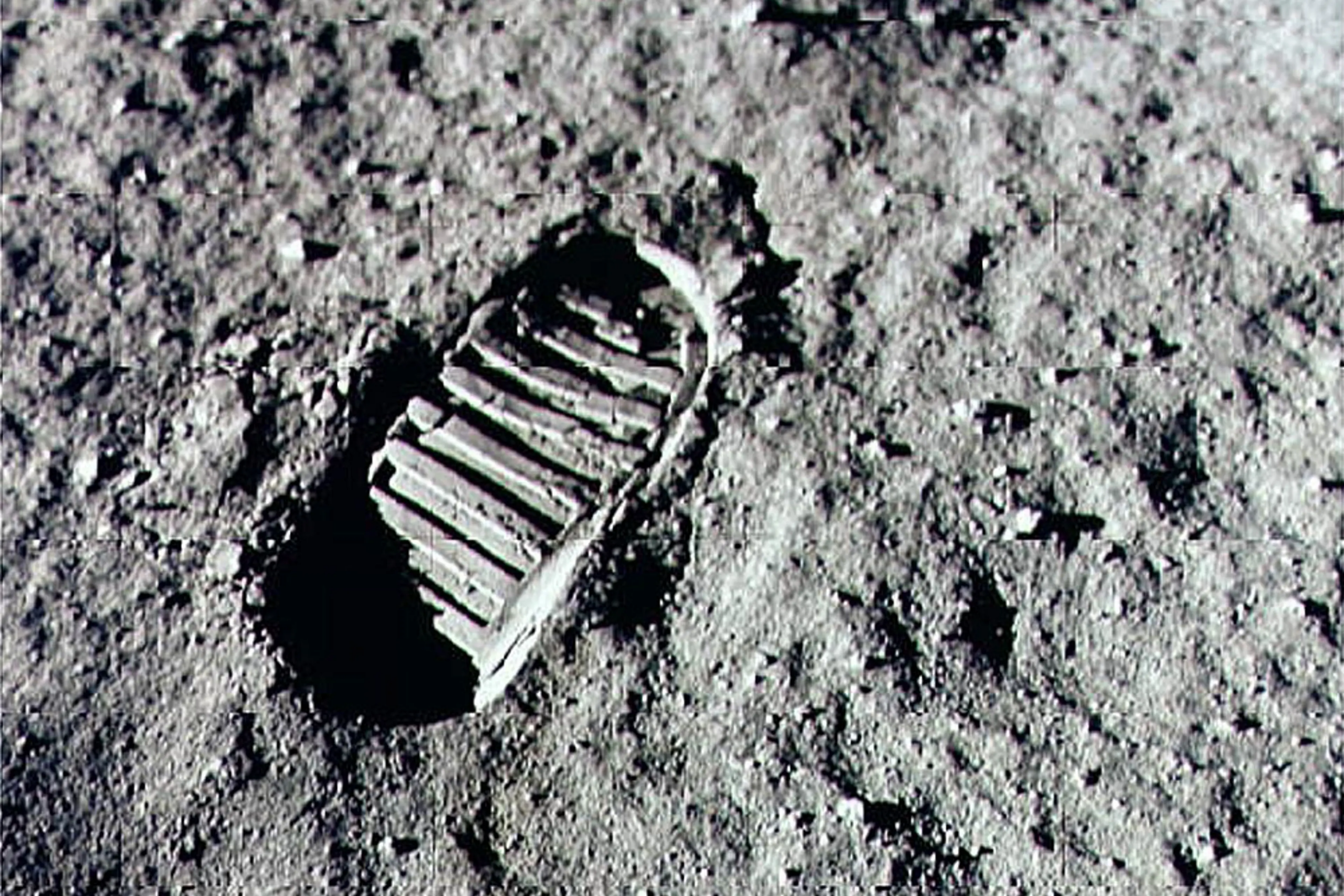
The wire ran beside the track because the train could not be trusted to look after itself.
A locomotive is a great deal of momentum heading toward a horizon it cannot see around, and two of them closing on one another in mutual ignorance is not an inefficiency but a funeral.
A signalman needed to know that the line ahead was clear before he let a train onto it, which is to say he needed to know something that had just happened in a place he could not see, and he needed to know it now, not in twenty minutes when the next train came back with the news.
That is the unglamorous birth of the central idea of this chapter: how to tell the next station something before the train itself arrived to announce it.
For almost the whole of human history the answer was brutally simple. You could not.
Information had a body.
To move a thought from one place to another you fastened it to some thing that moved through space, a runner, a rider, a ship, a pigeon, a sealed letter, a man with a good memory, and the thought then travelled at exactly the speed of that thing and no faster.
The Persians strung relay riders across their empire whom Herodotus admired for being stopped by neither snow nor rain nor gloom of night; the Mongols held a continent together with the Yam, a lattice of relay stations down which a message could gallop across Asia faster than an army could follow.
Every one was a triumph of organisation, and every one obeyed the same law: a message moved no faster than a messenger, a contract no faster than a ship, a military order no faster than a horse.
Distance ruled the world of knowing exactly as it ruled the world of going.
The subcontinent worked the same problem on the same terms.
Its great artery was the road Sher Shah Suri widened and policed in the sixteenth century along a line some trace back to the Mauryas, studded with sarais, the rest-houses set a day’s march apart; the British later renamed a stretch of it the Grand Trunk Road and pocketed the credit.
Down such roads ran the Dak, a relay of foot-runners and mounted couriers, which the Mughals refined into something close to an intelligence service, stationing news-writers in the provinces so a ruler in Agra might hear of trouble while there was still time to act.
The Marathas, holding a country of hills, leaned instead on speed and height: light horse, fast couriers, and chains of forts from which signals could be relayed by fire, lamp, or drum.
That last trick is worth pausing on, because it is the only one that truly beat the body: a beacon outruns a horse.
But a beacon can say almost nothing. It can shout one prearranged thing, the enemy is here, the king is safe, advance, retreat, and not a word more.
For any message with content in it you were back, every time, to a man on a road moving at the pace of his own legs.
Men knew the chain chafed long before they could break it.
Kalidasa, some fifteen centuries ago, gave us the Meghaduta, in which a banished yaksha, sick with longing for the wife he cannot reach, begs a passing monsoon cloud to carry his words to her across half of India.
The cloud cannot speak, is in no hurry, and may not go where it is sent, which is the ache of the poem exactly.
The wish in it is very old: to lift the message off the slow, mortal body that carried it and have it simply arrive.
The first man to come close did so not with a cloud but with a line of hilltop towers.
In the 1790s Claude Chappe raised a chain of towers across France, each within sight of the next, each carrying a great jointed wooden arm that could be folded into a code of positions; an operator read his neighbour’s arm through a telescope, copied it onto his own, and a configuration of timber rippled across the country faster than any horse.
Chappe gave it a name we still use, stitched from the Greek for far and for writer: the telegraph.
A short message could cross France in minutes that would have cost couriers days.
But it was hostage to fog, rain, and the perfectly ordinary darkness of every night; it needed a tower every few miles and a wakeful operator in each, and it carried only the thinnest trickle of words.
It had separated the message from the messenger, which was the genuine leap, but bound it instead to the line of sight and the weather.
The idea was sound. The medium was hopeless.
The right medium was the one the last chapter described.
An electric current could be made to run down a wire about as fast as anything in this universe travels, and it cared nothing for fog, darkness, or the curve of the earth.
In Britain the first practical version was the needle telegraph patented by William Cooke and Charles Wheatstone in 1837, and it found its first paying home, fittingly, on the railways.
Its most famous early triumph tells the chapter in miniature.
On the first day of 1845 a man named John Tawell poisoned his mistress in Slough and stepped calmly onto a London train, confident he was travelling faster than the news of what he had done.
He was not.
A description was tapped down the wire to Paddington and a policeman was waiting on the platform; the message had to render “Quaker” as KWAKER, because the telegraph’s alphabet did not yet run to the letter Q.
Tawell was hanged.
It was not the first time a man had been outrun by his actions, but it was the first time his history caught up with his future before his train could arrive in the present.
The name most people attach to the telegraph belongs to neither Englishman but to an American portrait painter, and the popular story of Samuel Morse is the lone-genius story in one of its least accurate forms.
Morse did not invent the electric telegraph, which several people on two continents were converging upon at the same time; he leaned heavily on the discoveries of Joseph Henry, whom he later declined to credit, and owed a great deal to his partner Alfred Vail.
What the Morse system got supremely right was not the wires but the code.
A dot and a dash mean nothing in themselves. They become the letters E and T only because sender and receiver have agreed in advance that they shall, and that agreement is what turns a twitching electromagnet into language.
It is the same agreement that turns scratches in clay into a tax record and lets a train from one company run onto another’s rails.
Information, like currency, becomes useful only when everyone consents to mean the same thing by the same sign, which is why the history of information is, more than people expect, a history of committees arguing about standards rather than of lone geniuses.
When Morse asked in 1844, “What hath God wrought?”, the honest answer was that God had wrought a wire, a switch, and a shared lookup table between two reasonable men.
And there the oldest chain in human experience was struck off.
The message had come loose from its body.
The signal now flew while the thing it described stayed put or, at best, crawled.
The news could arrive before the event was over, the order before the army marched, the price before the ship docked, the warning before the danger.
Information and matter, welded together since the first human carried the first thought to the first neighbour, had come apart, and once parted they would never again be forced to travel at the same speed.
What that severance built first was a business.
A wire is expensive to lay and worthless if it carries nothing, and the most valuable thing it could carry was the kind of fact whose worth lies entirely in arriving sooner than a competitor’s.
Paul Julius Reuter filled a gap between two telegraph networks, in 1850, with a relay of carrier pigeons, the new technology leaning briefly on the oldest one in the book, before he moved to London and built an agency on the recognition that distant news had become a commodity, gathered once at one end of a wire and sold many times over at the other.
This is where information reveals the strange property that sets it apart from everything else in this essay.
A loaf of bread feeds one belly and is gone; a ton of coal burned is a ton no one will burn again.
But a telegraphed report of a battle could be sold to fifty newspapers at once, each receiving the whole of it, the seller still holding the whole of it to sell again, each reader consuming it entire without reducing by a syllable the portion left for the next.
Copying it did not consume it; distributing it did not diminish it.
This is so ordinary to us now that the oddness has worn smooth, but it was genuinely new, and it is worth a pin, because in time it will become the central problem of the modern world rather than its central gift.
The markets felt the change soonest, because a market is at bottom a machine for acting on information.
Before the wire, a commodity could trade at one price in London and another in New York for as long as a packet boat took to cross the Atlantic, and clever men grew rich on the lag.
After the transatlantic cable held in 1866, the two prices chased each other into near-agreement within the day, and the lag that had fed the clever men closed.
The man who knows first owns a few minutes of the future, and a few minutes of the future (lately a few microseconds) is the only thing a market has ever truly paid for.
The stock ticker of the 1860s was simply the grid of the last chapter rebuilt for facts instead of watts, a continent-wide machine that had to stay synchronised second by second or fly apart, except that what it balanced was now knowledge.
The same severance reached the battlefield and the seat of empire, and there it showed that information at will is a blade with no safe end to hold.
A telegraph let a government in a distant capital send instructions to a general at the front and have them arrive almost immediately, which sounded like an improvement until generals discovered that ministers hundreds of miles away could now interfere in battles they could not see.
The tension between the people making decisions and the people living with their consequences begins, in many ways, with the telegraph.
The clearest demonstration of what the wire could do for a power that held it, against a people who did not, came in India, and it is not a comfortable one.
The British had laid telegraph across the subcontinent only a few years before, the great expansion of 1853 and 1854 under Dalhousie, so that when much of northern and central India rose against the Company in 1857 there were already thousands of miles of wire across the plains, and that wire is widely held to have saved British India for the British.
Warnings of the first risings ran down the line ahead of the rebels themselves, so garrisons learned what was coming before it reached them and loyal forces could be concentrated, by railway, faster than the revolt could spread on foot.
A captured rebel is supposed to have called the telegraph “the accursed string that strangled us”.
The railway and the telegraph together, the muscle and the nerve, were the imperial control system in its purest form.
An administrator wrote afterward that the telegraph had saved India; he meant that it had saved India for England, and the gap between those two readings is most of what colonial history is about.
To bind an empire that spanned the planet, the wires had to leave dry land, and the laying of the undersea cables was the most audacious engineering of the age, a thread of copper and gutta-percha paid out across thousands of miles of ocean until in 1866 the Atlantic held a working line and a week’s news from Europe reached America in minutes.
Within decades a web of cables ran from London to almost everywhere Britain cared about, so much of it through British hands that the empire’s enemies found they could barely send a private word without it passing under a British thumb, which is why the first thing the Royal Navy did on the outbreak of war in 1914 was to drag up and cut the German cables, forcing Germany onto routes Britain could secretly read.
Information had become, in the plainest operational sense, a resource on the footing of coal or grain or iron: a thing empires built, defended, sabotaged, and went to war over. A fuel.
The wire still had a wire’s failings: it ran only where someone had paid to string it, it reached places and not people, and at the far end sat a trained operator translating speech into and out of a code ordinary people could not read.
The telephone, patented by Alexander Graham Bell in 1876, attacked that last failing directly, and Bell was no more a solitary inventor than Morse: Elisha Gray filed a competing claim at the same office on the same February day, and Antonio Meucci and Philipp Reis had been at the problem before them.
What the telephone offered was the abolition of the intermediary. No code, no operator, just a human voice arriving as a human voice.
The wire passed out of the hands of trained operators and into the mouths of anyone who could afford the rental, the same democratising turn cheap print had given to memory.
But abolishing one intermediary tends to create the need for another.
A telephone network demands a switch, and at first the switch was a room full of people plugging cables into a board.
The replacement came, in the 1890s, from an undertaker in Kansas named Almon Strowger, who became convinced that the local operator, married to a rival undertaker, was diverting the calls of the newly bereaved to her husband, and rather than complain invented an automatic exchange that needed no operator at all and therefore no operator to bribe.
Whether she was truly cheating him hardly matters; a foundation stone of the self-routing network was laid not by a visionary contemplating mankind’s future but by a furious tradesman who suspected he was being done out of funerals, which is much closer to how the world advances than the version in the museums.
The wire’s deepest failing was that it was a wire, and the next step was to do without it.
The physics had been waiting in Maxwell’s equations, which predicted that the same disturbance could be flung through empty space with no wire at all.
Heinrich Hertz proved him right in the 1880s and is supposed to have remarked that it was of no practical use whatsoever, probably the first in a long tradition of famous last words about technology.
The name attached to the leap is Guglielmo Marconi, but the story again mistakes the assembler for the originator.
The waves were Maxwell’s and Hertz’s; important early work on generating and detecting them was done by Jagadish Chandra Bose in Calcutta, who demonstrated wireless signalling and microwave experiments years before radio became an industry and, being more curious than commercial, took out almost no patents.
Marconi’s gift, like Gutenberg’s, was synthesis and relentless promotion: he gathered the pieces, ignored the experts who told him the curve of the earth would stop the waves, and in 1901 claimed to have flung the letter S across the Atlantic.
What wireless truly unlocked was the one place no cable could follow: a moving ship in open water.
The lesson was driven home in 1912 when the Titanic‘s wireless operators summoned help across the dark Atlantic, while the much nearer Californian, whose set had been switched off for the night, heard nothing and came to nothing.
The regulations that followed, requiring ships to keep a continuous listening watch, are a small monument to a discovery we keep relearning: information arrives only when someone is listening.
Wireless also did something the wire by its nature never could.
A wire connects one point to one other; it is intimate, private, and addressed.
A radio wave goes out in all directions to anyone with a receiver, which makes it a poor servant of the private message and a magnificent one of the public broadcast, and once the stations began transmitting in the 1920s a single human voice could be heard, at one instant, by a whole nation, in every kitchen in the land.
A king could now speak to all his subjects together; so could anyone else who held the transmitter, and the demagogues of the age understood the gift rather better than the kings did.
Television added the moving image and its own war of standards, the rival colour formats refusing for decades to speak to one another in another rerun of the rail-gauge quarrel; and the satellite, an idea Arthur C. Clarke set down in 1945 and failed to patent, hung mirrors in the sky so the broadcast could leap oceans, until in July 1969 some six hundred million people watched the same two men walk on the moon at the same moment.
We had taught knowing to travel without a body, then without a wire, then to arrive everywhere at once.
Yet the world of information remained, until recently, a set of separate and incompatible streams: the telegraph spoke in dots, the telephone in voltages shaped like a voice, radio and television in waves of their own, and a fact living in one could not pass into the others without being laboriously re-made by hand.
What dissolved those borders was the most thoroughgoing standardisation in the whole story, the deceptively simple idea of rendering everything into number.
If a letter, a sound, a photograph, and a moving picture are each written out as long strings of two symbols, one and zero, on and off, then they are all suddenly the same kind of thing, and the same wire and the same machine can carry, store, and copy any of them with perfect indifference to which it is.
This is Morse’s dot and dash carried to its conclusion: a single universal code beneath all the others.
Digitisation was not a gadget; it was an agreement, the broadest humanity has ever reached about what a sign shall mean, and once it was in place the separate streams could be poured into one channel.
That channel, the internet, is mythologised more than almost any object of our age, and the mythology is wrong.
It was not the brainchild of a single visionary, and it was not, despite a story that refuses to die, built to let the American military keep talking after a nuclear war (this was, I confess, the canon in my own head for a very long time).
The decentralised design had a Cold War parentage of a sort, in Paul Baran at RAND, who in the early 1960s worked out how to chop a message into small parcels that could each find their own way across a damaged network and reassemble at the far end; but the same idea arrived independently, at almost the same moment, with Donald Davies in England, who gave the parcels the name we still use: packets, one more case of the species converging on a single solution from opposite ends of the earth.
The network actually built, the ARPANET of 1969, was made not to survive Armageddon but to let a few expensive and incompatible research computers share their time among a handful of universities; its first message, the word LOGIN, managed two letters before the receiving machine crashed, so the ancestor of the network that now carries the banking of the species began with the syllable LO and an error report.
What turned that experiment into something that could swallow the world was, again, not a machine but an agreement: a shared protocol devised in the 1970s by Vinton Cerf and Robert Kahn that let networks built by different people on different machines all speak to one another as if they were one.
The name is the argument: an inter-network, glued together by nothing more solid than everyone’s consent to format their packets the same way.
In the 1980s a rival set of standards, OSI, emerged from governments, telecoms, and international committees; it was more comprehensive, more formally structured, and by many accounts technically superior.
TCP/IP was rougher and less elegant, but it was already running, and engineers could download it and make it work.
The better metal had lost to the more available one, the better gauge to the more widespread; now OSI lost to TCP/IP, and accessibility defeated excellence one more time.
Even then the network was a thing for specialists until one more layer was laid on top, and that layer, the web, was built for the most modest of reasons: so that scientists could share their papers.
Tim Berners-Lee, at CERN in 1989, was trying to solve the dull problem that a vast collaboration generates a blizzard of documents on incompatible systems that no one can find.
His solution, a simple scheme of addresses, links, and a common format for pages, was deployed in 1990 and then, in 1993, deliberately released into the public domain rather than fenced off and sold.
It spread for the same reason printing had once spread: nobody could monopolise it.
I have a personal stake here.
The web first came alive in 1990, the year I turned eighteen, so I came of age almost exactly as the internet did, and neither of us looked impressive at the time.
Within five years, on 15 August 1995, the internet reached India through VSNL, astonishingly quick by the standards of the age.
In those days the future usually reached us through cinema and arrived slowly: Star Wars had transformed Hollywood in 1977, but for most Indians of my generation it remained rumour for years, met through magazine articles, grainy photographs, and pirated tapes.
The fictional future travelled slowly; the real one arrived almost overnight.
Before many Indians had met Luke Skywalker, they had been handed an email address.
It felt like a door opening before anyone understood what would walk through it. But that is getting ahead of ourselves.
The last wire to be cut was the one that still tied the connection to a place rather than to a person.
The telephone reached a house; the mobile telephone, and then the small computer we insist on still calling a telephone, reached a human being wherever they happened to be standing, so that information stopped arriving at addresses and started following people.
Here too the device that won did so by standard rather than brilliance: the common European mobile standard agreed in the early 1990s, with its little removable card of identity, let a phone bought in one country work in another and a network hand a call to another’s without dropping it, and that interoperability, dull as a treaty, is most of why the thing conquered the earth.
The handset is the strangest object in this chapter, because it is not really an object but a collapse: the telegraph, the post, the newspaper, the library, the radio, the television, the camera, the bank, and the marketplace, every separable institution of information this essay has watched humanity build, folded into a single slab of glass a labourer can carry in a shirt pocket.
For almost all of history, knowing what was happening elsewhere was the guarded privilege of priests and kings; now the whole accumulated apparatus of the second brain answers, more or less, to a fingertip, for very nearly anyone.
Information, summoned where it is wanted and when it is wanted, regardless of distance, weather, season, or station of birth. At will.
Nowhere has that arrival been more startling than in the country I am writing from.
India largely skipped the age of the household wire and went in a single stride from a place where a telephone connection took years and string-pulling to obtain, to a mobile handset in almost every adult hand.
When a new operator collapsed the price of mobile data in 2016 by an order of magnitude almost overnight, hundreds of millions who had never touched a computer came online within a couple of years, and the country that had spent the previous decades running the back offices of distant corporations down cheap fibre turned the same instinct upon itself.
It built, as public infrastructure rather than private property, a digital identity for over a billion people and a payment system riding on top of it, so that a roadside seller of vegetables with no bank branch in reach takes payment by pointing a customer at a printed square of code, and the money, which is now simply information about who owes what to whom, moves between them in the time it takes to blink.
That this is the granary and the clay token and the tax roll of the earlier chapters reborn as pure signal, a payment now nothing but a remembered promise travelling at the speed of light, makes me suspect this whole essay was always about one thing wearing different costumes.
It has lifted real people out of real difficulty, and it has also handed a government and a handful of companies a record more complete and more searchable than any emperor who ever burned a library could have dreamed, and both sentences are true at once.
For information at will is a bargain like the others, and the price is steep.
The oldest item on the account is that a thing which can be copied without being consumed can be copied without your knowledge, and every channel we have built to carry our knowing to the people we choose has been, from the first telegraph wire, equally available to people we did not.
Governments read the cables from the start; the British code-breakers who unpicked a secret German telegram in 1917, and helped thereby to pull America into the war, were only doing on a grand scale what the powerful had done since the first sealed letter.
The difference now is one of scale so vast it becomes a difference in kind: when every conversation, purchase, and movement is rendered into the same copyable string of ones and zeroes and routed through the same handful of channels, the watching no longer requires steaming open the envelope, because the whole of a life arrives already transcribed.
The same severance that freed us has set our own selves loose in the wires as data, to be gathered, stored, sold, and turned back upon us by states and companies alike.
And to the surveillance must be added the older cost broadcasting first revealed, the one voice in every kitchen that carries a lie as easily as a truth.
There is a subtler cost still, one that emerges only when information becomes abundant beyond measure.
For five thousand years we struggled against too little; we are now discovering the difficulty of too much.
The record was once precious precisely because every copy was dear, and whoever controlled the rationing controlled most of what could be done with it.
Print began to break that, and the wire and the wave and the network have now shattered it so completely that the ancient problem is turned upside down.
The trouble is no longer that we cannot find out. It is that we cannot stop finding out.
The species produces in an hour more than all the libraries of antiquity held, and the channel that once carried a precious trickle now vomits a torrent faster than any mind can take in.
The complaint is not new, and I notice it is almost word for word the one Plato put in the mouth of a king who feared writing, the one the early print-age scholars made as the books poured off the presses, and the one I hear levelled today at the LLMs that have begun to write back.
They have been wrong every time.
Yet there is a residue in the worry this time I cannot quite reason away, because the earlier widenings made a scarce thing abundant, while this one has made an abundant thing infinite, and an infinity of information is a different animal from a great deal of it.
When there is more than can ever be read, the reading is no longer the bottleneck. When everything is preserved, remembering is no longer the achievement.
The wire is indifferent to what it carries, as the grid was indifferent to what it powered; it will deliver a forgery and a revelation with the same fidelity and the same speed, and it falls to the receiver, every time, to know which is which.
I have been asking, for four chapters, how to make knowing appear where it was needed when it was needed. History has answered that so thoroughly it has abolished the question.
But the bottleneck has moved again, as it has at the close of every chapter.
Fire gave us energy at will but revealed that we needed it across the seasons.
Agriculture gave us calories at will but revealed that the surplus had to be moved and defended.
The simple machines and the metalworkers gave us force at will but revealed that the societies force built were too large to hold in any one head.
Writing and printing gave us memory at will but revealed that the remembered cleverness demanded to be driven.
Coal and the grid and oil gave us power at will but revealed that the systems power built were too vast and too fast to coordinate by any older means.
The wire and the wave and the network have now given us information at will, summoned anywhere, copied without cost, abundant past all reckoning.
And the constraint this triumph has uncovered is the strangest and most intimate of the whole sequence, because it is not out there in the world at all.
We possess more information than the entire species could read if it did nothing else until the sun went out.
What we do not possess, in any quantity adequate to the flood, is the thing that turns information into anything worth having: the judgement to choose what matters from what does not, to see the signal in the noise, to weigh the true against the false when both arrive at the same speed looking like twins, to decide, and to understand.
A human brain can remember a village but not a kingdom, the third chapter said; now a brain may read a library in a patient lifetime, but it cannot read a single morning’s output of the network it has built, and no further information will ever solve a shortage of sense.
It is a curious place to have arrived.
We set out, a million years ago, trying simply to stay alive, wanting more things to burn.
Fire, food, force, memory, power, and information: each solved some immediate problem and enlarged the world enough to expose the next constraint behind it.
And we have ended, somewhat unexpectedly, by building a machine that knows almost everything and understands nothing, and that hands the whole of its knowing to us on the unspoken condition that we supply the understanding ourselves.
The question the next chapter must take up is no longer about energy, or strength, or memory, or even information, all of which we have learned to command.
It is a question about thinking itself: whether the thinking too, the weighing and the choosing and the seeing of the pattern, might be made to come when we call it.
We had learned to summon all the information we could ever want. The thing we did not yet know how to summon, and the thing the roaring abundance of everything else now demanded with a new urgency, was intelligence.
06 Intelligence. At will.
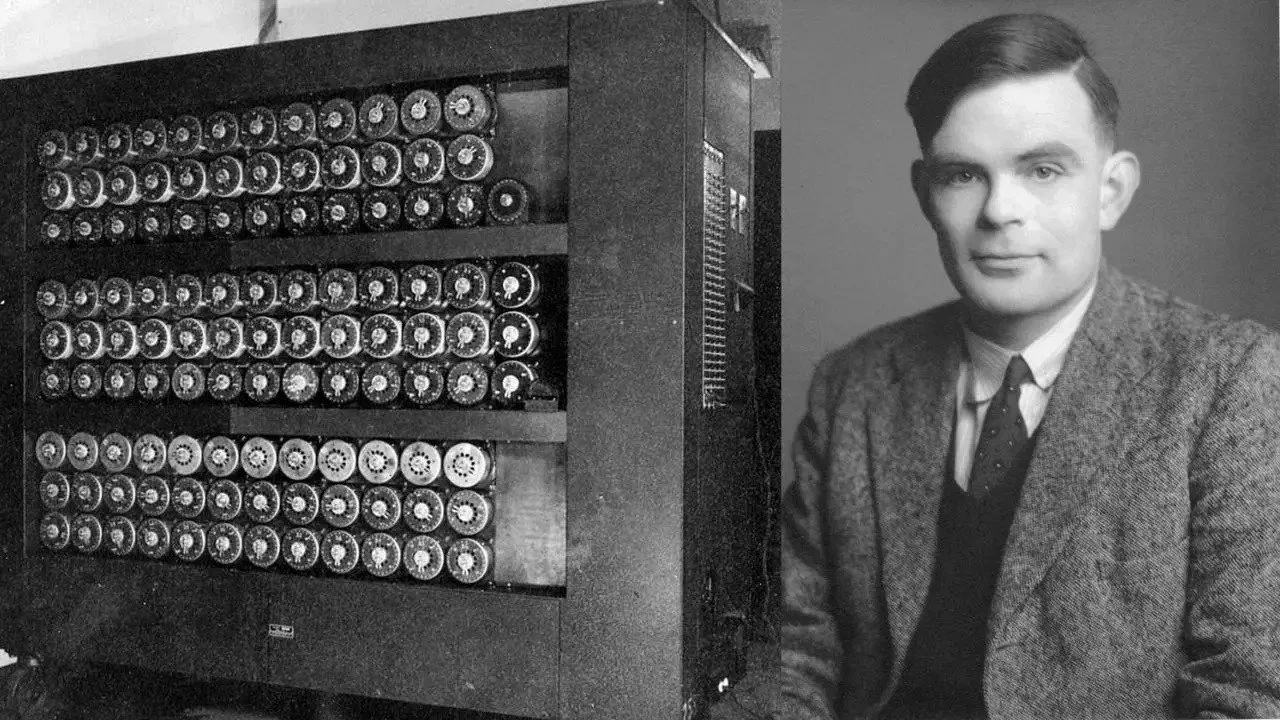
Information does nothing on its own.
A library does not read itself, a ledger does not balance itself, and the night sky will not tell you which of its points of light is the planet whose motion decides a harvest.
We spent thousands of years learning to summon facts to wherever we stood, and discovered, having succeeded, that access to information is not the same as understanding it.
The more abundant the record became, the more obvious the gap: we had more to read than anyone could read, and no more judgement than before.
Stand a person in front of more than they can hold in mind, once the rare affliction of kings and admirals and now the ordinary condition of a Thursday, and a very old helplessness arrives, moved from the muscle to the mind.
The body’s version was at least honest: the stone would not move, and that was that.
The mind’s version is worse, because the load does move, and somewhere in it is the single pattern that matters, the predator in the grass, the debtor about to bolt, the shadow on the scan the tired eye slides over, and it will not show itself merely because you are staring hard.
What such a person wants is not another fact. They have facts to spare.
They want the faculty that turns facts into a decision, and the much-abused word for that faculty is intelligence.
My argument is that intelligence, like everything before it in this essay, began as a scarce, personal, perishable thing, and that a great deal of human history is the slow work of prising it loose from the few skulls that happened to hold it.
This is not, you will be relieved to hear, a chapter about computers.
They arrive, but late, as the most recent answer to a question older than electricity, older than writing, probably older than speech: how a creature that must decide in order to survive can lay hold of a better decision than its own frightened, single mind can manage alone.
It helps to be honest about what intelligence is beneath the flattering things we say, and the honest answer is that it is mostly prediction.
The brain is not a museum of facts but an organ for guessing what happens next, assembled over a long and bloody apprenticeship by the simple method of deleting every lineage that guessed wrong about things that mattered.
As Douglas Adams put it, a learning experience is one of those things that says, “You know that thing you just did, don’t do that.”
The ancestor who saw the bent grass and predicted the tiger lived to become somebody’s ancestor; the one who saw grass and nothing more did not.
We are guessers first and thinkers second, which probably explains a fair amount about us.
It also explains our most expensive flaw, which is that a machine built to find patterns will find them whether or not they are there.
The faculty that spots the real tiger also spots the rabbit in the cloud and the grand design in what is merely a large number of unrelated events.
I say this with feeling, being a salesman by temperament, and a salesman cannot see three dots without running a line through them and a forecast beyond.
It matters here because when we finally built machines to find patterns for us, we built them in our own image, and they have inherited our talent for seeing tigers that are not there along with our talent for seeing the ones that are.
The deeper trouble, for most of history, was that good prediction was scarce, uneven, and mortal.
The elder who knew which clouds carried hail, the navigator who could read a swell, the physician who had seen the fever before, the builder who knew why one arch would stand: they were precious precisely because they were rare, and their intelligence lived inside them.
It could be taught, through apprenticeship and the long patience of watching a master, but that transfer was local, slow, and uncertain, and it narrowed further when knowledge hardened into hereditary craft, guild, or caste, so the question became not who could best learn but who had been born close enough to inherit.
This is the predicament of memory trapped inside ageing skulls, where the death of an elder is the burning of a small library, and the cure is the same in spirit: get the good reasoning out of the rare individual and into a form an ordinary person, on an ordinary day, could pick up and use.
The first and most underrated of those forms is mathematics, which we are taught to regard as calculation and which is really something stranger: reasoning done once and then stored.
An axiom is a starting point agreed in advance; a theorem is a conclusion painfully extracted from it and preserved for everyone who comes after.
Pythagoras worked out that the sides of a right-angled triangle obey a fixed relationship, and for two and a half thousand years builders, surveyors, and navigators have used the result without rediscovering it.
Newton compressed falling apples, cannonballs, and planets into a few laws; Fourier found that the most complicated signal could be broken into simple waves, which is why your phone and your medical scan apply him whether you have heard of him or not.
The reasoning had to be done only once, and when it turned out to be incomplete, as Newton’s did, the correction too was worked out once and shared.
That is the whole point. Mathematics lets you reason correctly about situations you have never met.
A merchant who cannot see next year can still work out what his loan will cost; a gunner who never studied gravity can still drop a shell on a hill he cannot see; an astronomer can say where a planet will stand a century after her death.
The reasoning was done in advance, by someone else, and packed into a few symbols that carry it across distance and time, exactly as writing carried memory and the granary carried food.
And, like the granary, it was not the work of any one people.
The Babylonians kept astronomical tables so accurate they could predict the heavens by arithmetic alone, with no theory of why the heavens moved, an early warning that prediction and understanding are not the same thing.
The Greeks gave us proof, the idea that a conclusion can be forced rather than asserted; Euclid served as a schoolbook for two thousand years because it is less a book of shapes than a machine for manufacturing agreement.
India gave the world the place-value system it counts with and a sign for nothing at all, along with Aryabhata reckoning the length of the year, Brahmagupta setting down the rules for zero and negative numbers, and the prosodists who found in Sanskrit metre the pattern now lazily called Fibonacci; centuries later a school in Keralam worked out the infinite series Europe would name calculus.
The Islamic world extended the Greeks and the Indians, and the Chinese, with counting rods and the Nine Chapters, were solving systems of equations while much of the world still counted on its fingers.
The conquest of reasoning, like that of food and force and memory, was something the species kept arriving at independently, because the problem was everywhere and the mind that faced it was everywhere the same.
A theorem still has to be applied by someone who understands it, and understanding is the scarce thing.
The next move was the discovery that you could often keep the understanding out altogether and keep only the steps: break a piece of reasoning into small, dull, mechanical operations so simple that a person can perform them correctly without the faintest idea why they work, the way a child arrives reliably at the answer to a long division while understanding nothing.
The abacus is the homely emblem, a board that holds the workings so the user need not.
Such a procedure is intelligence decanted out of the clever person who first worked it out and poured into a form any careful dullard can execute, and the word we use for such a recipe is the worn-down name of a ninth-century scholar at the House of Wisdom in Baghdad, al-Khwarizmi, whose book on solving equations by systematic steps also gave us, from a word in its title, algebra.
I have a particular stake in this, because decanting expertise into procedures that lesser mortals can follow is, more or less, the trade I have practised for the last decade or so, as a horse ranch in Pune, a school in Canada, and an accounting firm in Melbourne can testify.
I have spent years sitting with people who know how to do something difficult, coaxing out of them how they do it so that it can be written down, standardised, and handed to someone who gets the job done by following a process.
A standard operating procedure is an algorithm for human beings.
A compliance regime is an attempt to guarantee that a decision comes out the same no matter who is making it.
A law is a procedure written down so that a dispute is settled by the rule and not the magistrate’s mood.
And bureaucracy is procedure at the scale of a society, built on a genuinely radical principle: that what you get from the office should depend on your case and not on your face.
Each is the theorem’s trick played again: somebody did the hard thinking once so that everybody else need not.
The principle found a famous expression in aviation.
In 1935, during a demonstration flight of the new Boeing B-17, one of the most experienced test pilots in the United States forgot to release a control lock before take-off and crashed.
The pilot was not incompetent; the aircraft had simply become too complicated to trust to memory.
The solution was not to search for superhuman pilots but to invent the modern checklist, and flying became safer not because every pilot became exceptional but because exceptional judgement had been captured, standardised, and made repeatable.
I find this hard to regard as merely historical, having grown up in an aviation family; both my father and my younger brother were pilots.
My father spent the last twelve years of his life training over 650 pilots on a mobile simulator he designed and built himself, with a particular emphasis on Cockpit Resource Management.
What he was really doing was taking knowledge that lived inside experienced captains and converting it into procedures and scenarios that younger pilots could acquire in months rather than decades.
The documentation, the process map, the Jeppesen chart, the checklist: each moves a competence out of one skilled head and into a system that does not depend on that head and does not die with it.
A man who has spent his career writing down what experts know is in a poor position to be surprised by the later pages of this story, or to feel innocent of them.
Once you see that reasoning can be reduced to steps that need no understanding, a more dangerous idea follows: if the steps need no understanding, perhaps they need no human.
Several seventeenth-century minds had it.
Pascal, still a teenager, built a brass adding machine in the 1640s to spare his father, a tax official, the labour of summing revenue, so the first famous mechanical calculator was born of records, money, and the taxman.
Leibniz went further, sketching around 1679 a universal symbolic language and a formal method for manipulating its symbols by fixed rules, so that philosophers and lawyers and kings need no longer argue but could sit down and say, “let us calculate”, and watch the answer emerge.
The dream gave birth to the algorithm, the computer, formal logic, and artificial intelligence; it was also wrong in ways that took centuries to uncover.
In 1931 Gödel showed that any sufficiently powerful formal system contains truths it cannot prove; in 1936 Turing showed there are problems no machine can ever decide; and even where the calculation succeeds, it can tell us how to reach a destination but not whether the destination is worth reaching, a distinction we will return to.
Yet the idea beneath the dream, that disagreement is merely unfinished computation, remains one of the most powerful and most questionable our species has entertained.
The man who saw furthest but built least was Charles Babbage, who designed but never finished two machines; the first, the Difference Engine, would calculate and print mathematical tables automatically, and the second, the Analytical Engine, was something stranger, grasped by almost no one except Ada Lovelace, who saw deeper into it than its inventor.
It was to be instructed by punched cards borrowed from the Jacquard loom, which wove patterns by reading holes in pasteboard, so the principle of the computer arrived by way of a method of weaving cloth, an irony worth holding given Gandhi’s later insistence on the charkha and his suspicion of the industrial world that would one day build the computers on which Indians would come to run the world’s technology companies.
Because it followed changeable instructions, the engine could in principle do anything that could be written as a procedure, and Lovelace saw that this meant it was not about numbers at all but about anything representable in symbols, music or logic or language.
She also marked its limit, in a line that has aged well: it could originate nothing, and do only what we knew how to order it to perform.
It could follow. It could not begin.
A great deal of life refuses to fit a formula.
You cannot compute whether this ship will sink or this man will repay.
The turning point was the discovery that while you cannot predict the single case, you can often predict the mass, and that uncertainty itself has a mathematics.
It is usually traced to letters between Pascal and Fermat in the 1650s about how to divide the stakes in an interrupted game of chance, so the mathematics of uncertainty was born at the card table.
But the churchyard gave it its human problem.
In eighteenth-century Scotland the Church faced a painful question: what happened to the wives and children of ministers when the ministers died?
No one could say when a particular clergyman would go, but a properly counted population could say with unnerving accuracy how many men of a given age would die in a given span.
Out of that came the Scottish Ministers’ Widows’ Fund of the 1740s, often called the first actuarially based fund of its kind, and on the same insight a whole insurance industry was raised, converting dread of the unknown into a number you could price.
Later Bayes left a rule for updating a belief as new evidence arrives, which is what any good mind does anyway, except that Bayes wrote the habit down, turning judgement itself into a procedure that could be taught, repeated, and eventually handed to a machine.
What probability did for the single decision, the modern state did for the collective.
A state had long been a machine for remembering its subjects; now it became a machine for reasoning about them, counting them, sorting them into categories, charting their births and crimes and harvests, until the very name of the activity, statistics, carried the state in its root.
The factory turned the same idea on the worker, in the movement that called itself scientific management, whose apostles stood over labouring men with a stopwatch, broke each craft into its component motions, and reassembled them into one approved procedure any unskilled hand could be drilled to repeat.
The craftsman’s intelligence was studied, extracted, written down, and handed back to him as an instruction he no longer needed to understand, which made the factory productive and made the worker an interchangeable part in a process that thought on his behalf.
There is a bill for that, which I will come to, but notice the pattern, now repeating with the regularity of a drumbeat: judgement prised out of the skilled individual and deposited in a procedure, a table, a system that does not depend on him and does not die with him.
A war fused the threads.
The Second World War turned the reasoning of mathematicians directly onto the business of killing and of not being killed, in the discipline that came to be called operations research: how large a convoy should be to lose the fewest ships, at what depth a charge should burst, how a raid should be flown to bring the most crews home.
The example everyone retells concerns where to add armour to bombers that kept failing to return.
A statistician studying the bullet holes in the planes that did come back pointed out that the armour belonged not where the holes clustered but precisely where they did not, because the planes hit in those other places, the engines and the cockpit, were the ones that had not come back to be measured.
It is the chapter in miniature: disciplined method seeing the truth that every brave and experienced airman in the room had got exactly backwards, and teaching the institutions of the century that a team with a method could reliably out-think a roomful of confident individuals.
Only now can we let the computer in, because it is not a gadget that fell from the sky in the 1940s but the heir to all of this: the abacus and the algorithm, Pascal’s brass and Babbage’s, the actuary’s tables and the operations researcher’s models, given at last a fast and tireless body.
It too was forged in war, and again the popular story flatters the wrong people: the first break into the German Enigma cipher was achieved not at Bletchley Park but several years earlier by a group of Polish mathematicians, who handed their methods to Britain and France on the eve of the war.
What Bletchley did was build machines to grind through an unthinkable number of possibilities to find the pattern hidden in each day’s intercepted noise.
Out of that effort came the realisation, made precise by Turing on paper before any such machine existed, that a single device following a list of simple instructions could carry out any procedure that could be precisely described, so there need not be a different machine for every task but one universal machine that became whatever its instructions told it to be.
That idea, the stored and changeable program, is the true birth of the computer, and the architecture we hang on von Neumann’s name was the work of many hands.
There is a detail I find too apt to omit: before the machine took the name, a computer was a person, very often a woman, rooms of them doing the arithmetic of ballistics and astronomy by hand, and when the machine arrived it inherited the title exactly as the power loom had inherited the weaver’s.
First the machines automated calculation; then they automated procedure, taking over a great many of the things clerks and accountants and middle managers were paid to do, a sentence that lands rather differently for my readers in 2026 than it would have a century ago.
Automating procedure is not something a machine does by itself.
Every procedure had first to be written, in detail, by a human who understood both the task and the machine, and the mechanising of the world’s clerical work arrived as a sudden, enormous demand for such people.
That demand fell unevenly, and on one part of the world in a way I watched from the inside.
India had decided, against the grain of its reputation, to take the computer seriously.
Rajiv Gandhi, a pilot by training and a technologist by temperament, pushed through the mid-1980s a programme of telecommunications and computerisation his critics dismissed as a rich boy’s dream about rich boys’ toys: the telephone hauled into Indian towns through digital exchanges and roadside booths, and a scheme called Computer Literacy and Studies in Schools that put microcomputers, many of them imported British machines, into classrooms full of children who had no particular reason yet to need them.
I was one of those children.
My generation learned to program before it had worked out what programming was for.
We were taught BASIC, COBOL, Pascal, and Fortran, and none of it felt like preparation for anything; it felt like an eccentric branch of logic that happened to involve a keyboard.
Then the future arrived all at once.
As the year 2000 approached, the world realised that decades of its software, much of it in that same verbose COBOL and recording the year in two digits to save a few bytes, was about to mistake the new century for the old, and that every line would have to be found, read, and corrected by hand, by people who could still think in languages most Western programmers had abandoned a generation earlier.
The work was enormous, urgent, and supremely unglamorous, and India had, without planning to, produced a very large number of exactly the right people, inexpensive and reachable down the fibre lately laid.
The firms that became household names were built on that scramble, and the model it established, expertise gathered in one place and delivered cheaply to clients who would never meet the people doing the work, long outlasted the crisis that created it.
What strikes me, looking back, is how little any of us saw it coming.
At sixteen our ambitions were scattered; by middle age an astonishing number of the people I studied with, something like four in five, had converged on just two destinations, banking and finance on one side and IT on the other, many of them now living in the United States, not because they had dreamt of Silicon Valley but because that was where the demand happened to be.
I do not tell this as a tale of national genius, because it was very nearly the opposite, a country preparing by accident for a future it could not see.
What it had stumbled into was the export of reasoning.
The thing being sold was not goods, nor muscle, nor information, but judgement and procedure, the trained capacity to take a difficult problem apart and put it back together correctly: intelligence detached, like information before it, from the place that produced it and delivered wherever it was wanted.
Shipping reasoning across an ocean, however fast, still needed a trained human mind at each end to do the actual reasoning.
The older dream, running from al-Khwarizmi through Leibniz’s let us calculate to Babbage’s unbuilt brass, was to manufacture the reasoning itself, to build a machine that did not merely follow steps a human had worked out but reached the kinds of decision no one had managed to reduce to steps.
That is what we call artificial intelligence, and there have been broadly two ways to attempt it, the history of the field being essentially the long defeat of the first by the second.
The first is the obvious way, the way of al-Khwarizmi and the rulebook: write the knowledge down.
Sit with the experts, draw out their reasoning, and encode it as a tangle of explicit rules, if the fever is this and the rash is that then suspect the following, so the machine can chain through the rules and reach the expert’s conclusion without the expert.
These were the expert systems, and in narrow domains they worked well enough to earn their keep.
Then they hit a wall that should have been visible from the start: most of what an expert knows cannot be written down, because the expert does not hold it as rules.
The physician recognises the illness the way you recognise a friend’s face across a crowded room, instantly and without being able to say which features did it; press her for the rule and she will improvise something plausible that is not in fact what her mind did.
We are back at the wordless, personal intelligence we began with, and it turns out the most valuable kind was always exactly the kind that refuses to be decanted into steps.
The second way is stranger. Instead of writing the rules, you let the machine find them.
You do not tell it how to recognise a face; you show it a great many faces, each labelled, and a learning procedure adjusts the machine’s innumerable internal settings a little at a time, nudging them whenever it guesses wrong, until after millions of corrections it recognises faces reliably, without anyone, its makers included, able to say what rule it settled on.
This is machine learning, and the distinction at its heart is worth stating plainly: ordinary software does what a human explicitly told it to do, while a learning system does what it has inferred from examples.
For the first time we built tools whose competence we did not author and cannot fully explain.
The systems that do this best are built, very loosely, on a picture of the brain, layers of simple units each passing signals to the next with the strength of every connection adjusted by experience, which is why they are called neural networks.
For decades they were too hungry for data and computation to be worth much, until both grew cheap and one design, arriving in 2017 and called the transformer, let a machine weigh every part of a passage against every other part at once.
Fed enough text and enough computing power, that produces a large language model, which does something you may have watched your phone keyboard attempt, with far greater range: it predicts the next word.
Trained on more writing than any human could read in many lifetimes, it learns the statistical shape of language, the way arguments unfold and questions invite answers and code and contracts and bad poetry each keep their own grammar, and it can then continue a piece of text in a way that looks like writing, answering, summarising, translating, and something uncannily like reasoning.
That is why predicting the next word is at once accurate and misleading.
A chess player choosing his next move is also only choosing his next move, and the choice is doing a great deal of work.
This returns us to where the chapter began. Intelligence is prediction.
The brain guesses what comes next so the body may live long enough to guess again; the model guesses what comes next so a paragraph may continue, a piece of code may compile, a manager may sound more certain than he is, and a consultant may occasionally be replaced by another consultant with a subscription.
The resemblance should not be overdone, because a brain is not a transformer, whatever the more excitable commentators prefer to believe.
But it is enough to matter: the newest machine in this story is doing, in its own statistical way, the oldest work intelligence ever did, reading the pattern and anticipating the next step.
I do not want to oversell it, partly because enough people are doing that for a living.
What these systems can do is large.
They place a usable fluency in language, code, argument, explanation, and summary into the hands of anyone who can ask for it, instantly, in many languages, at a cost low enough to feel trivial.
A person who could not hire a lawyer can get a first draft of a legal letter; a student who could not find a tutor can ask for an explanation at midnight; a small business that could not afford a consultant can receive something dangerously close to consulting.
Much of it is imperfect, some of it is wrong, and a little is nonsense without the fancy tie, but the old pattern is unmistakable.
Printing did not give the world a better memory than the great trained memories of the oral age; it gave a cheaper one, and that was enough.
Iron did not beat bronze by being finer but because more people could get at it.
The GPS voice that sends you confidently into a service lane is no better a navigator than the sailor who could read currents and stars, but it sits in the hand of a child in the back seat, and that decides the matter for most of the world.
Intelligence has begun to enter the same trade: the best judgement remains rare and dear; a passable version of it, summonable instantly and widely, is the thing that has started to spread.
I want to be careful with that word begun, because the temptation is to declare the journey finished, and it is not.
Food was not abundant when the first farmers bent teosinte to their purpose; it was merely, for the first time, something they could grow rather than chase.
Power was not abundant when Newcomen’s engine thumped over its coal pit; it was merely available where the coal was.
Information was not abundant when Morse tapped his first message; it was merely loosed from the body that had always carried it.
Each took a long time, and a great deal of falling cost, to travel from available to abundant, and most of that journey belongs to the next chapter.
Intelligence stands at the very start of the same road.
It has been externalised, made transmissible and reproducible, and put within reach of anyone who knows how to ask, which is genuinely new; and it remains expensive, uneven, contested, concentrated in a very few hands, and incomplete.
It is available. It is not yet abundant.
That distinction is most of the difference between this chapter and the next.
Which brings the bill.
The first item is bias, because an externalised intelligence inherits the world it was made from.
A system trained on the record of human behaviour absorbs that behaviour entire, including the parts we have spent generations learning to disguise, so that a rejected loan, a longer sentence, a filtered résumé, or a lower score can return from a machine wearing the expression of neutrality.
This is not new prejudice; it is old prejudice with its fingerprints wiped off.
The second item is fluency without truth: these systems produce the plausible, and the plausible is not the true.
The wire of the last chapter carried a lie and a truth at the same speed and left the receiver to tell them apart; the newer machine does not merely carry the sentence, it makes the sentence, and a well-made false sentence is harder to doubt than a clumsy one.
The third item is depersonalisation, and appears when such systems are turned to decisions at scale: one official making a foolish judgement harms the few who come before him, but the same judgement built into a system and run a million times harms a million people with perfect consistency, and the injured party may find no one in the room able to explain what happened.
The old tax collector at least had a face one could resent; the algorithm offers a reference number and the immense spiritual comfort of being told that your request is being processed.
The fourth item is deskilling, and I cannot plead innocence, having spent a decade converting judgement into procedure.
When a capability can be summoned, the discipline that once produced it begins to look optional; the apprentice no longer learns the thing the machine now does for him, the driver forgets the route, the doctor trusts the scan before the mind.
A society that forgets how to do what its systems do for it is making a large bet that those systems will never fail, never be captured, never be withdrawn, and never quietly alter their terms.
The fifth item is concentration of power.
A tool sold to each of us as personal empowerment may still gather the real power elsewhere, because the largest learning systems demand data, chips, electricity, money, and scale in quantities only a few actors possess, so the old question of the second brain returns in a sharper form.
It is no longer only who controls the record.
It is who controls the reasoning built on the record: who trains it, who audits it, who may correct it, who decides what it may refuse, who collects rent each time the rest of us think through it, and who controls the particular version of the truth I am obliged to live by.
Set the particular machines aside, since their names will age faster than the argument.
The line is clear enough.
Fire gave us energy when we wanted it; agriculture gave us food across the seasons; the simple machines, the roads, and the metals gave us force beyond the reach of muscle; writing and printing gave us memory outside the skull; coal, electricity, and oil gave us power untethered from river, wind, and animal; and the telegraph, the networks, and the smartphone gave us information wherever we stood.
Now the long chain running from theorem to algorithm, from rulebook to checklist, from actuarial table to computer, from expert system to learning machine, has begun to give us judgement, prediction, classification, and explanation, in a form that can be summoned by anyone who knows how to ask.
Food. Force. Memory. Power. Information. Intelligence. At will.
That ought to feel like utopia, until one remembers that utopia did not begin life as a compliment.
Thomas More’s coinage named a place that was at once the good place and no place, an ideal that could not quite exist, and the warning sits inside the word.
We have seen enough history by now to know that every capability we summon arrives with a new scarcity folded inside it, and intelligence, only just prised loose and still costly, concentrated, and half-finished, will be no exception.
We can already summon information almost without limit.
We are now learning to summon reasoning in much the same way: imperfectly, expensively, unevenly, but unmistakably.
If knowing becomes abundant, and reasoning becomes abundant, what remains scarce?
If both the fact and the first draft of judgement can be had on demand, where does the bottleneck move next?
07 Abundance. And its discontents.

At the table of Napoleon III, the most honoured guests were served with aluminium, while the merely important made do with gold.
In the middle of the nineteenth century aluminium was the most expensive metal on earth, dearer than gold and silver both, and when the Americans finished the Washington Monument in 1884 they capped it with a small pyramid of the stuff, partly because it would not corrode and partly to show that the young republic could afford to set a precious metal where almost no one would ever see it.
Within a couple of years the price fell off a cliff.
What happened was not the discovery of new mines, because there were none to find.
Aluminium is the most abundant metal in the Earth’s crust; it had never been rare.
What had been rare was the means of freeing it, because aluminium clings to oxygen with a ferocity no ordinary furnace can break, and only a strong electric current, passed through the ore dissolved in molten cryolite, will prise the two apart.
In 1886 Charles Martin Hall in America and Paul Héroult in France, neither aware of the other and both about twenty-two, arrived at essentially the same electrolytic process within months.
The expense had never been geological; it was a matter of materials, process, and cheap electricity, and the moment that was solved the scarcity evaporated, because it had never been real.
The metal an emperor reserved for princes is now the foil we wrap a sandwich in and throw away.
The aluminium story is the whole argument of this chapter in miniature, because it describes the mistake the chapter is about.
The mistake is to look at the price of a thing in its difficult early years and conclude that the price tells you something permanent. It almost never does.
A thing may be expensive because it is genuinely scarce, limited by nature, or it may be expensive only because we have not yet worked out how to make, move, store, or use it efficiently.
Gold is expensive because there is only so much of it.
Aluminium was expensive because we had not yet discovered a practical way to separate it from the oxygen it clings to.
One scarcity belongs to nature, the other to technology, and from the point of view of the buyer they look identical. From the point of view of history they are completely different.
Capabilities tend to move through three stages, and we keep confusing them.
First a capability is scarce, the possession of the few.
Then it becomes available, rationed and dear but obtainable if you can pay.
And then, sometimes, it becomes abundant, so ordinary that we stop thinking of it as a capability at all.
We are forever mistaking expensive things for inherently expensive things, assuming that today’s price reflects some permanent law when it reflects nothing more than an immature material, an undeveloped process, or an infrastructure still in its infancy.
The history of civilisation is, to a surprising extent, the history of discovering that many of our apparent scarcities were not fundamental after all.
It is tempting to call this an economic story, because that is how it has been told since Adam Smith.
But the price is the symptom, not the cause.
Dig down through the economics of almost any great cheapening and you reach a change in our command over matter itself, which is why we named our early epochs after substances, stone and bronze and iron, instead of after kings.
A civilisation can do only what its materials permit.
Bronze depended on tin hauled across continents; iron lay nearly everywhere, and so iron won, by availability rather than merit.
Cheap steel, once Bessemer learned in the 1850s to burn the impurities out of molten iron with a blast of air, gave us railways that did not wear out and buildings that climbed past the height stone had always imposed.
Change the material, and the possibilities change with it.
The cheapenings I have watched within my own lifetime obey the identical logic.
A long-distance call in India was once a small expedition: you booked a trunk call through an operator and waited, sometimes for hours, and when it came through you spoke with the breathless efficiency of a hostage negotiation, because the meter was running and three minutes could cost more than a labourer earned in a day.
The little yellow STD and ISD booths on every second corner were monuments to the price of distance.
The first hard disk I owned held a few tens of megabytes and cost more than a decent bicycle, and I hoarded each one as though it were land.
Every one of these felt permanently expensive, and every one is now so cheap that most people under thirty cannot be made to believe it was ever otherwise.
And in every case the reason for the collapse is a material.
Computation became cheap because of silicon: the transistor at Bell Labs in 1947, the integrated circuit arrived at independently by Jack Kilby and Robert Noyce at the end of the 1950s, and Gordon Moore’s observation in 1965 that the number we could pack onto a chip was doubling at a steady, predictable pace.
Silicon is sand, purified and sliced and patterned with light until it does our arithmetic for us.
Communication became cheap because of glass: Charles Kao showed in 1966 that glass made pure enough would carry light for kilometres without fading, and within a few years a single hair of ultra-clean silica was carrying more conversations than all the copper of the old telephone empire put together.
Glass is sand too.
Storage went the same way.
The most consequential substance of the modern world turns out to be the stuff of beaches, and I take a disproportionate pleasure, as an electrical engineer, in the fact that the entire weightless digital civilisation rests on the second most abundant substance in the Earth’s crust after oxygen: sand.
Energy is now travelling the same road, and again the engine is materials rather than markets.
The silicon solar cell, built at Bell Labs in 1954, was for decades a costly curiosity fit mainly for satellites; the price of a module has since fallen by something like ninety per cent in little more than a decade, not because sunlight got cheaper but because we got better at making the material that catches it, with the perovskites now crowding in behind.
Storing that energy has followed the same curve, on the back of the lithium-ion battery that Whittingham, Goodenough, and Yoshino brought into being and Sony first sold in 1991.
The scale is worth holding in mind.
In 1964 the astronomer Nikolai Kardashev proposed ranking civilisations by the energy they could command, and by that measure we are not yet even a properly planetary one.
The Sun delivers roughly 170,000 terawatts of power to the Earth, while humanity presently uses about eighteen to twenty.
One must distinguish the available from the accessible, because most of that immense flood falls on oceans, clouds, deserts, and the dark side of the planet, and no technology we can imagine will capture all of it.
But the comparison settles something important. Energy is not scarce in any fundamental sense, and never was.
Like aluminium before the Hall-Héroult process, it only appeared scarce because we lacked the materials, the infrastructure, and the techniques to lay hold of what was already there.
The scarcity was never in the resource. It was in our ability to reach it.
Only now is it safe to turn to the thing everyone wants to discuss, because only now can it be seen in its proper place.
Intelligence, as the previous chapter argued, has lately become available.
It has not become abundant, and the whole shape of the present moment depends on keeping the two words apart.
Intelligence today is expensive.
Training a single frontier model costs sums that would have built a university a generation ago; running these systems at scale consumes electricity and silicon enough to alter the plans of national grids; and the largest organisations that use them meter the budgets and appoint someone to be cross about them.
The capability rests on the most extravagant material achievement of the age: processors etched by machines that print circuits with ultraviolet light at a wavelength of thirteen and a half nanometres, made by a single Dutch company, fabricated in a handful of plants, chiefly in Taiwan, that are among the most expensive structures human beings have ever built.
It is, in short, the emperor’s aluminium again, dear and reserved for those who can pay, and we are busy making about it the very mistake the diners at that imperial table never knew they were making.
This is not a disappointment to be apologised for. It is what the beginning of abundance has always looked like.
The telephone in 1900, the motor car in 1905, the computer in 1955, the mobile handset in 1990: each was real, useful, and plainly the preserve of institutions and the rich.
The reasonable expectation, drawn from every chapter of this essay, is that the cost of a given level of machine intelligence will fall steeply as the material substrate beneath it matures, exactly as the cost of computation, communication, and storage already has.
There are reasons this case may prove harder than the ones before it.
The easy decades of Moore’s Law are ending, for the honest reason that a transistor cannot be made much smaller than the atoms it is built from; and intelligence, unlike a stored photograph, has an appetite for energy that ties its cost to the cost of power, so the cheapening of thinking may end up waiting on the cheapening of energy, which is itself a materials problem only partly solved.
None of this overturns the pattern. It only means the road may be longer and stranger than the salesmen suggest.
Follow the pattern to the point where the materials have done their work and the cost of a once-scarce capability has fallen so far that we stop counting it.
The deepest mark of an abundant capability is not that it is cheap but that it has become invisible.
Nobody now describes himself as a user of electricity; the grid simply hums in the wall and we draw on it without thought, noticing it only in the dark of a power cut.
Douglas Adams once remarked that we no longer think of chairs as technology, despite there having been a time when humanity had not yet worked out how many legs a chair should have, how tall it ought to be, or why it had a tendency to collapse when someone sat on it.
That is the final destination of abundance.
A capability stops being a technology and becomes part of the landscape of existence, summoned without ceremony, present in whatever quantity is wanted, at the moment and in the place it is wanted. At will.
At this point it is tempting to imagine that abundance solves the problem. History suggests otherwise.
Again and again, human beings have learned how to create plenty long before they learned how to distribute it.
The physical fact of abundance and the social fact of access are entirely different things, and the gap between them can remain open for generations.
A thing can be abundant in the world and scarce in your hands.
The oldest capability in this essay demonstrates it most starkly: the world has produced enough food to feed every living person for many decades now, and yet people have gone on starving.
Studying the great famines of the twentieth century, and not least the Bengal famine of 1943 in which perhaps three million died, the economist Amartya Sen showed that famine is very often not a failure of supply at all but a failure of purchasing power, a collapse not in the amount of food but in particular people’s ability to acquire it, while the grain sits in the market and is sometimes even exported.
The food was abundant. The access was not.
The same gap reappears wherever you look, and it has a recognisable mechanism: a capability becomes physically abundant, cheap to make and easy to copy, and then a wall is raised so that the plenty on one side does not reach the need on the other.
Insulin was discovered in Toronto in 1921, and its discoverers, understanding exactly what they had, sold the patent for a token sum precisely so that no one should be gouged for the privilege of not dying; a century later, in the richest country on earth, people ration their doses by price.
The drugs that turned HIV from a death sentence into a manageable condition existed and worked by the late 1990s and cost more than ten thousand dollars a year, until Indian manufacturers, Cipla foremost among them, began producing generic versions for nearer a dollar a day, and the wall came down.
The capability had been there the whole time; what was missing was permission to reach it.
And this is the strange signature of the newest abundances of all, the digital ones, because a thing that can be copied infinitely at no cost has no natural scarcity whatever, so that when it is scarce the scarcity is always manufactured, held in place by patent, licence, encryption, and contract.
We have built an entire apparatus for keeping abundant things scarce, and have grown so used to it that the strangeness no longer registers.
So the future holds not one possibility but two, and the materials alone cannot tell us which we will get.
The first I will call the rising tide, and it is the reading the long sweep of history, on balance, supports.
The pattern simply holds: each capability, having become available, goes on to become abundant and to diffuse outward, exactly as printing widened from a clergy’s monopoly into a public possession, as the electrical grid spread from a few rich streets in Manhattan to nearly every dwelling on the planet, as the mobile telephone went from a banker’s brick to a vegetable seller’s lifeline.
The evidence is not negligible.
The share of humanity living in extreme poverty has fallen from the great majority of the species two centuries ago to a small minority today.
The Green Revolution that Norman Borlaug and, in India, M. S. Swaminathan drove through the 1960s and 1970s pushed high-yielding agriculture across the poor world fast enough to outrun the famines that everyone, and their Malthusian uncles, had confidently predicted.
Literacy, vaccination, electric light, telephony, and bandwidth have reached billions within living memory.
If intelligence and energy travel the same route, the tide keeps rising and the flourishing widens.
The second future is consistent with the very same record, which is what makes it dangerous.
I will call it the curdled milk.
The abundance is entirely real and entirely physical, but it separates rather than spreads, and stays on its own side of the wall.
The fabs and the grids and the models and the patents and the seeds are owned by a small number of actors who hold the data, the chips, the energy, the capital, and the scale that the rest of us do not, and they release the abundance only as a metered, revocable, rented trickle, on terms set entirely by them.
You do not own the thing; you rent access to a thin slice of it, kept in someone else’s cloud, governed by someone else’s licence, withdrawable at someone else’s pleasure.
This is not a science-fiction nightmare. It is, rather precisely, the oldest social arrangement we have: the manor rebuilt in silicon.
The medieval lord did not, as a rule, forbid the peasant to eat; he owned the land on which the food grew and took his rent from everything it produced, and the peasant lived, when he lived, on terms the lord set.
Replace the manor with the platform, the field with the data centre, the rent with the subscription, and the common with the walled garden, and you have feudalism with vastly better plumbing, an arrangement in which the means of abundance are more dazzling than anything a baron dreamed of and the sharing of its fruits, if anything, narrower.
The serf at least owned his own hunger. The tenant of the new manor owns nothing, and rents even the instruments with which he thinks.
The two futures run on identical technology.
The materials decide only whether abundance is physically possible; they are silent on whether it spreads.
That second question is settled not by silicon or glass but by who comes to own the means of abundance and on what terms the rest may reach them, and that is among the oldest arguments in human history, running from the first person who looked at a field and said “mine”, through the enclosure of common land and the factories of the Industrial Revolution and the labour movements that answered them, down to the quarrels of our own day.
The names and the slogans change.
The question does not: who owns the productive assets, who receives the surplus, and by what right?
What is new is not the quarrel but the scale of the abundance being quarrelled over.
Both of the futures described above are futures of plenty.
The fight is no longer between abundance and scarcity but over how abundance is arranged, over deprivation by design.
Even in the curdled future, the tenant who owns nothing and rents the very instruments of her thought commands more food, more medicine, more light, more power, more information, and more intelligence on demand than almost any human being who has ever lived, resources that emperors would have regarded as miraculous.
The disagreement over who controls the abundance is real, bitter, and worth having.
But it presumes something our ancestors could not.
The argument is no longer about whether enough can be produced, but about who gets to enjoy it.
Humanity spent a million years trying to cross that threshold. The crossing itself is the event. The quarrel over what lies beyond it comes after.
Step back from the examples and the pattern is plain.
A capability begins scarce and confined to a few: fire with whoever could keep it alive, memory with whoever held the records, force with whoever controlled the most muscle.
Over time we find ways to move that capability out of individuals and into systems, tools, and institutions; we store it, standardise it, and make it reproducible, and once that happens it can be copied, transported, improved, and shared.
The capability then becomes available, at first expensive and reserved for those who can afford it: the emperor’s aluminium, the long-distance call, the first computer, the first AI model.
But as materials improve, processes mature, and costs fall, availability gives way to abundance, and what was once remarkable becomes ordinary.
That has been the story of this entire essay.
Scarcity, externalisation, availability, abundance, with food, force, memory, power, information, and now intelligence.
Energy and intelligence are still in the expensive and uneven middle stage, but they are moving along the same path that transformed everything before them.
And the great abundances of this story, energy, materials, computation, and intelligence, some long arrived and some still on their way, are not four separate stories but one, because each is built on the others.
Cheap energy makes materials and computation cheaper; cheap computation designs better materials and better ways to gather and store energy; cheap intelligence runs on cheap computation and cheap power; and food, medicine, mobility, and most of an ordinary life sit on top of the whole arrangement.
The material constraints that have bounded every human life are no longer falling one at a time, as they did through all the chapters behind us, but loosening together, and the long campaign this essay has traced, the campaign against not having enough, is for the first time within sight of its end.
That is a stranger inheritance than it first appears, because we are a species shaped by scarcity.
Scarcity shaped our institutions, economies, laws, religions, and habits of mind; the granary, the tax roll, the market, the priesthood, and the careful counting of who owed what to whom were all, in one way or another, machinery for managing not-enough.
We have spent ten thousand years becoming very good at the problem of too little, and we have almost no practice at the problem of enough.
Lincoln is supposed to have observed that nearly any man can withstand adversity, but that the real test of character is power.
Abundance is power, in the plainest sense, and a civilisation arriving at abundance is being handed power on a scale no civilisation before it has held.
The question it leaves on the table is not whether we can manufacture the plenty, which we plainly can, and will do more cheaply with each passing decade.
It is the question our whole history of scarcity has never once forced us to answer.
What does a species shaped by scarcity become when abundance becomes ordinary?
08 Epilogue: Stories.
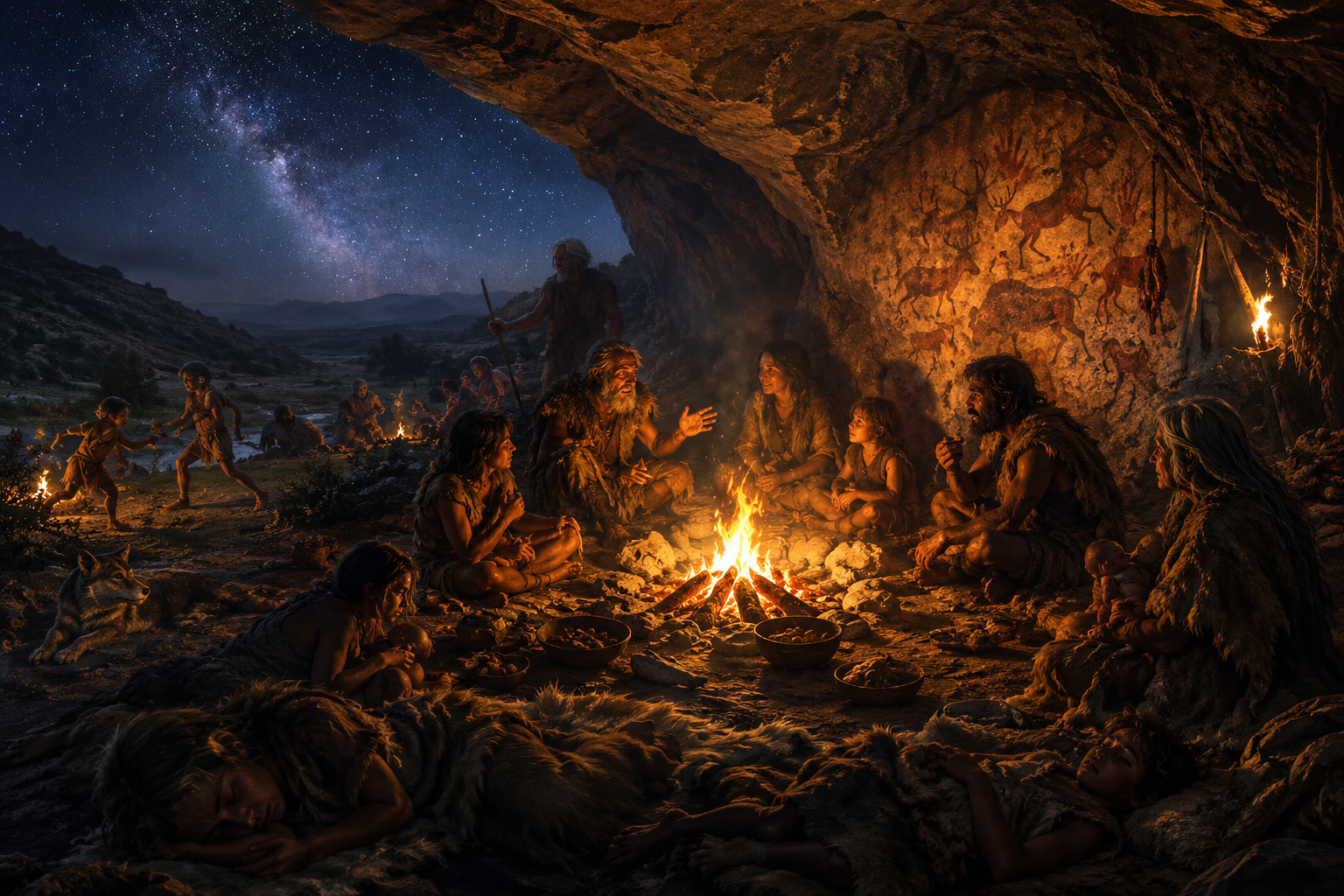
Looking back is itself a kind of luxury, and it is worth beginning with that, because for almost the whole time our species has existed there was no spare attention for it.
The next meal, the next winter, the next raid, the next fever appeared too closely for anyone to sit down and consider how far the road had run.
A creature living hand to mouth on the planet’s annual income does not get to be wistful or introspective.
Wistfulness arrives only when the wolf is no longer quite at the door, when the granary is full enough that one may afford an afternoon to wonder rather than to forage; so the plain fact that you and I can sit at the end of this account and survey the distance covered is, in its own modest way, the last piece of evidence for everything the essay has argued.
And what a distance.
We began beside a fire that came when we called it and went out when we told it to, and we have ended in a world where the buried sunlight of three hundred million summers arrives at the flick of a switch, where a payment is a remembered promise travelling at the speed of light, where a passable version of human reasoning can be had by anyone who knows how to click a button and just ask.
Fire, food, force, memory, power, information, intelligence: seven times over we watched the same move, a thing we were once wholly at the mercy of prised loose from the world, or from the few skulls that held it, and turned into something we could have when and where and in whatever quantity we wished. At will.
I confessed in the Prologue that the whole untidy heap of this reading settled, one ordinary afternoon, into a sentence that arrived as a joke: that civilisation looks, on a long enough view, like one very long search for more things to burn.
I have spent entire chapters since trying to take the joke seriously, and the more I have looked the less it has amused me, because it keeps turning out to be the plain description of what we were doing under every disguise.
The field is stored sunlight, the coal and the oil a hundred million summers spent in an afternoon, and the newest of our marvels only the most expensive fires we have yet learnt to keep lit.
Every wall this essay watched come down or circumvented was a way of getting hold of more to burn, and of burning as much of it where and when we chose rather than where and when nature happened to permit.
Things to burn. That was the search, the whole of it, running unbroken from the first banked ember to the data centre with a million GPUs humming somewhere now on my behalf as I write.
And the strangest thing I have to report, at the end of so long a hunt, is how many of the walls are coming down or dissolving at once.
The search is not finished, and in much of the world it is nowhere near finished; but its direction is no longer in any serious doubt, and that is a thing no human being before roughly the day before yesterday could have seen and meant.
I want to be careful not to mistake that refrain for the whole of the matter, because every one of those conquests answered a question that began with the word how.
How to eat across the seasons. How to move the stone too heavy to lift. How to remember more than a village can hold. How to drive the machine. How to find the pattern in the flood.
These are practical questions, and the genius of our species has been a near-monstrous, and dare I say stubborn talent for answering them by the same method each time: take the capability out of the fragile, mortal individual and pour it into a system, a tool, an institution, a procedure, a thing that does not tire and does not die.
That is what civilisation has always done. We externalise.
We push the constraint a little further out, and the little territory we have cleared of scarcity grows wider with each century, until at last, as the previous chapter argued, the constraints begin to loosen not one at a time but together, everywhere, all at once.
And the long campaign against not-having-enough comes within sight of its own conclusion.
But one thing in this account has never once submitted to that treatment, and the longer I look at the pattern the more its absence shows.
There is no Hall-Héroult process for meaning.
There is no ship to carry it, no wire down which to send it ahead of the train, no separate condenser that lets you run a life on a third of the fuel.
You cannot store a sense of purpose in a granary against the winter, nor digitise it into the universal code beneath all the others, nor train a model on the whole written record and have it hand you, at a price low enough to feel trivial, a reason to rise in the morning.
There is, in reality, no computer that is grinding out for 4 billion years trying to figure out the meaning of life, the universe, and everything.
Every capability in this essay could be lifted out of the person who held it and set down in something sturdier.
This one has not, and it is beginning to look as though it cannot, because it belongs to a different order of thing altogether.
It stays inside the body that needs it.
And only now, having cleared so much else out of the way, are we beginning to see it standing there, where it has always stood, smiling at our struggle to “solve for” it.
And yet we are not without an instrument, because we have been leaning on one throughout the essay without bothering to name it.
Look again at what actually did the coordinating in each chapter, and it was never the object.
The clay token did not make two strangers trust a bargain; it held a mark that both had agreed to read the same way.
A coin is a disc of stamped metal, worthless, until enough people hold in common the same understanding of what it settles and what it obliges.
Every standard and protocol this essay has admired, the gauge of the rail, the format of the packet, the vast agreement to render the whole world into ones and zeros, comes down in the end to a multitude consenting to mean the same thing by the same sign; and a sign that binds a multitude and outlasts every individual who honours it is only the hardened, collectively inhabited form of a story.
I have insisted, chapter upon chapter, that the hardware was never the achievement, that the wheel was nothing without the axle and the road.
The same holds one level deeper.
The tablet, the coin, the written law, and the humming network were only ever the medium.
What turned a band into a market of strangers, that market into an empire of people who would never meet, and that empire into a nation was the shared account running underneath.
We did not build civilisation on tablets and coins and cables. We built it on the stories those things were trusted to carry.
They were only ever the granary; the story was the stored sunlight kept inside.
The difficulty is that every story we presently inhabit was composed under scarcity, because scarcity was the governing fact of the whole long stretch in which we wrote them.
They divide the world into us and them, because for a million years there was not enough to go round and the band that hesitated did not become anybody’s ancestor.
They prize sacrifice, frugality, and the deferral of want, because want was the constant against which every life was measured.
They are, in their bones, instructions for conducting oneself well when there is too little.
And they have served us magnificently.
But instructions for the management of not-enough are a strange inheritance to hand a species that is, for the first time in its existence, within sight of what can only be labeled “more than enough”.
We have spent hundreds of thousands of years becoming the foremost experts alive on the problem of too little, and we have almost no settled wisdom worth the name on the problem of plenty.
This is why the conflicts that trouble me most are no longer the ones the earlier chapters prepared me for.
The old wars were over things: over tin, grain, coal, the field, the well, the trade route.
They were terrible, but they were legible, and in a certain sense soluble, because the thing fought over could in the end be made abundant, and a great deal of it has been since.
Those wars have not ended, and they go on wherever the abundance has yet to arrive, which is still a great deal of the world, most of which is poor even now.
But as the material constraints weaken, a growing share of our quarrels, and the most stubborn of them, are now waged between people who by any historical measure already command more than emperors dreamed of, and that wealth depends less and less on the thing in the warehouse.
It turns on identity and legitimacy and belonging, on whose account of the past is the true one and whose vision of the future is to be permitted, and beneath all of it, on whose version of reality the rest of us will be obliged to live inside.
Such quarrels have no Bessemer process and no falling cost curve.
You cannot mass-produce your way out of a disagreement about meaning, and two incompatible stories about what a life is for do not dissolve when the granaries are full.
If anything, a full granary leaves a person more leisure to fight about it.
I will not pretend to know which of those stories is worth inhabiting, because the moment a man in my trade begins prescribing the meaning of your life you would do well to check whether he is selling something.
But I will venture one observation, offered only as observation and not instruction.
A story built entirely on the enemy at the gate, on the lean year and the dread of it, loses its subject the moment the gate holds and the year turns fat; and a people who know no other kind of story will tend, I have noticed, to invent the enemy and manufacture the scarcity rather than live without the tale.
The harder thing, the rarer thing, the thing we have had almost no practice at, will be to tell ourselves stories large enough to organise a species that no longer has to fight for its bread, and yet honest enough not to pretend the fight is finished for everyone, since plenty in the aggregate and plenty in the hand are still, and may long remain, two quite different things.
That, I have come to believe, is the true shape of the inheritance, and it is why this essay carries the title it does.
For a million years the sentence that governed us had only one half, and we spent everything we had completing it.
Things to burn. We hunted them across every wall the world raised against us, and we have very nearly run the hunt to ground.
But there was always a second half waiting behind the first, unattended, because we never had the leisure or the surplus to attend to it; and as the burning is mastered and the walls come down together, that second half is what is left standing in the clearing, the one part of the sentence we have not learnt to summon at will.
Stories to tell. Not stories as decoration, nor stories as the lie a salesman drapes over a thing he means you to buy, but stories in the oldest and most load-bearing sense: the shared accounts that tell a species what the abundance is for, who is included in the word us, and what a life crowded with everything to burn is supposed to be in aid of.
The first half of the title was a problem of fuel, and we seem to be the most accomplished engineers of fuel the universe has yet produced.
The second half is not a problem of fuel at all, and never was, and no quantity of the first will purchase us a single line of the second.
I keep returning, in the end, to that first fire: the one we fed through the wet night and carried cupped against the wind from one camp to the next.
It kept the cold and the dark and the animals at bay, it pre-digested our food, and it let a tropical creature walk into a temperate winter and live.
But I do not believe for a single moment that the people gathered around it sat in silence while it burned.
Someone, on some forgotten night a million years ago, while the embers were being banked and the watch was being kept, was telling the others a story: about the hunt, or the dead, or the lights overhead, or where they had all come from and where they might yet be going.
Two technologies were lit that night, not one, and they have travelled side by side ever since.
The first we have very nearly mastered, and can summon heat and light and force and knowing in quantities those firelit faces would not have told apart from the doings of gods.
The second we have carried the whole way without once contriving to set it down outside ourselves, no nearer to externalising it than the band around that first hearth, which is either the great failure of the whole project or its actual point, and I find I am no longer certain which.
This essay opened on a man at a kitchen tap, some time after midnight, in a flat in a city that did not exist till recently, holding in two unthinking hands more of the world than any king of any earlier age, and feeling, as he swallowed the cold, clean water, precisely nothing.
I have spent every chapter since explaining the abundance pooled in those hands.
I cannot explain the nothing.
The nothing is the second half of the sentence, the part no wire will deliver and no model will draft, the part each of us is still, exactly as we always were, expected to supply for ourselves around whatever fire we have been given to sit beside.
We have very nearly finished the long search for things to burn.
We have hardly begun the older, harder, and more human business that was lit on the very same night and is carried still in the very same trembling hands: the stories we have left to tell.