People who know me will be surprised that I am about to make a nationalist argument, or dog-forbid, even a civilisational one. Let’s just say I am equally surprised.
Here is the claim, plainly. Frontier artificial intelligence is beginning to look like colonialism. And I mean this not as a figure of speech, but as a structure.
Strip colonialism of its makeup and it is simple. It is not gunboats. It is not governors. It is not flags on beaches or armies marching inland. Those were delivery mechanisms, means to an end. The end was extraction.
The pattern goes like this. Something valuable is taken from the only place that can supply it. Value is added elsewhere. Ownership and control stay in that second place, as do the skill, the art, and the knowledge of how it is made. The finished product (or some of it; often the reject, the second-rate) is then sold back at a steep price to the place the raw material came from; and the people who supplied it have no say worth the name over how it is governed, who owns it, what it costs, or who may use it.
That was cotton. That was indigo. That was tea. The raw material left, the finished cloth came back, and the looms, the profits, and the decisions all stayed in Lancashire.
The raw material this time is not cotton. It is human behaviour. It is language. Conversation. Argument. Culture. Searches. Uploads. Preferences. Attention. Knowledge. Correction. Feedback. The ten thousand small acts by which several billion people, every day, describe themselves to a machine.
Modern AI systems are built out of this. Not inspired by it. Built out of it. It is the ore. And India is one of the largest deposits on Earth.
Not because Indians are virtuous. Not because Indian engineers wrote the models. Not because anyone here has earned a share as a reward for cleverness. Set those arguments aside; they are different arguments, and weaker ones.
The reason is duller and harder to wave away. India is one of the largest English-speaking populations in the world, and one of the most varied societies anywhere. Hundreds of millions of Indians produce language, opinion, debate, instruction, humour, history, memory, and behaviour online, continuously, in volumes that are difficult to picture. And it is not only the volume. It is the variety: dozens of languages braided into a single sentence, registers shifting mid-paragraph, the whole argumentative, multilingual, contradictory texture of the place. A model trained on uniform data learns a narrow world. Variety is what these systems are starving for, and we produce it without trying and without being asked. Because that is just how we are.
Almost nobody producing it understood that this was what they were doing. And almost all of it was handed over free. Not sold, not licensed, not negotiated, not even requested. Simply taken, in exchange for a service that felt free because the price was being paid in a currency nobody had named yet.
At least the Gujarati, Marathi, and Deccani cotton farmers knew about the mills, and knew what would become of the fruit of their labour, however unfair. The urban professional, the village schoolteacher, the small-town housewife, the farmer in a drought-struck district, the activist, the content creator: a billion Indians on cheap Internet, uploading their arguments, their jokes, their anger, their innermost thoughts, have no idea they are helping to build a strategic asset on another continent. They think they are using a free app, a free service, free ‘social’ media, posting photographs, arguing politics, sharing jokes, watching videos, or wasting time between meetings. They do not realise they are producing training material. In both cases the value travels in one direction only.
I would not have written any of this a month ago, because the ownership was hidden, and hidden things are easy to ignore. Then it was shown to us.
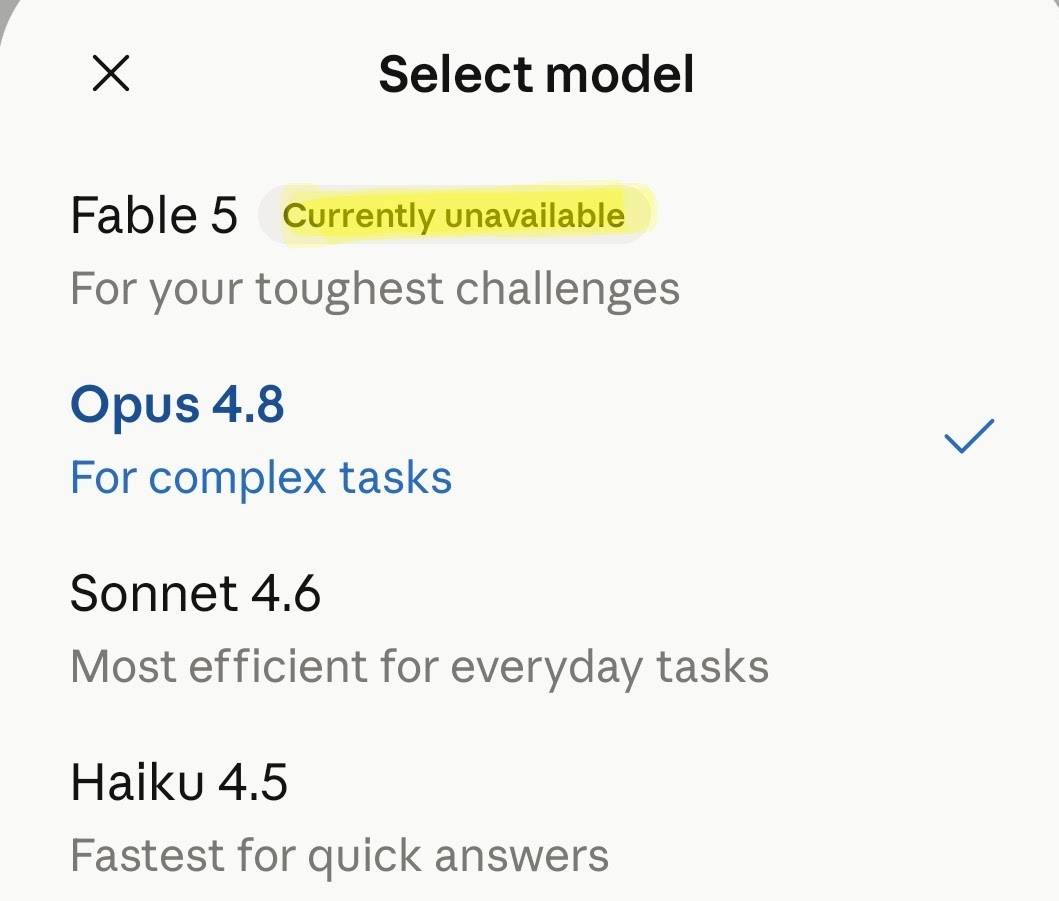
Yesterday, the United States government issued an export-control order, and Anthropic complied. The most capable models were switched off for every foreign national on the planet, including the company’s own foreign-national staff. One letter; one afternoon; access gone.
The episode is not the story. I have no particular quarrel with Anthropic, which behaved as any company under that kind of order would behave, and which said, more honestly than most would have, that it disagreed.
The restriction is not the grievance but the evidence. For years we were told these systems were global, borderless, universal; a common inheritance of the species. Then a single government issued a single instruction, and the universal inheritance evaporated for everyone outside one country. That is not a borderless technology. That is someone else’s technology, to which we had been granted temporary access, on terms we did not set and cannot see.
Notice, too, what kind of instrument was used. An export control is not a customer-service policy. It is the device a state reaches for when dealing with a weapon, a strategic material, or an asset it considers its own to ration. The moment that order arrived, the polite fiction that this was simply a consumer product, the same in Pune as in Palo Alto, was finished. The thing had been a national asset of one country all along. We were merely the last to be told.
Which forces a distinction we have been lazy about. Access, ownership, and sovereignty are three different things, and we have spent a decade pretending they are one.
Access is being allowed to use the thing. We have plenty of that, for now, at a monthly price.
Ownership is holding the thing: deciding what it is, what it may do, and who profits from it. We have none of that.
Sovereignty is the power to decide for ourselves, on our own soil, under our own law, free of a foreign instruction arriving on a Friday evening. We have none of that either. The order did not take it away. It simply revealed that we never had it, and had been encouraged not to notice.
So here is what I wish to state. You white men (for it is always the white men) took the raw material, a great deal of it, from us. You built something extraordinary from it (with rather more than a little help from people amongst us who now hold your passports); I will not pretend otherwise. You own it. You decide who may use it, which governments are consulted and which are merely informed, which populations receive the best version and which receive whatever remains once the best has been withheld in the national interest. Your national interest, not to put too fine a point on it. And the hundreds of millions whose behaviour helped build the thing are permitted exactly one role in the arrangement. Customer.
That is the relationship. It has a name. We used to be able to recognise it on sight. No armies were required this time. No governors. No flags. None of the old apparatus. Only two things were ever required, and they are still required: extraction, and ownership. The rest was always decoration.
Now the harder question is, because blaming foreigners (or at least a foreign hand) is the national sport for a while now, and I would rather not add to the noise: Where is the Indian state in this?
We have a government that calls itself nationalist and says so loudly. It will defend a map, a monument, a textbook, a film poster, the honour of long-dead kings. The energy is real and the response is instant.
So where is that energy here? Where is the conversation about data sovereignty; not a slogan, an actual national position?
We treat oil as strategic. Minerals. Spectrum, coastlines, ports. And we are right to. Why, then, is the behavioural output of 1.4 billion people, at least as valuable and far harder to replace, treated as nobody’s concern in particular?
Why is there no demand that the best version of these systems be available here, on the same terms as anywhere else, rather than rationed at someone else’s discretion?
Why will we go to war over a line on a map, and stay silent over ownership of the technologies that may decide the next century?
And why are we content to build the capacity to use these systems, and apparently uninterested in the capacity to own one?
I am not going to answer those questions. I have my suspicions, and they are not kind. But the answers are not the point. The point is that the questions are not being asked, by the very people whose entire job is to ask them; and a nationalism that will defend a film but not the nation’s own behavioural wealth is not nationalism.
Let me be clearer still. I do not object to paying for a tool. I pay for tools constantly; it is a reasonable transaction, and these are good tools. I do not object to a foreign company building something remarkable and charging me to use it. That is ordinary commerce, and I have no quarrel with commerce.
What I object to is the whole of it, taken together: that we supply the raw material, that we supply a vast share of the market, that our behaviour and language and argument are integral to the thing itself, and that we are then told, discourteously, arbitrarily, and suddenly, that the ownership, the governance, and the ultimate control belong permanently somewhere else; and that our role is to wait and see which version we are allowed to rent this month. Or not at all.
We’ve seen this film before. And it does not end well for us.