In my opinion, in 2026, with AI at your literal fingertips, bad presentation, wrong grammar, spelling mistakes, and amateur formatting really are unforgivable. It shows zero effort, zero attention to detail, and zero respect to your readers and audience, and is as off-putting as AI slop generated, copy-pasted, and shared without application of thought. To my mind, there is no difference between the two. They both show how little the writer or presenter cares about and takes pride in their own work, skill, and profession, leave alone the recipients of such amateurishly sloppy, casually disrespectful, and wilfully careless communication.
Let me explain why I feel so strongly about this.
There was a time, and not so long ago, when the defence was at least plausible. You did not have a dictionary at hand. You did not have a spell-checker (or, later, when you did, it missed the homophones). You were not formally trained in typography or layout. English was your second, third, or fourth language. These were not great excuses, but they were excuses nonetheless, and one extended a certain grudging charity.
That time, I am afraid to break it to you, is gone.
Today, you have tools that will catch your errors before you even finish the sentence. Tools that will restructure your argument, tighten your prose, fix your formatting, and tell you, with remarkable patience, that “their,” “there,” and “they’re” are not interchangeable, and this is literally the least they can do amongst their vast array of capabilities. These tools are free, or nearly so. They live in your browser, your phone, your email client. You do not have to look for them. They find you, instantly, guess what you want, and give it to you. It would not be an exaggeration to say they force their perfection on you, even in the face of stiff resistance.
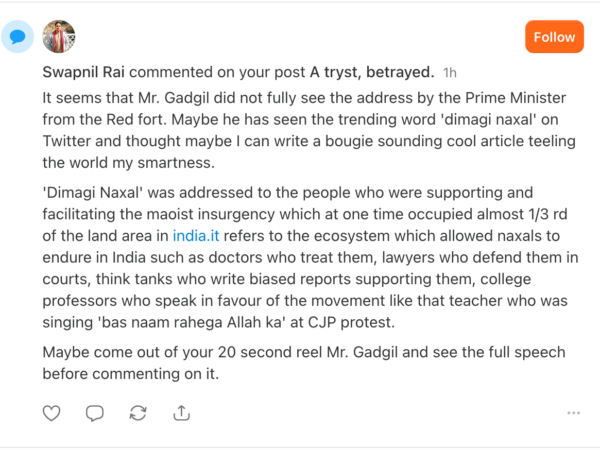
Now, before I go further, let me draw a line that I think is both obvious and necessary. I am not talking about the passionate message to your intimate partner at midnight. I am not talking about the quick post on your personal feed about the moon, a new bird species you spotted, or some rant about airline seat allocation, seen by friends who love you, possibly and partly because of your chaotic punctuation and quirky spelling. I am not talking about the two-line observation dashed off in a comment thread before your tea, and your indignation, goes cold. Those are conversations, not communications. The intimacy is the point; the informality is the contract. Nobody expects you to proofread your affection, your fanboying, or your rage. What I am talking about is professional and public communication: the kind where you are asking someone, very often a stranger, to take you, your ideas, and your work seriously. That is an entirely different matter.
And yet, in that professional and public space, the sloppy decks continue to arrive. The poorly formatted reports, the emails that read like a drunk autocorrect had a disagreement with itself, the presentations where the font changes three times on a single slide, where bullet points are orphaned mid-thought, where the company’s own name is misspelled on page two. Slide after slide of misaligned text boxes and stock photos that were last considered fresh in 2011, laid out with the visual coherence of a ransom note. And not just in the professional space. I am also talking of opinion pieces on social media, of apparently well-reasoned arguments, of film reviews and political think pieces, of travelogues and recommendations, of epiphanies and rants. I mean, to repeat, communication intended by the author to be taken seriously, in whatever context, format, medium, or target audience.
Here is what I find particularly galling: the very people who produce such work are often the same ones who will, in the same breath, complain that AI is making humans lazy. That is a bit rich, to say the least. My friend, if you had only looked at AI and seen the possibilities of a tool at your beck and call, instead of whatever petty perspective leads you to deride how others use it, you would have written that very critique in a more readable fashion and not made a fool of yourself in public.
Because here is the truth that nobody seems willing to say plainly, at the risk of being seen as someone encouraging AI slop (I am not; but if you need to be told that about me, perhaps this is a fine point to stop, unfollow, and go back to your sorry life): sloppy communication is not a skills problem anymore. It is a character problem, one that defines you in more ways, and with more clarity, than you would give it credit for.
Here is what it does. It tells me you do not respect the person reading your work enough to spend an extra ten minutes on it. It tells me you do not respect your own ideas enough to present them well; which, if your ideas are genuinely good, is a particular kind of tragedy. It tells me that somewhere in your professional calculus, “good enough” won the argument against “done properly,” and that you are perfectly comfortable with that outcome.
And there is something subtler but equally damning. When you produce careless work in 2026, you are also telling me that you could not be bothered to explore a set of tools available to literally everyone with a smartphone and a WiFi connection. That is not a confession of ignorance or incompetence. That is a confession of indifference. These are very different things, and indifference is far harder to forgive.
I have seen seasoned professionals, people with decades of experience and impressive designations and initials after their names, circulate documents that a reasonably diligent sixteen-year-old would be embarrassed to submit as homework. I have sat through presentations where the formatting errors overshadowed anything worthwhile the presenter had to say, not because I was focusing on the wrong things, but because it struck me as particularly disrespectful to expect an audience to separate signal from noise without providing even a modicum of help to do so. I have received proposals, actual commercial proposals asking for real money, real business, and real employment, that contained so many spelling and formatting errors that I wondered if they were done deliberately to avoid any suspicion of LLM use.
The argument I hear most often in defence of all this is, “Oh, people should focus on the content, not the presentation.” This is, with the greatest possible respect, complete nonsense. Content and presentation are not in competition. They are in partnership. A powerful argument dressed in a shambles is still a shambles. And if your content were truly that powerful, would you not want it to arrive looking its best? Or, think about this: do you not believe your content is good enough to warrant the minimum effort of making it presentable? So, is it I, the audience, who am disrespecting the message, or you, the messenger?
We dress up for job interviews. We iron our shirts and polish our shoes before important meetings. We proofread our wedding invitations. We do these things because we understand, instinctively, that how something appears signals how much we care about it. Your document is your proxy in the room when you are not there. And right now, yours is showing up with its collar askew, shoes unpolished, and a suspicious stain on the lapel.
In a world drowning in content, where attention is the scarcest resource anyone possesses, asking someone to wade through your careless, unedited, visually chaotic communication is not just poor form. It is an act of quiet aggression. You are saying, in effect: my time in producing this was more valuable than your time in receiving it.
That is a terrible thing to say to someone. Most people say it every single day without realising it.
So no, I will not be charitable about this. Not in 2026. The tools exist. The tutorials exist. The AI assistants exist, at every price point from free to very free. There is no longer a literacy barrier, a technology barrier, or even a language barrier standing between you and competent, clean, well-presented communication.
There is only the will to care. And if you cannot summon even that, then at least have the self-awareness to know what you are really communicating: not your ideas, not your argument, not your proposal.
Just how little any of it means to you. And if that does not bother you, then I, as the intended audience, could not care less.
#For-SM