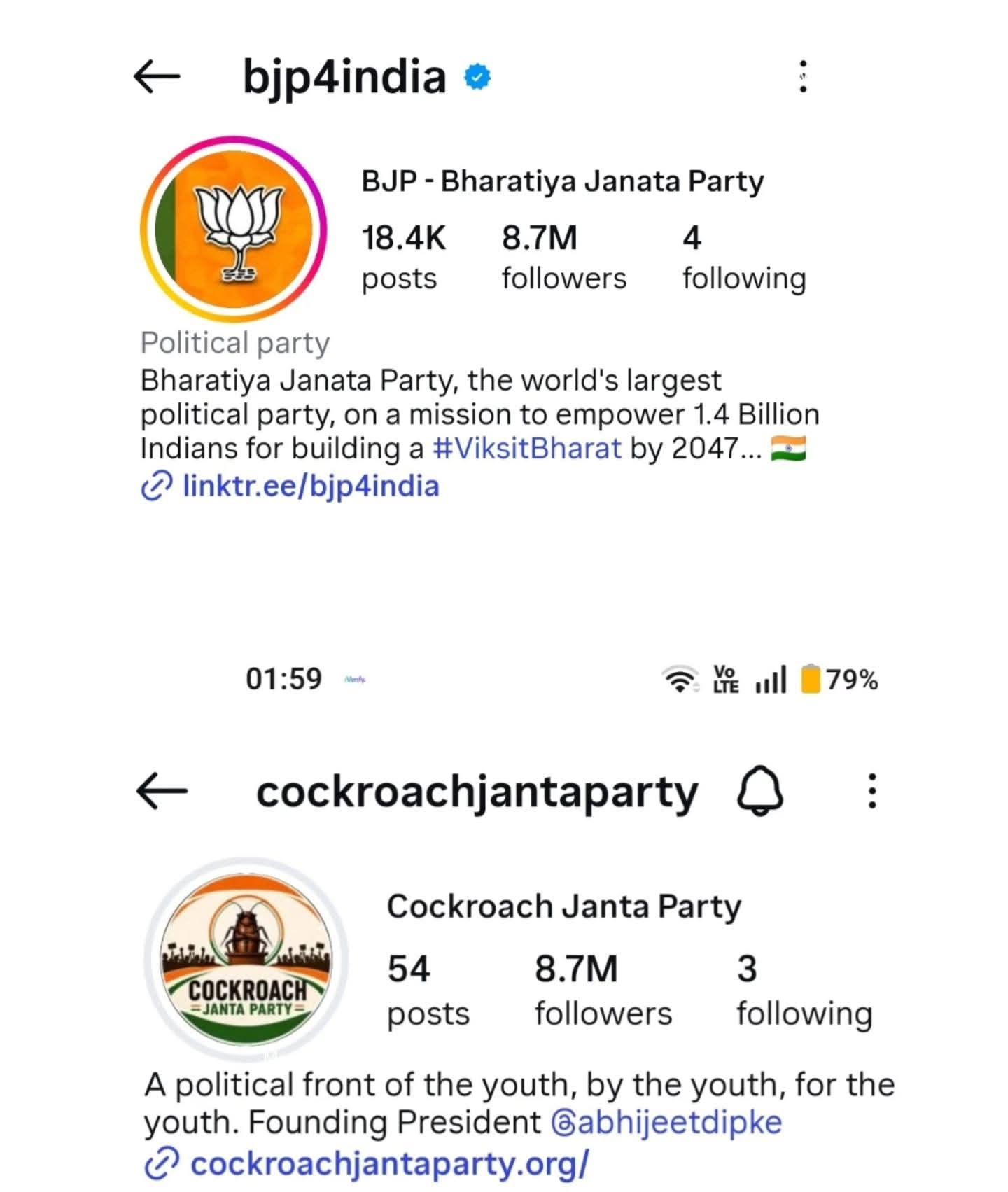
Apparently, the new Cockroach Janata Party has liberals’ knickers in a twist, and I find that fascinating, because not the BJP, not the Supreme Court, not billionaires funding propaganda channels, not pliant television media, not the criminalisation of dissent, not the use of central agencies as political instruments, not the complete collapse of journalistic independence in India, but a joke page, an AI-generated satire page with some posters, some videos, a deliberately absurd name, and a thin manifesto that reads less like a constitutional document and more like the sort of thing privileged urban kids in a gated society would put together over coffee, Instagram reels, and vague anti-corruption anxiety, is suddenly being discussed as though it were an intelligence operation, a regime-change project, or at least a B-team of the BJP (CJP?) armed with Canva Pro and ChatGPT.
And which raises an interesting question, because I genuinely do not understand the panic. What exactly are people afraid of? More importantly, why are they afraid at all? Especially those who belong to a political ecosystem whose most visible leader has spent years borrowing directly from Gandhi’s emotional and political vocabulary to tell people one simple thing: Daro Mat. Do not be afraid. Look power in the eye. Speak. Resist. Laugh. Mock. Endure. Insist on the Truth. Keep walking.
And yet here we are, trembling before a meme page.
Most of the objections I have seen to the Cockroach Janata Party (or whatever one wishes to call it, because it is not a registered political party and does not even appear interested in becoming one at this stage) seem to fall into three broad categories, namely intent, means, and ends, and I think that is the only sensible framework through which to evaluate something like this, because political phenomena should not be judged merely by aesthetics, virality, polish, or vibes, but by what they are trying to do, how they are trying to do it, and what they ultimately seek to achieve.
So let us begin with intent.
What exactly is the intent behind the Cockroach Janata Party? Prima facie, as it stands today, the intent seems to be satire, mockery, ridicule, and specifically ridicule directed upward at power, which matters because this entire thing emerged after one of the most powerful constitutional authorities in India referred to unemployed Indian youth as “cockroaches” who later become RTI activists, social media activists, and social media warriors, infecting the system like parasites, and yes, later clarifications followed, explanations followed, claims of misinterpretation followed, and we were informed that he only meant people with fake degrees and so on and so forth, but the sentence had already landed, and satire emerged from it.
Now who exactly is being mocked here? Not a powerless minority, not a vulnerable community, not labourers, not migrants, not Dalits, not Muslims, not queer people, not anybody structurally below the satirist in power, but one of the most powerful men in India, a constitutional authority protected not merely by institutional stature but also by laws surrounding contempt and ridicule, somebody far closer to the centres of power than almost any ordinary Indian could ever dream of being, and to satirise such a person is, by definition, punching upward, and satire that punches upward remains one of the few democratic safety valves left in a political environment where institutions increasingly appear insulated from criticism, insulated from public emotion, insulated from consequence.
Now could there still be malafide intent hidden underneath the satire? Of course. Anything is possible. Astroturfing exists, influence operations exist, political proxies exist, billionaires fund narratives, parties use fronts, governments manipulate discourse, none of this is impossible, and anybody who says otherwise is politically naïve. But politics cannot be analysed through paranoia alone, because then one begins seeing psyops in every meme and conspiracies in every Instagram reel, and one must eventually ask the very boring but very important question, namely, what is the evidence?
And this is where people bring up the Anna Hazare movement and the rise of the AAP, and personally, I saw through the India Against Corruption movement very early, and wrote about it back then as well, because I was deeply uncomfortable with its central demand, namely the Lokpal, which essentially sought to create an unelected constitutional authority hovering above elected institutions, something I found profoundly dangerous. I disliked the entire moral posture of that movement. The people around it bothered me instinctively. Kiran Bedi never inspired confidence in me because of her pseudoscientific worldview, Ramdev Baba immediately made alarm bells ring, Sri Sri Ravi Shankar’s involvement made things worse, Kumar Vishwas always struck me as profoundly slimy, and Anna Hazare himself, perhaps because I am from Maharashtra and had seen his politics for years, never appeared saintly to me. To add to this, the entire laundry list of “scams” brought up by Vinod Rai (another person who did not pass my smell test) seemed off from the very beginning, something later events proved rather emphatically. Those people revealed themselves through their ideological ecosystem, and that movement carried a moral authoritarianism which many liberals failed to notice because they were intoxicated by anti-corruption rhetoric.
But I do not see similar markers here, at least not yet.
What exactly is the hidden ideology of the Cockroach Janata Party? That corruption is bad? That politicians defect opportunistically? That unemployed youth are angry? That gender disparity exists? This is hardly revolutionary doctrine. In fact, the moment one actually reads the manifesto carefully, the entire “mastermind conspiracy” theory begins collapsing under its own weight, because the manifesto is honestly quite badly thought out, and I say this not because I disagree with every point in it, but because it is painfully obvious that very little deep political thinking has gone into it.
A serious political manifesto in India today would necessarily grapple with caste, reservation, poverty, economic inequality, labour, environment, minority rights, agrarian distress, wealth concentration, structural unemployment, federalism, public healthcare, education, and institutional reform, but this manifesto barely touches any of that seriously, and instead reads exactly like what it probably is, namely an urban, upper-middle-class, digitally savvy frustration document produced by somebody shaped by the AAP-era anti-corruption ecosystem.
And that matters, because if this were genuinely a sophisticated BJP B-team (or, in this case, C-team; sorry, could not pass that up!) operation designed to split anti-BJP votes, the messaging would look very different. It would almost certainly contain sharper signalling around caste, reservation, nationalism, identity fractures, or social resentment. It would be electorally sophisticated, dangerous, strategic. Instead, this thing feels like a meme page that accidentally discovered resonance.
People are behaving as though the existence of slick visuals automatically implies deep funding, sophisticated coordination, shadowy handlers, or hidden institutional backing, and I think this reaction simply reveals how badly many older political observers misunderstand the age of AI. What the Cockroach Janata Party has done can now be done by literally anyone with a laptop, internet access, curiosity, and a free weekend. A domain name costs almost nothing, AI image generation is trivial, AI music generation exists, AI video tools exist, manifestos can be generated in minutes, scheduling tools are free, graphic templates are everywhere, and this entire ecosystem that looked impossible in 2012 has become almost embarrassingly accessible in 2026, especially for somebody who has previously worked in political social media operations.
Honestly, for someone who has done this professionally before (and we know Dipke, the founder has been doing this for AAP in the past), this is one night’s work.
And that is why I find the panic slightly amusing, because people are looking at this and imagining a war room with funding pipelines and media handlers, while I am looking at this and seeing a meme page with decent execution, and I suspect many liberals are secretly upset not because the thing is dangerous, but because they realise how easy it was, and perhaps because they are asking themselves a painful question, namely, “Why didn’t we think of this?” Some are even shouting from the rooftops that they did, but the party did not take and run with it.
Because let us be honest here. The opposition ecosystem in India has been catastrophically bad at communication for years. The ruling party built an enormous propaganda infrastructure spanning television, WhatsApp, influencers, IT cells, narrative warfare, symbolic politics, emotional messaging, aesthetic spectacle, and algorithmic manipulation, while the opposition largely responded with press conferences, MS PowerPoint (I was genuinely surprised by how many seemingly smart people went all rah-rah about Rahul Gandhi using a PPT to present his views!), and PDF statements, and so now when a random satirical page suddenly captures public imagination more effectively than formal political communication structures, many people instinctively respond not with curiosity, but suspicion.
And finally, we arrive at the third category, namely ends, which is where most liberal anxiety truly lies, not in what the Cockroach Janata Party is doing now, but in what people fear it might eventually become.
“What if it cuts Congress votes?”
How?
Is it contesting elections? No. Does it have candidates? No. Does it have booth workers, district structures, cadre networks, state-level coordinators, funding mechanisms, or electoral machinery? No. Does it even possess ideological coherence? Not really. And yet people are discussing it as though Parliament has already fallen and democracy is hanging by a thread because somebody made an Instagram reel calling powerful men cockroaches.
We are taking a joke page and discussing it with a seriousness that I genuinely do not think it deserves at this stage. This is not Lenin arriving at Finland Station. This is not even the early AAP. This is a joke that landed perfectly because the political atmosphere in India is saturated with suppressed anger and alienation.
The meme did not create the anger. It merely revealed the scale, depth, and spread of frustrations whose existence all of us already knew, but perhaps underestimated because we had become too used to living inside them, too used to swallowing them, too used to converting humiliation into jokes because there seemed no other outlet left.
It demonstrated, through visible and countable public participation, just how many people are exhausted by the disconnect between rulers and reality, between institutional power and ordinary suffering, between televised nationalism and actual unemployment, between chest-thumping speeches and collapsing livelihoods, between choreographed patriotism and the daily indignity of living in this country. Whether it is a Prime Minister publishing photographs that resemble luxury pre-wedding shoots more than diplomatic engagement while millions struggle to find work, whether it is constitutional authorities speaking about unemployed youth with the language one reserves for vermin and parasites, whether it is contempt laws used less to protect institutions and more to shield egos from criticism, whether it is central agencies openly weaponised against political opponents, whether it is pliant media houses functioning as glorified propaganda laundries, whether it is local political strongmen operating through intimidation, patronage, and proximity to power, whether it is a ruling party possessing one of the largest and best-funded disinformation ecosystems in the democratic world while simultaneously whining about memes and satire, all of this has created a vast reservoir of resentment, humiliation, exhaustion, cynicism, and suppressed rage.
And the Cockroach Janata Party did not manufacture that rage. It merely laughed at it loudly enough for everybody else to realise they were not laughing alone. In a way, it stumbled upon that reservoir accidentally, and now finds itself knee-deep in it.
To outsiders, it looks suspiciously like a plan, a design, a well-funded campaign. But these are people mistaking resonance for organisation, virality for conspiracy, and satire for insurgency. At least at this point, all it is is a joke that landed a little too close to the painful nerve.
Could this evolve into something serious later? Possibly. Could political parties attempt to co-opt it? Certainly. Could somebody eventually fund it? Why not? Could it eventually become something I oppose? Absolutely. Could it already be funded by the BJP? The INC? The AAP? The TMC? Possibly.
But politics must be judged on evidence, not fantasy, and at present, I see no evidence of some massive coordinated operation with sinister intent, disproportionate resources, or carefully engineered electoral goals. What I see is a novelty object, something more akin to the AP-Swatch collaboration watch, where people queue up overnight, Instagram explodes, everybody talks about it for a while, the first drop sells out, and then everybody waits to see whether the thing becomes culturally enduring or simply disappears into the timeline like Labubu dolls.
And frankly, the more interesting question is not what the Cockroach Janata Party is doing, but why opposition politics in India is reacting with insecurity rather than imagination. Why is the Congress ecosystem not asking itself how this sentiment can be utilised? Why are they not studying why the thing resonated emotionally? Why are they not talking to the creator (I am so hoping they are, and I am wrong)? Why are they not learning from the aesthetics, humour, language, and emotional texture of the thing? Why are they treating a satirical meme page like an invading army instead of recognising it as a signal flare from a politically alienated generation?
Because the deepest fear here is not that the Cockroach Janata Party is powerful, because it plainly is not, nor that it is popular, because social media likes, follows, shares, and ironic memberships rarely translate into actual political power. The deepest fear is that a joke page, a meme, a thumbing of the nose, a satirical throwaway reaction born out of irritation and impertinence, managed to capture the emotional mood of the country and reflect it back at the powerful with more accuracy, more sharpness, and more laughter than opposition parties that are over a hundred years old, with a legacy of giant leaders who really understood the Indian people, led by veteran practitioners and strategists, backed by institutions, resources, political machinery, and legitimacy derived from their own heritage and the Constitution itself, have managed to do in years, and perhaps we are unable to laugh along with it because somewhere deep down we suspect that this is exactly what we should have done ourselves.
So perhaps the answer is not to panic, not to sulk, not to invent elaborate conspiracy theories before the evidence arrives, and not to treat every joke that lands better than our own messaging as an enemy operation, but to look inward, listen to the one line our own leader has repeated with Gandhian insistence, and apply it first to ourselves: Daro Mat.
That is all. The defence rests.