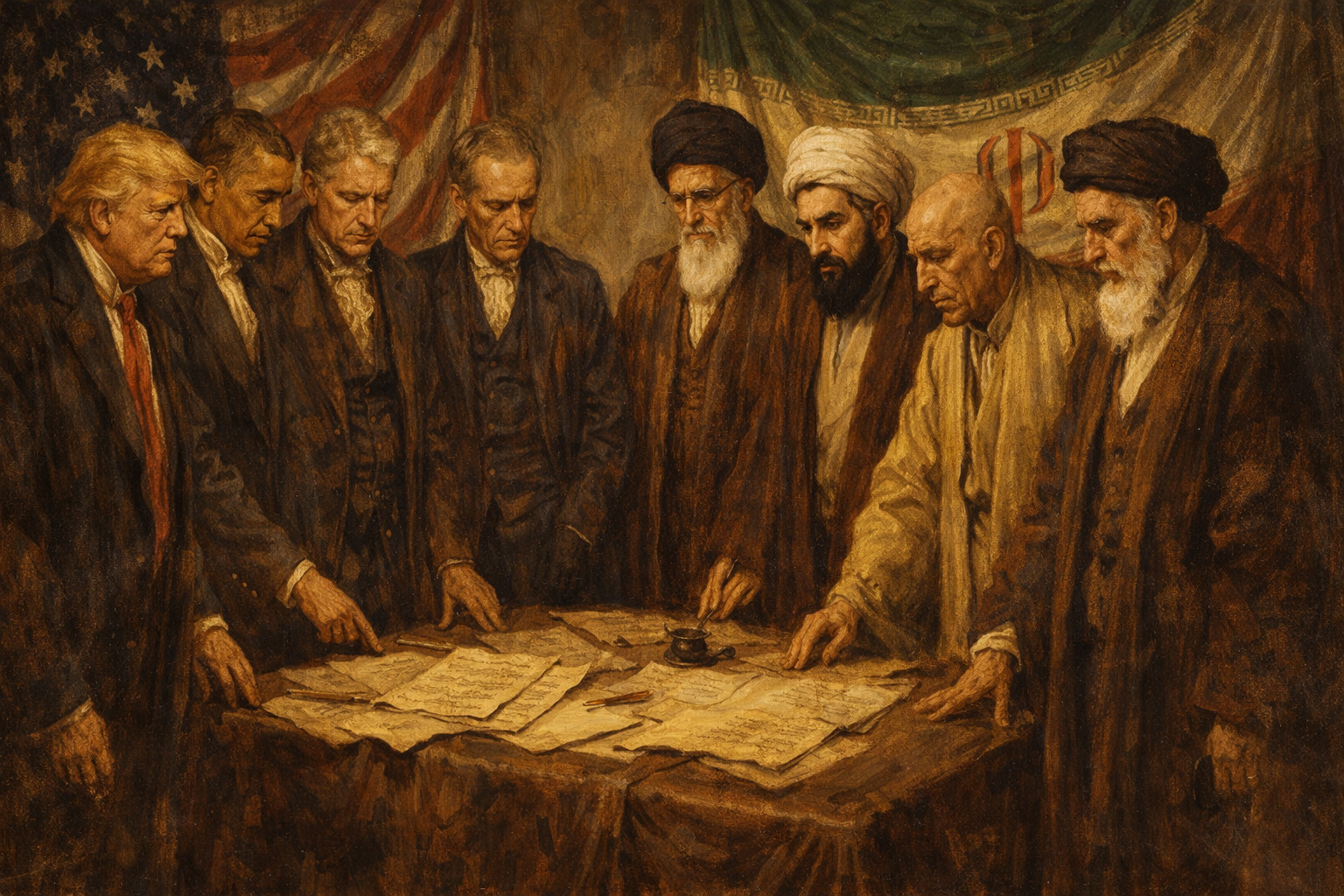
The most remarkable thing about the present war discourse around the United States, Israel, and Iran is not the war itself. Wars are dramatic; they dominate news cycles by their very nature, and one expects that. What has caught my attention is something far stranger: across American social media and commentary, writers, commentators, and perfectly ordinary voices are discussing, openly and without the slightest whisper of shame, the possibility that the United States might lose.
Some analyse the situation calmly. Some predict defeat. A few appear, rather cheerfully, to hope for it.
They say so plainly. No coded language. No nervous glance over the shoulder. No fear that the state will arrive at their door the moment the sentence leaves their mouth.
As a citizen of another democracy, India, that fact alone is astonishing.
In the India I inhabit today, even merely suggesting that an adversary might be stronger (even if the person suggesting it were to be an expert and were to provide supporting data) would provoke fury, both public and state. Predicting defeat would be interpreted as rank disloyalty. The familiar acronyms would enter the conversation almost immediately: UAPA, NSA, sedition, or whatever instrument of national security happened to be closest to hand to the regime in power. Indeed, I’d be lucky not be lynched by my own neighbours and friends. The boundary between analysis and treason would collapse, and rather quickly too. Yet in the United States, even in a political climate that critics describe as loud and vindictive and comprehensively unforgiving, people continue to say such things in public. That alone tells you something profound about how deeply the culture of free speech has taken root.
Part of the answer lies in the peculiar history of the American Constitution. The First Amendment did not begin life as the monumental principle it has since become. When the Constitution was drafted, many of the founders were preoccupied with building a strong federal government after a period of considerable political disorder. Excessive liberty worried them, which is not without its irony. The amendments that became the Bill of Rights emerged largely as a political compromise demanded by states that feared central authority. In other words, the amendment that eventually became the First was not originally intended to define American civilisation. It acquired that role gradually, through court decisions, political struggles, and, crucially, public habit.
Over time, the First Amendment came to occupy the very centre of American civic imagination. When placed alongside the Second, the underlying philosophy becomes unmistakable. The First protects the individual voice. The Second, however controversial, protects the individual capacity to resist power. Taken together, they express a deeply rooted belief that the individual precedes the state.
That belief produces one of the great paradoxes of democracy. Democracy appears to celebrate the collective will. Yet democracy survives only when the individual stands protected against that collective and, above all, against the government itself. The American constitutional tradition understands this instinctively. The Constitution is not written for citizens. It is written for the government. Its purpose is to restrain power, and to remind those who wield it that authority must remain under constant suspicion.
Once that idea enters the conversation, a deeper question follows: what actually holds a nation together?
Many societies organise themselves around identity or doctrine. Religion, tribe, ethnicity, political ideology; all of these can mobilise large populations and sustain states for generations. Pakistan, for example, rests upon the proposition that religious identity can organise a modern nation. The Soviet Union once attempted to organise an entire civilisation around the doctrine that workers must own the means of production. Ideas of this kind can endure for long stretches of history. Yet their power often remains tied to the structures that enforce them. When those structures weaken, the idea itself begins to fade.
A different kind of nation rests upon a different kind of idea altogether. The United States, India, the French Republic, Ireland, South Africa: all of these speak about themselves in terms of something larger than identity. They speak about themselves as propositions. These republics are built around beliefs about human potential. Their citizens are not merely told what they are. They are invited to imagine what they might become.
At first glance this sounds like aspiration. But aspiration alone does not explain the endurance of such ideas.
A nation may wish to be something. It may hope to be something. It may declare that it ought to be something better than it currently is. Those are all perfectly respectable positions. Wish. Hope. Ought. Aspiration. All of them belong to the language of desire and instruction.
The word that changes everything is “can.”
When a nation says that its citizens can be free, can speak, can dissent, can evolve beyond the limits of their past, it moves from aspiration into belief. It begins to speak about human capability rather than human obligation. That difference may appear subtle, but it transforms the nature of the idea entirely. A wish belongs to a moment. A belief about capability transcends time.
Once people begin to believe that they can become something greater than what they are today, the idea acquires a strange durability. It survives governments. It survives crises. It even survives the people who first believed in it.
This is why the American example remains so striking. A country at war still allows its own citizens to argue publicly that it might lose. Some even say they hope it does. The state does not silence them. That tolerance does not come from legal clauses alone; it flows from a civilisational confidence about the individual voice that has become so deeply embedded that most Americans would not be able to articulate it, because they have never had cause to question it.
The same underlying idea animates the constitutional vision of India, though we have, I confess, been rather less faithful to it than we might have hoped. It echoes through the self-understanding of other republics that define themselves through possibility rather than ancestry.
I sometimes suspect that older civilisations possess their own versions of this. The present conflict with Iran is a reminder that the United States is not confronting a newly assembled state but a civilisation with thousands of years of memory behind it. The Persian world has long cultivated its own sense of continuity and cultural confidence. Something similar exists, I think, within the Chinese civilisational imagination as well. Perhaps that is why such conflicts rarely unfold as simply as military analysts expect. When power meets power, the outcome may depend on weapons. When civilisations meet civilisations, something deeper enters the calculation.
Many people around the world openly hope for the decline of American supremacy. Some believe the United States has grown too powerful for the good of the planet. Perhaps that argument deserves consideration; I am not a geopolitical expert, and I offer no grand opinion on the matter.
Yet even if American power were to fade tomorrow, the idea that animates the American republic would remain extraordinary. It is an idea that places the individual voice at the centre of political life and defends that voice even when the nation itself is under threat.
Ideas built around identity eventually belong to history. Ideas built around human possibility tend to belong to civilisation.
The difference between them lies in a single word.
Can.