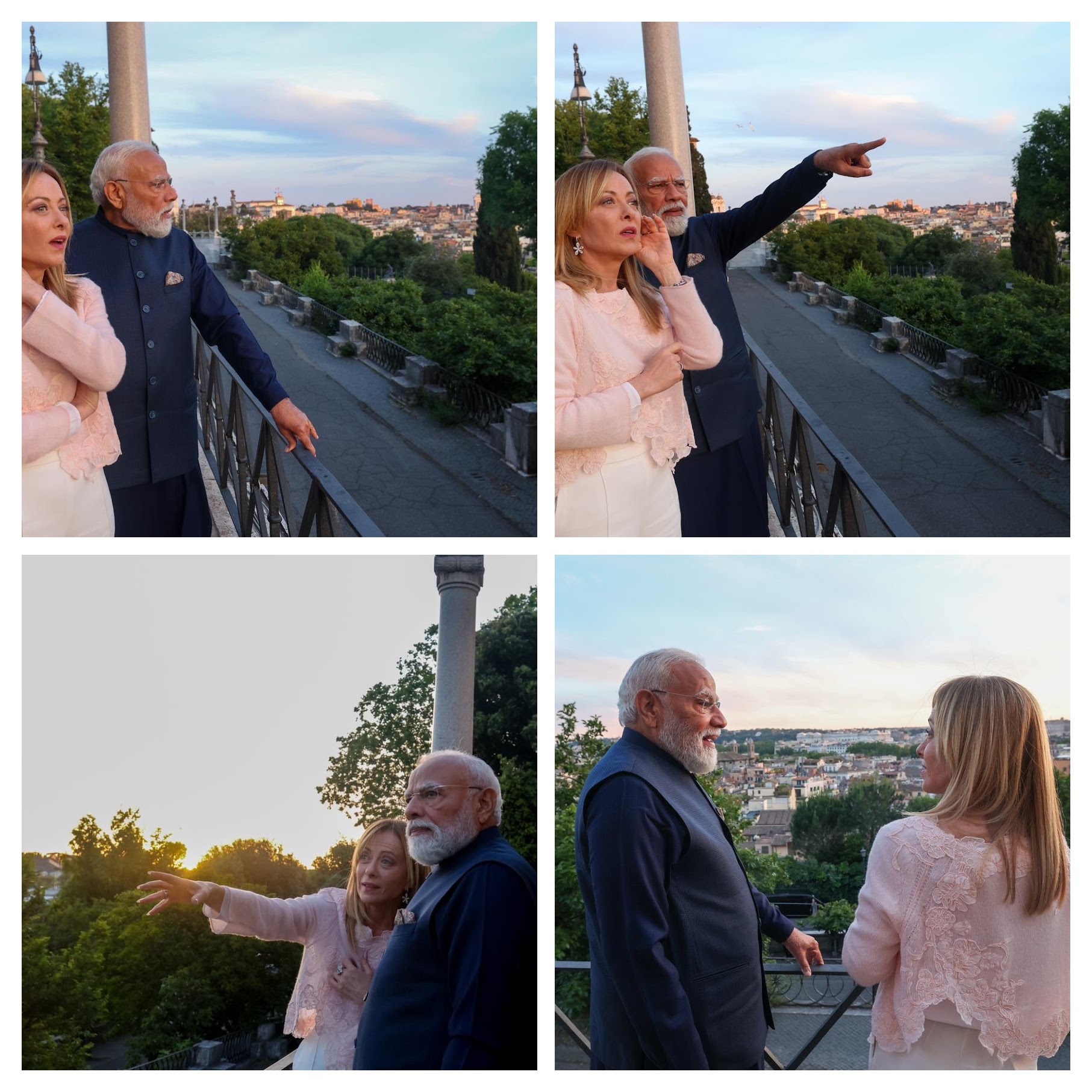
The irony of the Indian Prime Minister asking citizens to avoid foreign travel, postpone gold purchases, conserve foreign exchange, embrace austerity, and prepare for sacrifice, only to appear days later on a Roman balcony at sunset beside the Italian Prime Minister, a leader whose entire political brand rests on her self-declared inheritance of Roman civilisation, is the sort of detail a satirist would have to discard as too obvious. Rome, of all the places, a city whose very name has become synonymous with an Empire of excess, elite insulation, and rulers losing touch with the governed. A balcony, of all backdrops; the favoured architecture of royalty, popes, and a very real twentieth-century dictator, designed precisely so the elevated could be admired by the lowly without quite having to meet their eyes.
His appearance there elicited a reaction in me that Humphrey Bogart’s Rick Blaine would most certainly recognise, “Of all the balconies, in all the cities, in all the world, he walks into this one.”
And he posted the photographs himself. That, perhaps, is the most revealing detail of all. Of every image from the visit, this was the one his office chose to send out into the world. Somewhere offstage, just beyond the frame, one half-suspects a lyre being tuned, ready to sing, “तो? क्या कल्लोगे?”.
History is full of such photographs long before photography existed. In 1649, the English literally executed Charles I after years of argument over the divine entitlement of kings; one suspects the divinity diminished considerably between the shoulders and the neck. In 1672, the Dutch Republic descended into such fury over political decay and elite failure that its own Prime Minister, Johan de Witt, and his brother were lynched by a mob, mutilated, and partially eaten in the streets of The Hague (a rather literal interpretation of the public consumption of leaders, I must point out). In 1789, the Bastille was not stormed merely because bread was expensive (and cake was famously offered as the alternative), but because the French monarchy had come to symbolise a class that no longer even understood how its own comfort, nay decadence, appeared to ordinary people struggling to survive. In 1917, the Romanovs discovered that starvation and war become politically lethal when the royal court still appears drenched in luxury and distance.
Further back, Qin China collapsed barely years after unification in 206 BCE because impossible burdens, forced labour, imperial vanity, and elite extraction turned peasant resentment into rebellion. Nearer home, the Nandas’ greed and extravagance (the last Nanda was literally named ‘Dhana’) paved the way for Chandragupta Maurya and Chanakya. Regimes rarely fall when people become poor. They die when rulers appear untouched by the poverty around them.
Even Nepal recently offered a modern variation of the same lesson. The fury directed at Prime Minister K. P. Sharma Oli in 2024–25 was not born merely from policy disagreement, but from the grotesque visibility of privilege, especially among political families and wealthy young elites posting their excess on social media while ordinary Nepalis struggled to afford onions. The symbolism mattered more than the numbers, as it always does. And symbolism is precisely what makes these photographs so astonishing in their unselfconsciousness, given how we have all been conditioned on the narrative that the BJP and its Supreme Leader are great at optics.
To be clear, asking the people to tighten their belts and brace for impact is not new to the Indian Republic. Lal Bahadur Shastri once asked Indians during wartime to skip one meal a week, and imposed the discipline on himself first (rather quaint, that idea of moral leadership, but then he was Lal Bahadur Shastri, in all fairness). Nehru appealed for contributions to the national war effort, and his own family publicly donated jewellery and gold alongside ordinary citizens. That was the old republican ethic: sacrifice flowed outward only after it had been demonstrated by those who demanded it of others. Charity, to quote the homily, truly began at home. Today, sacrifice flows in one direction only, while photographs flow in the other.
And yet the reactions beneath this image are perhaps the most revealing part of all. 2.8 lakh likes. 56,000 hearts. 2,000 who could only summon astonishment. And then, somewhere buried in the numbers, 11,000 laughing reactions. That laughter matters. Because people were not laughing with him. They were laughing at him; at the absurdity of the image itself; at the staggering inability of a democratically elected leader to read the room while lecturing his citizens about austerity from a Roman balcony at sunset, in stunt that looked more like a pre-wedding shoot than an official photograph of two world leaders.
I am presuming that some are laughing out of impotence and helplessness (there are 48 angry reacts, to be sure, but then that is less than the number of people that will attend our Eid party next Wednesday), others out of disbelief, and many perhaps because ridicule is safer than rage in modern India. Social media, contrary to elite assumptions, has never reflected the Indian street particularly well. The real shift is elsewhere. Earlier, criticism of Modi in public was spoken in lowered voices, glancing over shoulders, after little disclaimers and nervous caveats. That hesitation is disappearing. I hear it now from petrol pump attendants, clients, security guards, domestic workers, vegetable vendors, neighbours, fellow audiences in cinema halls. People are expressing a sort of bewilderment at a man who increasingly appears unable to understand how he looks to ordinary people. The devotion no longer feels unconditional. And for the first time in years, I am encountering a public sentiment I have not seen even a month ago: “What exactly is wrong with this man?”
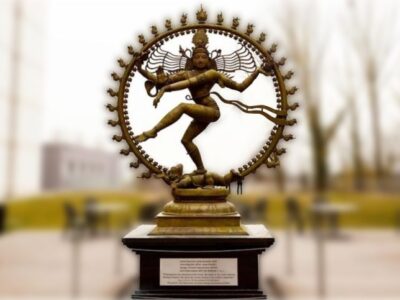
P.S.: As an aside, WTAF is this?