For years, Maharashtra and Bengal enjoyed a small, reliable cruelty at Karnataka’s expense. The Kannadigas, we had decided, were the “UP of the South”: communal, coarse, a southern annexe of everything the Hindi heartland did to embarrass the country. We said it with a smile, the way the well-bred say most things, and we believed it completely. We were the progressive states. The rot, obviously, lived elsewhere.
It is worth being honest about how that story is still told. UP, Rajasthan, Gujarat, Uttarakhand: these, we say, are the laboratories of Hindutva. The Hindi belt brewed the poison, and the rest of us are merely the late and unlucky recipients of it. It is a flattering account. It is also almost exactly backwards.
The truth is that these two regions never carried a single politics. They carried three, and carried each of them not as the hobby of a few orators but as a mass passion, argued in homes and union halls and akhadas and on the road to Pandharpur. To understand what has happened, the three have to be kept carefully apart, because they were never the same thing, and the laziest mistake one can make is to fold them into each other.
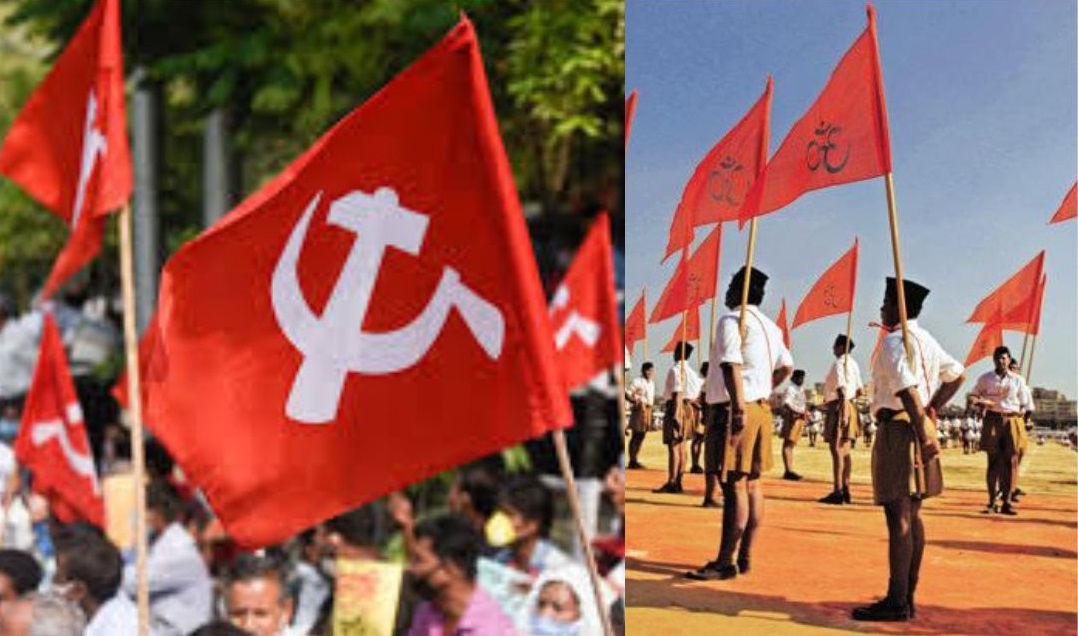
The first of them held that the answer was a Hindu nation, and was prepared to be violent in its pursuit. Hindutva was not a Hindi-belt invention. It was set down as a doctrine by a Maharashtrian, V.D. Savarkar, and the organisation built to carry it into every Indian street was founded in Nagpur, in 1925, where its headquarters has sat undisturbed for a hundred years. Behind it lay the long Maharashtrian memory of Peshwa rule, the Brahmin order with its rigid hierarchy of caste. Bengal supplied the same strand its scripture: Bankim Chandra’s Anandamath, the novel that gave India “Vande Mataram” and imagined the nation as a Hindu mother to be cleansed of the Muslim “foreigner.” From Bengal too came the Hindu Mahasabha’s most formidable figure, Shyama Prasad Mookerjee, who founded the Jana Sangh, grandfather of today’s BJP.
The second tradition believed the answer was force, and it gathered, broadly, on the left. Bengal practically invented the armed Indian revolution, in the Anushilan Samiti and Jugantar, in an eighteen-year-old Khudiram Bose on the gallows, in Bagha Jatin, in Surya Sen and the raid on the Chittagong armoury. It then went further than anyone else dared: Subhas Chandra Bose raised an actual army, the Indian National Army, and marched it to the country’s eastern gate. Bengal became, in time, a communist fortress, and lay under the Left Front’s yoke for thirty-four unbroken years; and in 1967 a peasant rising at Naxalbari gave a nationwide insurgency its name. Maharashtra kept its own version of the faith: the red flag over the Girni Kamgar mills of Bombay, the long communist presence, the Maoist decades that still grind on in the forests of Gadchiroli.
It is worth pausing on what Bengal has since done with that inheritance. The vast mass of anti-social elements and goondas that kept the Communists in power for thirty-four years moved, after 2011, almost in one body, to Mamata Banerjee’s Trinamool; and it has moved again, this year, to the BJP. From the Communists to the Trinamool to the BJP, in two short strides. The boundary between the camps, it turns out, was always porous. What travelled was never the doctrine. It was a temperament, an appetite for politics conducted as mobilisation and as combat, a thing the far left and the far right can each satisfy completely, and which the patient creed of the reformer cannot satisfy at all.
For there was a third tradition, and it believed something gentler but harder: that a society is obliged to correct itself, and that it does so by argument and persuasion, by example, and by the slow work of conscience, pressing hard against injustice but never reaching for the fist. Maharashtra grew this temperament over centuries, in the Varkari saints, in Dnyaneshwar and Tukaram and the Mahar saint Chokhamela, and then in Jyotirao and Savitribai Phule, in Ranade and Gokhale, in Shahu of Kolhapur, and in Ambedkar at the Mahad tank, claiming, against the whole weight of the old Peshwa order, the simple right to drink water. Bengal grew the same temperament in Rammohan Roy and the Brahmo Samaj, in Vidyasagar’s long fight for the widow, in Tagore, and in the Bauls, those wandering minstrels who sang caste and creed away as so much nonsense. The Indian National Congress itself, founded in Bombay in 1885, was born of this temper: a broad, inclusive, talkative, even argumentative, dialogue-and—debate-minded approach.
So let us be clear about the bookkeeping. We did not receive any of this, least of all from the “Northies” (or, as we call them, Bhaiyyas). We made all of it all by ourselves. The Congress and the RSS both walked out of Maharashtra to go and remake the country, forty years apart. Bengal sent out its bomb-makers, then an army, and finally Naxalbari, which named a war still being fought in the forests of central India. The reformers’ template seeded movements in every province.
In short: Maharashtra and Bengal were the laboratory of the entire Indian political mind, the cure and the poison alike, and we shipped the lot.
This would be a fine point to score over dinner, were it not for what the last decade has done with it. Of the three traditions, it is the worst that has come home and made itself comfortable. Maharashtra today is an ugly place in which to be a minority. The repertoire is familiar, and it is ours now: a pig’s carcass left at a mosque gate, a festival procession that halts, deliberately, outside Friday prayers to dance and to jeer, the annual theatre of Ram Navami turned into a loyalty test. The machinery of the state has fallen into step. This very week, in the run-up to Bakri Eid, the Pune police have clamped prohibitory orders across the city. In fact, even Saras Baug, a public park, has been shut, and without even the wafer-thin excuse of law & order, but with the express intent of disallowing Muslim families to gather there on Eid, which, as it nears, turns the official mind at once to the curtailing of festivities and community joy under the mask of prevention of disorder.
But the truly bitter part is not that the violent right has won. It is what it is now permitted to do to the third tradition, the tradition of the persuaders. Narendra Dabholkar spent decades fighting superstition with nothing more aggressive than argument, evidence, and a patient campaign for a law. In August 2013 he was shot dead on a morning walk in Pune. Govind Pansare, another rationalist, was shot in Kolhapur in 2015. The same circle of gunmen was then linked to the killing of the scholar Kalburgi in Dharwad and the journalist Gauri Lankesh in Bengaluru. The state that produced the reformers is now, with great efficiency, producing their assassins (and talking of producing assassins, let’s not go down that route, especially if you are, as I am, a Maharashtrian Chittapavan Brahmin).
There is an economic verdict on all this too, and we are still pretending not to read it. Maharashtra was the industrial heart of the country for a century, and that heart is visibly failing. The Vedanta-Foxconn semiconductor project, some ₹1.5 lakh crore, planned for Talegaon near Pune, went to Gujarat; the Tata-Airbus aircraft project went to Gujarat; and with the projects go the enterprise, the jobs, and the people themselves. Capital is many things, but it is not blind, and it has never had much appetite for a place at war with itself.
So consider where we have arrived. Maharashtra still calls itself, on every banner, the land of Shahu, Phule, and Ambedkar. Bengal still introduces itself as the home of the Renaissance and the first modern Indian mind; the ballot box, this month, said otherwise. We made the antidote and we made the poison, and at home, in the laboratory itself, we are now administering the poison to ourselves and burying the antidote.
I think it is time we owe the Kannadigas an apology, though not for the joke. The joke was accurate enough. We owe it for the smugness underneath, for the easy certainty that this was always someone else’s disease. It was never a question of geography. We invented the experiment, and we ran it on everyone else first; and the rationalists of Pune and Kolhapur fell to the same guns as the rationalists of Dharwad and Bengaluru. The chickens, fed for the better part of a century by our own hand, have simply come home to roost.
To paraphrase the famous Fahmida Riaz poem:
“हम बिल्कुल तुम जैसे निकले”