To those who are worried about the CJP, I invite you to look at the BJP social media pages and spend some time reading the comments below them. You might genuinely be forgiven for believing there is a massive backlash building against the party and its leaders, specifically Narendra Modi. The comments are full of jokes about Adani, unemployment, inflation, petrol prices, the NEET fiasco, paper leaks, crime statistics, dollar rates, and lately, endless mockery of austerity messaging directed at ordinary Indians while the Prime Minister himself travels with the logistical footprint of a touring empire. But I assure you that if elections were held today, the BJP would, in all probability, either retain or gain power in your city, your state, and almost certainly the country.
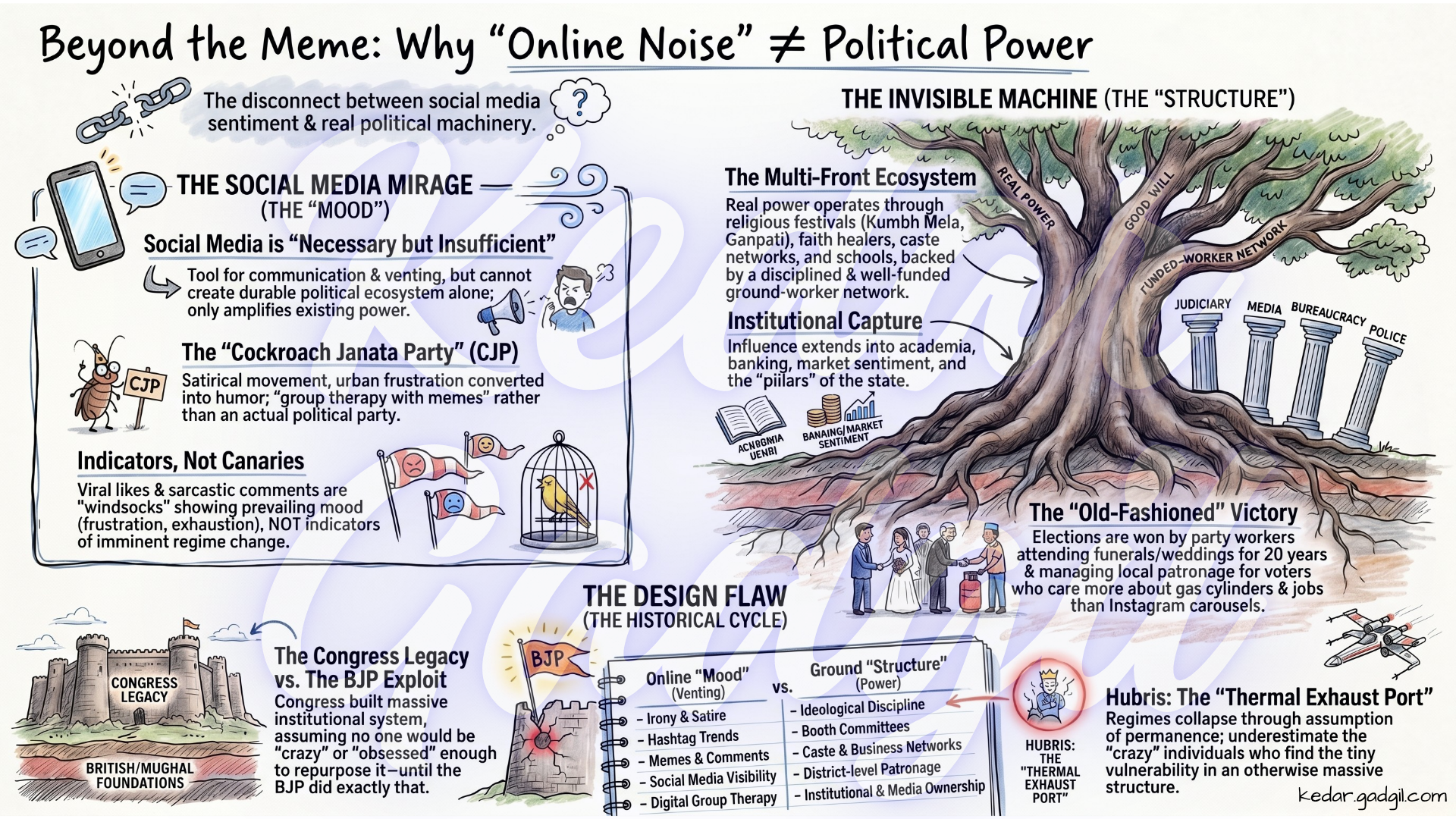
Because social media is not India. Social media is not politics. It is an integral part of communication, influence, opinion sculpting, and increasingly, emotional venting. But it is not all there is. In mathematical terms, and forgive me because I remain incapable of resisting systems thinking even in political discussions, it is necessary for sure, but by no means sufficient. The only people who can truly use social media effectively are those who already possess power elsewhere, because social media by itself does not create durable political ecosystems. It amplifies existing ones.
And the BJP understands this far better than liberals do.
The BJP does not operate social media in isolation. It operates it in combination with mainstream media (AV and print), instant messaging networks (chiefly WhatsApp), religious festivals (Pujo, Ganpati, Shiv Jayanti, Kawad Yatra, Kumbh Mela, and everything in between), faith healers (swamis, babas, gurus) and their congregations, posters and hoardings (what advertising people call OOH media), caste networks, local businessmen, coaching classes, schools, resident welfare groups, district-level patronage systems, and a very large, very expansive, and ubiquitously visible network of ground workers who are not just ideologically committed, but organisationally disciplined and well-funded. You may call it the politics of hate, majoritarianism, communalism, or propaganda. They would call it patriotism, nationalism, cultural preservation, or civilisational defence. Whether one agrees with them or not is politically less important than understanding that they genuinely believe it.
Then throw central and state agencies into the mix. Add influence over education, academia, research institutions (you would be surprised how much influence you can have by controlling something like the ICHR), banking ecosystems, market sentiment, and of course the regular institutional pillars like the judiciary, police, election commission, bureaucracy, and administrative services. Add media ownership through aligned business interests. Add the fact that Indian institutions are historically adaptive rather than ideological, and therefore tend to bend toward power because survival, promotions, contracts, transfers, and protection usually matter more to individuals than abstract constitutional morality.
And before liberals become too smug about all this, let me hasten to add that none of this is new or uniquely invented by the BJP. Congress built much of this system on top of the foundations of the Raj infrastructure, which itself modified older Mughal systems while adding its own unique little contributions from the Enlightenment, the Renaissance, industrial bureaucracy, census administration, and modern statecraft. The idea is actually very simple: build an ecosystem leaning toward your worldview with such depth, scale, and ubiquity that it becomes invisible through familiarity, omnipresent through repetition, and eventually mistaken for permanence itself.
The problem is that such systems are rarely permanent.
And empires, regimes, and dominant political formations almost always make the same fatal mistake. They assume the system they built can never be turned against them because they fundamentally underestimate the kind of people history occasionally produces. It is the design flaw, the thermal exhaust port, the tiny vulnerability that eventually brings down the entire structure even if it means flying through the Meridian Trench, ignoring your targeting computers, and trusting the Force while firing proton torpedoes into a hole the size of municipal accountability in India. And before somebody dismisses this as fantasy nerd nonsense, anyone who has spent time around Pune and grown up on Maratha history will understand the parallel immediately. If you were Uday Bhan standing on Kondhana fort on the moonless night of 4 February 1670 and somebody asked whether to mount a guard along that absurdly vertical cliff face, you too would probably have looked at it and gone, “Nah, nobody is going to be that crazy.”
That is how most regimes collapse. Through assumptions.
So, to summarise: Congress built a massive institutional ecosystem with the presumption that nobody would ever be sufficiently ideological, organised, patient, and frankly obsessed enough to systematically occupy and repurpose it. In this, they were not very different from the British, the Mughals, or most dominant powers before them.
To summarise the summary: the exploit that allowed the BJP to rise was built by Congress itself with the assumption that nobody would ever be that crazy.
To summarise the summary of the summary: hubris is a female canine.
But coming back to the point, liberals who think somebody commenting “Modi shud take press confarance” while sitting on the toilet at 8:12 am is evidence of the green shoots of a revolution need to understand that a million, or even ten million, likes and comments do not a regime change make. They are indicators for sure. They are weather vanes. They indicate shifting mood, frustration, exhaustion, ridicule. But that is all they are. Windsocks turning toward prevailing winds. Not the canaries in the coal mine liberals desperately want them to be.
Here is the thing though: I stopped making political predictions a while ago because Indian liberals (and I am very much part of this tribe, unfortunately for my blood pressure and long-term optimism) have spent the last decade predicting imminent BJP collapse with the consistency and confidence of astrologers announcing planetary doom. And I have yet to see any serious evidence of this happening in the near future.
But democracies do not move in straight lines forever. Political moods change. Coalitions fracture. Economic realities intervene. Leaders age. Cadres become complacent. Every dominant political formation eventually starts mistaking momentum for permanence, and history usually punishes that mistake eventually, although admittedly not according to timelines convenient to columnists, podcasters, and Twitter intellectuals.
In short, and to repeat: hubris is what it is.
Which brings me back to the Cockroach Janata Party itself, which I think both supporters and opponents are taking far too seriously. The CJP is not a political party. It is not even the beginning of a political party. It is urban political frustration converting itself into humour because humour is safer than rage and considerably easier than actual organisation. It is group therapy with memes. It is the sound educated liberals make after ten years of watching institutions bend while simultaneously lacking the patience, structure, manpower, money, muscle, or appetite required to build an alternative political machine.
And honestly, there is nothing wrong with that. Satire matters. Mockery matters. Humour matters. But a meme page is not a booth committee. An ironic membership form (yes, I filled it, and therefore, technically speaking, I too am a “member”, whatever that means) is not cadre-building. A comment section is not a constituency. And yes, before somebody jumps in, the BJP absolutely has a massive online ecosystem, trolls, IT Cells, hyperactive supporters, ideological volunteers, and permanently enraged uncles with tricolours in their bios screaming “anti-national” at engineering students and stand-up comedians till three in the morning. But even that ecosystem is only one arm of a much larger machine. The actual strength of the BJP does not come from Twitter wars or Instagram comments. It comes from the fact that outside social media too, in towns, districts, mandals, caste networks, temples, business circles, local institutions, and neighbourhood power structures, they have built visibility, organisation, familiarity, and trust among enough people to convert sentiment into votes repeatedly. That is the difference. Online energy can create noise. Only organisation creates electoral durability.
And this is why the AAP comparison does not fully work either. AAP did not emerge because hashtags trended. It emerged because money, organisation, activist networks, media amplification, and serious ground machinery existed simultaneously. Frankly, and this part will annoy people, sections of the anti-Congress ecosystem itself were perfectly happy amplifying AAP at the time because weakening Congress suited them politically. None of this happens magically because educated people become sarcastic online for six months.
As I said, I joined the Cockroach Janata Party myself. Ironically, obviously. I joined because it was funny, because mocking power feels good, because after enough doomscrolling even fake political participation starts feeling emotionally therapeutic. But then they circulated one of those polls asking the actual question: Congress, BJP, or CJP?
And the answer for me was immediate. The CJP is not real. The actual political choice remains Congress versus BJP, and my vote remains where it has always remained. I was not converted in 2014. I was not converted in 2019. I was not converted in 2024. Despite all my frustrations with Congress, and believe me there are enough frustrations there to sustain a small team of cardiologists, gastroenterologists, and therapists indefinitely, I remain fundamentally more aligned with the constitutional and liberal framework it at least nominally represents than with the majoritarian project represented by the BJP. And of course, there is Rahul Gandhi. That too is part of why I continue to retain some degree of hope there, although that is as far as my political leanings go.
Over years of political activism, both online and offline, I have come to believe that the real problem with social media politics is that it constantly mistakes mood for structure. Every evening the Cockroach Janata Party trends, the memes fly, liberals congratulate each other for bravery in comment sections, and for a few brief minutes everybody feels history may finally be turning.
But elections in India are still won the old-fashioned way, through exhausted men sweating under shamianas in forty-degree heat, through the management of both perception and booths, through caste equations, local patronage networks, slimy businessmen funding mandals and blood donation camps, party workers attending funerals and weddings for twenty consecutive years, and voters who have never heard of your meme page and could not care less about your Instagram carousel explaining authoritarianism because the transformer failed again, petrol crossed another psychological number, their son still cannot find a job, they need a gas cylinder urgently, and somebody at the local office at least answers their calls.
The internet is where India vents. The country itself is somewhere else entirely.