Over the past few weeks, we’ve seen a string of stories emerge that seem, at first glance, to point in the same direction. One company reportedly managed to rack up an AI bill of half a billion dollars in a single month after giving employees effectively unrestricted access to AI tools. Uber reportedly tore through what was supposed to be an annual AI budget in a matter of months. Microsoft reportedly began tightening access to certain AI coding tools because the costs were escalating faster than anyone had anticipated. Predictable commentary followed on social media.
AI consumes too much electricity.
AI consumes too much water.
AI requires too many GPUs.
AI requires too much silicon.
AI requires too many scarce resources.
Therefore, AI will eventually run into hard physical limits and the whole thing will somehow slow down, stabilise, or become self-regulating.
Perhaps. But I am old enough to have heard versions of this argument before, and old enough to have been wrong about some of them myself.
When I first started working in the late 1990s, bandwidth was a genuinely scarce corporate resource. This is one of those statements that immediately reveals my age, much like mentioning cassette tapes, dial-up modems, or the fact that there was once a time when “going online” was an activity rather than a permanent state of existence. My company worried about employees downloading large files, we monitored internet access aggressively, usage policies were enforced, and network administrators were treated with the sort of respect normally reserved for minor feudal lords because they controlled access to something expensive and limited. If somebody decided to download a large file, particularly the sort of large file that young men of the late 1990s were disproportionately interested in downloading, there was a non-trivial chance that other people in the office would notice.
The same thing happened with software. I can remember organisations that had fewer legal copies of Microsoft Office than they had employees. People shared machines. People waited their turn. Entire procurement discussions revolved around whether another licence could be justified. Nobody looked at Microsoft and concluded that the future involved every employee carrying multiple copies of Office in their pocket while paying effectively nothing for the privilege. Yet here we are.
The same thing happened with storage. The same thing happened with memory. The same thing happened with processing power. The same thing happened with servers. The same thing happened with cloud infrastructure. The same thing happened to long-distance telephony. The same thing happened to owning mobile phones. Every generation looks at the technology that is currently expensive and assumes that its expense is somehow a permanent feature of reality rather than a temporary feature of design, engineering, global supply chains, materials research, energy management, and economics.
That does not mean today’s concerns are imaginary. Bandwidth really was expensive. Storage really was expensive. Compute really was expensive. ISDs and STDs really were expensive. And today, AI really is expensive. The mistake is assuming that today’s cost structure is tomorrow’s cost structure.
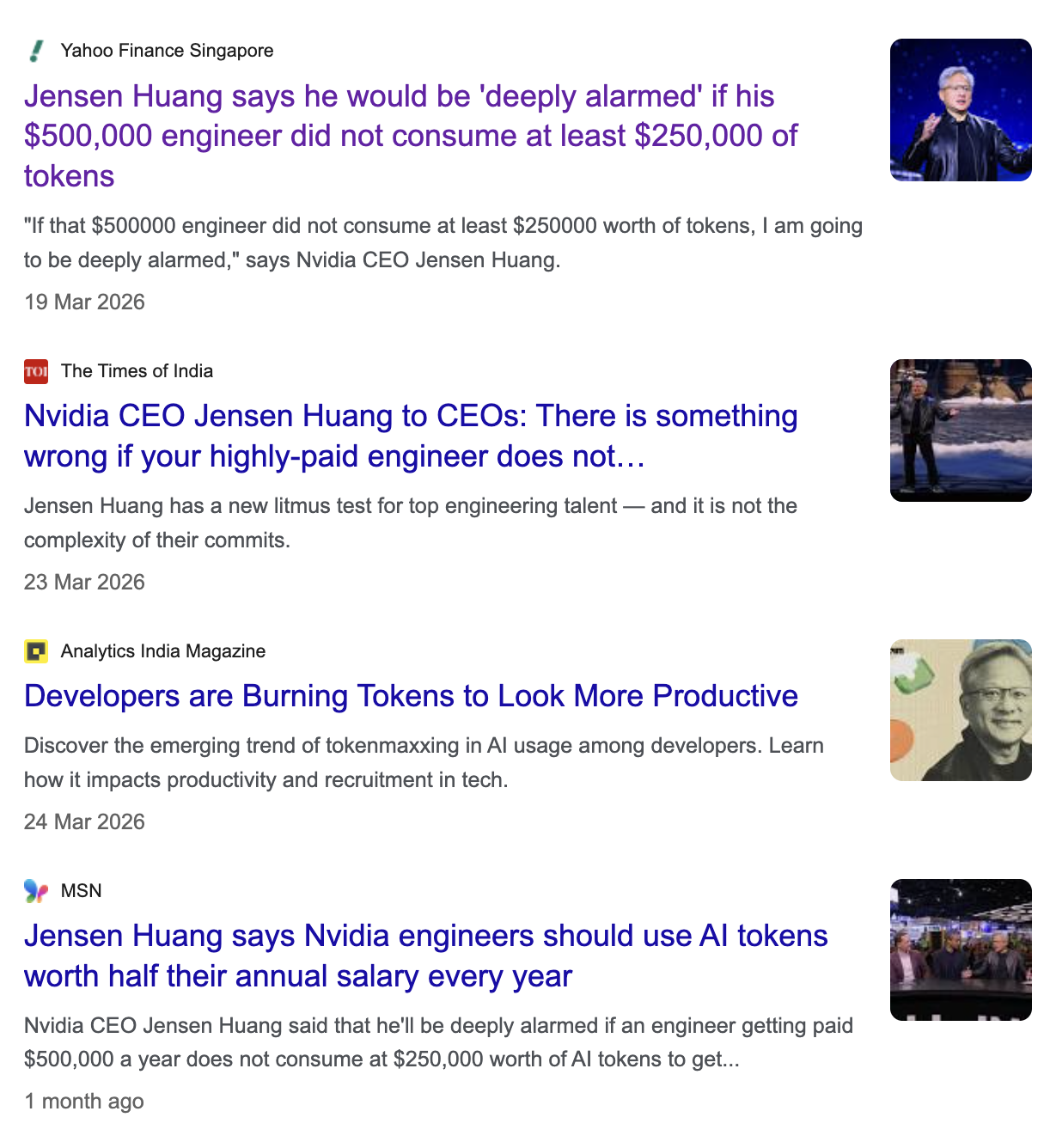
What makes this particularly interesting is that NVIDIA’s Jensen Huang responded to these concerns in a way that bordered on heresy. Speaking a few months ago, he argued that companies were looking at the entire issue backwards. In one widely discussed interview, he suggested that if a US$500,000 engineer was consuming only a few thousand dollars’ worth of AI, he would be more worried than reassured. The cost of the tokens was not the point. The leverage created by those tokens was the point. He compared engineers refusing to use AI because of the cost to chip designers refusing to use CAD software because the licence was expensive. In both cases, the saving is real, but so is the opportunity cost.
He went further. Jensen argued that, over time, every engineer would effectively have dozens, perhaps hundreds, of AI agents working on their behalf. Tasks that are currently rejected because they are too difficult, too time-consuming, or require too many people would increasingly become feasible. In that world, the role of the human shifts from execution toward direction. The engineer becomes less of a coder and more of an architect, a systems thinker, a specifier of intent, with armies of digital assistants handling much of the implementation work underneath.
Whether that future arrives exactly as he (the maker and seller of the expensive and currently scarce chips that AI needs to exist) imagines it is almost beside the point. Whether he has any personal stake in the matter (he does, as much as the Chairperson of BAT or ITC has in defending people’s right to smoke) is irrelevant to this discussion. What matters is that he is making a fundamentally different argument from most of his critics. They are looking at AI as a cost centre. He is looking at it as a force multiplier.
That said, Jensen Huang is right. And wrong. Let me explain.
He is right because he understands that the long-term trajectory of useful technology is almost always toward abundance rather than scarcity. When he says that a highly paid engineer consuming significant amounts of AI should not be viewed as a cost problem, he is really making a leverage argument. He is suggesting that organisations are asking the wrong question. The question is not how many tokens an engineer consumed. The question is whether those tokens helped create something valuable. If a company is paying somebody half a million dollars a year and that person is spending only a few thousand dollars on AI assistance, Jensen’s view is that the organisation may actually be underinvesting in productive capacity rather than demonstrating admirable financial discipline.
Where he is wrong is in assuming that more consumption automatically translates into more value. History does not support that conclusion either. Human beings have an extraordinary ability to waste any resource that becomes abundant. We wasted bandwidth. We wasted storage. We wasted email. We wasted cloud infrastructure. We will absolutely waste AI. In fact, judging by some of the stories emerging from large enterprises, we are already doing so with considerable enthusiasm.
What interests me most is that everyone seems to be arguing about the cost of intelligence at precisely the moment when the more important question may be what happens when intelligence itself ceases to be the scarce resource. For most of modern business history, ambitious ideas were constrained by the number of people available to execute them. We would like to analyse this market. We would like to test these scenarios. We would like to rewrite this system. We would like to evaluate these alternatives. Unfortunately, we do not have enough people. That sentence has quietly governed an astonishing amount of organisational behaviour for decades.
Suppose that constraint begins to disappear. Suppose that every reasonably competent professional eventually has access to dozens of digital assistants capable of researching, analysing, documenting, testing, drafting, modelling, and executing tasks that previously required teams of people. The conversation changes completely. The limiting factor is no longer access to intelligence. The limiting factor becomes judgment, prioritisation, taste, governance, ethics, and purpose.
And that is why I find the current debate faintly amusing. We are arguing about tokens in much the same way our predecessors argued about megabytes. We are treating a temporary bottleneck as though it were an eternal truth. The companies that succeed will not be the ones that spend the least on AI, nor will they be the ones that spend the most. They will be the ones that learn how to distinguish productive intelligence from expensive noise and, more importantly, learn what to do when intelligence itself becomes abundant.
Because if that future arrives, and I suspect it will, inevitably as always, the question will no longer be whether AI is too expensive. The question will be whether human wisdom and creativity can scale as quickly as the intelligence we have created. History gives me considerable confidence about the former. It gives me rather less confidence about the latter.