
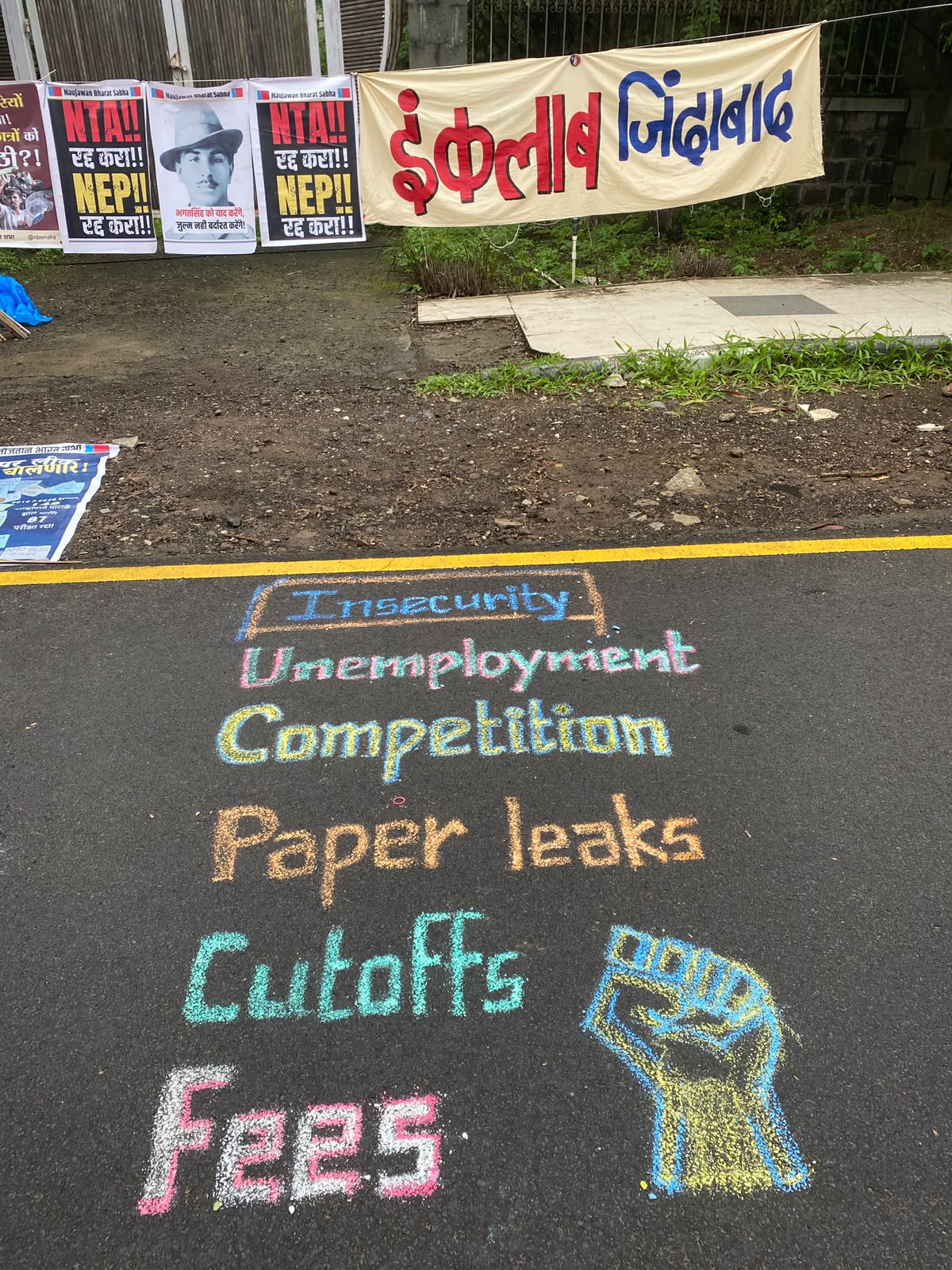
For nearly a fortnight, the group had been locked.
The administrators had switched it to admin-only sometime in the second week of July, when the detentions began and nobody was quite sure any longer who was reading what, and for two weeks the only messages permitted were from the admins, terse and functional: helpline numbers, the names of lawyers who would come to a police station at two in the morning, reminders to carry water and ORS, reminders to record everything.
Four hundred and some people, reading in what appeared to be silence. Then, one afternoon yesterday, the lock came off. The first post was a meme from Lagaan.
“Hum Jeet Gaye.”
Dharmendra Pradhan had resigned.
Minutes later came the video that captured the triumphant moment: Abhijit Dipke standing on the platform, hollow-cheeked, the tape from the saline cannula still on the back of his hand, receiving a phone call, and then grinning like a man who has just remembered how as he grabbed a microphone and shouted the news to everyone as the crowd erupted in cheers. A boy who had spent the previous fortnight being kept alive by a drip, captured on film at the precise moment he became a footnote in the history of the Republic.
And then the group detonated.
Congratulations. Memes. Voice notes of people laughing and crying simultaneously. Videos from the platform, from hostels, from somebody’s terrace where they appeared to be bursting last year’s Diwali stock in the monsoon. Photographs of grandmothers holding phones. People who had not typed a word in weeks suddenly had permission to speak, and they all spoke at once, and it was chaotic, and undisciplined, and utterly glorious.
For a few minutes, nothing existed except victory. Then somebody asked the question: “So… what do we do now?”
Nobody answered it. The memes rolled on over it the way traffic rolls over a pothole. But I have not been able to stop thinking about that question since, because I believe I know the answer, and I believe the answer is going to break this movement’s heart. Possibly mine as well.
This essay is my attempt to explain why.
What I was doing there
I should first explain what a fifty-three-year-old man was doing inside the chat groups of a student movement.
Lurking, mostly. I was added by a Facebook friend’s daughter, on the strength of a vague testimonial (possibly something on the lines of “uncle is okay, he won’t say anything weird”), and I did what people my age (and especially I) almost never do online, which is keep quiet. And while it wasn’t easy (and anyone who knows me will attest to this), it is a skill I acquired late in life, like parenthood, and at considerable expense, and I am pleased to report it finally paid a dividend.
For weeks, I read.
Not Facebook, where the movement existed for the sole reason of being fought over by retired uncles and aunties. Not LinkedIn, where it was seen as an opportunity to post AI slop (“What the student protests teach us about agile leadership”). Certainly not television, where it was broadcast as an existential threat, a foreign conspiracy, or an irrelevant distraction that’s easily ignored, and, on some occasions, all three at once.
The movement actually lived on Instagram, on WhatsApp, on Telegram, on Signal. In private groups. In broadcast channels. In stories that vanished in twenty-four hours and memes that went viral.
And what I saw there for the past two months I want to put on record before I say anything else, not just because as a chronicler and diarist, that is what I do, but also because I came away more impressed than I have been by any institution, public or private, in this country in years.
I watched decentralised co-ordination that any management consultant would bill crores to diagram. No high command, no politburo, no steering committee, no charismatic neck for the state to wring; when one co-ordinator was absent (picked up by the police or unwell or simply out of contact), three replaced her within the hour, because org chart? What org chart? I watched route planning that anticipated barricades before the police had erected them. I watched live tracking of RAF movements conducted with the calm of air traffic control. I watched medical students set up first-aid points and law students circulate one-page cards on what to say and, more importantly, what not to say at a police station. I watched people describing the contents of their backpack to tide over anything. I watched seniors assign themselves to walk juniors home. I watched groups design women’s safety protocols with a seriousness that the Republic’s official institutions have never quite managed.
And I watched them police themselves. One evening, a boy referred to a Union Minister by an abbreviation I shall not expand here; within a minute, four others had descended on him. Not our language. Not our movement. Delete it. He deleted it. Fourteen-year-olds enforcing a code of conduct that our Parliament cannot.
They joked constantly. They set the Home Ministry’s press releases to item songs. They rated lathis and police uniforms. Humour was not a relief from the movement; humour was the fuel, the thing that kept four hundred frightened people from becoming four hundred panicked ones.
One observation, though, I must make before I proceed.
These children assumed, instinctively, without ever discussing it, that a peaceful democratic protest in their own country required encrypted apps, VPNs, backup channels, and operational security. They treated surveillance as a given. And in all those weeks of reading, across all those groups, I did not once see a serious discussion of violence. Not once. Not a whisper. They sang, they mocked, they organised, they bled. And they encrypted.
It is a sad commentary on a democracy when its most peaceful citizens (some of them as young as fourteen) believe that evading their own government is a precondition of petitioning it.
Now that we have noted it, and mourned it (perhaps), we can move on.
Enter Sharmaji ka beta
The title of this essay is not a joke, or not only a joke, but sociology.
Because the longer I read those groups, the clearer it became who was actually in them, and it was not who the television studios claimed, and it was not, entirely, who the Left’s veterans might have wished.
Let me introduce him properly.
Though, a word about the surname first. It is a handle, not a census. He is just as often Agrawalji ka beta, or Singh sahab ka, or Patilanchi mulgi; and sometimes, as we shall see, he is not strictly savarna at all. But the sensibility I am about to describe was manufactured in the savarna household, and that is the address at which I shall write to it.
Sharmaji ka beta is somewhere between fourteen and twenty-four. His parents are software engineers, or bankers, or consultants, or doctors, or managers in multinational companies; people with EMIs, health insurance, and opinions in a PTA. His grandparents were teachers. Or PSU employees. Or railway officers. Or bank clerks who retired as bank managers. Or government servants. Or faujis.
His family is not aristocratic. Nor has it ever been desperate. It is that great, anxious, striving artefact of the twentieth century: the Indian post-Independence middle class. The grandparents climbed through the public sector, one increment at a time. The parents climbed through liberalisation, one appraisal cycle at a time. The child inherited both ladders, bolted end to end.
He grew up in a house with books, or at least with the idea that houses ought to have books. With English. With career guidance, solicited and otherwise. With entrance examinations as the family religion and coaching classes as its clergy. With the quiet, unexamined confidence of a family that has been dealing with institutions, rather than hiding from them, for three generations.
I want to be careful here, because it is fashionable to sneer at this boy, and I refuse to let my readers have that pleasure.
He is not privileged in the vulgar sense. His anxiety about employment is real; he has watched brilliant seniors deliver food on rented motorcycles. His anger about paper leaks is real; he has watched two years of his life dissolve in a single Telegram forward, and there is a bitter irony in the fact that the same app carried both his stolen question paper and his revolution. He is sincere. He is intelligent. He is, in my observation, genuinely kind.
But he belongs to a family whose relationship with the Indian state has been one of participation rather than exclusion since 1947, and that single fact, as we shall see, is the hinge on which everything in this essay pivots.
Who actually won
The organised Left was present, and let nobody tell you otherwise. They brought what they always bring: the slogans, the songs, the daflis, the muscle memory of five decades of agitation. They knew how to hold a road. They provided the movement its grammar.
But they were not its bulk.
The bulk was Sharmaji ka beta. Or, more precisely, betas. And betis. And not just Sharmaji, but the Sharmaji of every region. Banerjee, Godbole, Bhatt, Dave, Pai, Iyer, Panda, and… you get the point. Savarna, well-to-do, urban, educated, middle-class. The sanskari betas of the sanskari families of India. (And spilling past the strict Brahminical boundaries too: the Agrawals and Jains from behind the shop counter, the Singhs and Chauhans, the Patels, the Reddys, and yes, even the Yadavs; the sensibility travels with the ladder.) Bharjatiya would have found it tough to choose who to cast. Or caste. Same thing.
The important thing to note is that these are children from households that voted BJP in 2014, again in 2019, and, in all probability, again in 2024. Their parents believe in vikas, Ram Mandir, and Akhand Bharat. They think Sanskrit, Guru-Shishya Parampara, Yoga, and Ayurveda are the solutions to neo-capitalistic societies and their modern problems. These are the children the regime simply could not process or resist, dismiss or disperse, because the entire machinery of dismissal, the well-oiled apparatus that converts every protester into a Khalistani, a Pakistani, a Maoist, a missionary, an urban Naxal, or that all-purpose classic, an anti-national, jammed completely when pointed at a boy whose grandfather retired from the Ordnance Factory and whose mother observes Karva Chauth.
Governments know exactly what to do with protesters. They have a century of practice (or at least twenty-four years, in the case of the Modi Sarkar, both as CM and then as PM). What they do not know, what no government anywhere has ever known, is what to do when its own social base sends its children into the street (or, at the very least, cannot stop its children from taking to the streets).
That is why the government blinked. Let us not, even accidentally, romanticise it. Pradhan did not resign because Modi or the state (same thing nowadays) or even Pradhan himself discovered their conscience. He resigned because somewhere in that machine, somebody ran the numbers and realised that the boys and girls facing the water cannon were the same boys and girls whose parents constitute the party’s floor, and that every lathi was landing, with exquisite precision, on its own vote bank’s backside. And on their voting finger.
The BJP did not lose the battle yesterday. It lost it the moment the CJI called the youth of the country ‘cockroaches’. He has insisted since, interview after interview, that he did not mean what everyone took him to mean; but, in a delicious irony for an ecosystem that thrives on fire-and-forget tactics, on fake WhatsApp forwards and morphed videos, nobody was listening to the clarification.
The only Prime Minister they have ever known
To understand how completely, consider what these students remember.
Nothing. That is what they remember. The oldest of them were in primary school when Manmohan Singh left office; to them he is a photograph, a soft-spoken (or, if they are to believe their BJP-voting parents, silent) rumour. Most were born after 2004. Some after 2010. “Congress-mukt Bharat” lands on them the way “Indira Hatao, Desh Bachao” or “Sampoorna Kranti” landed on me: as history, faintly noble, entirely finished.
Narendra Modi is not, for this generation, one Prime Minister among many. He is the only Prime Minister they have consciously experienced. He is not a chapter in the book. He is the book.
And he made sure of it. For a decade, the man put his face on everything: the vaccine certificate, the ration bag, the petrol pump hoarding, the metro inauguration, the moon landing. My generation found this either inspiring or irritating, according to taste. But nobody in the PMO appears to have considered the actuarial consequence of personalisation, which is this: when you put your face on everything, everything eventually puts its face on you.
So when this generation sees paper leaks, it does not see a systemic failure with roots in five decades of rot. It sees him. Unemployment: him. The broken universities, the unfilled teaching posts, the crumbling infrastructure, the police violence, the captured institutions: him, him, him, him. Not because these children are unfair, but because they were offered no other address to write to.
The old vocabulary has stopped working on them, and it is genuinely fascinating to watch it fail in real time. Pakistan does not frighten a boy whose enemy is a question-paper mafia in Nashik. “Anti-national” does not wound a girl who spent the night outside a police station waiting for her classmates, singing Jana Gana Mana partly out of sentiment and partly, I suspect, out of irony and pure mischief, because what exactly is the RAF supposed to do about that. The ED, the CBI, and the Income Tax department hold no terror for people who own nothing yet. Civilisational rhetoric bounces off a generation whose civilisational experience is buffering.
They do not particularly hate Modi, which would at least be a relationship. It is worse. They have stopped finding him relevant. The old Right has not merely become unpopular with this generation.
It has become unintelligible.
Nine circles
Now I come to the part of this essay I have been simultaneously most eager and most reluctant to write.
Somewhere last night, I found myself doing something absurd. I began, mentally, drawing a Venn diagram: my politics on one side, theirs on the other.
And the overlap staggered me.
Secularism, they hold it not as an ideology but as a reflex; the group that shut down the abusive abbreviation shut down a communal joke even faster. Constitutionalism, they quote Articles at policemen the way my generation quoted film dialogue. Democracy, and not merely elections but the thicker thing, the right to be heard between elections. Institutional independence, they can explain what has happened to the Election Commission with a fluency that should embarrass most newspaper editors. Rage at the misuse of agencies. An instinctive, unlectured decency about gender that my generation is still being sent to workshops to acquire (and is completely incapable of grasping). Suspicion of state violence. Suspicion of surveillance. Protection of minorities, protection of women, defence of public universities.
And the icons. This is what truly caught me off guard.
They lean on Gandhi and quote him unironically. They speak the language of Satyagraha and Ahimsa. They invoke Bhagat Singh, and not the sanitised poster Bhagat Singh, the shaheed with the moustache and the convenient politics; several of them actually know he was an atheist socialist, which is more than can be said for most of the people who have his sticker on their number plates. They quote Babasaheb Ambedkar, and specifically the warnings: the grammar of anarchy, the contradiction between political equality and social inequality, the bit about bhakti in politics being a sure road to degradation, which they deploy with visible relish.
And they shout “Jai Bhim”.
Not carefully. Not as a demographic courtesy. But lustily. Willingly. Without a moment’s hesitation. It rolls out of these children, savarna children, Sharmaji’s betas and betis, alongside Inquilab Zindabad and Azadi, as if these slogans had always belonged in the same breath.
The first time I saw it, in a video from the platform, a boy in a Nirma-washed white shirt with his fist up, I confess something in my fifty-three-year-old chest went sideways. Nine circles out of ten, I thought. Nine circles of my politics and theirs, overlapping almost perfectly, across a gap of forty years. Men my age have founded entire political careers on less agreement than this.
Nine circles.
But not ten.
The tenth circle
The tenth circle is reservation.
There. I have said it, and you may exhale, because you knew it was coming; every Indian reader knew it was coming the way one knows the interval is coming, and I have delayed it as long as honesty permits.
On affirmative action, the image comes apart. The same boy who shouts Jai Bhim, who admires and holds the Constitution in respect, who despises communal politics, who walked his juniors home past the barricades, who stood between the water canon and the girls, will tell you, with complete sincerity and considerable pain, that reservation is the injustice at the heart of his life. That even Babasaheb intended it for a mere decade. No more.
And I want to insist, before a single reader reaches for a familiar weapon, that this is not hypocrisy.
Hypocrisy would be easier. Hypocrisy can be exposed. What I saw is something far more durable: a genuine, coherent, inherited moral conviction, sitting peacefully alongside nine other convictions I share, held by people I had come to admire.
This is not an incidental disagreement, a rounding error in an otherwise splendid consensus. I am convinced it is the fault line along which this entire movement, this entire generation, will eventually divide.
But before we get to that, we owe him something. We owe him an explanation instead of an accusation. Because if there is one thing I learned in those groups, it is that he did not reason his way into this belief.
He inherited it.
The acceptable Dalit
But wait, you will say. This movement’s face is Abhijit Dipke. The boy on the drip. The boy on the platform. And Dipke is Dalit.
He is. And his presence at the head of this movement, far from disproving what I have just written, may be its most elegant confirmation.
Consider what else Dipke is. He is educated in Boston. His English is the English of seminar rooms and TED stages. He is fluent, urbane, ironic, legible. In every register that matters to a savarna drawing room, he reads as one of us who happens to be one of them.
We have seen this figure before. His name was A. P. J. Abdul Kalam. The Muslim who read the Gita, played the veena, quoted the Thirukkural, never married, ate simply, and built missiles pointed at Pakistan. The Right Wingers from my generation did not adore Kalam despite his being Muslim; they adored him because he had been so thoroughly exempted from being Muslim that the category no longer stuck to him. He was the acceptable Muslim, the good Muslim, the patriotic Muslim, the Muslim who seemed to acknowledge that he had a Hindu heritage. And our acceptance of him cost the prejudice nothing. If anything, it fortified it; he became the standing alibi, the exhibit produced in every drawing room where “all of them are like that” had just been pronounced. Point, in such a room, at the oldest friend, the colleague of thirty years, the neighbour whose biryani arrives every Eid, and the answer comes without a heartbeat’s pause: “Arre, not HIM. He’s different. I meant the others.”
The friend gets a free pass. The category stays sealed.
Dipke is that free pass. Because he arrives Boston-stamped, he registers in the savarna mind not as quota but as merit; not as the beneficiary of anything but as the vindication of everything. So Sharmaji ka beta can fast in solidarity with a Dalit, march behind a Dalit, weep at the sight of a Dalit’s cannula, and walk home with his convictions about reservation not merely intact but reinforced. He now carries proof on his phone. How can I be casteist? My leader is Dalit.
Not THAT Dalit, of course. The others.
And there is a second blade here, quieter and crueller. Consider what it took for Dipke to be followable at all. Leadership of this movement had, it turns out, its own entrance examination, and the cut-off was set precisely where savarna comfort begins. A first-generation learner from a district board, with no Boston on his CV and no English of the seminar room, could never have stood on that platform, cannula and all, and been garlanded for it. The movement against rigged examinations was led, in the end, by the one Dalit who had already cleared the most exclusive examination this country conducts: acceptability.
None of which Dipke chose, and none of which diminishes him. He starved for these children; the debt runs one way. But a conviction that can survive daily contradiction by its own leader was never built out of evidence, and so no evidence standing on a railway platform will dismantle it.
To find out what it was built from, we must leave the platform and go home to the dinner table.
The dinner table
Nobody sits a child down and teaches him to oppose reservation specifically. It arrives the way accent arrives, the way taste arrives: at the dinner table.
It arrives in his father’s story about the colleague who got the deputation. In his mother’s aside about the neighbour’s son and the medical seat. In the coaching-class teacher’s motivational speech, which contains, tucked between the exhortations, a precise accounting of how many seats are “left” in the general category, delivered in the tone of a man reading out casualty figures. It arrives in family WhatsApp groups, in forwards typed in yellow font on green backgrounds, in the anecdote.
You know the anecdote. Everyone in this country knows the anecdote. It has a hundred thousand tellers and only one script:
I scored 640. Someone else scored 350. They got the seat.
I must have encountered that anecdote fifty times in my life before I ever thought to interrogate it, which tells you something about me, and I encountered it again in those very chat groups, in the middle of the victory celebrations, typed by a boy who had, just two weeks ago, been sharing the location of first-aid tents.
Here is what I have come to believe about that anecdote. Its arithmetic is usually genuine. The 640 is real. The 350 is real, or real enough. The pain is entirely real; tell a seventeen-year-old that the number he bled for is insufficient and you have wounded him in the one place his entire upbringing taught him to keep his worth.
The problem is not the numbers. The problem is what the anecdote has been framed to hide.
The missing defendant
Because notice what the anecdote does. It puts two children in the dock, facing each other. One with 640, one with 350. It invites the listener to adjudicate between them, and the listener, being human, does.
And while everyone in the courtroom is absorbed in this contest, the actual defendant walks quietly out of the building. Baaizzat bari. Not guilty.
Because we fail to ask the question the anecdote is constructed to prevent: why are two capable children fighting over one seat at all?
It is not divine scarcity. It is manufactured scarcity. A country of a billion and a half that has not built colleges to match its children. Teaching posts sanctioned and never filled, or filled at salaries that guarantee they are filled badly. School boards so unequal that two students of identical ability arrive at the same examination from different centuries. An entire parallel economy of coaching that exists only because the schools have been allowed to fail, so that admission now goes not to the child who learned the most but to the family that could afford the most efficient drilling. And at the end of it all, one examination, three hours, a single morning of a single day, deciding the entire trajectory of a human life, an arrangement so obviously deranged that only the blind cannot see it. Unfortunately, while we haven’t all turned blind, we have closed our eyes so tightly to it that there is no difference.
The state’s job was to make the seat plentiful. Instead it made the seat scarce, and then, and this is the genius of it, it arranged the lighting so that when two children collide in the scramble, each sees only the other.
The boy with 640 stares at the boy with 350. Neither of them stares at the government.
Reservation is visible. It has a name, a percentage, a column on the form. The vacancy that was never created, the college that was never built, the teacher who was never hired: these have no column on any form. You cannot rage at an absence.
So the rage goes where it can be seen. It has gone there for seventy years.
What education is for
Somewhere underneath all this lies a question nobody in this country asks any more: what is education actually for?
It has always had two purposes. The first is practical. Prepare a person to earn a living; to put bread on the table, to work, to be employable, to be useful to themselves, their families, and their communities in the economy of their time. The second is larger, and older. That is to prepare a person to live. To read a book they will never be examined on. To follow an argument to its end, including the uncomfortable end. To understand a thought they disagree with, and say so without shouting. To enjoy music, art, cinema, food, conversation. To conduct themselves decently among strangers, and to leave the society around them slightly better than they found it.
A good system serves both purposes. A bad system sacrifices one for the other. Ours has managed something more remarkable: in the pursuit of each, it has abandoned both. In the memorable words of DJ from Rang de Basanti (and I paraphrase freely), we are standing with one of our legs in one boat, another in another, and pissing on ourselves.
The brutal truth is that we do not produce employable people. Ask any employer, and then ask them again now, in the age of AI, which has made memorisation, the one skill our schools genuinely drill, the most worthless human capacity on the market. The working world these children are entering runs on judgement, adaptability, and the ability to keep learning; we spent their childhoods teaching them to retain and reproduce, which is the precise job the machines took first.
And we do not produce cultivated people either. We produce engineers who have not read a book since school, doctors who cannot construct an argument, toppers who have never stood inside a museum or a botanical garden or a library or wielded a saw or a screwdriver or ladle unless a project carrying marks required it.
So what do we produce? I have thought about this for years (probably since 1994, when I graduated as a fresh electrical engineer knowing literally nothing more than how to somehow get passing marks in my exams), and the honest answer is that nobody knows. Not the boards, not the universities, not the parents paying for it, not the children enduring it. We produce exam-cracking machines. We produce marks and mark sheets. We produce ranks and ‘merit’ lists. We conduct, with tremendous seriousness and at colossal expense, a nationwide ranking of children asked to prove their entire academic worth in three hours flat, and we have all agreed to call it education. The learning is incidental.
Which is also why the leaked paper wounded these children the way it did. In a system where the rank is the only real product, stealing the paper is not cheating within the system. It is the theft of the only thing the system makes, the only tangible thing the children can show for the years, for the sweat, for the blood, and not to put too fine a point on it, the tears.
What a serious Republic would have done
None of this, I should add, is a mystery awaiting a solution. Every remedy has been sitting in plain sight for decades, in commission reports that were commissioned, submitted, tabled, and forgotten, only to increase the paperwork now bound in fat files bound by red bureaucratic string sitting in some steel almirah, waiting for the inevitable fire to burn it all down so that it can be deemed lost. Permit me, just this once, the consultant’s vice of a list, if only to demonstrate how short it is.
A serious Republic would build. Colleges, universities, laboratories, seats; enough of them that a seat stopped being a lottery ticket and became what it is in any functioning democracy, which is basically a starting point for other reforms, not the actual reform itself!
A serious Republic would pay for it. Here is what ours pays. This year’s Union budget for school education and literacy, for every government schoolchild from Kashmir to Kanyakumari, is ₹83,562 crore. The municipal budget of Mumbai is ₹80,953 crore. The higher education budget is two-thirds of the school figure. And research, the thing universities exist to do, receives 0.64 per cent of GDP, which is, give or take a tenth of a decimal, exactly what it received in the 1980s, back when South Korea and China spent in our league. They moved on. And up. We stayed. The results sit on a scoreboard we have agreed not to look at: not one Indian university in the world’s top hundred; IIT Delhi at 123 celebrated in official press releases as our best ever, which it is, which is precisely the point; about a dozen in the top five hundred, and the list is essentially the IITs plus the faithful IISc. And every IIT on that list was founded before 1994; the oldest of them under Nehru, the youngest under Narasimha Rao. Of the six IITs created in the last twelve years, not one appears anywhere near it. The scoreboard the minister celebrates is running entirely on capital built by the governments his party has been working so hard to erase.
A serious Republic would treat the teacher as its most important public servant. Singapore starts its schoolteachers on salaries higher than its young doctors. Finland and South Korea admit people to teaching the way we admit people to the IAS: competitively, prestigiously, murderously cut-throat; and are rewarded with queues of their brightest wanting in. We, meanwhile, hold NEET for the custody of our bodies and UPSC for the custody of our districts; but for the custody of our children, we hold the TET, an eligibility test that guarantees no job, applies only to classes one to eight, and confers nothing but the right to wait. And we cannot even conduct that much honestly. In 2021, the UP-TET paper was stolen and the examination cancelled with some twenty lakh aspiring teachers already in their seats. In Maharashtra, the 2020 edition ended with the marks of seven thousand-odd candidates tampered for money and the head of the examination council himself under arrest. Last November, in Kolhapur, a racket was caught selling the paper on the eve of the exam. And the paper for this June’s test leaked in Bhiwandi the day before the examination, which now stands postponed; the accused are being produced before a magistrate in the very week these children were dancing on that platform. The selection paper for the guardians of the examination system, stolen again and again and again. I would call that satire, but satire has standards.
And a serious Republic would ask what its examinations actually measure. Ours measure memory, which is exactly why they can be stolen; a memorised fact is portable, and so is the question paper that demands it. The reform has been sitting in pedagogy journals for half a century: the open-book examination, which tests whether a mind can think with knowledge rather than warehouse it. You cannot profitably leak a paper that tests thinking; a stolen open-book paper is stationery. In one stroke, the leak mafia loses its product and the coaching industry loses half its purpose, because you cannot drill a child for a question that has not been written to be drilled for. The deeper (and I dare say, saner) answer to the leaks is to build papers not worth stealing.
Instead, the Republic is otherwise engaged. It spent 2023 removing evolution and the periodic table from the Class 10 textbooks, in an exercise officially called rationalisation, so that the last science most Indians will ever formally study now contains neither Darwin nor Mendeleev. And this monsoon it is fighting over the egg. In Bengal, among the earliest acts of the new government was handing Kolkata’s school meals to ISKCON, whose kitchens permit no egg, no onion, no garlic; this, after a campaign in which its leaders were photographed eating fish for the cameras of a fish-loving electorate. Fish before the vote; khichdi after. In the land of maachh-bhaat, the Republic’s most urgent educational question this season is a boiled egg on a seven-year-old’s plate.
All of the above is the government’s record. Or, to stay with the subject, this is the government’s report card.
Sharmaji ka beta has never been shown it. All his life, he has been shown only the boy with 350.
The mythology of merit
And beneath the anecdote lies a deeper faith, the true religion of the Indian middle class, the one belief that unites households that agree on nothing else: merit.
The score as the man. The rank as the soul. I believed it too, at that age all teh way till I turned 20, and it flattered me enormously, which should have been my first clue.
Because a mark is not produced in an examination hall. It is merely collected there. It is produced earlier, and elsewhere, by things no hall ticket records: the language spoken at home, and whether it was the language of the question paper. The books on the shelf. Parents who could explain the homework. The coaching class (and the transportation to and fro), and the fee that bought it. Food, enough and on time. Electricity (even air conditioning nowadays) through the night before. A clean bed. A clean bathroom. A safe home. A safe street. And the subtlest ingredient of all, the one nobody lists because those who have it cannot see it: the inherited assumption that institutions are yours, that the form is meant to be filled by people like you, that the office will receive you, that the system, whatever its moods, is fundamentally your system, empathetic and responsive to your needs, concerned with securing your future.
You see, the race that ended in that examination hall began generations before either runner was born.
In Sharmaji ka beta’s case, I can date it. It began the day one grandfather passed a matriculation examination in some district town and became a teacher. Or joined a PSU. Or the Railways. Or a nationalised bank. Or stood in line at a recruitment rally and came home a soldier. That one clerical miracle, whichever it was, purchased the stability in which his parents could study, and their studies purchased the flat in which he had his own room, his own desk, his own lamp, and his 640.
His 640 is real, and it is his, and he worked for it. And it stands on a plinth three generations tall, and the plinth is invisible to the boy standing on it, because that is the nature of plinths.
Meanwhile the boy with 350 may be the first person in the history of his family to sit in an examination hall at all; the first to fill the form, the first to believe the office would receive him. His 350 may represent a longer journey than the 640. Not always. But often enough that the comparison of raw numbers is not measurement. It is signalling.
This is what reservation actually is, stripped of seventy years of shouting: not the creation of an inequality, but a response to one that was already ancient when the Constitution was signed. It did not rig a fair race. It arrived because the race was never fair, because some families had been forbidden from the track for a thousand years while others were doing warm-up laps. It is crude. It is imperfect. It has been cynically administered and cynically expanded and cynically weaponised by every party this Republic has produced, mine included.
But, and this part is important, it is an attempted correction of a distortion that already existed. It is not the distortion.
Sharmaji ka beta has been raised, lovingly, by honest and hardworking people, to believe the exact opposite. And no examination he has ever been drilled for has tested that belief.
The split that is coming
Which brings me back to the question in the group.
“So… what do we do now?”
Here is what I believe happens now. The movement has won its first battle, and it is now approaching its first ideological split, and the split will not run along the line everybody expects.
It will not be Modi versus anti-Modi. That contest is, among these children, essentially over; they have already left, and no amount of airport renaming will bring them back. The Right’s own strategists know this, which is why the panic behind the resignation smelled the way it did.
The split will be over a harder question: what do we mean by justice?
One side of this generation will follow the logic of its own slogans to the end. If you shout Jai Bhim, if you believe in the Constitution, if you revere and quote Babasaheb, then sooner or later you must accept what he actually prescribed for it, and that road leads to structural reform: massive educational expansion, yes, but also affirmative action defended without embarrassment, hierarchy confronted rather than merely deplored.
The other side will oppose Modi with complete sincerity, demand clean examinations, independent institutions, free media, an end to bulldozers, all of it, and simultaneously regard reservation as the theft of its future. It will want the Republic repaired and the hierarchy left respectfully undisturbed.
You can already see the two political imaginations waiting to receive them, and I say imaginations rather than men, because the men are incidental. There is a Kejriwal-shaped politics: govern cleanly, fix the schools, fix the hospitals, catch the leakers, and ask no impolite questions about who sits where in the social order, even as Bhagat Singh and Babasaheb adorn their offices, while Gandhi disappears mysteriously. And there is a Rahul Gandhi-shaped politics which insists that a democracy of unequal citizens is an unfinished democracy, and that finishing it requires precisely the impolite questions, caste census and all.
Administrative reform versus social transformation. Clean scarcity versus contested plenty. That, I believe, is the real post-Modi contest, and this generation will fight it internally before it fights it electorally.
And here is the detail that makes it combustible: on this one question, Sharmaji ka beta agrees perfectly with his father.
Think about that. On everything else, the dinner table is a battlefield; the boy has spent months defending “andolanjeevis” to a father who watches Arnab Goswami on the nine o’clock news like it is darshan. But raise reservation, and the generational war goes suddenly, eerily quiet, and father and son find themselves on the same side of the table, sharing the same anecdote, the same 640, the same 350.
And that father is my generation. We were in college, or queuing up to enter one, in the summer of 1990, when Mandal burned; we watched boys our own age set themselves alight on the evening news, and whichever side of the argument we took (I was with the ABVP, leading the anti-mandal protests then!), we filed the grievance away without fully resolving it, and it has sat there for thirty-five years. Today it is our cohort that runs the government, the companies, the newsrooms, the universities, the police, and the courts. The grievance sits in our marrow still. It has been waiting all these decades for reinforcements.
They have arrived. The old grievance has found a young voice, better memes, brighter eyes, and cleaner hands.
When the split comes, it will not be a clean generational fracture, old against young, which would at least be legible. It will run through the middle of the movement, through friend groups, through those very chat windows, with each side armed with the same Constitution and the same martyrs. Reminds you of something, doesn’t it?
The first crack
I want to return, finally, to the group, because the group, as usual, got there before yours truly did.
The celebration was still in full flow. Abhijit Dipke’s photograph was still being reposted with garlands of emojis. Somebody had put Pradhan’s face on the Sholay tanki scene and somebody else was demanding it be printed on T-shirts.
And in the middle of this, someone typed: “The next target is Modi.”
Fireworks, agreement, a hundred thumbs.
Thirty seconds later, a reply: “Modi going won’t change anything if reservations remain.”
Nobody fought. A few likes appeared under the second message; a few under the first; the memes closed over both like water. The celebration carried on, and to this hour I doubt either boy remembers the exchange.
I remember it. Thirty seconds apart, in a jubilant chat window, I watched the next twenty years of Indian politics introduce themselves to each other and shake hands, neither recognising the other.
The fracture has already begun. It simply has not been informed yet.
What I am, and am not
I should be honest about my own position in all this, which is: nowhere.
I cannot stop what is coming. I am not a leader; the movement has no post of Distinguished Lurker. I am not an organiser; I was the man reading the logistics, not writing them. I am not a politician, and at fifty-three, with my particular CV, the country may consider itself safe from the prospect.
I am a diarist. A chronicler of my times. I observe. I notice patterns. I write them down. That is the whole job description, and I am not even certain it is a job.
Perhaps somebody younger, somebody inside those circles rather than pressed against the glass, will one day find the words that I cannot: the words that let a boy keep his 640, keep his pride in it, keep his pain, and still see the plinth under his feet. It will have to be one of their own. These children have stopped listening to my generation, and given what my generation has done with its turn, I find it difficult to blame them.
I merely record what I believe I have seen. That’s what I do. I sit here and I know things.
The last lie
I hope I am wrong. I want to be wrong with an intensity I usually reserve for medical reports, specifically my cholesterol.
Because what I saw in those weeks was the best political news of my adult life. A generation that is decent by instinct. Constitutional by reflex. Braver than mine, funnier than mine, and organised in ways mine could not have imagined without a head office. A generation that took on the most powerful political machine this Republic has ever produced, armed with memes, ORS, and six kids’ refusal to eat, and won.
They agree on almost everything that matters. Nine circles out of ten.
But I suspect the tenth will be enough. It usually is. Movements are rarely defeated by their enemies; they are dismantled by their unexamined inheritances, and this movement is carrying one, lovingly packed by its parents, ticking quietly under the celebrations.
Consider what Sharmaji ka beta has already discovered, in his short life, entirely on his own.
He discovered that the government lied to him about nationalism; that the tricolour on the forward and the boot on his classmate came from the same warehouse. He discovered that it lied to him about religion, about dissent, about the anti-nationals, who turned out to be his classmates from his own hostel corridor. He discovered that it lied about the surveillance that supposedly did not exist and the achhe din that supposedly did. He discovered, hardest of all, that it lied to him about the man whose face was on everything.
Each discovery cost him something, and he paid, and he marched, and he won. I watched him do it, and I am not ashamed to say there were evenings I sat alone with my thoughts feeling something dangerously close to hope.
My fear is a small one, and it is this.
He has found every lie except the oldest one. He has not yet discovered that they also lied to him about who stole his seat.









Thank you for “Sharma-ji ka Beta”. Thoughtful and well-written!