I have written about the Cockroach Janata Party twice already, once to argue that the conspiracy theories around it were running well ahead of the evidence, and once to argue that a meme page is not a revolution, and I had assumed that was that.
Then, over the past fortnight, I watched people close to me, people whose judgment I have trusted for decades, arrive at positions so contrary to one another that they could not possibly all be reading the same reality. One is convinced the whole thing is a clandestine op by parties unknown. Another is half-convinced it is the beginning of something historic and has literally injected himself centre stage and grabbed the microphone. A third refuses to discuss it at all on the grounds that discussing it is exactly what “they” want, though he has so far been unable to specify who “they” are, which I suppose is the whole point of a good “they”. And it struck me that if this lot is confused, the confusion must be fairly general, and that I had answered the easy question in my two earlier pieces (what is this thing?) while ducking the harder one (what is one supposed to do about it?). So here is my attempt at clarification. Not of everything, because everything will be clear only in hindsight, and hindsight famously arrives after the counting is over and the Prime Minister is being sworn in. Just my own perspective, and such advice as a man with my track record of political prediction (I retired from that business a while back, and for excellent reasons) is qualified to give.
The conspiracy theories first, and briefly, because I have flogged this horse twice and it is starting to look at me reproachfully (if it had hands, it would put them on its hips). In the past month the CJP has been described to me as a BJP front, a Congress plant, an AAP revival project, a foreign operation, and an intelligence experiment, occasionally by the same person in the same week, or even the same afternoon (sometimes separated by a mere two G&Ts), which would make it the most cross-functional organisation in Indian history.
I understand the instinct. We have lived through a decade in which astroturfing turned out to be real, IT cells turned out to be real, fronts and proxies and laundered narratives all turned out to be real, and a certain paranoia is the rational residue of having been fooled before. I felt the pull myself; the first time I saw how polished the CJP material was, my immediate thought was “somebody is paying for this”, and it took me a full day to remember that I know precisely how cheap this production has become, because I have used the same tools, and a competent person with a laptop can do all of it over a weekend with money left over for a pizza.
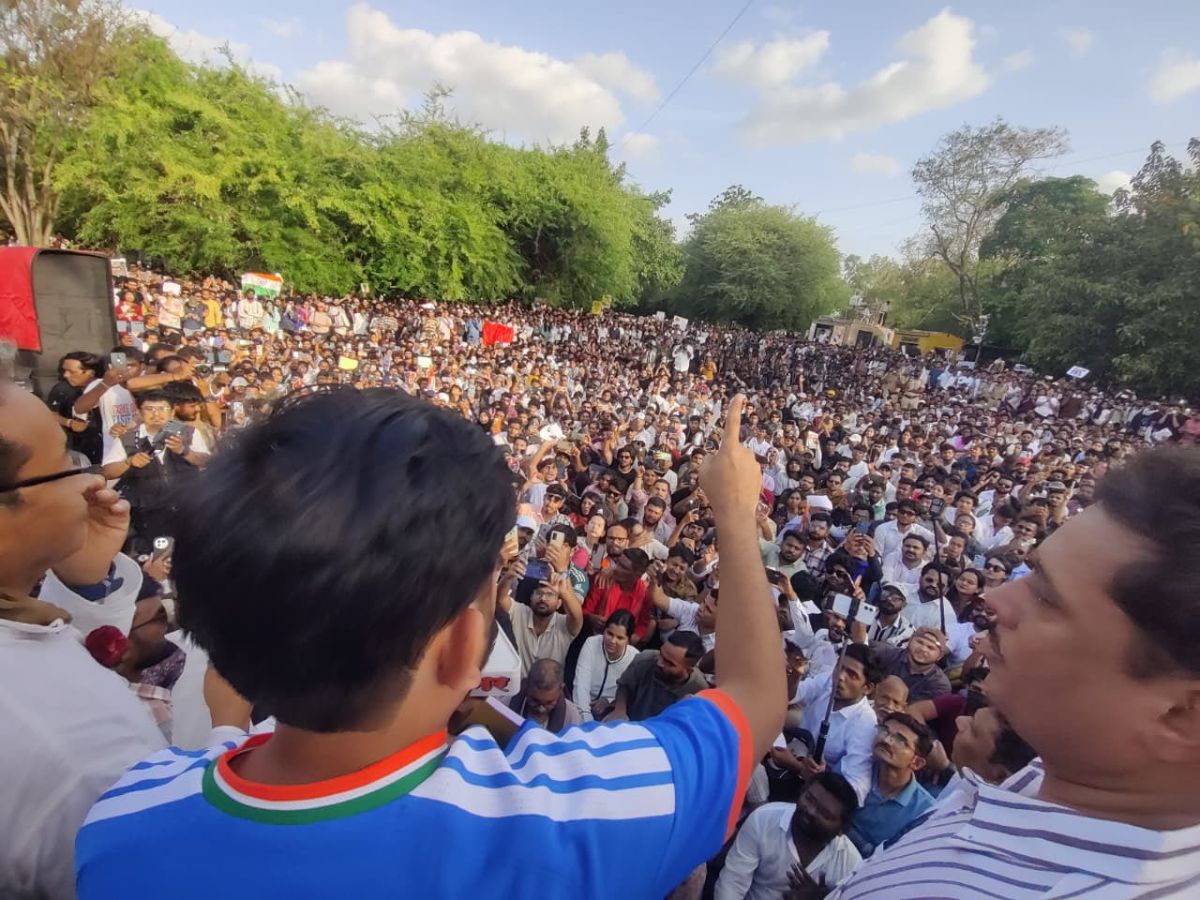
The actual record, as of today: a Chief Justice called unemployed young Indians “cockroaches” (clarifications were issued; the sentence had already landed), a former AAP social media hand named Abhijeet Dipke turned the insult into “Main Bhi Cockroach”, the Instagram following crossed eleven million inside three days and has since passed twenty million, over three and a half lakh people signed the membership form, sitting MPs joined for the photograph, the government geoblocked the website (Dipke is challenging the ban in court), and there have been sit-ins at Jantar Mantar and, as of yesterday, a demonstration in Pune, in my own backyard (kind of), demanding the Education Minister’s resignation over the exam leaks.
That is everything. Everything else is supposition, and notice what the suppositions have in common: every one of them is a self-portrait. The man who sees a BJP op has spent a decade being out-organised by the BJP. The one who sees an AAP revival never recovered from 2013. The one who suspects a Congress plant has plainly never sat through a Congress communications review, because a party capable of producing something this nimble would not be circulating its press releases as JPEGs. If the anger was purchased, nobody has to ask what it is a response to; a theory about Soros is cheaper than a look at the unemployment or exam leak data. The conspiracy is the establishment’s way of changing the subject, and on this subject the liberal commentariat is establishment, however much it enjoys the show of dissent. A month into this episode, we have learnt very little about the Cockroach Janata Party and a great deal about ourselves, and the exchange rate is not in our favour, at least from where I sit.
And what we would see, if we looked, does not flatter anybody. Even the government’s own replies to Parliament concede double-digit unemployment among urban youth, and official figures in India are a genre of optimistic fiction if not outright fantasy; they do not count the engineering graduate delivering food, the PhD driving an Uber, the postgraduate on her fourth attempt at an examination whose paper will leak (or already has) anyway, or the lakhs who have stopped looking. When the Lokniti-CSDS people asked young Indians which party best addresses their problems, the single largest answer, ahead of every actual party including the one I vote for, was “no one”.
What interests me, however, is not merely the unemployment itself, but the strange civic disconnect that surrounds it. Last year, at a senior citizens’ housing complex where my mother lives, I listened to a room full of intelligent, experienced, educated people spend an hour cataloguing everything that had gone wrong around them.
The roads were worse. The water supply was unreliable. The city was dirtier. Corruption was rampant. Public services seemed to function only accidentally. By the end of the session, they had collectively assembled a fairly devastating indictment of the state of governance. And yet, when asked who they intended to vote for, the answer was immediate and unanimous: the very people who had governed through the period they were describing. It was not ignorance. It was not stupidity. The connection between suffering and responsibility had simply dissolved.
You see the same phenomenon everywhere, and almost always in the passive voice. We complain about the education system, but only now, after years of paper leaks, are large numbers of people publicly demanding that the Education Minister answer for it. We complain when trains collide or run late, but the Railways Minister rarely occupies the centre of that anger. We complain about crime and insecurity, but seldom ask what exactly Home Ministers are supposed to be doing if not maintaining public order. We complain about pollution, traffic, unemployment, and corruption as though these were weather rather than the consequences of decisions taken by namable people. The taxes are high, the roads are bad, the jobs are scarce, the governance is failing, but who, exactly, is responsible? The subject quietly disappears from the sentence. Somewhere along the way we uncoupled governance from accountability, and responsibility now floats around like a ghost, visible to everyone and owned by nobody.
The young seem less willing to participate in that fiction. They have inherited a country where examinations fail, jobs are scarce, institutions stumble, and opportunities shrink, and they are increasingly unwilling to accept the idea that these are merely unfortunate facts of life. Whether the Cockroach Janata Party itself amounts to anything is a separate question. But the instinct to reconnect outcomes with accountability, to insist that somebody somewhere must answer for what has gone wrong, strikes me as considerably healthier than the passive resignation that preceded it.
Now, the standard adult response to all this anger is a demand, delivered in the tone of a viva voce examiner: “Fine, but what is your solution?” And I want to spend a paragraph on this, because it is one of the oldest and most dishonest tricks in the incumbent uncle’s toolkit. A man who points at a pothole is not required to submit a monograph on road metallurgy. A patient describing chest pain is not asked to propose the surgical procedure. Identifying a failure and fixing a failure are different jobs, and the second one is what we pay the government for; that is the entire arrangement. Demanding solutions from twenty-two-year-olds is simply a way of converting their complaint into homework and then pre-failing them on the homework, after which the complaint can be dismissed as unserious. It is doubly rich coming from a political class that has had decades, budgets, ministries, commissions, and five-year plans to produce solutions of its own, with results currently on display at Jantar Mantar. The young do not owe us a manifesto, a project plan, a budget, a Gantt chart, or a swim-lane diagram. They owe us, at most, honesty about what hurts, where it hurts, how much it hurts, and who might be hurting them, and on present evidence they are supplying it in bulk. Mind you, taking the anger seriously is not the same as taking its every prescription seriously. Anger is evidence of a disease, not a qualification in medicine, and the young can be entirely right about what hurts and entirely wrong about what to do about it, as the candle-holders of 2011 demonstrated at national scale. Whether a particular minister should resign over the latest leak is an arguable proposition; that the leak happened, again, is not. The grievance gets my support unconditionally. The proposals will have to queue up and be examined one at a time, like everybody else’s, though I don’t think it’s a bad idea to start with said Minister’s head.
“But Anna Hazare! But 2011! We have seen this film!” Yes, we have, and I walked out of that film in the first reel, in writing, so permit me the indulgence of an old man pointing at his own archive. I opposed the so-called “India Against Corruption” movement from its early weeks, and not because of what AAP later became or what the vote arithmetic did. I opposed it because of what it was demanding right then: the Jan Lokpal, an unelected ombudsman to be installed above Parliament, the judiciary, and the executive, accountable to nobody in particular, a constitutional monstrosity that people far more learned than I called out at the time. Pratap Bhanu Mehta called the draft subversive of representative democracy. Aruna Roy and the NCPRI tore its design apart. They were shouted down by people holding candles, and many of us who agreed with them stayed more silent than we should have, which is its own small confession.
And then there was the company on that stage: Kiran Bedi and the fake narrative on which she built an entire career, Ramdev and his pseudoscientific but very real corporate empire, Sri Sri presiding beatifically while spouting nonsense about exchange rates and petrol prices, and Vinod Rai’s laundry list of “scams” that have aged like unpasteurised milk left out on a hot afternoon. The ideology was on the sleeve (or in their case, the faux Gandhi topis); one merely had to look at it. The CJP, so far, has shown me no such markers. No draft bill, no council of the virtuous to be seated above the Constitution, no godmen and cringe poets on the dais, demands about jobs and exam integrity that the Constitution already expects an ordinary elected government to meet. The day a Lokpal-shaped object appears in its literature, I will oppose it with the old enthusiasm, and you may print this paragraph and wave it at me. Until then, I decline to convict on the record of a previous accused.
But there is a second lesson from 2011 that liberals refuse to learn, and it concerns not the movement but us. Remember how that dais filled up. It began with a fasting old man and within a fortnight it was a duty-free shop of celebrity conscience: actors, retired generals, television anchors conducting outrage like an orchestra, and a procession of public intellectuals each angling to be appointed the movement’s brain. The same instinct is already warming up around the CJP. Within a fortnight of the launch, the expert columns had arrived, instructing the nation that the phenomenon was “worth careful study” and explaining what it should mean for electoral strategy, and the comparisons to Dhaka and Kathmandu were being traded by commentators who, three weeks earlier, had never heard of Abhijeet Dipke. The “I thought of this first” crowd has made itself heard, as I noted in my earlier piece. And give it a month, on current trajectory, before some gentleman of a certain age offers himself up as the movement’s “ideological anchor”, a job title that should disqualify any applicant on sight, a principle of which Douglas Adams was the pioneering proponent when he observed that anyone capable of getting themselves made President should on no account be allowed to do the job.
I know this instinct from the inside, which is why I am being rude about it. I am a 53-year-old man with 48 years of opinions and a documented weakness for explaining things, and the urge to march over and tell these kids how to run their movement is entirely real. My generation descends on every promising youth mobilisation the way relatives descend on a wedding, full of strong views about the seating, the caterer’s idea of a dahi vada, the officiating priest’s omissions, and the bride’s make-up, until the thing suffocates under middle-aged advisors explaining Gramsci to twenty-year-olds who came to talk about paper leaks and the minister who should answer for them.
And before somebody objects that Gandhi himself was a forty-something outsider who grabbed the microphone of a polite lawyers’ club and turned it into a mass movement: yes, granted, the rule has one famous exception. Statistically, however, you are highly unlikely to be a Gandhi, I most certainly am not, and the gentleman applying for ideological anchor is very definitely not. Listen, advise if asked, critique in the open, write (this is me writing), and then go home. The kids built the stage. The most useful thing on offer from our side is an honest audience, which is rarer than advisors and considerably harder to fake.
About that lawyers’ club, since I have brought it up. The Indian National Congress, the party I have always voted for and will keep voting for as long as Rahul Gandhi leads it, was founded in 1885 with the blessings of the colonial government, by, of all people, a retired British civil servant named Allan Octavian Hume, an Englishman chiefly distinguished by his enthusiasm for ornithology (no, seriously). It is recorded history that India’s great rebellion was started by an Englishman who liked birds, as a safety valve, a place for educated natives to pass resolutions in December and go home. For thirty years it petitioned. And debated. And petitioned again. Until Gandhi turned it into an actual rebellion, jails filled, an empire was talked, marched, disobeyed, and starved out of the subcontinent, and then came 1947, and here is the part we skip at our own peril: the rebellion inherited the house. It kept the Raj’s steel frame and renamed it the IAS. It kept the district magistrate raj. It kept, of all things, the sedition law its own leaders had been jailed under, and used it. It moved into the bungalows. Within thirty years, the party of jail-goers was filling the jails itself, during the Emergency, with many of the same kinds of idealists who had once filled them for it. None of this happened through some cinematic betrayal; it happened through inheritance, because when you win the house, you start worrying about the plumbing. And the plumbing has its own politics.
As I have written before, Congress then built the great institutional ecosystem of patronage, media, bureaucracy, and influence on the assumption that nobody would ever be obsessive enough to capture it wholesale, which is exactly the exploit the BJP ran, much like the thermal exhaust port of the Death Star. The BJP, in turn, now controls more institutional machinery than any formation since Nehru and still campaigns as a persecuted insurgent, which tells you the rebel costume outlasts the rebellion by decades. Apple sells rebellion from the world’s most valuable boardroom; Virgin made anti-establishment a brand manual; Indira played the outsider from the precise centre of power. Every successful rebellion faces the same morning after, and most of them handle it by pretending the night before never ended.
Will the CJP ever face that morning? Here I must be more sceptical than its admirers would like. Strip away the virality and inventory what actually exists. There is a founder who has demonstrated genuine political instinct, communication skill, and an ability to convert a moment of public outrage into a national conversation. There is now a small but visible leadership layer beneath him as well: an investigative journalist, a political researcher and filmmaker, and a former management consultant with an IIT and LSE pedigree. These are not frivolous appointments. They are articulate people with credible professional backgrounds and obvious intellectual ability. What they are not, at least as far as the public record currently shows, are seasoned political organisers or mass-movement builders. Their credentials suggest the capacity to explain a movement. They do not yet demonstrate the capacity to build, or indeed run, one.
And since I am confessing biases elsewhere in this article, I should probably confess one here too. For whatever it is worth, the leadership of the CJP does not currently pass my smell test. That is not evidence. It is certainly not an argument. Politics cannot be conducted on vibes, instincts, gut feelings, Spidey sense, or whatever Marvel-themed terminology one wishes to borrow for one’s political intuitions. If it could, I would have retired years ago and simply wandered around sniffing political parties. Still, I would be dishonest if I pretended otherwise. Something about the people, the rhetoric, the ecosystem, and the speed with which all this has materialised sets off faint alarm bells in the back of my mind. I cannot yet tell you whether those alarm bells are detecting an actual fire or merely a badly wired toaster. It is entirely possible that the CJP turns out to be the beginning of something valuable, constructive, and politically necessary. It is equally possible that my instincts are picking up signals the available evidence has not yet caught up with. At present, I simply do not know, and what I do know is that instincts are useful for asking questions, not answering them.
And that distinction matters, because political communication and political organisation are not the same thing. The former gets you on television. The latter gets voters to polling booths. The former can build an audience of millions. The latter requires district units, local leadership, fundraising networks, volunteer management, dispute resolution, candidate selection, booth committees, and the endless, deeply unglamorous labour of persuading actual human beings to show up repeatedly for years. Beyond the founder and a handful of spokespeople, very little of that machinery is currently visible. Perhaps it exists and we cannot see it yet. Perhaps it is being built right now. Or perhaps it does not exist at all. At this stage, nobody outside the organisation really knows.
The manifesto remains so thin that calling it underdeveloped flatters it, and the movement has so far displayed a genuine talent for mockery and only intermittent evidence of deeper political thought, which is a perfectly sustainable ratio for satire and a potentially fatal one for politics. The probable futures, in descending order, still seem fairly obvious: it fades the way most viral phenomena fade; it gets absorbed into somebody else’s political ecosystem; it settles into life as a pressure group that resurfaces whenever examination scandals erupt, which would honestly be a respectable contribution; or, a distant fourth, it becomes an actual political party. That final outcome would require years of patient, unglamorous work of exactly the kind not yet in evidence: durable local structures, money, discipline, and the peculiar willingness to attend strangers’ weddings and funerals for a decade. None of that is impossible. I simply do not yet see evidence of it.
And there is the structural problem nobody in the movement has had to face yet: it is a machine built on anger, and machines built on anger must, the moment a grievance is addressed (imagine, hypothetically, an apology, a resignation, a fresh Education Minister, a cleanly re-conducted NEET, followed by another uneventful examination year), either find new anger or switch off. Anna’s movement solved this by becoming a party. The party solved it by becoming, in Delhi, a government, at which point it discovered that governments are the natural prey of movements. There is a food chain here, and it is circular.
So, the guide, in plain words, for the sane liberal. Believe the anger; the numbers underwrite it. Do not invent conspiracies; wait for evidence, and know what evidence would actually look like: unexplained money, caste-signalling in the messaging, godmen on the dais, a Lokpal-shaped demand, coordination that no weekend hobbyist could manage. Sign the ironic membership form if it amuses you (I did; technically I am a member, whatever that means) and lose no sleep over it. Do not join the steering committee, do not draft their manifesto, do not appear as their spokesperson on news channels, do not offer to anchor anything. If asked for advice, give it honestly and then leave the room. Keep voting exactly as your judgment of the actual contest dictates, because the actual contest remains what it was, and a meme page is not on the ballot. And keep separate in your head the four things everybody keeps welding together, namely the grievance, the movement, the leadership, and the party-that-does-not-exist, because you can back the first, watch the second, doubt the third, and withhold judgment on the fourth all at the same time, and that combination is not fence-sitting, it is the whole job of a sane person and a responsible citizen.
As with most things in life, I am uncertain. I do not know how this ends. Neither do the people who are certain, and the difference between an analyst and an astrologer is supposed to be that the analyst admits it. What I do know is that the memes will stop, because memes have a shelf life, and the grievance will still be sitting there, compounding like an unpaid credit card bill, and some kid at Jantar Mantar or Pune University will go home, prepare for the re-examination if there is one, and check the results portal at midnight with the same acidic mixture of hope and dread that her father knew, and his father before him.
Whether the Cockroach Janata Party still exists on that night is a small question. The better question is addressed to my own side of the table: what will the sane liberals have done in the interval? The RW, through its organisational fronts, will have held its shakhas, funded its mandals, and attended its funerals; it does not waste anti-incumbency, grief, or anger, even other people’s. If, by that night, all my tribe has produced is three fresh conspiracy theories, four panel discussions, and one op-ed offering the children strategic direction, then the joke will have completed its circuit, because the kids called themselves cockroaches and laughed at power, and we responded by being frightened of the kids, or for the kids, neither of which is a practical position.
Daro mat, my leader keeps telling the country, and the country may even be listening. It is his own supporters, trembling at a meme page, who appear to need the instruction read to them twice.