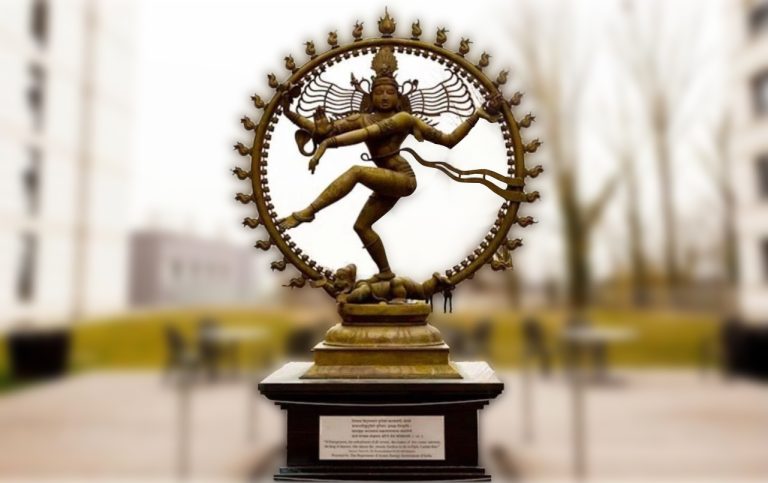
All you people itching to do tit for tat, demanding to know why the BJ Party made Shiva or Hanuman dance or flew a god-shaped kite, do you not remember that we did all of this, and much worse (if that’s the word you’re looking for), long before these self-appointed protectors of the Hindu religion arrived, and nobody batted an eyelid? That Ganapati spent ten days every year in Pune and Mumbai dressed as a cricketer, a film star, an astronaut, or whichever politician was in the news, and people thronged the pandals precisely to admire, laugh at, photograph, and judge the most outrageous ones? That we cracked jokes about Lambodara and Marutichi sheput, about Parvati running away and Mahadev giving chase, about Narada wandering about stirring up trouble, and about Indra, king of the gods, somehow landing himself in yet another mess involving jealousy, insecurity, lust, terrible judgement, or all four at once?
We grew up on stories in which the gods were anything but sanitised. There was adultery and murder, vanity and deception, greed and envy; rishis who had supposedly conquered worldly desire spent centuries in tapasya only for an apsara to turn up and demonstrate that enlightenment had loopholes; Menaka interrupted Vishwamitra’s penance, Urvashi desired Arjuna and cursed him when refused, and sages lost their tempers so spectacularly that kingdoms, dynasties, and generations yet unborn paid the price, because anger management was evidently not on the gurukul syllabus. Durvasa’s temper alone kept half the Puranas in business.
And we accommodated, quite happily, gods who would give today’s self-appointed guardians of propriety an aneurysm: gods who drank, gods offered liquor and meat, deities of feasting and fertility and blood and intoxication and death; Shiva himself wandering the cremation grounds smeared in ash, trailed by ganas and ghosts, serpents for jewellery and bhang for company, until it was time to become Nataraja and dance the universe to its end. Bhairava took his offerings in alcohol, Kali appeared bloodied and wild-haired amid all the imagery of death, and countless folk and local traditions combined devotion with practices that sit rather awkwardly inside the sanitised, homogenised, vaguely Victorian Hinduism now being sold to us as the only one that ever existed. Even death was not politely hidden away: Yama presided over it, Chitragupta kept the accounts, vetalas occupied corpses, kings conversed with the dead, goddesses wore garlands of skulls, and entire bodies of stories let ghosts, ancestors, gods, humans, and demons wander in and out of each other’s worlds without anybody demanding a certificate of decorum.
Nor did divinity bother to conform to respectable human form. We had an elephant-headed god riding a mouse, a warrior goddess on a tiger, Hayagriva with the head of a horse, Narasimha half man and half lion, Hanuman who was monkey and warrior and scholar and diplomat and devotee all at once, Garuda between man and eagle, the Nagas in that wonderfully strange territory between serpent and human, and gods with four arms, ten arms, several heads, third eyes, blue throats, snakes for ornaments, skulls for garlands, and vehicles ranging from mice and peacocks to owls, bulls, swans, and makaras. A religious imagination this fantastical, and we have decided that its gravest concern today ought to be whether somebody has depicted Hanuman dancing.
Sacredness never meant putting everything behind glass either. We put Om on clothes, rings, lockets, keychains, calendars, shop signs, trucks, and our own bodies; we printed hymns on things that travelled through ordinary life with us; there was a Hanuman sticker on the back of every second truck, Ganapati on schoolbags, Shiva on T-shirts, mantras on bracelets, deities tattooed on arms, and nobody assumed that the sacred had been insulted merely by turning up in an ordinary place. We drew Laxmi’s tiny footprints from the doorstep into the house every Diwali, inviting the goddess of wealth to walk in off the street like an expected guest; we wrote Shri on the first page of every new ledger and stamped her image on cash boxes, calendars, and wedding invitations; and we made children touch their foreheads to books, pens, and instruments because Saraswati lived in them, so that no child who accidentally kicked a notebook escaped without an apology to the goddess. We flew kites shaped like gods and gave children toys of Hanuman and Ganapati; a mechanic invoked Vishwakarma, a restaurant called itself Annapurna, shops were named Ganesh and Balaji and Durga and Laxmi and Mahadev, and even a liquor shop could carry a divine name without anybody declaring the end of civilisation and organising a mob about it. Perhaps that was because we understood, intuitively, that the sacred does not become less sacred by entering everyday life; our gods were everywhere because they belonged everywhere, in Sanskrit shlokas and children’s cartoons, in exquisite temple sculpture and gloriously kitschy calendar art, in elaborate pujas and family jokes, and no imperfect representation ever became an exhibit in a blasphemy trial conducted on social media.
And we laughed at them: at Ganapati’s stomach and Hanuman’s tail, at Narada’s meddling and Indra’s insecurity, at Krishna’s mischief and Shiva’s gullibility, at Shiva and Parvati bickering over a game of dice like any long-married couple, at sages who could alter the fate of kingdoms with a word yet could not count to ten before cursing somebody. We laughed because they were ours. These were gods you could complain to, bargain with, tease, dress up, feed, wake in the morning, put to bed at night, sing to, dance for, carry through the streets, and finally lower into the water while promising to meet again next year; goddesses you could welcome like family, Gauri arriving in Maharashtrian homes as a married daughter come back to her maher for a few days, fed her favourite things, adorned, fussed over, and sent off with a heavy heart; divine, yes, and also woven into family, neighbourhood, language, food, theatre, music, and childhood. Their stories survived because generations of Indians argued with them, exaggerated them, contradicted them, regionalised them, sang them, painted them, performed them, and occasionally took the piss out of them. A religion confident of itself does not need its gods to behave like humourless political functionaries under permanent security cover.
Which is why I find this urge among those opposed to the Right, this itch to turn the tables, so disturbing. When someone on their side shows Shiva dancing or dresses Hanuman oddly, and we respond with “Aha! Imagine if WE had done this to YOUR god!”, we do something far worse than score a point: we accept the very premise that got us here, that religion is territory requiring guards, that gods need protection from human beings, that taking offence confers moral authority, and that the correct answer to somebody else’s intolerance is a demonstration of our own. And whose god is “your god” anyway? Demand reverence, police representations, maintain ledgers of insults, comb photographs and videos for blasphemies to pin on the other side, and it will not matter that we began ironically; perform an intolerance long enough and nobody, including us, will be able to tell it from the real thing.
I would much rather reclaim the gods they have taken from us, because those gods were far more interesting than the permanently offended versions now on offer. Give me Mahadev in the cremation grounds, ash-smeared and surrounded by his bizarre ganas, dancing, loving, sulking, granting boons far too readily, and leaving Vishnu to clean up the consequences; give me Narada cheerfully setting another cosmic quarrel in motion, Indra panicking because some rishi has been meditating for suspiciously long, Durvasa losing his temper yet again, Kali terrifying everybody, Krishna stealing butter, Ganapati trundling along on his mouse, and Hanuman streaking across the sky. Give me gods who feast and quarrel, boast and sulk, err and forgive, who terrify us one minute and make us laugh the next, whose stories were told by people who understood that divinity does not have to be fragile in order to be sacred. And give me Ganapati in a ridiculous costume at a Pune pandal, surrounded by people laughing, admiring, arguing, and taking photographs.
Those gods were never in danger from us. We were the ones who stood waist-deep in the water every year, begging them to come back.