I have been on social media since the 1990s, from the early BBS (Bulletin Board Services) and all the way through chat rooms, messaging apps, forums, and now AI bots, and the one thing I can tell you that has remained unchanged is that people love to argue.
Unfortunately, as I have realised over the past 25 years of social media, there is one more painful truth I have come to realise: People do not know how to construct an argument.
And I am not talking of the unlettered or uneducated trolls. I am not even speaking of the young and hot-blooded. I see mature, educated, well-travelled, well-read people unable to, figuratively, throw a straight punch.
The more I thought about why this is so, the more I realised that there is something deeper than ails us, not just in India, but I will confine myself to this country and its citizens. And that something is a lacunae in our education, in the syllabus we are taught, and when & how we are taught it.
There are four major pillars that are missing, and they are so interconnected that I would not know where to start. But let me try by listing what we do right first:
- Mathematics remains strong. Governments have experimented with pedagogy and tinkered with syllabi, sometimes clumsily, yet no serious faction has questioned the necessity of mathematical rigour. We still expect children to calculate, to abstract, to reason numerically, and to generally have numerical awareness and literacy.
- Languages, too, have survived ideological turbulence. We debate medium of instruction, mother tongue, English dominance, Hindi imposition, cultural erosion, and try and create new rules to satisfy some civilisational inferiority complex or pander to some voter block, yet in practice we allow parents, institutions, and teachers considerable autonomy. Students learn to read, to write, to speak in different languages with ease (mostly).
- Geography proceeds undisturbed. Rivers flow where they flow, tectonic plates move without parliamentary approval, and the monsoon refuses to align itself with political, religious, or social narratives.
- History, of course, is the first subject to be rearranged whenever a new government settles into office. More battles, in my opinion, have been fought over what, who, and how much should be taught than were actually fought in history. It appeals deeply to ideological instincts because it offers narrative legitimacy, not merely for the present, but retroactively for the past. That said, many scholars far more rigorous than I have analysed this tendency in detail, and so I am content to leave that particular battlefield to them.
So, not languages, not mathematics, and not history or geography. What, then?
Scientific Method
We are taught science in school, but almost never the structure that makes it reliable in the first place. We memorise laws, solve equations, and repeat conclusions, yet we are rarely taught what the scientific method actually is: systematic observation, forming a hypothesis, testing it through experiment, insisting on replicability, submitting results to peer review, and above all ensuring that claims are falsifiable, meaning they can be proven wrong. We are seldom shown how this method developed, how it is criticised, and how it improves itself over time.
That gap matters. When we do not understand the method, we start confusing today’s conclusions with the process that produced them. If a medical recommendation changes or a treatment shows limited success, we see it as proof that science is shaky, instead of recognising that revision is part of how science works.
When a particular drug fails, or results are modest, it becomes tempting to doubt the entire system. From there, it is easy to say that if scientific outcomes are uncertain, then all uncertainties are equal, and that traditional beliefs and rigorous research deserve the same standing.
One must admire Arthur C. Clarke’s observation that any sufficiently advanced technology is indistinguishable from magic, but to invert it to claim that therefore all magical-sounding claims are simply sufficiently advance technology we do not understand yet is simply silly.
Evolution by Natural Selection
Indian syllabus creators have, in their immense wisdom and occasionally questionable priorities, decided to postpone Darwinian evolution until the tenth and twelfth grades, and even then to treat it as one more examinable chapter in an already crowded syllabus. From personal experience, it is often skimmed in precisely the subject where depth and detail matter most. This approach overlooks a simple truth: evolution is not an optional add-on to biology; it is the organising principle that makes biology intelligible.
Evolution explains why organisms look the way they do, why systems adapt, why complexity emerges gradually rather than magically. It rests on a clear mechanism: variation, selection, and replication across time. Wherever these conditions exist, change accumulates. The insight has even been extended, cautiously, to domains beyond biology, including the evolution of ideas and cultural practices. Whether or not those extensions always succeed, the core biological principle remains one of the most powerful explanatory tools humanity possesses.
There is a moment, when one truly understands natural selection, when scattered observations begin to cohere. Diversity makes sense. Adaptation makes sense. Even failure makes sense. Patterns that once appeared arbitrary reveal structure. Humility follows, because evolution does not centre human preference; it centres survival and replication within constraints.
Without a deep and intuitive grasp of evolution, the mind remains vulnerable to simplistic narratives. Complex phenomena, gradual processes, random variation, and other clear markers of natural selection are interpreted as conspiracy and intention. A population poorly trained in evolutionary thinking is more easily seduced by fake news, grand myths, and tidy stories that promise comfort instead of truth, which as you will agree, is a dangerous path to be on.
Civics & The Indian Constitution
Civics has long lived in the shadow of history. It deserves independence.
In the earliest years, civics should begin with responsibility. Responsibility toward shared spaces, toward truthfulness, toward cooperation. Children understand responsibility before they articulate rights.
As students mature, the structure of government, separation of powers, federalism, rights and duties should become familiar terrain. In high school, constitutional study must deepen. Selected Articles should be read directly. Amendments examined for context and consequence. Landmark Supreme Court judgments discussed as turning points in the interpretation of liberty and equality.
Students should encounter the debates of the Constituent Assembly. They should read Dr. B. R. Ambedkar on constitutional morality and justice. Ambedkar warned the Assembly that “Constitutional morality is not a natural sentiment. It has to be cultivated.” That cultivation cannot be outsourced to chance or adulthood.
They should also understand the living safeguards built into the document. In Kesavananda Bharati v. State of Kerala (1973), the Supreme Court held, by a narrow majority, that Parliament’s power to amend the Constitution is not unlimited. The basic structure doctrine emerged from that judgment, affirming that essential features such as constitutional supremacy, democracy, secularism, federalism, separation of powers, and individual dignity cannot be destroyed even by amendment. Students should grasp why such limits exist and how they protect the constitutional framework from legislative excess.
Legal literacy must accompany this immersion. How laws are made. How they are challenged. What judicial review means. What due process entails. What reasonable restrictions look like in practice.
The right to dissent and peaceful protest should be taught explicitly, with clarity about its structure and limits. Democracy depends upon citizens who understand both power and its boundaries.
Freedom erodes when citizens do not recognise its edges being redrawn.
Philosophy as Discipline
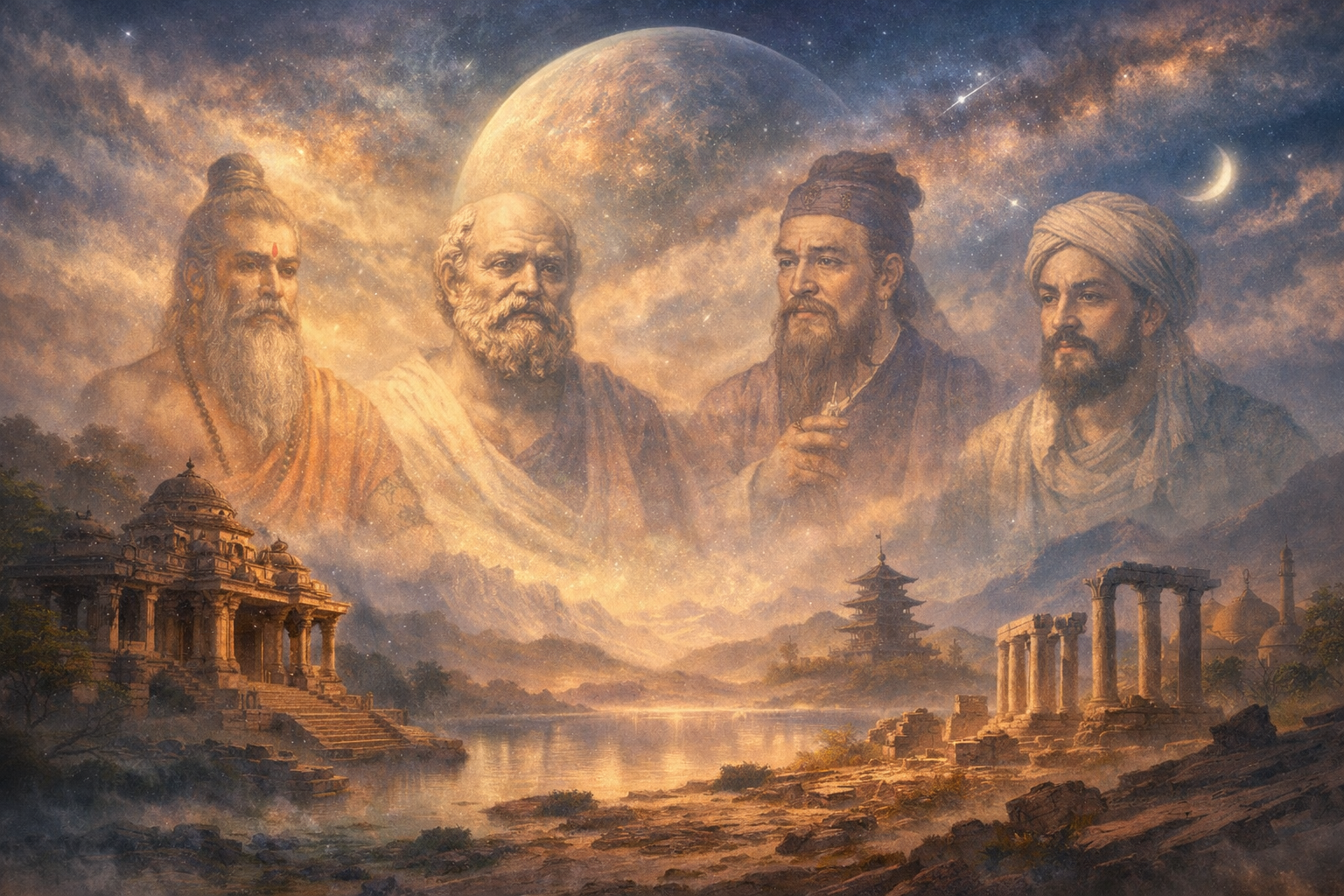
Civics without philosophy becomes mechanical. Philosophy without civics becomes abstract.
Logic must be taught deliberately. Premises, conclusions, valid inference, fallacies. Students must practise constructing arguments and dismantling weak ones. They must recognise ad hominem attacks, false binaries, hasty generalisations, appeals to popularity, and the confusion between correlation and causation.
Ethics must follow. We inherit morality from our families and communities. Ethics teaches us how to examine that inheritance. Competing frameworks of justice, harm, equality, duty, and consequence should be explored with seriousness.
Political philosophy belongs here as well. Ideologies are structured responses to enduring questions about freedom, authority, and equality. Students should understand these intellectual traditions before adopting them as identities.
Spiritual and metaphysical inquiry should find space within philosophy. Questions of meaning, belief, and transcendence can be examined philosophically rather than tribally.
These strands reinforce one another. Courts reason ethically. Laws encode moral assumptions. Ideologies shape constitutional amendments. Logic underpins both science and jurisprudence.
Without this foundation, public discourse collapses into assertion.
Education as Innoculation
The dysfunction visible on social media is not born there. It is amplified there.
Adults are difficult to retrain. Children are not.
If we treat civics, philosophy, scientific method, and evolution as core disciplines right off the bat in our schooling, we build citizens capable of reasoning before reacting.
Artificial intelligence will generate information at scale. It will not generate judgement. Democracies depend on citizens who can recognise overreach, evaluate evidence, dissent responsibly, and revise beliefs without surrendering coherence.
We have spent decades rearranging historical narratives. The more consequential reform lies in strengthening the intellectual foundations that shape how citizens interpret those narratives.
Think of this as vaccination, as innoculation against misinformation, against fake news, against gullibility. If we fail to teach children how to think about power, morality, evidence, and change, the loudest voice in their pocket will teach them what to think instead. And that, my friends, is a recipe for disaster. A disaster we are already living through.