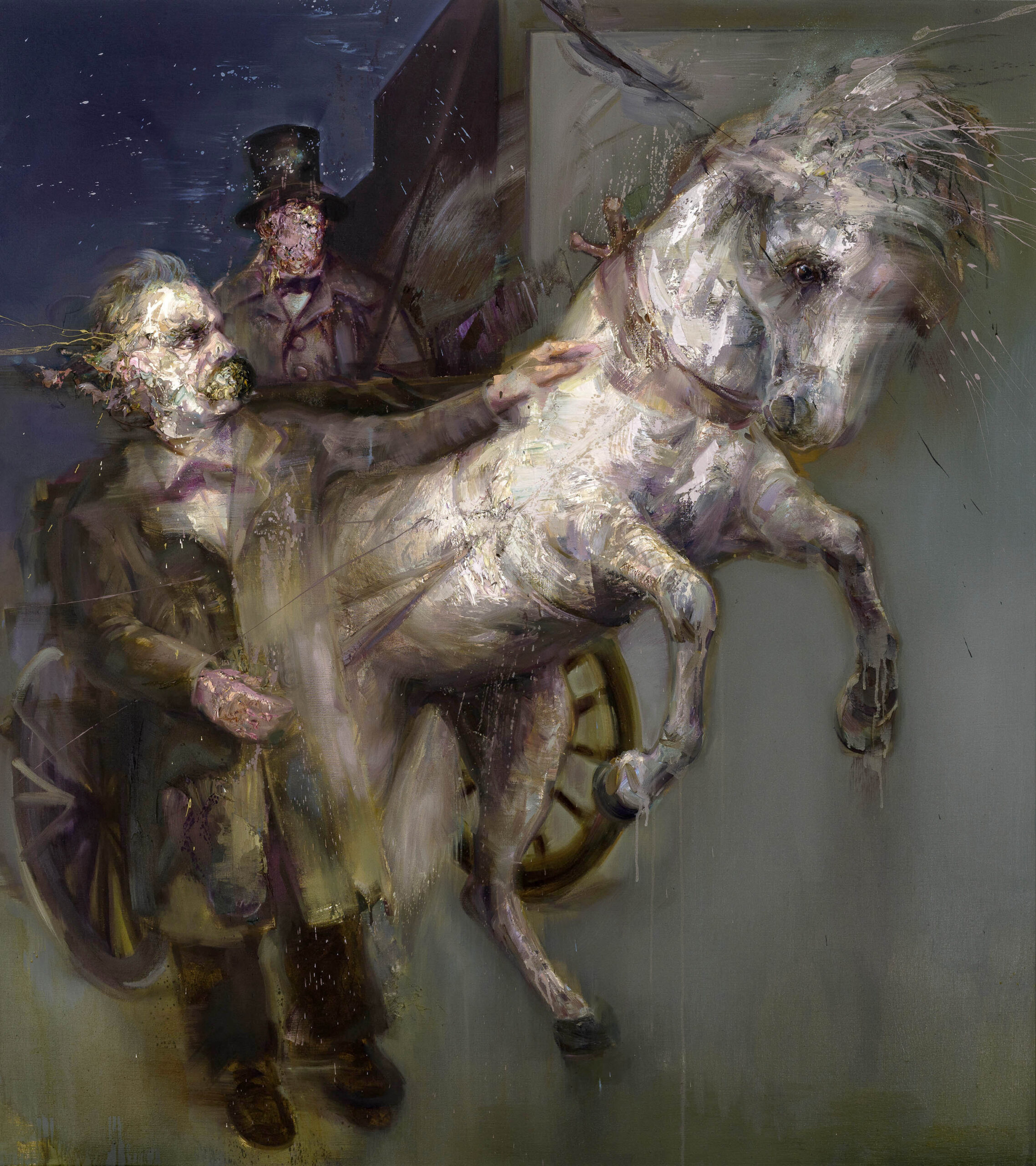
Image: The Turin Horse and Friedrich Nietzsche by Mathieu Laca – oil on linen
I am puzzled. Sad. Angry. Tired. Scared. Apprehensive.
But mostly, I am disappointed.
Now, disappointment is a layered thing. It has gradations. And the layer you find yourself in depends rather entirely on whom, exactly, you are disappointed with.
The first layer is the easiest to bear: I am disappointed in those I have always opposed. But that, as they say, is par for the course. Being disappointed in a pickpocket for picking your pocket is a bit like being surprised that the monsoon is wet. The pickpocket is simply doing what the pickpocket does. It is their Dharma, if you will; their calling, their craft, their raison d’être. One does not waste the good china of one’s emotional reserves on the predictable.
The second layer stings a little more. I am disappointed in those I thought were my allies. The people and institutions I had allied with, believed in, even defended vehemantly in public. These are the police officers of our little metaphor; the ones whose job it was to ensure the pickpocket never got close enough to be a problem in the first place. They failed. And that failure is more painful than the original crime, because it came with a warranty that was never honoured. But even here, one must be honest: the police officer, like the pickpocket, is ultimately a third party. One can curse them. One should, really. But to direct too much emotion their way is, in the end, a distraction from a far more uncomfortable reckoning.
Which brings me, with some reluctance, to the third and deepest layer.
Myself.
Because, you see, I was naive enough to believe that the world operates on some basic principle of order. That there is karma, fairness, a cosmic sense of proportion. That the system would work, justice would prevail, the culprit would be caught, and the scales of the universe would, with a satisfying click, return to equilibrium. I believed this with the serene confidence of a man who has never once considered that he, too, has a pocket worth guarding, and a responsibility to guard it.
I was, to put it plainly, fondly delinquent in my own duty.
And so the chain of blame, long as it is and well-populated with pickpockets and failed constables, must ultimately begin and end at my own door. I knew the neighbourhood. I had been warned about the neighbourhood. I walked through the neighbourhood with my hands in my pockets, whistling cheerfully, mildly affronted that anyone would suggest I take precautions.
That is the disappointment that cuts deepest. Not in the obvious villains, who were only ever being themselves. Not in the self-appointed saviours, who turned out to be human. But in myself, for the breathtaking, almost heroic quality of my own naivety.
Of course, we are not actually talking about pockets here.
We are talking about my sense of justice. Of fairness. Of right and wrong. Of the basic, stubborn belief that this universe is, beneath all its noise and chaos, a place where things eventually make sense.
We are speaking of, as the smart reader must have figured out by now, my sanity.
So, question: In these times, is yours intact or broken? If broken, who do you blame for it? And if intact, tell me how you do it and more importantly, why you choose to lie about it.