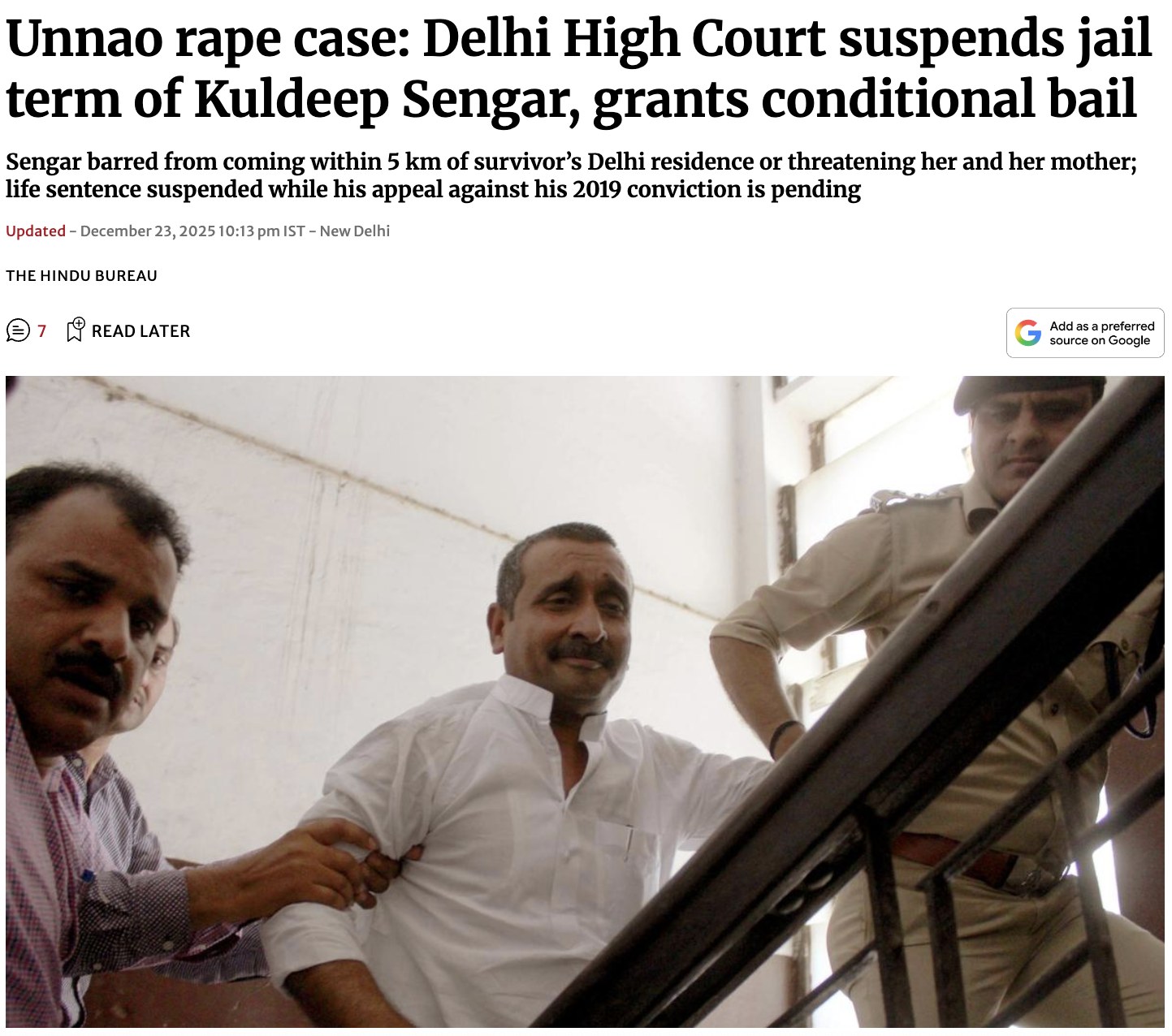
In any Indian film (or, for that matter, in almost any popular cinema anywhere), Kuldeep Sengar would meet his grisly end at the hands of a vigilante, the victim’s brother, the women of the village who finally rise together, an honest cop, the victim herself, a gang member (or his wife or offspring) who has lived under his boot all their lives and discovers redemption in destroying him, or even his own mother or father who have shielded him forever before realising their error. These are not exotic fantasies. They are familiar, repeated tropes because they satisfy a deep audience instinct that some acts rupture the world so completely that only finality, with all the blood and related gore, restores balance.
So strong is this instinct that even a judge sentencing such a character to life imprisonment would feel, on screen, like an anticlimax. The audience would walk out dissatisfied, feeling that the story had cheated them. Prison would appear too lenient, too procedural, too small for the horror that preceded it. The punishment would not match the crime in emotional terms. This is not bloodlust so much as a demand for narrative proportionality, a belief that extreme cruelty requires an extreme reckoning if the moral universe of the story is to make sense.
And yet, in real life, this very audience returns to the ballot box and votes for the same political order that produced, protected, and normalised such figures. Power is quietly exculpated of the crime of bad governance, as though brutality and impunity were acts of fate rather than outcomes of political choice. The suffering is absorbed into a loose, comforting idea of karma, detached from the state, the vote, and responsibility itself. A civilisation that insists on cosmic moral accounting somehow absolves earthly authority altogether.
There was, however, a moment when this spell had begun to break. The freedom struggle created a groundswell in which people long trapped in cycles of caste, rebirth, and resignation started asking an entirely new question of power: why do our lives not matter to those who rule us? Representation, dignity, and wellbeing were no longer metaphysical concerns but political demands. The adoption of the Constitution marked a decisive turn away from fate and towards responsibility, a framework that insisted that the state answer to the weakest citizen, not merely to tradition or force. Mahatma Gandhi captured this moral inversion in his talisman, urging lawmakers to measure every decision against the face of the poorest and most vulnerable.
What we are witnessing now is a deliberate undoing of that hard-won clarity. The Right wing’s greatest coup has not been electoral, cultural, or even ideological, but moral. It has trained citizens to once again treat governance as destiny, injustice as spiritual arithmetic, and cruelty as something that simply happens rather than something that is enabled, protected, and rewarded by power. By reviving an older habit of mind, one in which kings are not blamed and suffering is metaphysicalised, it has quietly severed the link between vote and consequence. Democracy cannot survive that severance. It depends on the insistence that power be named, judged, and replaced when necesssary. When that insistence dissolves, cinema continues to know exactly how villains should end, but politics forgets who put them there in the first place.