And so, having announced my intentions in what was meant to be only a short trailer (and already long enough to try the patience of anyone who has not learnt to endure my peculiar style of long sentences and longer digressions), I suppose I must now get on with the first instalment, which is, in the manner of all such beginnings, not really a beginning at all but an attempt to stitch together many threads of history that have very little in common except that they have all, in one way or another, deposited Indians in corners of the world where they were never really expected to be, and where, by some combination of sweat, silence, and stubbornness, they ended up staying.
Because the truth is that there was never a single “first migration,” no dramatic moment where Indians en masse decided to pack their trunks and head West, but rather a series of overlapping flows, some voluntary, some less so, some aspirational, some frankly desperate, and each leaving behind a very different kind of diaspora.
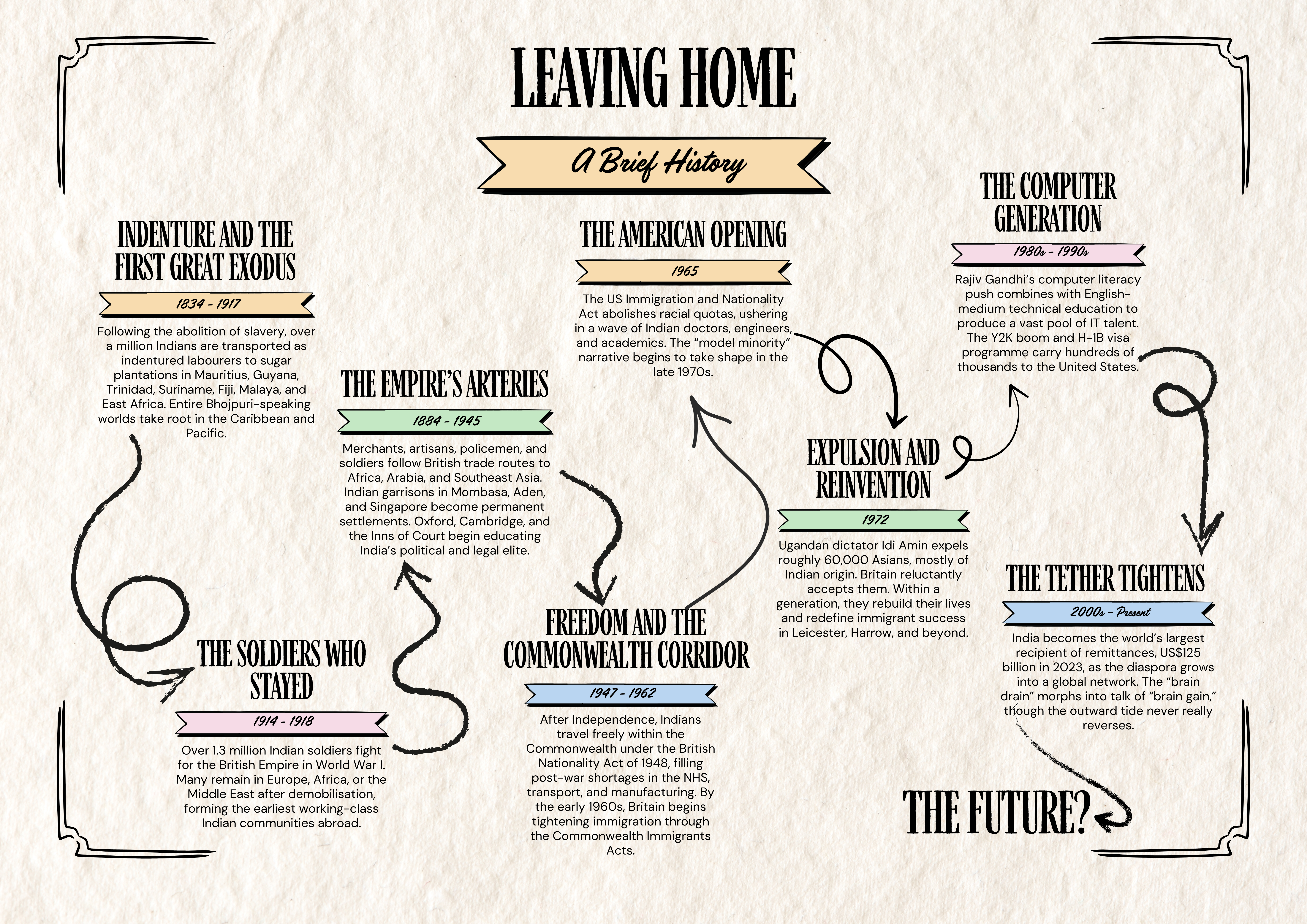
There was, to begin with, the great wave of indenture after the abolition of slavery, when between 1834 and 1917 over a million Indians were shipped off to work the plantations of Mauritius, Guyana, Trinidad, Suriname, Fiji, Malaya, Natal, and elsewhere, many of them never to return, their descendants today speaking Creole and Bhojpuri-inflected English rather than anything recognisably Indian. And then, quite separately, there were those who travelled as free traders, as artisans, as policemen and soldiers following the empire’s arteries into East Africa, into Southeast Asia, into the Middle East, some to Hong Kong and Singapore, others to Zanzibar and Mombasa, each finding niches in the imperial economy, each eventually calling those places home.
And then, after World War I, there were the sepoys and cavalrymen and mule drivers of the British Indian Army, who had been dispatched to France and Mesopotamia and East Africa, and who, when the guns fell silent, did not all hurry back to their villages in Punjab or Uttar Pradesh but sometimes chose to remain where they had fought, demobilised but not dislocated, adding another quiet strand to the Indian presence abroad. Back in India, meanwhile, the interwar decades were years of political upheaval and economic strain, with famines, communal strife, and the slow crumbling of imperial legitimacy, and it is not hard to see why some Indians might have thought that a small shop in Nairobi or Durban, however precarious, was a safer bet than a field in Bihar or a mill job in Bombay.
At the same time, there was the altogether different current of the colonial elite, the young men (and they were almost always men, and almost always from privileged castes and classes) who made their way to Oxford and Cambridge from the mid-nineteenth century onwards, where they debated in the Oxford Majlis (founded in 1896), took tea at the Indian Institute (established 1884), and learnt, often by osmosis, how to argue like parliamentarians, how to think like lawyers, how to speak in the cadences of a House they might never enter, only to return to India later and become its lawyers, its politicians, its agitators, its framers of Constitutions, its Prime Ministers and Presidents and dissidents. And of course, not all of this required Oxbridge polish, for there were also the Inns of Court in London, the Inner Temple, the Middle Temple, Gray’s Inn, Lincoln’s Inn, which trained an entire generation of Indian lawyers whose English wigs and gowns concealed, at least for a while, their ambitions to one day discard both wig and master and claim the bar of their own country. One must admit, without false modesty, that without those institutions, Indian politics would have looked very different, and perhaps, dare I say it, even less argumentative (which is to say, hardly Indian at all).
After 1947, of course, the pattern shifted. No longer colonial subjects, Indians became Commonwealth citizens, and under the British Nationality Act of 1948, many thousands arrived in Britain not as curiosities but as workers in the NHS, in factories, in the transport system, as junior doctors, nurses, and engineers, their labour desperately needed in a battered post-war economy. But, as always, gratitude was short-lived, and the Commonwealth Immigrants Acts of 1962 and 1968 began to close the door, transforming what had seemed like an open corridor into a narrow funnel, through which only the credentialled and the fortunate could squeeze. Then came Idi Amin’s expulsion of the Ugandan Asians in 1972, which at first looked like disaster, as nearly 60,000 Indians were forced to flee overnight with barely more than a suitcase, but which, paradoxically, accelerated Indian consolidation in Britain: the refugees rebuilt their lives with quiet resilience, their small shops and motels becoming symbols of industriousness, and within a generation they were being hailed as proof of immigrant grit, the very embodiment of the “model minority.”
And across the Atlantic, America too discovered Indians, though not before the Immigration and Nationality Act of 1965 removed its own racial quotas and opened the door to highly skilled professionals. From the late 1960s onwards, a new wave of Indian doctors, engineers, and professors established themselves, small at first, then gathering momentum. Back in India, it was Nehru’s Five-Year Plans that had already set up the IITs and IIMs, producing engineers and managers in numbers far exceeding what India itself could absorb, and then came Rajiv Gandhi in the mid-1980s, introducing computers and basic programming into schools and universities, seeding a generation of English-speaking, tech-literate engineers by the hundreds of thousands, if not millions, just in time to ride the Y2K wave. By the 1990s, the IT boom and the millennium bug panic turned Bangalore, Hyderabad, and Chennai, and later Pune and Gurgaon, into pipelines for the H-1B visa programme, and by the year 2000, Indians were the single largest beneficiaries, a dominance that remains to this day. In FY2023, for instance, USCIS approved more than 386,000 H-1B petitions, and Indians made up over 70% of them, a statistic so lopsided that one wonders whether Silicon Valley might collapse altogether if Indians one day decided to collectively stay home (that was an attempt at sarcasm; in reality, no, it won’t, despite the mistaken impression that a lot of NRIs seem to harbour due to hubris).
It was in this late twentieth-century moment that the myth of the “model minority” began to crystallise, at least in the West. Indians, it was said, were polite, industrious, deferential, and competent, which in translation meant they worked hard, kept their heads down, earned more than average, and did not frighten the neighbours. They sent their children to the best schools, they avoided politics, they avoided religion as a topic (at least in public), they did not raise their voices. And in numbers, they excelled: Indian-American households now report median incomes of US$145,000, far above the American average, with personal earnings of around US$106,000 among full-time workers, while in Britain the “Ugandan Asians” who had been received with suspicion in the 1970s became by the 1990s the backbone of thriving Leicester and Harrow neighbourhoods.
But none of this migration was ever simply about individuals making it alone, for Indians, whatever they claim about independence of spirit, have always been tribal at heart, and so they married Indians from back home, or summoned spouses from their own caste and community, and slowly extended the line from one man in a hostel room in Wembley or New Jersey to entire families and then entire villages abroad, funded by remittances that not only kept parents afloat but built houses, paid dowries, and established credibility in the lanes they had left behind. In fact, India has, for years now, been the single largest recipient of remittances anywhere in the world, US$125 billion in 2023 alone, more than Mexico or China or the Philippines, and every one of those dollars represents both the tether that ties the migrant back to his village and the slow growth of a diaspora that was never meant to be permanent but has, by sheer persistence, become so. The Indian abroad was never really abroad, for the Indian abroad was always tethered, and in tugging his kin along, he steadily increased the diaspora’s size until it was no longer an outpost but a presence.
And if one listens closely, there is irony too, for while Indian policymakers spent the 1970s and 1980s lamenting the “brain drain” and occasionally calling their best and brightest home, Indira Gandhi famously asked scientists and academics to return and some did, the reality is that the outward flow never really stopped, and only much later, in the 2000s and 2010s, did a trickle of returnees try to reframe the story as “brain gain.” Yet the diaspora’s gravitational pull remained the stronger force, and India learnt to console itself with remittances, pride in global CEOs, and the occasional Pravasi Bharatiya Divas celebration.
But of course, all haloes cast shadows, and this one hid plenty. Behind the gleaming averages were the Gujarati corner-shop owners working sixteen-hour days in Birmingham, the Malayali nurses in Gulf hospitals who endured both drudgery and discrimination, the Sikh taxi drivers in New York who never featured in Forbes profiles, the families who struggled quietly with mental health crises, marital discord, and intergenerational tension, but who had no language in which to speak these aloud, because it was easier to wear the badge of success than to explain its costs.
And yet, to look at the arc as a whole, one cannot deny that the model worked, at least for a time. Indians abroad became known as the quiet achievers, the reliable hands in the operating theatre, the diligent coders in the back office, the neighbour who was polite if not especially sociable. It was a stereotype that was, in its own way, flattering, and it bought (yes, without the ‘r’; that’s not a typo) acceptance, mortgages, and places in good schools.
That said, success without noise is never permanent, and silence, like all bargains, has an expiry date. The first generation was too busy surviving, the second too busy proving itself, but the third, born citizens, born entitled to their place, has no intention of being polite forever. And so the halo, never built to last, begins to slip, and the noise, which was always there, begins at last to be heard.
And it is that noise, now rising in decibels across campuses and community halls, across online groups and political rallies, across living rooms and festive celebrations, that we shall turn to next: the moment when the once-model minority begins to speak for itself, sometimes wisely, sometimes foolishly, often loudly, and almost always revealing far more about its insecurities than its confidence. The age of quiet success has passed; the age of noisy identity has begun. We explore this in the next part (whenever I write it): The Cacophony: Noise Without Success. Stand by.