Every nation has its myths, and every democracy has its secret. Ours is simple to state and difficult to accept. India is not democratic because Indians are democratic. India is democratic because the Constitution exists, and because the Constitution has come to be associated with a man whose life, ideas, and moral standing have made it something more than a legal document. Only this explains why a civilisation that never experienced equality in its social structure still insists on retaining a political vocabulary built entirely upon it. It explains why a society that reveres hierarchy at home nevertheless votes with near-religious enthusiasm for its governments and guards its electoral rituals with a passion often absent in its civic life. It explains why, in a land where obedience is often seen as virtue, the idea of rights continues to smoulder even in the most unequal corners.
But this attachment did not emerge in 1950. It grew slowly, almost unintentionally, from the peculiar, even improbable, circumstances of our founding. When the Constitution was adopted on 26 January 1950, India had no democratic tradition to fall back upon. We had no centuries of flattening, no Reformation, no Renaissance, no capitalist upheaval that redistributed dignity along with wealth, no revolution that had turned subjects into citizens before the law could recognise them as such. We had fought an empire, but we had not fought the social order beneath it. We had expelled the British, but we had not expelled hierarchy. In truth, we had not even fully quarrelled with it.
The Constituent Assembly understood this. It is why the debates from 1946 to 1949 read like a strange dialogue between the country that existed and the country that was being summoned into existence. There is a tension on every page between the gravity of social reality and the ambition of political imagination, between those who saw democracy as a wager worth taking and those who feared that the burden was too great. In this labyrinth stood Bhimrao Ramji Ambedkar, appointed Chairman of the Drafting Committee not because he commanded political strength but because he commanded intellectual authority. He was an outsider twice over, rejected by his own society and repeatedly defeated in electoral politics, yet became the architect of the most powerful social transformation India had attempted. Only an outsider could see, without sentiment, the architecture that needed to be dismantled.
His authority was moral long before it was constitutional. The anti-caste movements of Maharashtra, shaped by Phule and Shahu and carried forward by Ambedkar’s own political and scholarly leadership, had already forged a language of equality that struck at the moral core of Hindu society. In the south, Periyar’s rationalist revolt created a parallel and equally fierce critique of hierarchy, even though it developed independently of Ambedkar’s politics. And decades after Ambedkar’s passing, Kanshi Ram would carry his ideas far beyond their regional origins, giving them a national organisational force that Ambedkar himself never witnessed. These were separate traditions, born of different histories, yet all converged upon the truth Ambedkar embodied most completely, that equality cannot be negotiated or postponed. He did not merely criticise caste; he demanded its annihilation. He did not merely seek reform; he sought liberation. And so, as the Constitution took shape under his hand, millions who had no place in the old Indian order began to see themselves reflected for the first time in the new one. It did not matter that the drafting was collaborative or that Nehru, Patel, Alladi Krishnaswami Ayyar, K M Munshi, and others shaped vast portions of the text. What mattered was that Ambedkar’s moral argument formed its spine, the principle on which the republic could not bend without breaking.
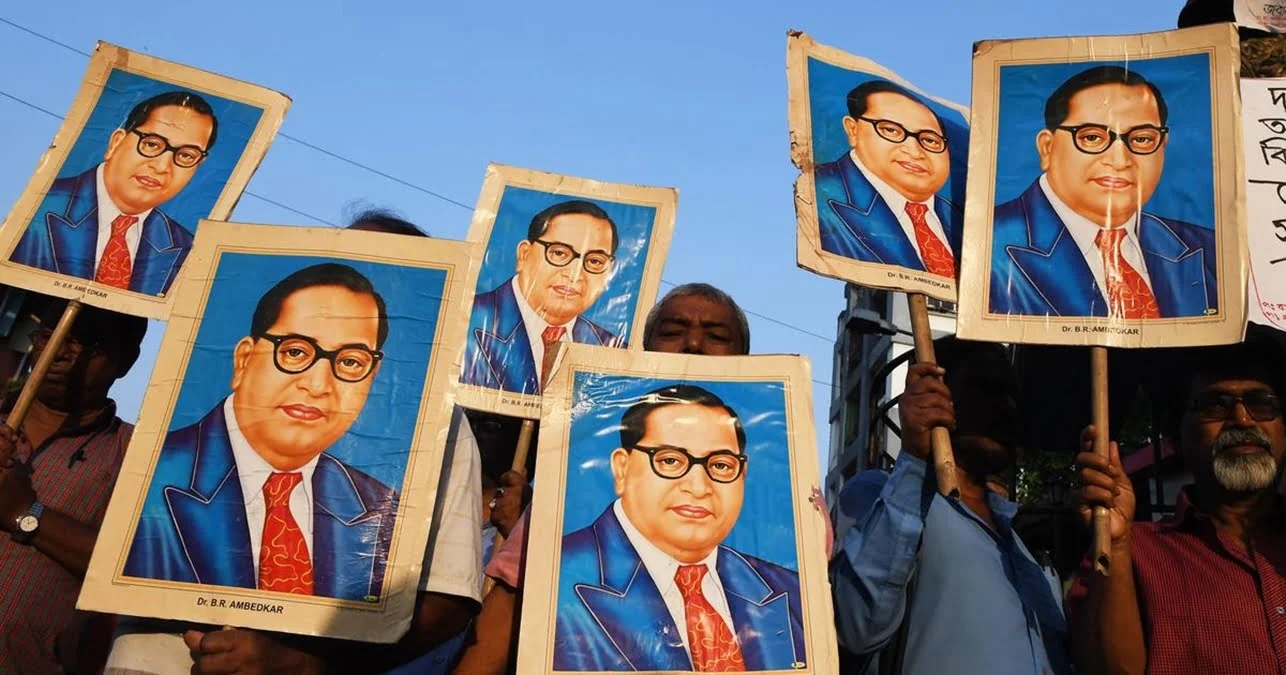
This is why the Constitution became sacred. Not because it was perfect, nor because it was understood, but because it was theirs. Not theirs in authorship, but theirs in aspiration. It promised to millions what India had denied them for millennia. Ambedkar’s association with that promise turned the Constitution from a legal charter into a moral anchor, yet its sanctity also grew from something deeper and less articulated. For those whom civilisation had consigned to the margins, it was the first text in Indian history that acknowledged their full humanity without condition. It was the first document that did not ask them to wait, to obey, to purify, or to endure. It addressed them as citizens rather than subjects. As the decades unfolded, Ambedkar’s legacy travelled far beyond the geography of his lifetime, carried first by Dalit movements in Maharashtra, then by southern anti-caste assertions, and finally by Kanshi Ram’s nationwide reanimation of Ambedkarite politics, which transformed the Constitution from a statute into a symbol of collective dignity. The irony, of course, is that most who revere the Constitution today would struggle to explain its federal structure or quote its Articles or distinguish its Fundamental Rights from its Directive Principles. They do not defend it because they have read it. They defend it because they recognise who it defended first.
This reverence is simultaneously our weakness and our strength. It is a weakness because it replaces comprehension with devotion. It is a strength because devotion, in the absence of a democratic culture, is sometimes the only shield a democracy has. Millions of Indians, especially those at the bottom of the caste pyramid, consider the Constitution the guarantor of their humanity more than any devotional text or political ideology. For them, Ambedkar is not merely the Chairman of the Drafting Committee; he is the architect of dignity itself. Strip the Constitution of its moral force and you strip those communities of their primary source of protection. This is why any attempt to dilute its authority is met with a ferocity that surprises those who mistake Indian democracy for a purely electoral phenomenon.
And this is also why democracy, for all its fragility in India, refuses to collapse. Our institutions may wobble, our media may bend, our federalism may strain, our public reasoning may corrode, yet the Constitution retains a kind of untouchability that no government has yet succeeded in violating openly. Even the most powerful regimes feel compelled to swear allegiance to it, to invoke Ambedkar while quietly despising his philosophy, to celebrate the text while dismantling its spirit. That fear, the fear of touching the sacred, is the last meaningful check on authoritarian ambition in India. It is a peculiar safety valve, neither rational nor procedural, yet undeniably real.
Of course, this reverence cannot substitute for true democratic culture. For democracy to thrive, the virtues of equality must be lived, not merely litigated. They must enter the home as much as the ballot box, the office as much as the polling booth, the school playground as much as the courtroom. This has not yet happened in India. We remain unequal in instinct even while professing equality in aspiration. We treat the Constitution as holy, but equality as negotiable. We worship Ambedkar but rarely practise what he preached. We celebrate the right to vote while resisting the right of our domestic worker to sit on the same chair. We quote the preamble but preserve our prejudices. We defend democracy while preferring hierarchy.
Yet, even with all this, democracy has not perished. It is bruised, distorted, mocked, manipulated, yet somehow alive. And if it is alive, it is because the Indian imagination, for all its hierarchical inheritance, has found a single point around which equality can be defended without apology. The Constitution gives us that point. Ambedkar gives us that lineage. Our democracy survives not because we are democratic, but because we believe, however vaguely, that this document is a covenant we cannot break without breaking something inside ourselves.
So, is democracy possible in India. Yes, but not yet. And is democracy going away from India. No, because its foundations, though cracked, are held up by millions who have nowhere else to go. Democracy here is not the culmination of a long social evolution, as it was in the West. It is the beginning of one. It is not a reflection of our history, but a rebellion against it. It is not a testament to what India has been, but a wager on what India might yet become.
The question, then, is not whether India is ready for democracy, for we are clearly not. The question is whether we are willing to become ready, willing to undertake the long and uncomfortable labour of flattening a civilisation built on layer upon layer of inherited inequality. That labour will be the true test of our future, and until it is complete, democracy in India will remain what it has always been, improbable, precarious, and utterly indispensable.
And perhaps this, more than anything else, is our task. Not to glorify democracy as though it were a birthright, nor to despair at our unpreparedness, but to understand that we are living in the narrow space between the two, carried forward by a Constitution we treat as sacred and a society that has not yet learned to live up to it. If we can close that gap, slowly, painfully, deliberately, then democracy in India will cease to be a miracle and become a habit. Until then, it survives, not because we have earned it, but because we have begun, at last, to imagine it.
⸻
Afterword – The Work Ahead
When this journey began, it began with a question that refused to leave me. Is democracy possible in India at all. It was a question offered without malice or despair, simply as an invitation to think, and like all such invitations it opened a door that could not be easily closed. Over three parts, the question has grown rather than shrunk. It has become heavier, more intricate, more entangled with history and memory and the quiet stubbornness of social habit. And yet, even with all that, the answer remains what it was at the beginning. Yes, democracy is possible in India. No, it has not yet arrived in its full form.
The three parts of this series were simply three ways of approaching that unresolved truth. The first showed how democracy in the Western world was not a sudden illumination but the end product of centuries of levelling, bargaining, bloodshed, economic rearrangement, and philosophical rebellion. The second showed how India’s civilisational arc, older and deeper in many ways, did not undergo such levelling, and therefore carried its hierarchy intact into modernity. The third argued that despite this, democracy survives here because the Constitution became a moral refuge for those long denied dignity, and because Ambedkar’s association with that document endowed it with a sacredness that no regime has yet dared to breach openly.
Taken together, these three movements reveal a paradox at the heart of Indian democracy. We behave democratically in the polling booth, but not always in the home or the workplace or the street. We guard elections fiercely but do not always guard institutions with equal vigilance. We quote the Preamble but organise our social lives according to older grammars. We vote as citizens once every five years, yet often live the rest of our lives as subjects of birth, caste, wealth, language, or region. We defend the Constitution with passion, yet our everyday culture does not consistently reflect its values. This contradiction is not incidental; it is structural. It is the tension between a political architecture built on equality and a social inheritance built on hierarchy.
To understand our present, therefore, is to recognise the shape of this contradiction. India today is a democracy with rising inequality, an electoral powerhouse with fragile institutions, a society where caste has not disappeared but merely reinvented itself for modern life, a public sphere where democratic participation is high but democratic culture is thin, a nation where constitutional faith thrives even as constitutional morality struggles to find daily expression. None of this makes India uniquely flawed. It simply means that India is still building the soil that other democracies inherited long before they drafted their laws.
If democracy is to strengthen here, certain foundations cannot be ignored any longer. Social equality is not optional. Institutional integrity is not ornamental. Civic literacy is not an academic pursuit but a survival skill. The cultural rejection of hierarchy cannot remain confined to speeches or slogans; it must become visible in daily conduct. Without these, political democracy may survive, but it will remain fragile, brittle, and vulnerable to manipulation by those who understand the power of social deference better than they understand the duties of citizenship.
The work ahead, therefore, sits on several fronts, each of which demands patience rather than spectacle. We need an education system that treats constitutional values as lived virtues rather than examination chapters. We need empowered panchayats and municipalities that allow citizens to practise self-governance rather than outsource it entirely to distant capitals. We need economic pathways that enlarge opportunity and reduce the weight of inherited privilege. We need transparency that makes secrecy difficult and accountability unavoidable. We need a judiciary that commands respect through independence and restraint. We need a public discourse that can tolerate disagreement without reducing opponents to enemies. Above all, we need a cultural shift that treats casteism, sexism, and feudalism not as private quirks but as public offences against the idea of equal citizenship.
None of this will be accomplished in one election cycle or even one generation. Democracies mature slowly. They grow as people grow, through practice rather than proclamation, through friction rather than comfort. The West did not become democratic by virtue of enlightenment alone; it became democratic because its social conditions made equality imaginable long before constitutions made it enforceable. India must now travel that path in reverse. We already have the Constitution that demands equality; we must now build the society that can sustain it.
Yet, for all the difficulty of that path, there remains reason to hope. Democracy here survives not because we are fully democratic, but because millions believe that the Constitution protects them in ways no earlier order ever did. It survives because Ambedkar’s moral authority continues to outshine the ambitions of those who would rewrite the social contract. It survives because the vote has become, for the poorest Indian, an instrument of dignity rather than a ritual obligation. It survives because equality, though unevenly practised, has begun to enter the Indian imagination, and once it enters the imagination it becomes very difficult to erase.
So where do we go from here. We begin by recognising that democracy is not a birthright bestowed upon us in 1947, nor a finished project completed in 1950, nor an inheritance guaranteed by any single leader or party. It is a discipline, a habit, a culture, an ethic. It is something a civilisation must learn slowly, painfully, honestly. We are still learning. We are still unready. Yet we are not incapable. The Constitution gives us a map, even if the road remains unbuilt. Ambedkar gives us a compass, even if we have not fully learned to follow it.
India’s democracy is improbable, precarious, at times exasperating, yet utterly indispensable. It is not a reflection of who we are but a reminder of who we might still become. And if we continue the hard labour of equality, if we treat hierarchy not as destiny but as an obstacle to be dismantled, if we defend the institutions that defend us, then democracy here will cease to be a miracle and become a habit. That is the work ahead. That is the invitation. That is the unfinished task of our republic.