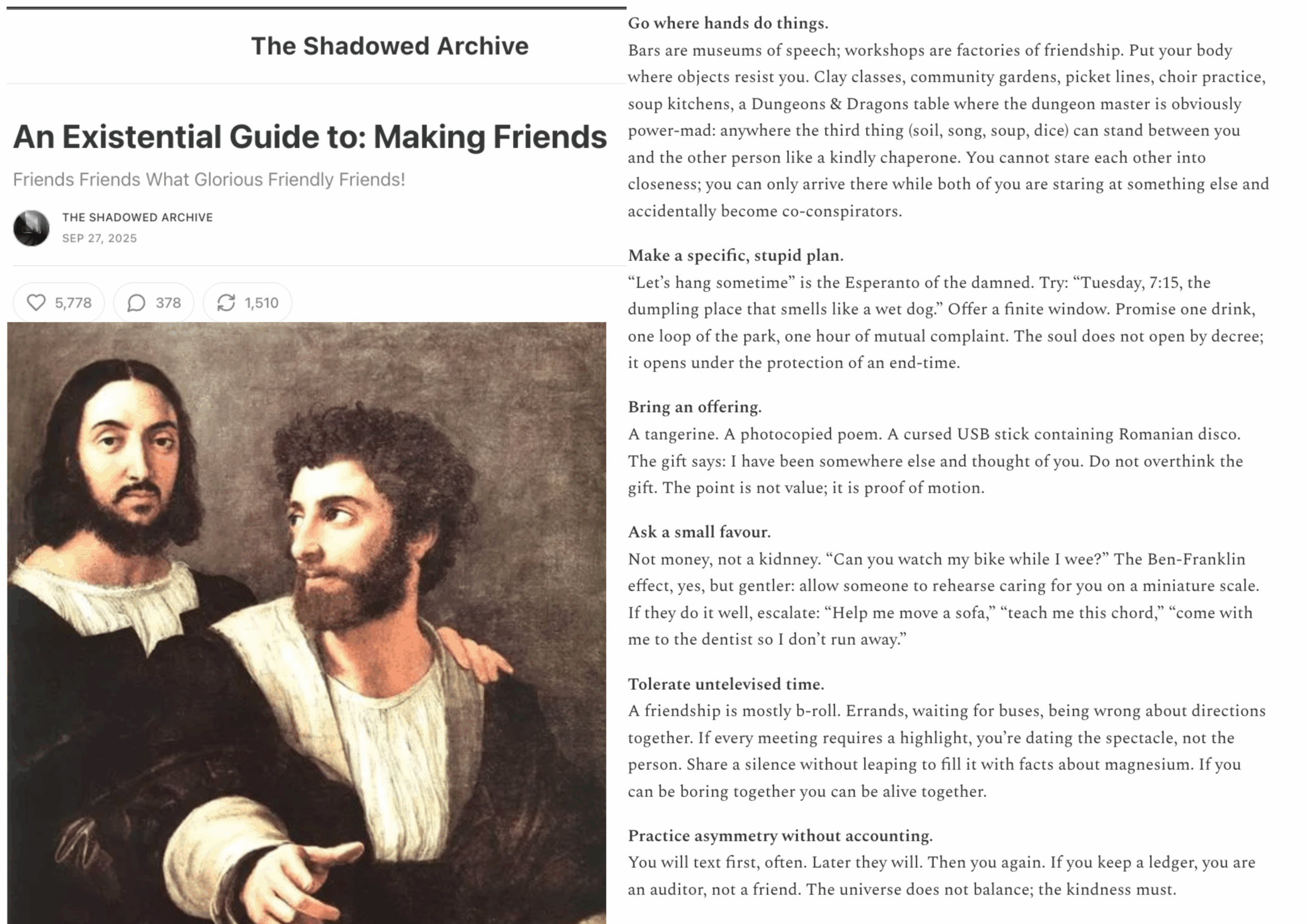
A very dear friend, Karthik, sent me this Substack article with a straight-to-the-point and uncapitalised (as is his wont)
what beautiful writing this is.
That’s high praise, coming from him.
I read it, one of those rare things that, if it were a book, and I had bought the physical copy, I would classify as literally unputdownable (and as an aside, who first used that phrase, I wonder?), and I was swept off my feet, undone by its rhythm, by its reverence for the absurd, by the way it seemed to look both inward and outward at once, like a mirror held up to the soul under a flickering light. I instantly sent it to four dozen dear friends on WhatsApp, ruing aloud that I wished I could write like this.
At least ten of them, some I have known since childhood, others for a couple of months, though in either case long enough to know my stylistic conceits (and limitations), replied almost immediately with some version of “But you already do.” I told them that if flattery alone could make me write like that, I’d take it in a heartbeat. But I wasn’t fishing. I was struck, genuinely and deeply.
And then Ahmed, who has known me for over two decades and has long mastered the art of landing truth without ceremony (sometimes, like a satin cloth flung at my head… wrapped around a brick, to be perfectly honest), wrote,
Yes, I see what you mean. You have a sense of irony and self-deprecation. But the difference between how you currently write and this piece is that it’s more inward-looking and plays off what the author encounters inside, while you seem to play off more from outer situations and people.
To which I replied,
It’s also so sincere, I almost feel like I need to be friends with that writer, after I offer them a hug first.
I don’t know quite where I’m going with this, but I suspect my future writing may begin to show the influence of that piece, not imitation, but err… osmosis. Because what I admired most in it was not the wit or the structure (over which, I would like to believe I have enough mastery at present), but the faith it had in its own absurdity, the courage to be both foolish and profound in the same breath, to make a joke and a prayer occupy the same sentence without apology, none of which I can do if and when I want to, even if badly enough to labour over the output for nights on end stubbornly.
It made me realise that I have often hidden behind irony, that my self-deprecation sometimes functions as armour, that I tend to write about the world when perhaps I should risk writing from within it. I want to see if I can let my words be less about precision and more about presence, to trust that meaning will survive the fog if the emotion is clear, to let the reader feel something first and think later. In a sense, I need to trust my reader and allow them credit for their intelligence rather than explain everything from a microscopic level, fearful that they might just miss something.
Because that is what that essay did to me, it made me feel seen (exposed?) in ways I didn’t know language could manage without turning sentimental. It reminded me that writing, like friendship, is a kind of metaphysical hospitality, the act of opening a door in yourself and hoping someone wanders in without wiping their feet too carefully.
(Here it comes; pardon the juvenile attempt, but kindly applaud the courage to try:)
And so I’ll try, the next time I sit down to write, to let the room be a little messier, the light a little dimmer, the silence between sentences a little longer, to let the truth arrive uninvited and slightly drunk, as it always does. And maybe then, if the words behave, I’ll have come a step closer to the kind of writing that doesn’t just describe friendship, but enacts it, the kind that sits beside you, offers a half-eaten biscuit, and says, without saying it, you are not moss, my friend; you are still alive.