After several evenings of cinematic fluff, romantic comedies, feel-good dramas, and those endearingly brainless entertainers that my partner, Misbahji, adores, I decided it was my turn. We had watched too many films that left the mind undisturbed, the heart lightly tickled, and the conscience entirely intact. So I proposed we balance the ledger with something from my side of the shelf, the kind that insists on making you uncomfortable. That is how we landed upon Ardh Satya. It was a revelation. For someone who prefers the lighter end of the spectrum to find herself moved, provoked, and silenced by Govind Nihalani’s grim masterpiece reminded me that cinema, at its best, bridges temperaments. As I write this, we are about to watch Shool next, having already revisited Parinda some weeks ago. But it began here, with Ardh Satya, a film that refuses to let the viewer stay untouched.
There are films that tell stories, and there are films that become stories about the time they inhabit. Ardh Satya is the latter. I watched it again tonight, on Amazon, of all places, in the antiseptic comfort of a well-lit living room, and felt that familiar ache of anger and admiration, the sense that this was not merely a film but a mirror that India once dared to hold up to itself. A mirror, incidentally, financed by the state. Imagine that: a government-funded act of self-critique. The National Film Development Corporation, back when it had the moral courage to back art that questioned the hand that fed it. Try picturing that now, in 2025, when a propaganda film can have the Prime Minister for a marketing manager.
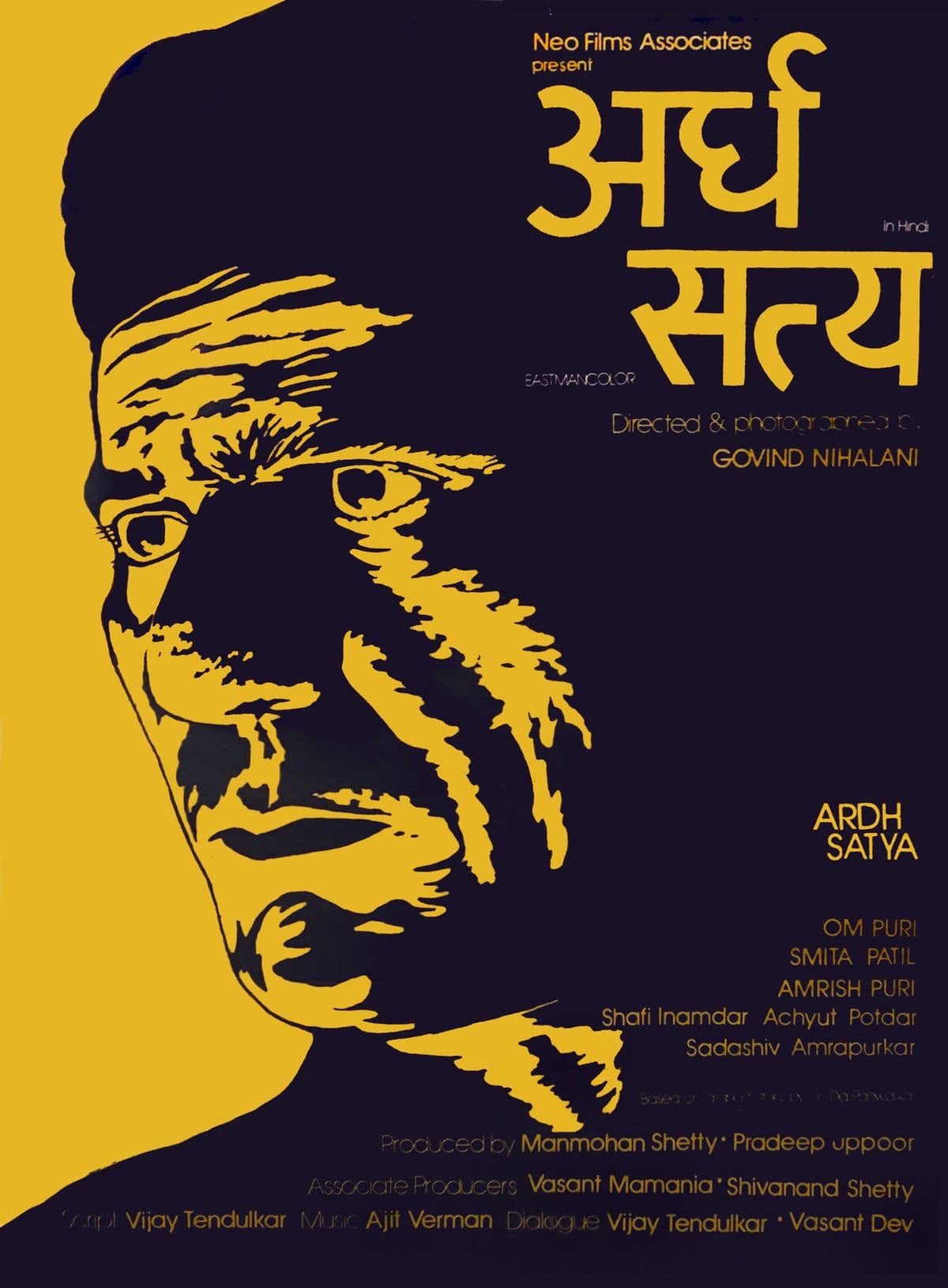
Poster by https://www.facebook.com/manjula.padmanabhan.94
But let me not start by shouting at the present. Let me instead speak of the past, because Ardh Satya belongs to a time when cinema was neither entertainment nor escape; it was an inquiry into our collective conscience. Govind Nihalani’s film, drawn from S. D. Panvalkar’s story and cut to precision by Vijay Tendulkar’s pen, appeared in 1983, a year when India was fraying at every edge. The Khalistan movement was on the boil, Assam was bleeding, Naxalites were being hunted, and yet the same state that was cracking down on dissent gave its highest awards to a film that dissected its own police force. That paradox itself is the half-truth of our democracy, the ardh satya that Nihalani forced us to confront: a nation simultaneously repressive and self-reflective, brutal and tender, tyrannical yet still capable of remorse.
It is easy to forget how radical that was. Today, when every dissenting syllable must wear camouflage and shout BMKJ loudly for it to be considered valid, the idea of a state-backed art film about systemic rot feels almost mythological. But the real myth was playing in the theatres next door, the Amitabh Bachchan “Angry Young Man” decade, that operatic rage of Zanjeer, Deewaar, Trishul, Don, Laawaris, Kaalia, and Shakti, culminating, perhaps, in Coolie, the same year as Ardh Satya. Bachchan was our fantasy of rebellion: handsome, articulate, righteous, perpetually framed against a moral horizon where good and evil stood at convenient distances. He was the man we wished we were, the anger we wanted to feel without consequence.
Om Puri, on the other hand, was the man we actually were. His Sub-Inspector Anant Velankar was a creature of contradictions, beating up suspects by day and crying over poetry by night, defending a stranger’s wife’s honour while talking lewdly and sneering at women who danced for a living, worshipping his father even as he watched him beat up his mother, hating corruption but practising it in smaller, more forgivable doses. Nihalani’s genius lay not in glorifying him but in unmasking us, sorry, him. The film refuses to give us a hero, only a protagonist, a man who is at once victim and perpetrator, saviour and sinner. Even Smita Patil’s character, forgiving his drunken violence, is drawn not as a saint but as another casualty of love’s misplaced endurance. Every face in this film carries the grey dust of reality; no one is clean, which is precisely why everyone is believable.
And perhaps that is why it still hurts to watch. Not because we no longer believe in such men, but because we have become them. The tragedy is not that India has changed too much, but that it has not changed at all. The same machinery that crushed Velankar’s spirit still grinds away, only more efficiently. One could remake Ardh Satya today with digital cameras and new faces and it would play like breaking news.
When I tried explaining this to someone younger, they nodded politely but were unmoved. They watched it on Amazon too, pausing every ten minutes for snacks, phone calls, and moral digestion. And I realised that part of the film’s magic depends on how you watch it. I grew up in single-screen theatres, hot, crowded, uncomfortable rooms where you surrendered yourself completely to the story. There were no cushions for your conscience. You entered in daylight and emerged dazed in darkness, sweating, shaken, sometimes weeping. It was communal catharsis. Today’s multiplexes are malls with screens attached, designed for distraction. Even when the hall is empty, the mind is not. The ritual is gone, and with it the readiness to be moved.
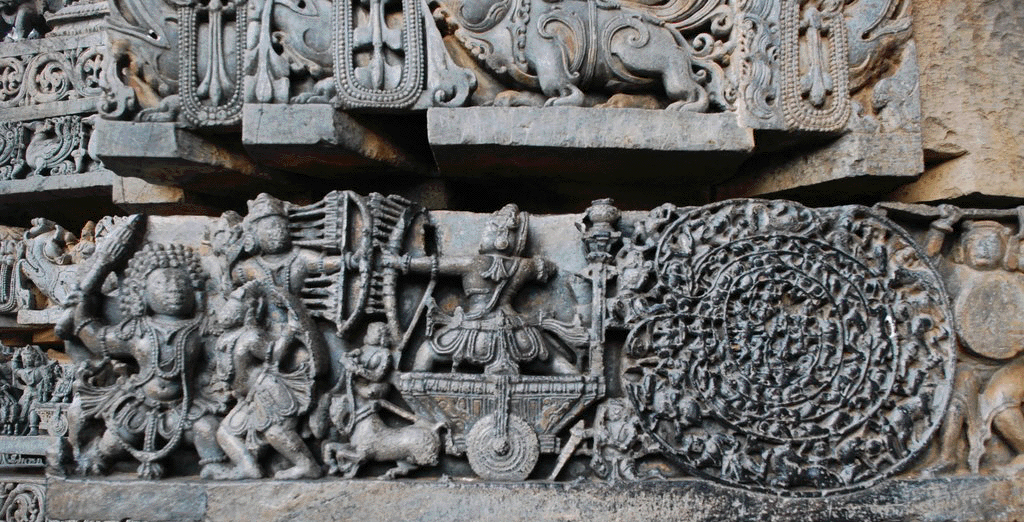
Still, even through my paused-and-resumed, snack-ridden viewing, the film pierced through. There’s a moment when Velankar recites a poem, Chakravyuh, written by Dilip Chitre specifically for the film, invoking Abhimanyu, the doomed warrior who knew only how to enter the labyrinth, not how to exit. I paused the film there (yes, hypocrisy noted) because Misbahji asked what a Chakravyuh was. And I found myself explaining the Mahabharata, its philosophy, its layers, the siege within the siege, the futility of bravery when wisdom is incomplete. That pause became a revelation of its own: how those of us raised in Hindu households assume that everyone shares our mythic vocabulary, how we forget that cultural inheritance is not universal. And yet, that conversation, her curiosity, my explanation, felt like an echo of what Nihalani wanted, to make us interrogate what we take for granted.
Velankar’s Chakravyuh is not mythical; it is bureaucratic. His superior, Hyder Ali, offers him the path of complicity, be the dog tied to the master’s door. Inspector Mike Lobo, suspended for drunkenness, embodies the opposite, a rebel who has drowned in his own defiance. Between obedience and despair, there seems no third way. And so Velankar chooses a violent transcendence: self-annihilation as liberation. In that moment he becomes Abhimanyu, breaking out of the labyrinth not by strategy but by sacrifice.
This motif, of rebellion through self-destruction, has haunted Indian cinema ever since. Jackie Shroff’s Kishen in Parinda (1989) walks the same path, sacrificing himself when he realises that he has failed both, to lead an honourable life himself and to shield his innocent kid brother from reality. Manoj Bajpayee’s Inspector Samar Pratap Singh in Shool (1999) follows suit, seeing no redemption in either obedience or resistance, only in the purifying logic of a bullet. All three men are crushed by systems that tolerate only two kinds of men: the obedient and the broken. They refuse to be either.
Side note: The only other protagonist I can recall who went there (well, almost) was Nana Patekar’s Maj V S Chavan in Prahaar (1991).
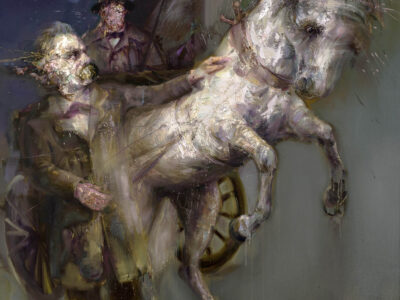
And this, inevitably, leads me to Albert Camus. Sisyphus, condemned to roll his boulder for eternity, finds freedom in acceptance. Camus calls him happy because he understands the absurdity of his task and still chooses to push. But what of Velankar, Kishen, Samar Pratap Singh? They do not push the boulder; they smash their heads against it. Their revolt is not endurance but refusal. Where Sisyphus endures endlessly, these men exhaust themselves deliberately. Perhaps that is the Indian version of absurdism: we do not find meaning in persistence; we find dignity in quitting with purpose.
Camus says Sisyphus ought to be happy. But if Anant Velankar had accepted his fate, would he have been happy? If Kishen had reconciled himself to his compromises, if Samar Pratap Singh had learned to live with corruption, would they have found the serenity of the absurd? Or is happiness, in such a world, the final betrayal?
I do not know. Perhaps none of us do. Perhaps every Indian who still believes in truth, or even half of it, is pushing some private boulder up some endless hill. The question is whether we have the courage to keep pushing, or the clarity to stop. What do you think?
P.S.: I had an alternate ending to my essay in mind. Those of you who read (and think) can tell me if I should have left it in.
I leave Velankar in his cell, Kishen in the burning den, and Samar Pratap Singh on the blood-stained floor of the Assembly. Each lies where his rebellion brought him, still, unresisting, emptied of every illusion but one: that it was worth it.
Velankar, in the half-light of his cell, feels no triumph, no despair. The walls are neither enemy nor friend; they are simply there, like the world he tried to fix. The rope will come for him soon, and he will not flinch.
Kishen, somewhere between the flames and the gunfire, has stopped running. He no longer fights Anna or tries to protect his brother. The fire eats everything, even guilt, and for the first time he breathes freely.
Samar lies among the overturned chairs in the Assembly, the acrid smoke of gunpowder hanging over him like incense. His blood seeps into the marble he once swore to protect. The guards’ bullets are still echoing when he realises that order and chaos are the same thing wearing different uniforms.
They are all dead, yes, but death is not defeat. Their failure is complete, and therefore perfect. Each, in his final moment, has seen the circle close, the system devouring itself, the revolt folding back into silence. There is no redemption, no grand reckoning, only the stillness that comes when struggle has spent itself. And in that stillness lies the truth that Camus called happiness: not joy, not peace, but clarity.
The prisons, the fire, the Assembly, these are their mountains. Each brick, each ember, each bullet a fragment of the stone they pushed all their lives. They never escaped it, but they ceased to be crushed by it. The struggle itself, even when it ended in death, was enough to fill their hearts.
One must imagine Velankar happy. Kishen too. And Samar Pratap Singh.