If I Were Mayor for a Day…
Not long ago, I attended a seemingly innocuous event in the senior citizens’ housing complex where my mother lives in Pune. It’s a quiet, well-organised place, one of those communities where each flat holds decades of memory, and where time moves to the rhythm of newspaper delivery and temple bells. The residents are people who’ve built this city, stone by stone and vote by vote. Engineers, teachers, retired bureaucrats, entrepreneurs, homemakers, men and women who had once held typewritten appointment letters, proudly ridden government buses, and seen rupee coins grow thinner with time.
Into this world came a radio personality, a local celebrity with just the right mix of charm and mischief, to conduct a game. The premise was simple:
“If you were mayor of Pune for a day, what would you do?”
A microphone was passed around. And like a genie summoned from a bottle, the answers came pouring out. But they were not playful. They were not whimsical. They were not even ambitious. They were, in every respect, sincere.
Every speaker, in their way, painted a portrait of institutional collapse. Roads riddled with potholes, water supply reduced to a trickle, garbage that refused to be collected, drains that overflowed even before the rains began, police who responded after the crime was committed, courts that ground justice into years of dust, and systems, education, healthcare, transport, that seemed to function only by exception, not rule. Above all, what united these grievances was a single, repeated lament: increasing corruption. That great equaliser. That slow-moving cancer. That termite quietly hollowing out the Indian state. They were angry. They were tired. And they were right.
⸻
But Who Will You Vote For?
Which is why I was unprepared for what came next. Casually, almost without thinking, I asked:
“So, who do you plan to vote for in the upcoming municipal elections?”
The answer was unanimous. Without hesitation. Without irony. The BJP, of course. Of course.
This is the same party that has ruled the city, the state, and the nation for the past several years. The party under whose uninterrupted rule every single complaint they had just articulated had flourished and metastasised. The same BJP whose mayors, corporators, councillors, ministers, MPs, and MLAs had held power during the very decade in which Pune had, by their own description, declined into dysfunction.
And yet… that disconnect. That total severance between experience and accountability. It was not that they were unaware. It was not that they were brainwashed. These were educated, worldly-wise people. And still, they could not, would not, connect the dots between the governance they endured and the government they enabled. In that moment, I realised I wasn’t looking at a political contradiction. I was looking at a civic divorce. A society that had decoupled the act of voting from the consequences of being governed. A citizenry that had stopped expecting politics to influence policy. A democracy where the franchise had been stripped of its force.
⸻
This Is Not Just a Privileged Problem
Now, it would be convenient, almost soothing, to believe this cognitive dissonance is a problem of the elite. That it is only gated-community retirees and pensioned professionals, shielded by caste privilege and economic cushion, who have lost the plot. That those further down the ladder, closer to the edge, must surely see the connections more clearly. But reality, once again, is uncooperative.
Take your mind back to 2020. The pandemic had just struck, and in its wake, the government responded with all the gentleness of a sledgehammer. Lockdowns were imposed with four hours’ notice. Livelihoods vanished overnight. And on the highways of India, a great exodus began. Men, women, children, many with only one pair of chappals between them, walked for hundreds of kilometres to return to their villages. Some were beaten by police. Some gave birth on the roadside. Some collapsed and died. Some reached home only to find no oxygen, no jobs, no help.
And these were not hypotheticals. These were real people. Entire news cycles revolved around them. They were photographed, documented, mourned. And then, some months later, they voted. They lined up in the same dusty polling booths where their ration cards had failed them. And they voted for the same people who had presided over their abandonment. UP went back to Yogi. Bihar stayed with Nitish. The BJP surged ahead again in the national tally.
It was then I understood: this is not about privilege. It is about something else. Something deeper. The decoupling is universal. It is as true in the skyscrapers as it is in the slums. We are all complicit in treating politics as something separate from life, a theatre, a tournament, a televised show. We know what hurts us, but we no longer believe that governments are the ones responsible for pain, or that our vote can change it. That belief, the very core of a democratic society, has withered. And what remains is a hollow ritual, repeated every five years, like a national superstition we can’t quite shake.
⸻
A Band-Aid Republic
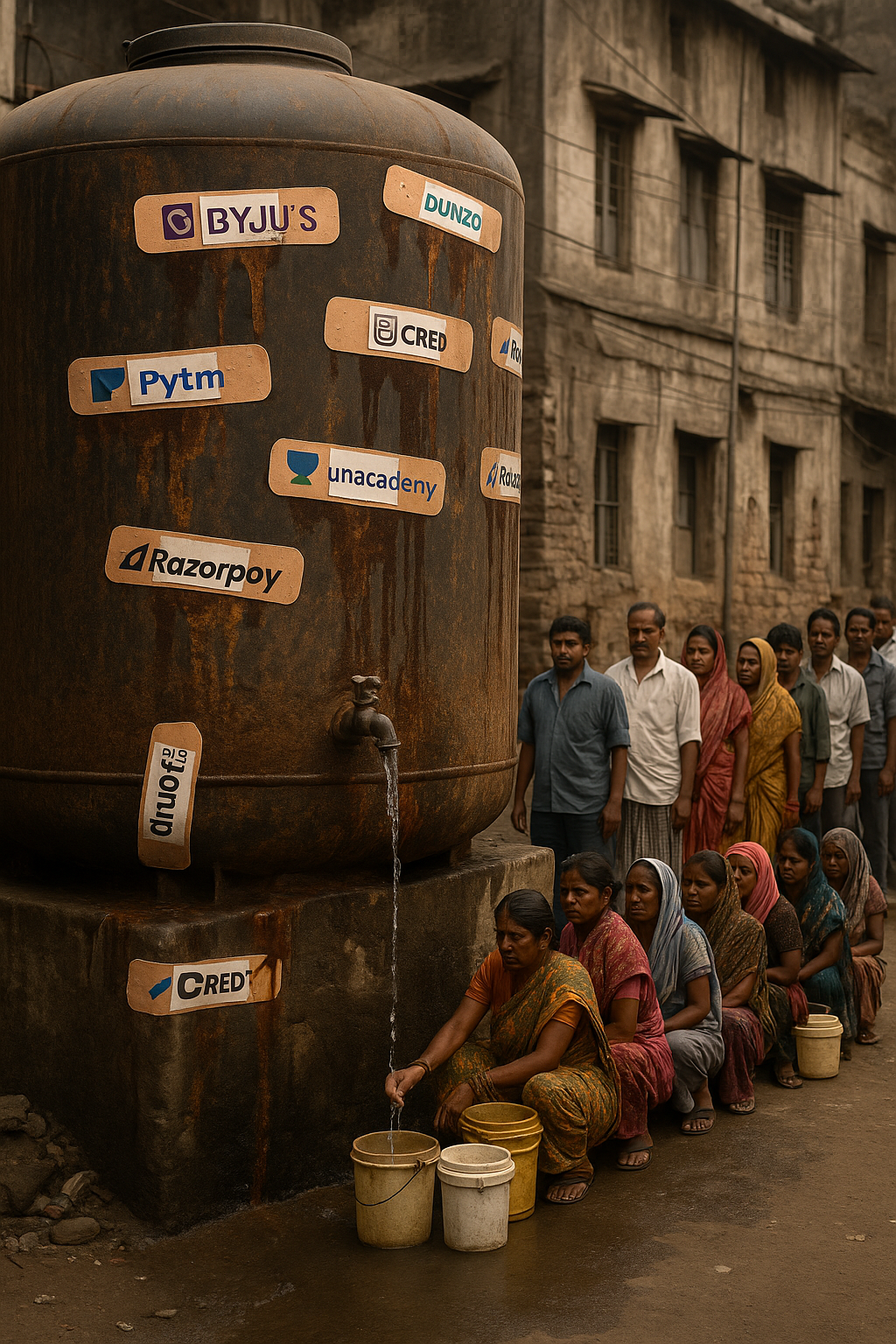
I said something recently on LinkedIn that caused a minor flutter among the thinking classes. I observed that many Indian startups today exist not because of India’s progress, but because of its profound and institutional failure. They are not innovators born of excess. They are patchwork solutions to systemic collapse. A startup in logistics exists because public transport has crumbled. A fintech company solves what the banking system refuses to touch. EdTech is a substitute for failing schools. HealthTech is what you reach for when the government hospital doesn’t answer your call.
And far from being a sign of prosperity, this is a sign of a State in retreat. I called us a band-aid republic, where entrepreneurs are applying private fixes to public wounds, while the State stands by as spectator, or worse, as cheerleader. The responses to my post were overwhelming and illuminating. People agreed, applauded, engaged. But most thought I was criticising startups. They didn’t realise the post was about the government. They couldn’t see that it was a critique of governance, not of entrepreneurs. Even the most educated, self-aware, globally informed Indians could not bring themselves to say: this is the government’s job, and the government is failing.
It’s not ignorance. It’s not ideology. It’s a kind of learned helplessness. A conditioned amnesia. We don’t expect the State to work anymore. We’ve outsourced our imagination. And in doing so, we’ve let governance become optional, something that can be replaced by an app, or a speech, or a godman, depending on the day.
⸻
The Four Myths That Make Us Blind
In this vacuum, myths have taken root. Myths that are repeated so often, they have acquired the texture of fact. They are passed down like heirlooms, polished, recycled, protected. They are: Overpopulation. Freebies and Reservations. Corruption. Caste- and Religion-based Voting. Each one is seductive. Each one is dangerous. Each one lets us look away from who’s actually in charge.
We are told we have too many people. That the problem is numerical. That there are too many mouths to feed, too many bodies on the streets, too many children in classrooms, too many citizens, full stop. And yet, the same people tell us that our demographic dividend is our greatest strength. That we are the youngest country in the world. That India will lead the 21st century because of its people. The same people also say, sometimes in whispers, sometimes in manifestos, that Hindus must reproduce more. That one child is not enough. That we are falling behind. So what is the problem? Not how many people we have. But who those people are. The problem is not overpopulation. The problem is the wrong people populating.
The second myth is that of freebies and reservations. That we have become a culture of handouts. That nobody wants to work. That reservations are killing merit. That subsidies are destroying accountability. And yet, entire generations of upper-caste Indians have been raised on subsidised everything: subsidised college seats, government jobs, petrol, railways, pensions, even controlled prices for medicines, rent, power. Their parents got lifetime benefits. Their children inherited the security. And now, when a Dalit boy gets a laptop, or a tribal girl goes to a university, it is called unfair. Unmerited. Dangerous. It’s not socialism they oppose. It’s sharing.
Then comes corruption. We pretend it was invented in 1947. Or maybe in 2004. Or maybe by a single political party. But the truth is older. Corruption is in the soil. Forts fell not to siege, but to bribes. Empires were not conquered, but bought. Priests, kings, clerks, teachers, doctors, everyone had a price. Everyone still does. And yet, we express moral outrage only when the corruption helps someone else. Bribery only offends them when they’re not the ones being bribed.
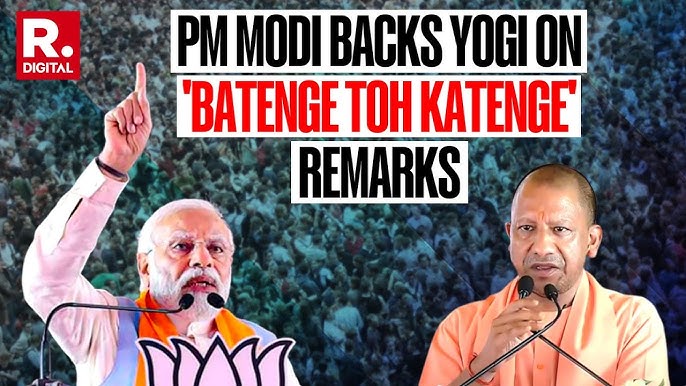
And finally, we come to caste- and religion-based voting, the main reason why the right wingers think India is not yet ‘Vikasit Bharat.’ They are quick to claim that India will never become a developed nation until people stop voting on the basis of religion and caste. But they forget that it was their own ideological ancestors who turned religion into political identity. The Sangh Parivar, from the RSS and VHP to the Jan Sangh and BJP, built an entire narrative of Hindus versus others, branding themselves as saviours of the faith (saving it from whom, exactly?) while accusing opponents of “appeasement.” Their real problem isn’t religion-based politics. It’s the wrong religion doing it. Their slogans (“Ek hain to safe hain” and “Batenge to katenge,” amongst other equally virulent chants) are open calls for Hindu consolidation within a narrow identity (defined, not to put too fine a point on it, by them!). But let a Muslim, Christian, or neo-Buddhist politician appeal to their own community, and suddenly, it’s the death of democracy.
Just to refresh our memories, it was Savarkar, not Jinnah, who first championed the two-nation theory, insisting Hindus and Muslims could never truly share a nation. And yet, for decades, across tens of thousands of localities, Indians of all religions have coexisted in peace, proving that claim wrong every single day.
So when those who lit the fire complain about the heat, it’s not just hypocrisy. It’s performance. And it would be funny, if it weren’t so tragic.
⸻
The Taxpayer’s Amnesia
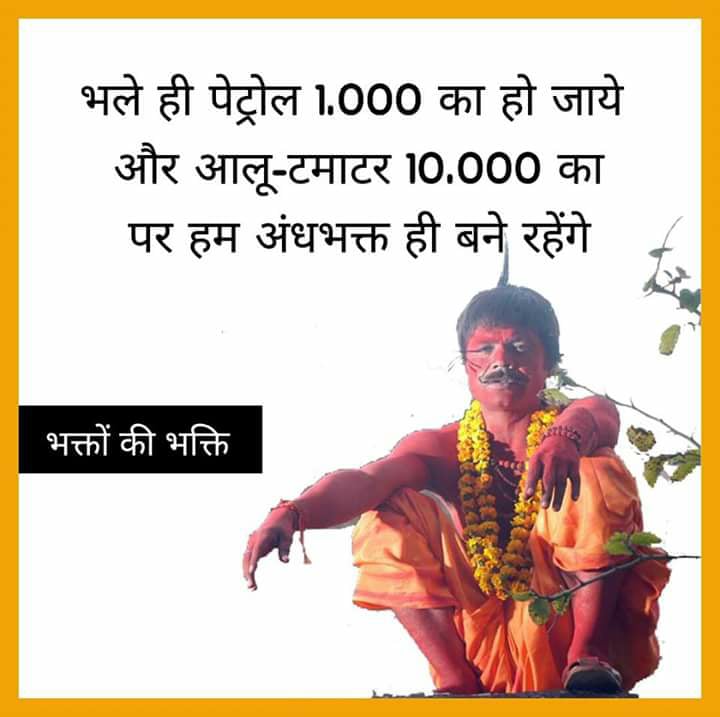
Nothing encapsulates this hypocrisy better than the great Indian taxpayer. “I pay so much tax,” they say, puffing out their chests. “And I get nothing in return.” This is the anthem of the educated middle class. The salaried elite. The urban voter who sees themselves as subsidising everyone else. And yet, they never ask: who is not giving me what I paid for? Who took my money? Who failed to deliver? They complain about the system. They rage about inefficiency. But they cannot bring themselves to name the system’s custodian. And so, even here, the passive voice reigns.
The taxes are high. The services are poor. The corruption is rampant. The governance is failing. But who is responsible for it? The government is never mentioned. The minister never named. The party never blamed. The passive voice isn’t just bad grammar. It is a democratic anaesthetic. It lets you feel the pain without tracing the source. It lets you speak without accusing. It lets you see without holding accountable. It is our civic language now. It is how we survive. It is how we surrender.
⸻
The Reality Show We Mistake for Democracy
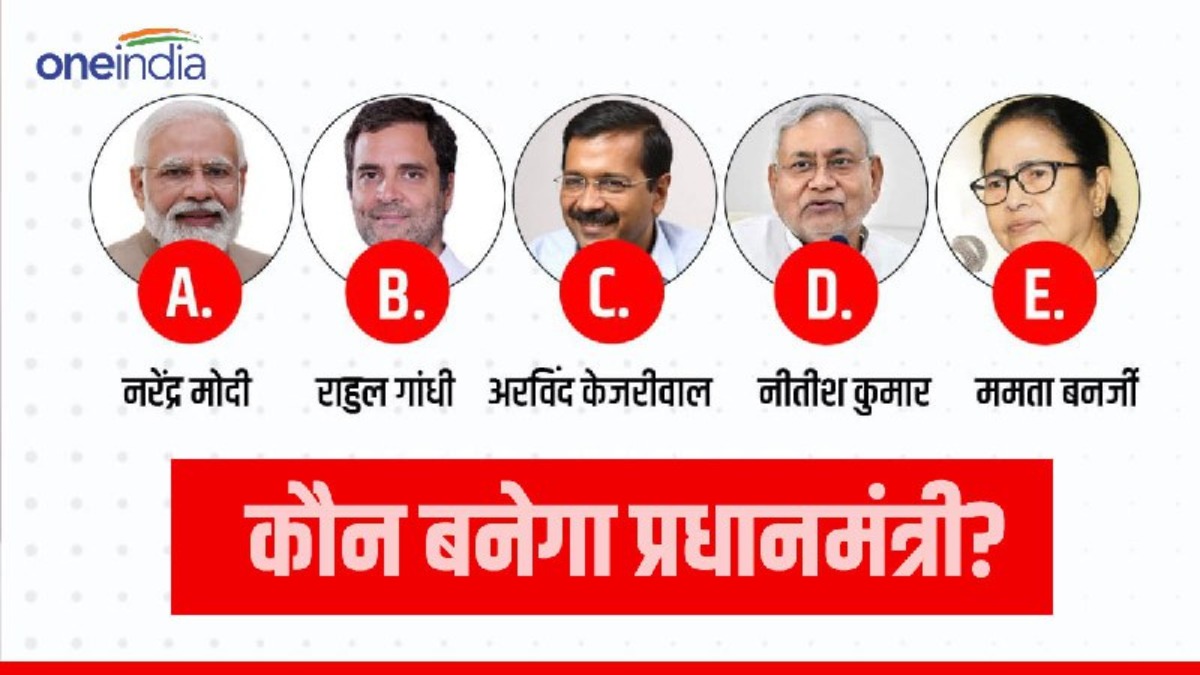
And so we drift. We know things are broken. We feel it every day. We speak of it at dinner tables and drawing rooms, in queues and in cabs. But when it comes time to act, we freeze. Because governance, for us, is no longer a responsibility. It is a spectacle. A soap opera. A carnival of slogans and stunts and social media soundbites. It has become entertainment. We follow politics the way we follow cricket: passionately, but without consequence. The Prime Minister is not the head of government. He is a performer, indeed a star, a showstopper. The election is not a moment of accountability. It is a fan contest. The rally is not a policy forum. It is a music festival. We are not citizens. We are spectators.
⸻
The Ending We Keep Writing
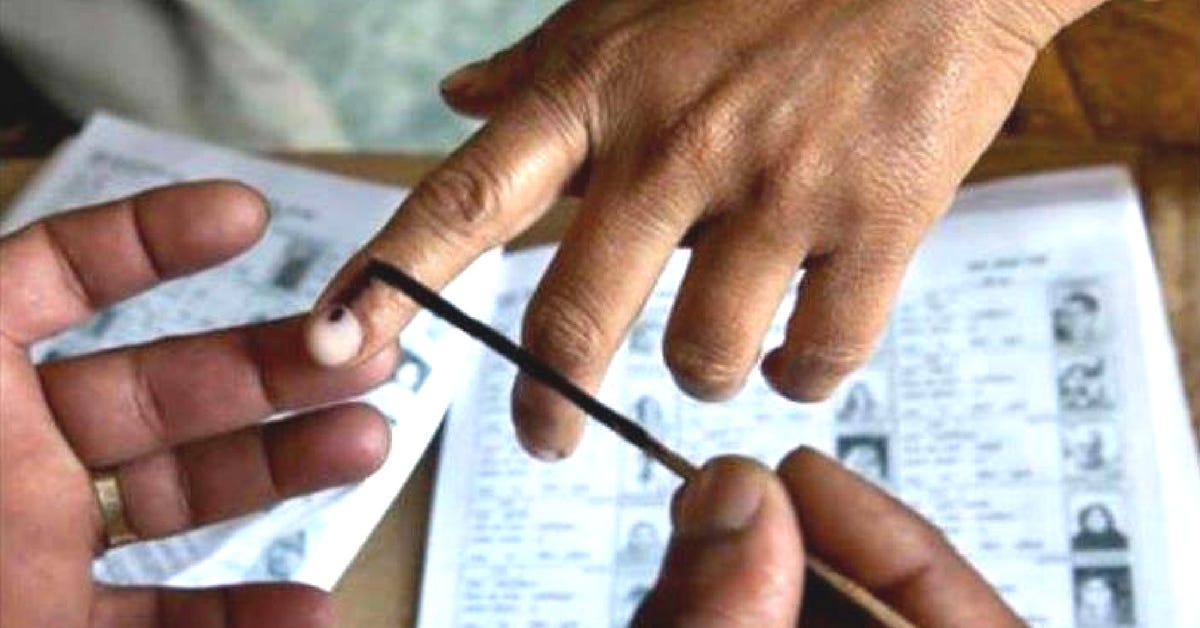
And so, year after year, election after election, season after season, the show continues. The cast rotates. The slogans get louder. The graphics get slicker. The hashtags change. But the script, somehow, stays the same. We suffer. We complain. We forget. We vote. We suffer again.
This is the loop we are trapped in, not by force, but by habit. We have become skilled at compartmentalising our anger, at insulating our intellect from our instincts. We see broken roads, empty taps, missing teachers, lawless police, corrupt administrators, and dying hospitals. And we talk about them at length. We post. We joke. We rant. But when the moment comes to exercise power, real power, we do not ask who was in charge, who failed, who should be removed. We vote for the man who made us feel proud, for the woman who looked like strength, for the party that spoke our tongue, or our faith, or our fear. And in doing so, we make governance a fiction and politics a performance.
We must break this pattern. We must recouple what we have spent the last decade uncoupling. We must rebuild the connection between our vote and our voices, between policy and pain, between governance and the governed. We must begin again to see that the problems in our streets, in our schools, in our neighbourhoods, in our air and water and food, are not accidental. They are not divine punishment or cosmic coincidence. They are choices, made by people, in offices, with power that came from us.
And if we gave it, we can take it back.
This is the work that remains. To restore the nerve endings of our democracy. To revive the lost muscle of accountability. To train ourselves again to speak in the active voice, to name names, to point fingers, to ask questions. It is not rebellion. It is responsibility. It is not anti-national. It is what makes the nation.
If we do not reclaim this link between what we suffer and who causes that suffering, then we will continue to be spectators to our own decline. The show will go on. The applause will rise and fall. The cast will fight for TRPs. And all the while, the country will slip further backstage.
But if we can remember that the stage is ours, that the plot is ours, that the ending is not yet written, we may still have a chance.
Because like our movies, everything must end happily. And if it hasn’t, it can only mean one thing: Picture abhi baki hai, mere dost!