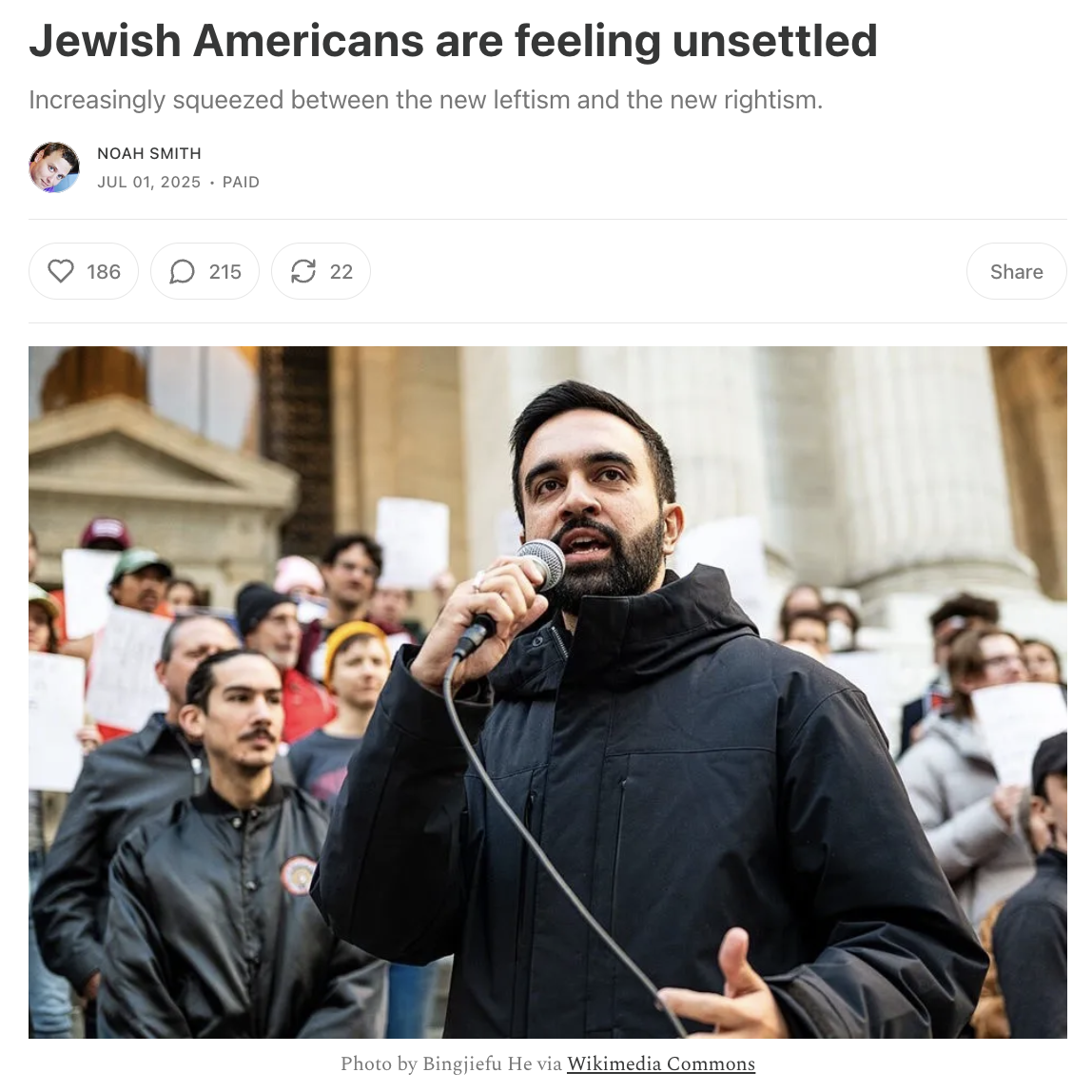
Apparently, we must all pause. American Jews are feeling “unsettled.”
That is the mood captured in Noah Smith’s latest lament, a careful essay wrapped in worry. His words say one thing, but the image says more: Zohran Mamdani, a Muslim-American legislator (and a candidate for NYC’s upcoming mayoral elections) and critic of Zionism, stares out from the top of the page. He is not mentioned in the article. But his face is the point, a silent accusation, a convenient threat. It is a dog whistle, just loud enough for the anxious to hear.
Let us be clear. Jewish people have suffered. The Holocaust was not merely a crime. It was a civilisational rupture. And the world has not forgotten. From reparations to memorials, museums to statehood, we have been told, and have agreed, to never forget. We remember so well, in fact, that we have built an entire global posture around it.
Jewish communities, particularly in America, have moved from the margins to the centres of power. This is not antisemitic fantasy. It is historical fact. Media, finance, academia, policy. The Jewish presence is not only significant, but often disproportionate to numbers. A testament to resilience and brilliance, yes. But also, undeniably, to power.
And yet the story now offered is one of fear. The powerful feel threatened. Not by bombs or bullets, but by hashtags, protests, and a few brown-skinned voices refusing to apologise for existing.
They are unsettled. Not by the rubble of Gaza or the corpses in Rafah, but by the crumbling monopoly on moral authority. For the first time in decades, the script is not working. The Holocaust, once a sacred memory, is now repurposed as a rhetorical shield. It is invoked not to inspire vigilance, but to justify violence. Zionism has become a theology of impunity.
Israel is not ashamed. It kills in the open, with cameras rolling. It annexes, bombs, starves, displaces, and does so explicitly in the name of Judaism. Ministers quote scripture. Rabbis bless artillery. Settlers chant holy curses while torching olive groves. This is not fringe fanaticism. This is state policy.
And yet, American Jewish institutions remain largely silent. Worse, they are active enablers: funding, lobbying, laundering the occupation’s image. The liberal Jew, once the voice of conscience, has grown quieter. “Not in our name” has become “now is not the time.”
Liberals like me have always resisted collective blame. We have argued that a people cannot be judged by their government. But when the government claims to act in their name, with their funding and approval, the distinction weakens. Silence begins to look like complicity.
And the truth is, this generosity is unevenly applied. Muslims, for example, are routinely expected to apologise for every jihadist’s crime. No distinction is made between the everyday believer and the suicide bomber. The burden of guilt is collective. The suspicion is automatic. Even those who speak out loudly against extremism are offered no reprieve. They are, at best, treated as exceptions; at worst, as liars.
But when Jews are asked to reflect on the violence carried out by a state explicitly claiming their name, history, and theology, we are told the question itself is antisemitic. That double standard is not just unfair. It corrodes the moral basis of any claim to victimhood.
This is not a call for guilt. It is a call for reflection.
And it is also a call for moral proportion. Because while it is true that antisemitic incidents in the West have risen since 7th October, it is crucial to separate that real, reprehensible rise from the structural horror of what is unfolding in Gaza. There is no equivalence. Without trivialising either, I must say it is akin to placing America’s problem with school shootings next to the killing fields of Flanders in the First World War. Yes, both involve bullets. Yes, both involve grief and young lives lost. But to speak of them in the same breath is not just inelegant. It is indecent.
The Jewish community in America is not under siege. There is no state-led effort to disenfranchise, expel, or destroy them. There are no camps, no ghettos, no forced migrations. There is, in fact, a robust infrastructure (legal, political, cultural) protecting Jewish life in the United States. Hate crimes are prosecuted. Antisemitism is broadly condemned across the political spectrum. Jewish Americans are safer, wealthier, and more politically connected than almost any minority group in the country.
Meanwhile, in Gaza, children are being buried in mass graves. Hospitals are being bombed. Infants, pregnant women, the elderly, and entire families are being erased. Some are machine-gunned while queuing for food from international aid agencies. And this is not a rogue military operation. It is a policy. It is not a moral lapse. It is a doctrine. The West, especially the American establishment, continues to shield it diplomatically, arm it militarily, and justify it culturally.
To pivot from that horror to how uncomfortable it might make Jewish students feel on elite campuses is not just a non-sequitur. It is a form of evasion. It turns a mirror away from the atrocity and asks the world to admire one’s own distress instead.
When we said “never again” after the Holocaust, we meant it universally. Not just for Jews. Not just for Europe. We meant that no people, anywhere, should face systematic dehumanisation and extermination. That promise was made to humanity, not to a tribe. For Jewish identity to root itself in that trauma and then ignore, excuse, or rationalise another genocide in its name is not just morally incoherent. It is ethically obscene.
If I have been abused, and I truly understand that pain, I do not reserve my empathy only for others who look like me. I do not need the same abuser to strike again in order to feel solidarity. True remembrance, true reckoning, makes one more compassionate, not more callous. To weaponise past suffering to justify present cruelty is to betray the very memory one claims to protect.
In India, liberal Hindus are expected to oppose the horrors done in the name of their gods. Brahmins are expected to feel a collective shame about their treatment of Dalits. Men are expected to feel the guilt of every man who has wronged a woman. And I agree with every single one of these. So, why should Jews be spared the same reckoning? Religion is not innocent when the state wraps itself in scripture. When democracy bleeds into theocracy, the faithful must choose whether they are believers or bystanders.
So yes, perhaps it is time, long past time, for American Jews to feel unsettled. Not because their way of life is under threat, because it is not. They remain, by every available metric, among the most powerful, protected, and prosperous communities in the Western world. What ought to trouble them, instead, is the simple and terrible fact that something monstrous is being done in their name, under their flag, with their money, their silence, and in many cases, their explicit approval. This is not merely complicity born of ignorance or distance. It is complicity that has been rationalised, ritualised, and made almost invisible beneath the weight of historical exceptionalism.
To feel unsettled in such a moment is not a sign of persecution. It is the beginning of moral clarity.
And if that discomfort deepens, it should.