Dear friends,
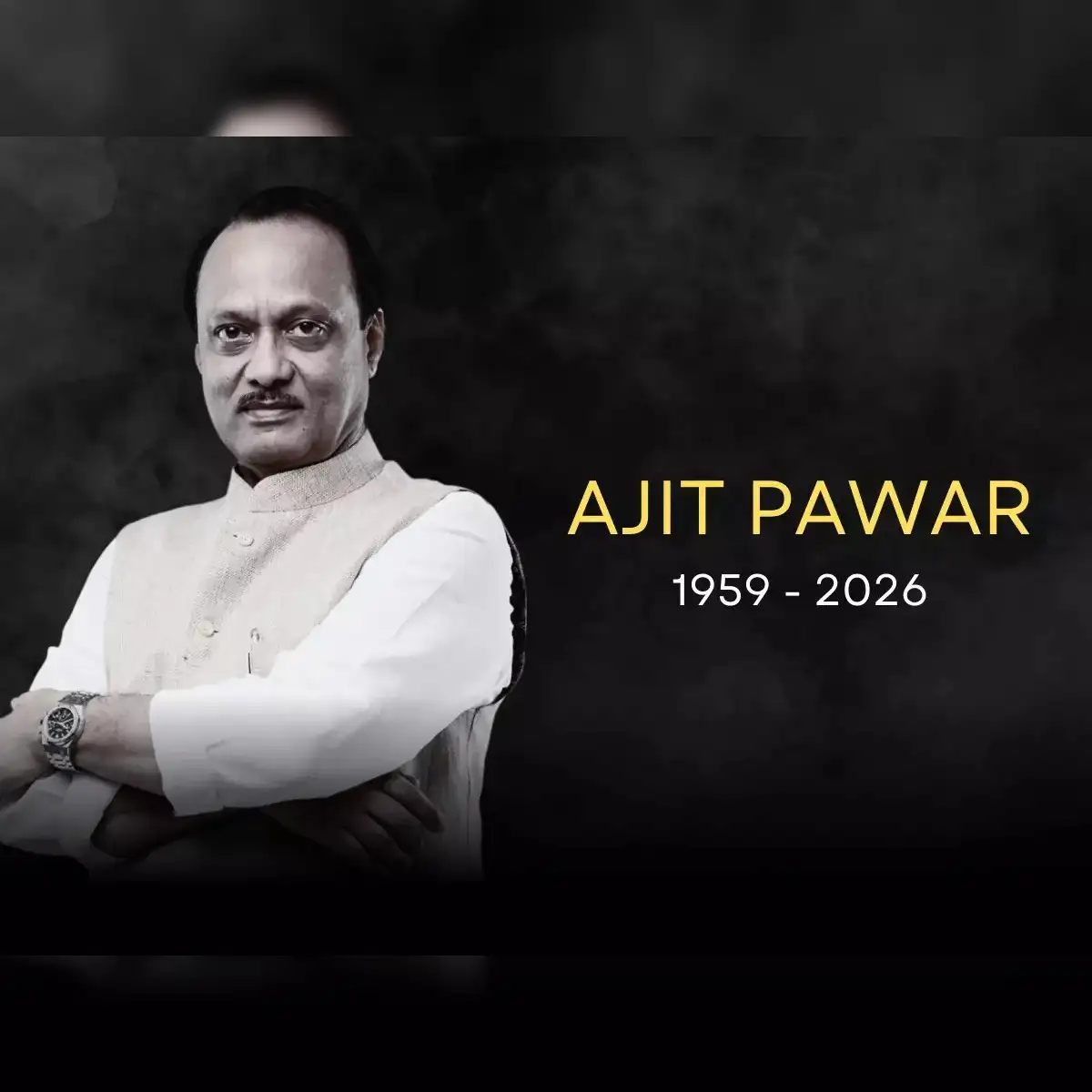
What happened this morning was not the kind of news one expects to wake up to, and certainly not the kind of news one is prepared for, even as someone who lives and breathes politics, even as someone who is, by his own admission, a political animal. The Deputy Chief Minister of Maharashtra dying in a plane crash is not a headline that fits easily into the rhythms of an ordinary day, and when I first saw it, I was too stunned to react in any considered or calibrated way. I did what I instinctively do. I shared it with my political groups. I spoke about it with my network. I put it out on social media. And the language I used was not the language of grief. It was the language of shock. It was along the lines of:
WTF is happening? My mind is reeling right now,
followed by,
What happens now?
A little later, a gentleman commented on that post and asked a perfectly fair, perfectly humane question. Could you not have prefaced this with a single line of grief? And he was right. I agree with him. With a little distance and a little introspection, I should have done exactly that. I should have first acknowledged the loss of life, the loss of a human being, the loss of four other innocent souls, two cockpit crew and a cabin crew member, before moving to shock, disbelief, or analysis. I accept that failure. I accept that my reaction left something to be desired.
But I also want to examine why that reaction emerged the way it did, not merely as a personal failing, but as a symptom of the kind of politics we now live with, and the kind of political culture we have collectively normalised in the Republic of India.
In the immediate aftermath of the crash, as is always the case with political deaths and political accidents, there were conspiracy theories. That was expected. There are always people who will claim that nothing is an accident, that circumstances point not to coincidence but to design, that someone more powerful must have had a hand in it. We see this everywhere. The Prime Minister skips a meeting, a party leader overtakes another on a walk, a Chief Minister uses a particular word instead of another, the Leader of the Opposition wears or does not wear a particular garment, and suddenly it acquires a life of its own, with commentators and so-called experts insisting that it means something, that it signals something, that it is symbolic of a deeper plot. Deaths, illnesses, accidents, marriages, operations, travel, everything, and sometimes even doing nothing attracts conspiratorial readings, debates, social media posts, and shouting matches.
Basically, tinfoil hat nuts are everywhere. No surprises there. So what unsettled me this time was not the presence of conspiracy theories, but the ease with which they were accepted. The first time someone voiced the suspicion that this was not an accident, that it was murder, that someone higher up (or lower down, or sideways, doesn’t matter) wanted him out of the way, the speed with which others around that comment nodded along and agreed was startling. I am not an expert on aerospace accidents (even though my friends seem to think I am, just because I come from an aviation family and have had at least one accident wreck my life), and I am not opining on what happened. There will be an investigation. There will be a report. We will know why it happened, how it happened, and hopefully how to prevent it in the future. Please note that my concern is not the accident per se (that is a question for others, far more qualified than I, to answer). It is our reaction to it.
To understand that reaction, I think there are two things we need to confront.
The first is what has happened to politics itself over the last few decades. Ever since the 1990s, since liberalisation, globalisation, and opening ourselves to world markets, we have seen the rise of a new kind of politician, one who treats politics less as a calling and more as a profession. I am not suggesting that such people did not exist earlier, or that everyone before this era was a saint devoted purely to service. That would be historically absurd. What I am saying is that the proportion has changed. Exposure to global trends and to capitalism (and I say this as a staunch capitalist myself, without assigning blame) has also normalised a view of politics as a career, a vocation for extraction, rather than a noble task of service. A job where what you take home matters more than what you give back.
You see, politics, to me, is
all actions that lead one to attempt to influence policy
that affects a large number of people. But increasingly, we see politicians who treat it like a reality show. They are the contestants. The audience watches, judges, and votes, without any reference to reality (their own, specifically, not the politicians, whose reality they most certainly affect). The objective is not to stay true to principles, but to win the game, and to extract the maximum possible from the position while doing so.
I remember the first time I watched a reality show where contestants were scheming, fighting, lying, and forming & breaking alliances. It stressed me out. Until one of them said something that made it all click.
All I was trying to do was win the game.
It was a British show where people played some game, completed some task, or outguessed each other or something. later, they voted one another off. They were not being cruel because cruelty mattered. They were being strategic because winning mattered. And over time, I, the same person who was once disturbed by this behaviour, have become immune to it. You cooperate, you defect, you betray, you align, you oppose, not because of belief, but because of advantage. The objective is to win. And the audience will love you for it.
When politicians begin to see themselves this way, it is inevitable that the public will start seeing them this way too. This is how we end up with people who complain endlessly about bad roads, corruption, taxes, pollution, water, sanitation, safety, policing, and infrastructure, and yet look you in the eye and tell you that their supreme leader is not responsible for any of it. Governance is blamed on faceless bureaucrats on tenure and salary. Political leadership that is directly elected to represent us is credited only with the wins. This divorce between governance and government exists because politics has been turned into spectacle, and politicians themselves have encouraged that transformation.
So when such a politician suffers a calamity, is jailed, falls ill, or dies in an accident, the reaction is predictable. There is genuine grief among those directly touched by him, those he enriched, sometimes intellectually (as I see within my friends, many of whom are journalists, media people, academics, etc.) or, more often, financially (which is most other people). For many others, there is a shrug. A meh! A sense that a contestant has exited the show. Shock at the twist, not grief at the loss. That is why my own reaction was a double take, a WTF. Not because I thought death was trivial, but because shock arrived before sadness. With reflection, grief should have come first. But shock is what surfaced immediately.
The second point follows naturally from this. When politics becomes a game where anything goes, where Saam, Daam, Dand, Bhed are invoked casually, where Machiavellian cleverness is admired, where Chanakya Neeti is reduced to a justification for amorality, conspiracy becomes the default explanation for everything. Murder is almost legitimised in the imagination as a valid political tool. Once you accept that all is fair in love and war, and that politics is both love and war, then every outcome must have a hidden hand behind it.
I did this myself. My first reaction was not to ask what his politics stood for, or where his ideological stream would go. It was to ask who benefits. Who inherits the money. Who inherits the power. What happens to his coalition. His position. His loyalties. His allegiances. And when I say assets, I do not mean only financial assets (which, from what I hear, are so substantial, indeed vulgarly so, as to boggle one’s mind). I mean power, influence, networks, political capital, workers, followers, party leadership, and so on. Who gets the keys now? It was the immediate thought after the shock of the kahaani mein twist.
I am not proud of that line of thinking, but I recognise it. Of course, only after it was pointed out by friends who I can always rely on to call out my blind spots and biases.
There was a time when the death of a political leader raised questions about the future of ideas and of political continuity. About what will happen to their ideology, to their legacy, to the road they have cut through the woods as their life’s work and who will inherit the mantle of their leadership. Today, it raises questions about the redistribution of gains. For many contemporary politicians, I struggle to articulate what their politics actually stands for beyond tactical manoeuvring. Unlike earlier figures, where one knew clearly where many, if not most of them stood, today ideology feels secondary to accumulation. And so my mind went there first.
That itself should trouble us.
So yes, I accept that my reaction was flawed. I accept that I should have expressed grief before shock, and shock before analysis and questioning. I do not offer this as a justification or an excuse for a lapse in empathy. I offer it as an explanation, and more importantly, as a reflection of the political culture we have collectively built and now inhabit. My reaction is not unique. It is shared, in different forms, by millions. And that, perhaps, is the most unsettling part of all.
To end, let me offer my heartfelt condolences to the bereaved families of the dead, including the crew and other passengers, and hope whatever reservoir it is that they derive their emotional and physical strength from has enough in it to sustain their peaceful transition from grief and anger to memorialisation and remembrance to peace and acceptance.
With love.
Kedar