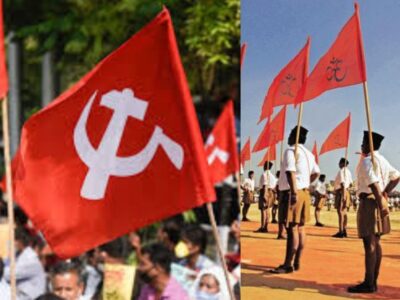
It is the 31st of December. The year is ending. And I might have some good news for my friends. It is not the kind of good news we usually look for, but good news nevertheless.
It is what has been happening in Maharashtra in the run-up to local municipal elections. BJP workers rebelling openly over ticket distribution. Old hands being sidelined. Loyalists breaking down, shouting, protesting, some even crying in public, as people who have joined the party yesterday, many of them straight from the Congress, are handed tickets, influence, and insulation. Senior leaders speaking on record about hurt, anger, humiliation, and betrayal. Scenes that look excessive until you realise they are not emotional outbursts but organisational stress fractures.
Yes, it is only one state. Yes, these are only municipal elections. This is not collapse. But it is not incidental either.
Because this is exactly what I said would happen, almost a decade ago.
I said then that any party that becomes large enough to govern India with the kind of unchallenged mandate the BJP claims it has will not destroy the Congress. It will become the Congress. Not in ideology, not in history, but in structure. In behaviour. In internal life.
And that is exactly what we are watching now. And not merely because former Congress leaders and workers have migrated into it in large numbers, though that is the most visible and easiest explanation. The deeper reason is far more banal and far more unavoidable.
Scale does this.
Any party that grows large enough, powerful enough, wealthy enough, and institutionally dominant enough to rule India authoritatively, especially in the absence of a visible external opposition (something that it has stamped out using all the power it has come to control), will automatically generate opposition from within itself. It will produce factions, rival satrapies, internal power centres, ticket wars, loyalty auctions, discipline failures, and moral incoherence. Dissent does not disappear in India. It changes address.
This is not corruption. This is not degeneration. This is India.
And this is precisely how the BJP is becoming the Congress. The chaos. The plurality of opinions. The disagreements. The arguments. The infighting. The camps. The sense that nobody quite knows who stands for what anymore. The spectacle of insiders accusing other insiders of betrayal. The slow realisation that power does not simplify India, it complicates you.
So yes, the BJP today is beginning to look uncannily like the Congress at scale.
But that brings us to the real question. If the BJP is becoming the Congress, then what is the difference?
The difference is grammar.
The Congress has grammar for this chaos. History. Muscle memory. Experience. It has been around since the late nineteenth century. Over that time, it has broken apart, split, coalesced, shed factions, absorbed contradictions, lost power, regained it, fractured again, and somehow learned how to live with permanent internal disorder. It has housed extremists and moderates, young radicals and ageing grandees, incompatible ideologies and clashing ambitions, all under one increasingly frayed roof.
It has survived not because it was clean, but because it was resilient. Not because it was coherent, but because it was elastic.
That is why, despite everything that has been done to weaken it short of legally banning it, the Congress still stands. Bent, battered, electorally diminished, but upright. It has paid the price of chaos over generations and learned how not to be destroyed by it.
The BJP has no such grammar.
It was not designed for this phase. Its organisational DNA was built for iron discipline, strict hierarchy, ideological clarity, instant and unquestioning obedience, and total homogenisation. Those are enormous strengths when you are small, marginal, insurgent, or fighting an entrenched establishment. They are liabilities when you become the establishment yourself. The moment chaos enters the bloodstream, there are no antibodies. Because it has not been vaccinated. Yet.
And this kind of infighting, this kind of internal pluralism, this kind of uncontrolled churn, will eventually break the BJP in its current form. That does not mean the end of the BJP as an idea, or even as a political force. Parties rarely disappear. It may split. It may fracture. It may rebuild itself under new names, new leaders, new compromises. Over the next fifty or hundred years, it may well acquire the grammar required to be a durable alternative to the Congress.
But what we are witnessing now is not that. What we are witnessing now is a flash that mistook dominance for permanence, homogenisation for order, and success for sustainability. And in doing so, it sowed the seeds of its own failure.
Somewhere in all of this is the deeper irony. Congress is not chaotic because it chose to be. It is chaotic because India is. Because the civilisation is plural, argumentative, internally divided, emotionally excessive, historically layered, and incapable of being flattened for long. The Congress resembled India because it represented India for the longest time. Any party that governs India long enough eventually starts to look the same.
The BJP will get there. But not yet.
In its obsession with a Congress-mukta Bharat, it has ended up creating a Congress-yukta BJP. And that is not necessarily a bad thing. It is simply India reminding power how this country actually works.
This reminds me of a joke about an Englishman brought in to teach a very stubborn Punjabi English, and then locked up in a room together with an expectation that by the time they emerge, the Punjabi would have learnt the King’s tongue. Of course, as any Indian knows, what happens when the door finally opens is the Englishman stumbles out, saying, “Oye paincho, lassi kithhe hai?”
The BJP is that Englishman. And the Punjabi? No, that isn’t the Congress. That’s India. We are like this only.