Note: This was written on 21 January 2026, and updated on 01 March 2026.
I was scrolling absent-mindedly (as one does nowadays) when Disney (of all institutions, the great manufacturer of childhood morality, the global supplier of good triumphing over evil, and swelling orchestras) asked a simple PR question on one of Meta’s platforms (Instagram or Threads, I can’t remember):
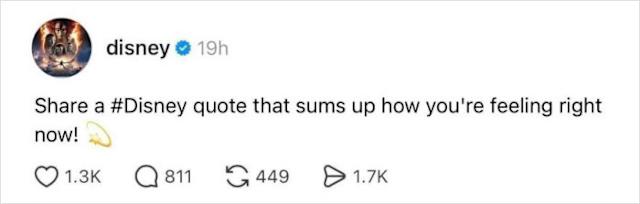
What followed was not nostalgia or brand affection or clever marketing engagement (which is what they probably hoped for) but something far more unsettling and far more honest, a flood of screenshots and quotes and images from Disney’s own films that held up a mirror to authoritarianism, to power, to empire, to conformity, to obedience, to the establishment, lines spoken by animated lions and space rebels and outcasts and misfits that were never meant to be read as indictments of the present but suddenly were. Disney, startled by what it had unleashed accidentally, by how quickly a PR exercise had turned into something that made them very uncomfortable, pulled the post down. In that moment, something in me clicked. A recognition that this was the point, this was the place to begin, because it captured in miniature the confusion I have been carrying for years.
But let me back up a bit for that.
I grew up in the 1970s, the 1980s, the 1990s, and by the time the calendar turned over to the 2000s and we welcomed the new millennium dancing to ‘Waiting for Tonight,’ I was already past twenty-five, married, working, earning, travelling, doing all the things one does when one believes, often without articulating it, that the world has a shape, that there is an order to it, not a perfect order, not a just order in every corner, but an order nonetheless, an international order, a domestic order, a moral order, held together by institutions, by norms, by laws, by a shared understanding that some things were settled, that some lines, once crossed in history, were not to be crossed again. Yes, I know, and I have always known, that this came wrapped in privilege, in gender, in sexuality, in education, in class, in geography, in passport colour. But it was not just my family, not just my neighbourhood, not just my schooling, it was the air itself, the books I read, the films I watched, the news I consumed, the conversations I overheard and later participated in, all of them oriented towards a broadly progressive lens, towards the idea that humanity, for all its regressions, bent towards empathy, that diversity was a strength, that power needed justification, that cruelty required apology, that righteousness was not about domination but about restraint.
The stories mattered, because they always do. More than ideas or ideologies or theories or books or manifestos. It was these stories we heard. In Hollywood, in Bollywood, in the mythology we were told and retold. The moral grammar was strikingly consistent. The small man fought the large empire and won, or even if he lost, if he did not ‘win’ in the crude sense, he won in the only way that mattered, with dignity intact, with the moral universe bending in his direction. The Rebel Alliance against the Empire, ragtag pilots and smugglers against planet-destroying machines. Amar, Akbar, Anthony’s fractured identities finding unity against corruption and power, even fate. Spartacus standing up in chains and forcing an empire to confront its own brutality. Moses facing Pharaoh with nothing but conviction. The Pandavas, fewer in number, fighting the Kauravas at Kurukshetra with only Dharma by their side. Shivaji against Afzal, intellect against brute strength. The Marathas against the Mughals, determination against might. Tipu against the British, pride against commerce. Kabir, Tukaram, voices from the margins speaking truth to authority. Even the Brahminical stories I was fed, despite their casteist underpinnings (and I cannot emphasise them enough), were rarely about the triumph of state power and more often about the poor Brahmin, the Sudama, rewarded for honesty rather than for conquest. Kindness, empathy, the Sermon on the Mount, the Buddha under the Bodhi tree, the Golden Rule (which my father never stopped preaching to us), all of it reinforced the same lesson, that goodness did not need scale, that power without morality was suspect, that blind obedience was less noble than conscientious refusal.
Alongside these stories sat a set of axioms that felt so self-evident they barely registered as beliefs. The moon landing was real. Vaccines were a net good. The earth was round, or spherical enough for the point to stand. Women were equal to men. All humans were equal in worth and potential. Democracy, for all its messiness, was better than authoritarianism. Governments had an obligation to care for those who could not care for themselves. Courts existed to restrain power. Laws were forward looking and at the cutting edge of social morality. The Constitution existed to shield the common citizen from authority and the government. The army was incorruptible. People became kinder and wiser as they aged, and should be respected. Education and travel broadened the mind and made someone a better human. Diversity strengthened societies. These were not things one argued about in good faith, they were the ground beneath the argument, the background radiation of public life (and private worlds), the reason conspiracy theorists and radical extremists were marginal figures, curiosities to be studied rather than movements to be feared.
When I read about the past, about the British in India, about how they arrived as traders and left as rulers, about how they dismantled kingdoms and economies and cultures with such little friction given the comparative sizes of the two nations, when I read about the Nazis and how easily and quickly they took over the German nation and captured the imagination of the German people, when I read about how Churchill created a famine and killed millions without any significant resistance or opposition to this inhuman act, when I read how the rich and famous gambolled in and gambled with wealth that was far beyond even the imaginations of their subjects whom they consistently and systematically oppressed, my reaction was not admiration for their cleverness or even anger at their actions so much as shocked disbelief, a repeated internal refrain of “Could they really do that?”, followed by the comforting answer that this was then, that this belonged to a time before international law, before human rights, before the United Nations, before the lessons of two world wars had been institutionalised into something sturdier than good intentions.
When I read about apartheid, the reaction was the same:
Really, they could do that?
(Of course, the relief came from knowing that eventually they could not, that the world, however belatedly, had said no).
When I read about the United States arresting Manuel Noriega, dragging a foreign head of state out of his palace, it was shocking precisely because it felt unprecedented, an aberration, something that would provoke debate and restraint and a collective intake of breath. And then they hanged Saddam Hussein, the strongman they had armed and funded and shaken hands with across a table while he was gassing the Kurds, and we told ourselves: at least there was a trial. They shot Muammar Qaddafi, the eccentric who had been invited back into the fold just years earlier, photographed warmly with the leaders of the very nations whose bombs would later chase him into a drainage ditch. And still we said: well, he was no saint. We kept finding reasons. We kept adjusting the frame. We kept telling ourselves that these were complications, aberrations, ugly but exceptional moments in an otherwise ordered world. We were wrong, of course. We were just not ready to know it yet.
And then, slowly at first, and then all at once, the question stopped working the way it used to. When I watched Narendra Modi blur the lines between party and state, attend temple inaugurations as prime minister, allow party symbols to bleed into governmental space, it unsettled me, but I still framed it as overreach, as politics playing rough, as something that would be checked by institutions.
And then came the morning of 08 November 2016, when he appeared on television at eight in the evening and announced, with four hours’ notice, that every five-hundred-rupee and thousand-rupee note in the country was no longer legal tender. Simply. Just like that. The savings of the poor, the liquidity of small businesses, the cash economy on which hundreds of millions of Indians depended entirely, all of it voided overnight, with no consultation, no parliamentary debate, no warning to the Reserve Bank of India beyond what was strictly logistically necessary. Economists said it would be catastrophic. It was. The GDP contracted, the informal sector was devastated, people died standing in queues outside banks that did not have enough new notes to dispense. The Supreme Court, years later, upheld it. The question that occurred to me then was: can he really do that? And the answer, delivered by a nodding parliament and an accommodating judiciary, was: apparently, yes.
And then came Article 370. A constitutional provision, however imperfect in its evolution, that had defined the relationship between Jammu and Kashmir and the Indian Union for seven decades. Abrogated. Simply. On 05 August 2019, with the valley already blanketed under the heaviest security deployment in its history, with its own elected politicians under house arrest, with the internet cut, with the phones cut, with the people of the state given no voice and no notice and no recourse, a state bifurcated into two union territories by executive fiat, its special status stripped away in an afternoon’s parliamentary session. The opposition protested. It did not matter. The Supreme Court sat on petitions for years before delivering a judgement that, with the greatest respect, amounted to a constitutional shrug. Can they really do that? They did.
And then COVID arrived, and on 24 March 2020, with four hours’ notice again (four hours seems to be the preferred interval for announcements of civilisational consequence in this administration), Modi declared a complete national lockdown. Not a partial lockdown, not a phased one, not one with provisions for the hundreds of millions of daily-wage workers, migrant labourers, and informal-economy workers who had no homes to go to and no savings to survive on. A total lockdown, effective midnight. And so they walked. Millions of them. Hundreds of kilometres, on foot, carrying children and bundles of belongings, along highways and railway tracks, back to villages they had left years before in search of a livelihood, because the city had been closed by decree and no one had thought to ask what they would do. Some of them died on the road. The government said the economy would recover. It did, eventually, for some. Can he really do that? He did. And was applauded for decisiveness.
And then there was PM-CARES: the Prime Minister’s Citizen Assistance and Relief in Emergency Situations Fund, created in March 2020 to receive public donations for COVID relief. Created not under the existing Prime Minister’s National Relief Fund, which had parliamentary oversight and was subject to Right to Information requests, but as an entirely new, entirely opaque entity, audited by private auditors of the government’s choosing, exempt from RTI, exempt from parliamentary scrutiny, exempt from the Comptroller and Auditor General’s purview. Thousands of crores of public money, donated in good faith by ordinary citizens and corporations alike, vanishing into a fund that answers to no one and nothing except the Prime Minister’s office. When journalists filed RTI requests, they were told PM-CARES was not a public authority. When opposition politicians demanded accountability in parliament, they were told it was a private fund. Can they really do that? They not only did it, they are still doing it, and the courts have, as is their custom in these matters, looked gently away.
When central agencies were used not merely to harass but to systematically break the opposition, to hollow it out, to destroy it, when the judiciary bent under pressure, under threat, under inducement, when vengeance replaced accountability, I asked the same question again, and for a while the answer still felt uncertain, still felt contested.
Donald Trump changed that at a global level. Not because he was uniquely monstrous, though he is, but because he made visible something I had not wanted to see. When Roe v. Wade was overturned, it was not just a policy shift, it was a signal that rights I had assumed were settled were in fact permissions, revocable at the whim of power. When LGBTQ people were thrown out of the military, when cruelty was reframed as order, when norms were broken not apologetically but performatively, something cracked. When talk of annexing Greenland was floated without embarrassment, when international law was treated as a punchline, when the idea of sovereignty became negotiable again, the past stopped feeling past.
And then the Epstein files arrived, three and a half million pages of them, released in stages by a Justice Department that simultaneously withheld the pages most inconvenient to its own president, and what they revealed was not a surprise, not really, because most of us had suspected it, but there is a particular kind of nausea that comes from suspicion becoming confirmation. A financier of no obvious legitimate income, operating the most extraordinary network of access and influence the modern world has produced, trafficking children, and not merely getting away with it, but being protected by it: by prosecutors who offered him a sweetheart deal that a first-year law student would have rejected, by powerful men who kept visiting after his first conviction, by institutions that looked away because looking away was easier and safer than looking at what was in front of them. Prince Andrew, arrested. Peter Mandelson, arrested. Lawrence Summers, resigned in disgrace from Harvard. Names across governments, royal families, financial institutions, academia, the entire architecture of respectable power, connected to a man who was, in the plainest possible language, raping children. Virginia Giuffre, his most vocal accuser, dead by suicide. The perpetrators’ names redacted; the victims’ names unredacted by mistake, or perhaps not by mistake at all. And Trump’s own name appearing thousands of times in the files, with specific, detailed allegations of abuse against a minor, pages relating to those allegations quietly removed by his own Justice Department before publication, in direct violation of the law his own hand had signed. Can they really do that? They did. They are.
And while that was still settling, in the very first days of the new year, US Special Forces bombed Caracas in the middle of the night and kidnapped the President of Venezuela, Nicolás Maduro, along with his wife, and flew them to New York to face drug-trafficking charges. One hundred and fifty aircraft, twenty airbases, a replica of the presidential residence built in advance to rehearse the operation. Trump called it “one of the most stunning, effective and powerful displays of American military might in American history” and announced, almost as an afterthought, that the United States would be taking Venezuela’s oil. Venezuela, which sits on the largest proven crude oil reserves in the world. The UN called it a violation of international law. Legal scholars called it an act of aggression under the UN Charter. Venezuela’s own Defence Minister called it a “cowardly kidnapping.” Maduro, in an American courtroom wearing prison-issue khaki, said simply: “I am a kidnapped president. I am a prisoner of war.” Trump, asked whether the Nobel Peace Prize-winning opposition leader María Corina Machado would have any role in Venezuela’s future, dismissed her as a “very nice woman” who “doesn’t have the support within, or the respect within, the country,” and announced that the United States would “run” Venezuela, “essentially,” with Rubio and Hegseth designated to manage things, until “such time as we can do a safe, proper and judicious transition,” after which American oil companies, with military backing, would move in to “fix the badly broken oil infrastructure.” He was not being sarcastic at all.
And then there is Gaza, Israel, the open, relentless display of force, the flattening of civilian life, the hollow theatre of international condemnation, the United Nations speaking and speaking and being ignored, and the old question returns, really, can they just do that, and the answer, now, is not deferred, not complicated, not hedged, but blunt and immediate: yes, they can, and they are. The international order I believed in reveals itself as paper-thin, dependent not on law but on restraint, not on institutions but on the willingness of the powerful to pretend they are bound by them.
And now, as I write this update, Iran is burning. Ali Khamenei, Supreme Leader of the Islamic Republic for thirty-seven years, is dead, killed in a joint American-Israeli military operation that struck twenty-four Iranian provinces, his own compound in the centre of Tehran, and, almost incidentally, a girls’ elementary school in the southern city of Minab, where at least a hundred and eight children died before their school day had properly begun. Trump announced Khamenei’s death on Truth Social, called him “one of the most evil people in History,” and promised that “heavy and pinpoint bombing” would continue “uninterrupted throughout the week.” Netanyahu said the goal was to “create the conditions for the brave Iranian people to take their destiny into their own hands.” The UN Secretary-General, Antonio Guterres, said an opportunity for diplomacy had been “squandered.” The bombs continued. Iran, for its part, launched retaliatory strikes on US bases across the Middle East, on Tel Aviv, on Bahrain, on anything it could reach, and the region teeters on the edge of something that no one has a word for yet, because the words we used to use, escalation, crisis, conflict, all feel inadequate now, like calling a tsunami a wave. Trump, asked who should replace the Supreme Leader of Iran, said, “I don’t know, but at some point they’ll be calling me to ask who I’d like.” He added that he was “only being a little sarcastic when I say that.” A little.
This is where the Disney moment loops back, because if media shapes minds, if stories teach us how to feel about power, then what happened to us. We were raised on rebellion. We were raised on the underdog. We were raised on Neo choosing the red pill, on a diverse band of misfits saving the world, on Zootopia telling us that prejudice is learned and justice is possible, on World War II films that celebrated ordinary people standing up to tyranny, on Rocky Balboa losing on points but winning in meaning, on every narrative telling us that empires fall and conscience endures. And yet here we are, watching real empires behave like the villains of our childhood, and the collective response is not uprising but exhaustion, not rebellion but resignation.
I am not doubting the moon landing. I am not doubting vaccines. I am not doubting the shape of the earth. But I am doubting the rules of reality I thought governed power. I find myself watching conspiracy theorists with their wild claims and thinking not that they are right but that the world has shifted so far that my insistence on institutions and law and restraint makes me sound like the eccentric, the one clinging to a story that no longer maps onto the terrain. I look at the United States, a country whose Second Amendment speaks of a well-regulated militia precisely to prevent tyranny, and I see untrained, unidentified men in masks dragging people out of cars and homes, using guns and tear gas on residents, acting like the jackbooted thugs of regimes America once condemned, and I feel my mind recoil, not because I do not understand what is happening, but because I understand it too well.
America was supposed to be the anchor, the last illusion if nothing else, the place where free speech, however imperfectly practised, was at least understood as foundational, where immigration was recognised as the bedrock of national identity, where federal and state power existed in tension but within a shared commitment to law. Watching that unravel, watching a president demand another country surrender its sovereignty, watching chaos justified as strength, I feel the same disorientation I felt reading about the Raj or Nazism or apartheid, except this time there is no temporal distance to soften it, no historical arc to reassure me that justice will eventually prevail.
And the thing that breaks me, truly, is not the violence, as terrible as it is, nor even the impunity, as breathtaking as that is. It is the brazenness. The fact that they no longer bother to construct a convincing fiction. Saddam had weapons of mass destruction. Qaddafi was about to massacre his own people. Noriega was a drug trafficker. The lies were at least lies, which meant there was still a residual understanding that the truth needed disguising, that power needed a story it could tell the world and itself. Now there is no such concession to decency. Trump simply said he was taking Venezuela’s oil. He said the bombing of Iran would continue until he achieved “peace throughout the Middle East and, indeed, the World,” in capital letters, as though the capitalisation made it more real. He said he expected Iran to call him and ask who he would like them to be governed by, and was only being a little sarcastic. And in India, demonetisation happened simply, a lockdown happened simply, Article 370 was stripped simply, PM-CARES was created and hidden simply, each act of executive overreach delivered with the same television-address confidence, the same unilateral certainty, the same complete indifference to the question of whether any of this was constitutional, or legal, or humane, or even particularly well thought out.
The word “simply” is doing a great deal of work in those sentences, and I want to dwell on it. Because that is precisely what has changed. It is not that power has become more cruel, it has always been capable of cruelty. It is that the doing of things has become simple. Modi demonetised the economy of a billion-and-a-half people with four hours’ notice because he could, and nobody stopped him. He stripped a state of its constitutional status with its own politicians under arrest because he could, and nobody stopped him. He announced a national lockdown that sent millions walking barefoot down highways because he could, and nobody stopped him. He created a relief fund immune to parliamentary scrutiny and public accountability during a pandemic because he could, and nobody stopped him. Trump deported people to foreign prisons without due process because he could. He kidnapped a sitting head of state and declared his country American-administered territory because he could. He and Israel bombed Iran into a succession crisis because they could. And Epstein trafficked children for decades, across borders, in private jets, on private islands, with the names of the powerful in his contacts book, because he could, and nobody stopped him, and when they finally did, he died in a maximum-security prison in circumstances that have never been satisfactorily explained, and the files that might explain them are being drip-fed to a public that is told, simultaneously, that everything is being released and that some things cannot be.
Can they really do that? That used to be a question. Now it is barely worth asking.
So here I am, a child of the 1970s, now past the half-century mark, living in a world that looks nothing like the one I was promised, not by politicians, not by slogans, but by stories, by axioms, by the quiet (no, by the constant) assumption that progress, however slow, was real. And I find I have to sit with an uncomfortable, deflating, humbling truth that creeps up on you somewhere past fifty, if you are honest enough to let it: the world has not changed. Not really. Power has always done exactly this. It stripped constitutional protections and called it integration. It demonetised economies overnight and called it reform. It locked down a billion people with four hours’ notice and called it decisive leadership. It hid public money from public scrutiny and called it efficiency. It hanged the dictators it had armed, shot the leaders it had rehabilitated, kidnapped the presidents it had sanctioned, bombed the children it had not bothered to name, and called all of it, at various times, justice, or liberation, or peace, or simply necessary. It trafficked children in plain sight of presidents and princes, and called it, for the longest time, nothing at all, because naming it would have required looking at it, and looking at it would have required doing something about it, and doing something about it was simply not convenient.
None of this is new. All of this is ancient.
What is new is me. What has changed is that I have finally, reluctantly, at some cost to my sense of the world and my place in it, grown up. The question can they really do that was never a question about them. It was a question about me: about how much I was willing to see, how much I was willing to name, how comfortable my ignorance was, and how hard I was willing to hold onto it. Turns out: very. For a very long time.
They could always do that. They were always doing that. I was just not paying attention. And attention, it turns out, was always the price of admission.
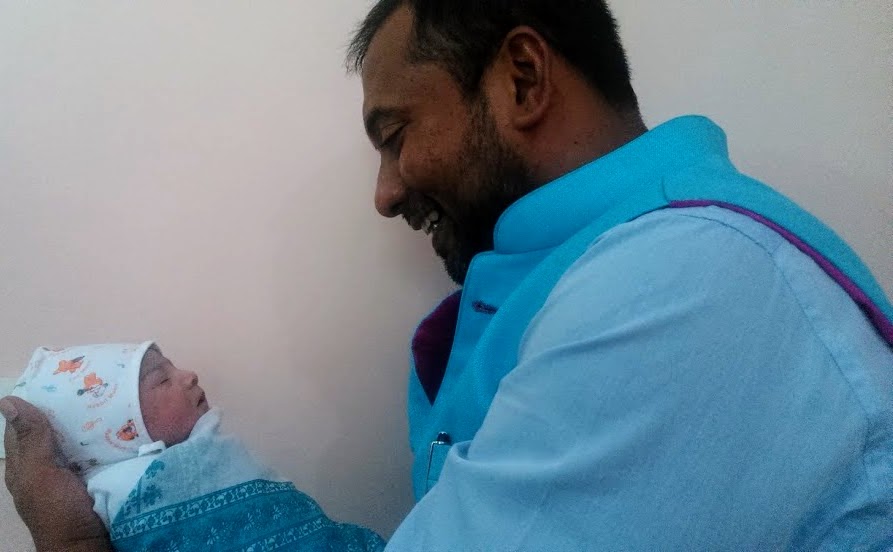
Postscript: The photograph is me holding my daughter, Kymaia, about an hour after she was born. The reason for that photo is to serve as a reminder that this world belongs to her and I am merely a trustee and caretaker on her behalf until she comes of age to take over and run it, that her innocence and potential to achieve great things is what makes this world better, and not my cynicism and defeatist attitude. That she will be the change, the ray of light, the force for good. And all my doubts are like the mist that will vanish into thin air once the sun is out. I may or may not be right. But I’d rather live in hope than in despair. And this photo right here reminds me of that. Even as I look upon this world and wonder what happened to it.