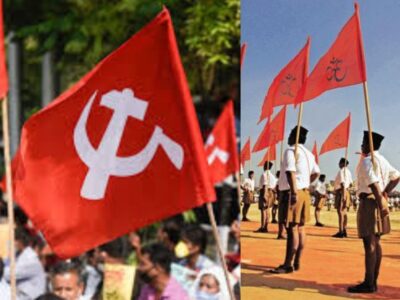
After my last post on Savarkar’s definition of Indianness versus Nehru’s, on purity versus plurality, someone made an observation that Savarkar was not always like this. He was once a staunch nationalist, a fierce revolutionary, and an anti-colonial activist, someone who went to jail and suffered for the cause.
As someone raised on stories of the ‘Swatantryaveer’, let me confirm that this is true, and precisely why the observation is more than interesting, in fact fascinating (though most certainly not exculpatory). Because once you start pulling at that thread, Savarkar begins to look less like an exception and more like part of a larger, deeply unsettling pattern.
Across India and elsewhere, there were figures who began their lives opposing authority, empire, and injustice, who went through incarceration or persecution, and who emerged transformed in a strangely predictable way, by going sharply right. This leads me to a hypothesis: when fear overwhelms courage, when pressure pushes people towards collaboration, it often disguises itself as religious nationalism, moral certainty, and civilisational duty.
TL;DR: When push comes to shove, wimps tend to turn rightwards.
Consider Savarkar himself. A revolutionary nationalist in his early years, delivering fiery speeches, burning foreign goods, writing pamphlets, attempting escape by jumping into the sea, and organising resistance right in the den of the British Lion, in London. But when sent to Kala Pani, he eventually breaks, pleads for mercy, and upon conditional release, articulates a theory of nationhood centred on the nonsense about sacred lands and civilisational purity, one in which people recede and abstractions take over. Later, as a principal architect of the two-nation theory, he even attempts, thankfully in vain, to persuade princely states to remain outside the newly formed Indian nation.
Or Keshav Baliram Hedgewar, active in Congress and Khilafat-era mobilisation, jailed by the British, who hires a lawyer against Gandhi’s express instructions to court arrest without defence, and upon release leaves the party altogether. He withdraws from mass anti-colonial struggle to build an organisation devoted to ‘cultural discipline’, Hindu consolidation, and religious nationalism, carefully distancing, nay completely disassociating from and even denouncing the freedom movement.
Look beyond India, and the shape remains familiar. Benito Mussolini, jailed as a socialist agitator, later discovers fascism, the rest being history. Jacques Doriot, arrested as a communist, goes on to collaborate with the Nazis, reinventing himself as France’s “little Führer” (and I’m not even kidding!) before meeting his end under Allied fire.
Different countries, different lives, the same reassembly of belief and sharp rightward movement post-incarceration.
What sharpens the pattern is the role religion plays at precisely this moment. After prison. After humiliation. After power has demonstrated its capacity to break bodies and wills. God appears, or scripture, or civilisation, usually dressed up as cultural pride. And, conveniently, it finds shelter behind nationalism.
If one is tempted to blame circumstances alone, history offers a parallel archive of people who endured prison, brutality, deprivation, persecution, and yet, and yet did not take this turn.
Bhagat Singh went to the gallows rejecting gods and civilisational mysticism outright. Jawaharlal Nehru emerged from repeated incarceration physically weakened but intellectually enlarged, holding on to pluralism as lived reality. Vallabhbhai Patel endured prison and illness without retreating into sacred geography or purity rhetoric. Nelson Mandela, after twenty-seven years in jail, chose coexistence over vengeance and democracy over the emotional comfort of righteous fury.
This is what surviving intact looks like. These men (and I am sure an equal number of women) did not bend. They did not break. They just emerged stronger.
This is where Gandhi needs to enter the frame, because he breaks the false binary that the right relies on so heavily. The opposite of cowardice is not necessarily armed rebellion, or bombs, or armies, or the romance of violence. Mahatma Gandhi understood this more clearly than any person in history (or, I would hazard, will in the future). His insistence on Ahimsa (non-violence) and Satya (Truth) was not a moral affectation or a spiritual hobby; it was a political theory rooted in courage. Gandhi repeatedly spoke of Nirbhay or Abhaya (fearlessness) as the core condition of freedom, the state of being so unafraid that power loses its leverage over you.
To practice Satya and Ahimsa was not to be passive. It was the active and energetic refusal to let fear dictate action, the refusal to mirror violence, the refusal to surrender one’s moral agency even when the cost was imprisonment, beatings, or death. In Gandhi’s imagination, courage did not require weapons, and dignity did not require domination. It required the ability to stand unprotected and still not yield.
That is a form of bravery religious nationalists do not understand, because it offers no shelter, no mythology, no divine insurance. And then they shroud their ignorance in disrespect and mockery.
This explains the central strategic error of the right wing, in India and elsewhere, especially where they are in power. They believe fear is adhesive. That terror produces loyalty, that intimidation produces obedience, that violence (or the constant threat of it) is enough to secure allegiance. This belief runs through every authoritarian project, every religious-nationalist movement, every culture-policing impulse. They assume others will react to fear the way they themselves do, by submitting, collaborating, keeping their heads down. And some, especially those who have been pretending to be courageous, or had a family name to protect, or wealth to lose, succumb and switch, giving the right wing the mistaken impression that this is all it takes.
But history is a brutal teacher. Fear has never produced durable legitimacy, never sustained moral authority, never built anything that lasts. It produces silence, yes, and compliance for a while, but it also produces resentment, withdrawal, resistance, and eventually defiance. The right wing’s imagination is limited by its own cowardice. It cannot conceive of people who do not bend when threatened, who do not barter dignity for safety, who do not confuse survival with living. That is why its only language is menace, and why it mistakes the absence of immediate rebellion for victory. It has no other weapon, and it does not realise how often that weapon has failed historically. The day comes, sooner than they expect (and unfortunately later than we optimists hope for), when the oppressed finally decide they have had enough, and the courage that they had bottled up for so long comes gushing out to change the course of civilisations and nations.
And that is the day they will run, once again, not away from those they tried to intimidate, but towards. To fall at their feet and beg for mercy, promising to be reformed, pleading to be forgiven. Like the prodigal sons they claim they are, having returned to the parental doors, repentant and full of remorse, hoping to be taken back.
Darpok saale. Sab ke sab.