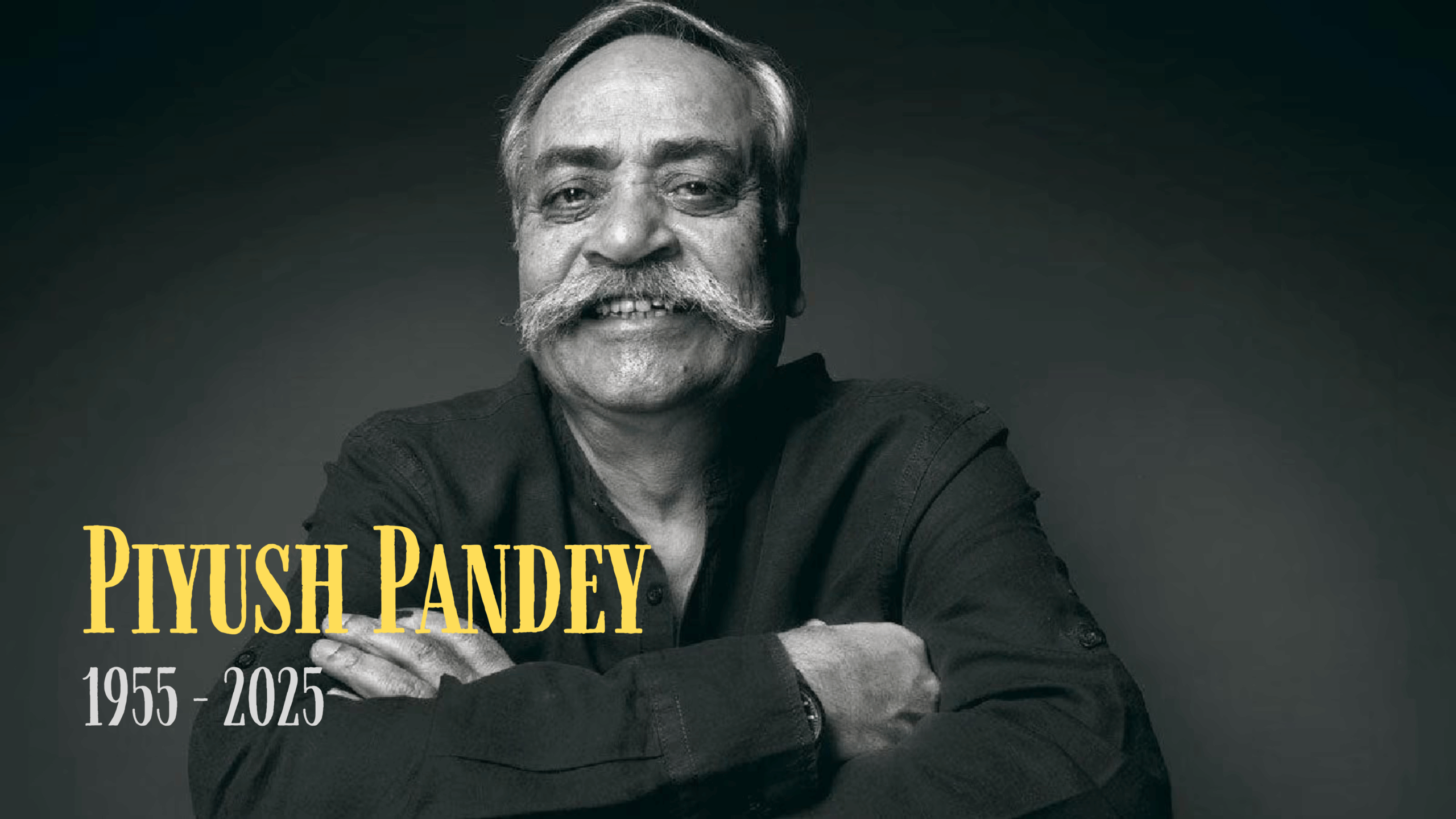
Admit it: you have probably believed something simply because Piyush Pandey made it feel true.
Say that to yourself if you must. Forgive me for saying it out loud here, because I am the sort of person who will admit that a well-turned line has sent me into a mild trance more times than I like to own, partly from awe, partly from embarrassment, partly because there is consolation in being shepherded by a sentence that fits like an old shirt. I knew Pandey from Yari Road in the late eighties and early nineties; he was my neighbour then, a fixture in the common seating area with a bellowing laugh, two golden retrievers his girlfriend kept, and a moustache that would have made Nathulal envious. He was the sort of man whose company could fill a landing as easily as a sentence could fill a room. Yes, I once accepted his invitation upstairs and left feeling oddly pleased at the privilege (including the can of soda he offered), and oddly ashamed for being pleased. So I will admit at the start what I will admit again at the end: I am not immune and neither are you.
For those of us who grew up in the nineties, “Mile Sur Mera Tumhara” is not merely a song; it is an evocation, a national conjuring made audible: those faces, those voices, that sudden, aching sense that a quarrelsome, sprawling country could, for once, be imagined as something that sings together even while singing in different languages. If, when the first chord strikes, your throat tightens, do not call it sentimentality; call it craft at work. An editorial decision became melody: someone chose who would be heard and how, and millions of private memories condensed into one public memory.
Then comes the uncomfortable fold. The same ear for cadence, the same knack for a line that lodges like a tooth, the same instinct for the single image that will carry ten thousand meanings found itself at work in a different register, in a very different India. “Ab Ki Baar, Modi Sarkar” arrived: a phrase that turned empty posturing into political momentum, lights and sound into votes, packaging into power, with the same swift certainty that a tune once moved feeling, a dance once sold chocolates, a witty turn of phrase sold an adhesive. Pause over that paradox if you can: unity summoned on one side, partisan allegiance summoned on the other; both emanating from the orbit of one brilliant practitioner who specialised in selling feeling. It makes the head spin when you try to write about it without sounding like you want to have it both ways.
If you need another historical provocation, consider how cultural creators can leave tangled legacies. Allama Iqbal, who gave us the lyric that many of us learned as “Sare Jahan Se Accha,” later developed political arguments that were read by some as providing intellectual ground for the idea of separate nationhood. One person, two very different public effects; admiration for the lyric does not settle the questions raised by the later politics. The lesson is not to arraign the artist; it is to remember how easily craft can be pressed into conflicting causes.
Call him what he was: astonishingly good at making ideas feel inevitable, a craftsman of persuasion. If you want to swoon for the technique, go ahead; I will not stop you. The Fevicol frames that turned adhesive into a comic myth are as instructive as the Cadbury moments that made a wrapper feel like a promise of tenderness. These were editorial choices as much as clever copy and seductive visuals. To compress a complex feeling into a two-line cadence, to find the one image that will carry ten thousand memories, to know when an economy of words will do the moral work of a paragraph: these are rare abilities, technical, partly teachable, and beautiful when used to summon something generous. I will praise the method even as I nag myself for being so easily dazzled.
But beauty is not proof. This is the point I keep returning to even as I sip the tea of nostalgia: we collapse a useful distinction far too readily, between the seller and the believer. The believer stakes reputation, conscience, perhaps life, on the truth of a claim; the believer submits that claim to argument and evidence. The seller, however brilliant, specialises in making the claim familiar, comfortable, therefore plausible; the seller optimises for recall not refutation. I say this with my hand up in complicity, because I have been the gullible audience for a dozen persuasive sentences I did not want to check. It is far easier to be moved than to take on the labour of testing what moves us.
Sellers also usually operate in a market: clients commission work, briefs set the goals, agencies execute, political operatives shape strategy. Responsibility becomes many-handed and dispersed. So when we look for culpability it is rarely concentrated on the visible maker of the line; that dispersion does not absolve us from the civic duty of asking where the moral ballast is meant to sit. Both functions matter in public life, but when we confuse them we hand judgement to charm, and that is an expensive habit for a democracy.
This problem seeps into every corner of public life. We look to athletes for moral exemplars because they are visible; we take actors’ intimacies for guidance because intimacy creates trust; we let television presence stand in for argument because presence commands attention. Fiction can shape ideology because words seduce. Algorithms and the economics of attention accelerate the error: repeatability is rewarded, nuance is not; repetition becomes a kind of secular consecration so that the best-selling sentence, repeated enough times, begins to feel like evidence.
In politics the hazard is sharper because slogans summon rather than argue. The most gifted persuaders know exactly how to make posture feel like destiny. That is a little terrifying when you remember you forwarded a phrase once and felt very modern and decisive about it. Indeed, once you have forwarded it you own it; it, in turn, owns you. That is how it is designed. That takes genius. That takes practice. That takes craft. Piyush was one of the finest practitioners of that art.
So what now, beyond smug scepticism? Three modest habits will do most of the work. First, practise provenance: when a line charms you, ask who benefits, who commissioned it, and what it asks you to stop seeing. Second, teach rhetorical literacy everywhere you can: in schools, in newsrooms, in family chats where everyone thinks they know history because of a forwarded clip. Third, insist on reasons: if a political appeal is theatrical, require that it be accompanied by verifiable claims; choreography without cause is theatre posing as policy. Practically, pause before you forward; ask three simple questions: who gains, what is elided, will this survive scrutiny, and prefer sources that answer them. This is a small civic hygiene that will save more reputations than any parade of moralising.
Praise the ear, celebrate the craft, do so with gratitude and honesty. Do not mistake a brilliant salesman for a believer in every idea he sells. Piyush Pandey was a genius of selling, not an apostle of any particular creed. That awkward, necessary distinction is the lesson his work leaves us with.
And yet, with his passing fresh, the first thing we owe him is tenderness: to his family, to his friends, to the small rituals of condolence, to remembering his laugh, the way his moustache twitched when he smiled, the unnoticed courtesies of a neighbour who shared tea on a step. For a while, let our questions wait with respect. Then, when the flowers wilt and the speeches have been said, let our mourning yield a small, stubborn practice: the next time a line lifts your chest, do not simply nod and move on. Pause. Name the craftsman. Savour the music. Then ask three plain questions: who stands to gain if this line is repeated, what does it ask you to stop seeing, can it bear the light of reason as well as the warmth of feeling. Teach that pause to your friends, insist on it in your reading rooms and newsfeeds; above all, remain, stubbornly and slightly rebelliously, the author of your own convictions. Being dazzled is permissible, being unthinking about it is not.
We will miss his laugh, and the way his moustache moved when he smiled, and the small generosity of being invited upstairs to listen. We can do that mourning without mistaking the music for the message. If you ask me what to do now, I will say this simply and without ceremony: be grateful for the craft, be kind in the hour of death, and then, after mourning has had its small, necessary season, return to the work of thinking. That would be the worthiest tribute.