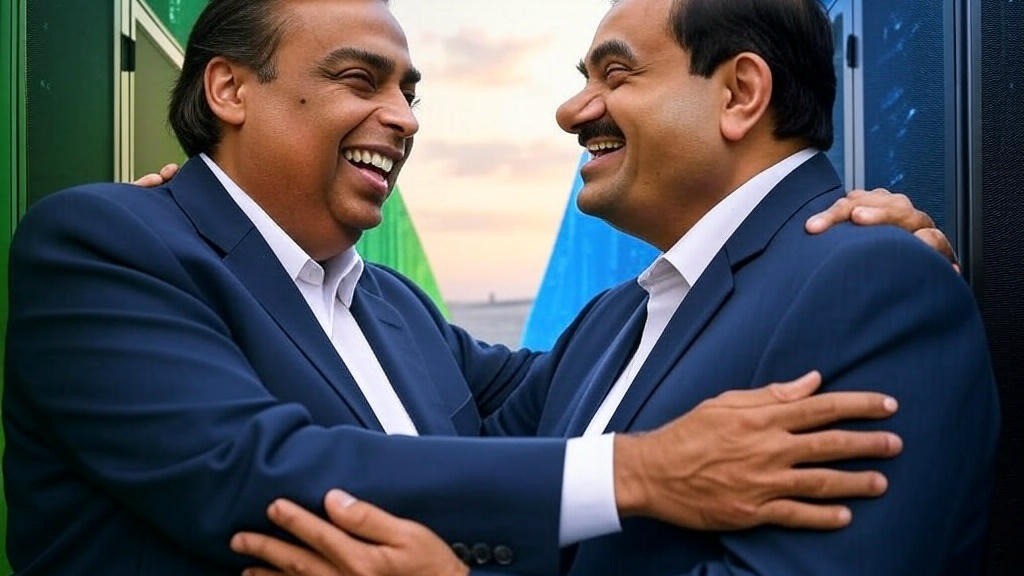
I am always faintly amused, and occasionally alarmed, at the speed with which otherwise sensible people rush to defend billionaires.
Alleged defamation?
Careful, that’s character assassination.
Higher taxes?
Don’t punish success.
Breaking up monopolies?
This is how innovation dies.
And these are not oligarchs in disguise. They are not heirs to petro empires. They are not even especially wealthy. They are middle-class professionals with EMIs, SIPs, perhaps a faux SUV, and a resolute belief in the power of compounding (mainly from FDs in PSU banks). At no point does their daily life intersect with that of the billionaire they are defending (even if they work for one). The closest they have come to extreme wealth is refreshing a stock portfolio app twice before lunch, or discussing defence deal scams, or watching the FM present the nation’s budget, all of which are quite ironic in their own way. But I digress.
I was curious. Why would someone who was so far away from a billion dollars that if I were to ask them how many zeroes there are in one, they’d be at a loss, want to badly to defend those that really need no defending? It took me a while to understand what was happening. You see, it is not ignorance. It is anticipation.
Let me explain.
In the 1970s and 80s, in that unfashionable socialist era we now dismiss with the smugness of liberalisation, money was something you earned and guarded, but did not mythologise. Flaunting wealth was considered bad form, and indeed, that rich uncle who brought gold back from Dubai and showed it to the neighbourhood was not aspirational, but embarrassing. Calling yourself rich would have required either irony or alcohol (usually both). Everyone was middle-class by self-admission. Yes, the caste privilege showed when we claimed we were’ Upper’ middle class (just to separate us from the riff-raff, still put us firmly in the ‘deserving’ category), but no one ever claimed to be wealthy. It was impolite.
Today, modesty has been replaced by what I call pre-emptive alignment.
No one thinks of themselves as middle-class anymore, upper or lower. “Middle class” is merely a temporary administrative error in an otherwise inevitable billionaire journey. I am not average, I am pre-wealth. I am not constrained; I am incubating. My current income is not reality, it is rehearsal.
And so, when someone proposes a tax bracket that might inconvenience the ultra-wealthy, or suggests that billionaires ought not to be a protected species, these future magnates rise as one. Not because their present lifestyle is under siege, but because their imagined future lifestyle feels personally insulted. They are not defending a billionaire. They are defending their own future, their projected autobiography.
Meanwhile, the billionaires themselves occasionally style themselves as rebels, as anti-establishment crusaders pushing back against “the system”. Which is fine. If you own the castle and still want to describe yourself as storming it, that is between you and your publicist. My concern is not their self-image.
My fascination is with the middle-class citizen who hears a criticism of concentrated wealth and instinctively thinks,
Careful, that might be me someday. Better align myself with it. One never knows when I might be on the other side.
Funny that this same feeling of empathy never shows up when they think of the truly oppressed people. Because, of course they don’t.
Alas, the mathematics is unromantic. The probability of an average Indian salaried professional becoming a dollar billionaire is so vanishingly small that it belongs less to economics and more to mythology. In cold numerical terms, they are far closer to the poorest Indian than they will ever be to the person whose fiscal inconvenience or reputational slight they are protesting.
But statistics are poor competitors against fantasy.
It is much nicer to imagine that one is a temporarily embarrassed wealthy person, that one is one good quarter, one lucky break, one disruptive idea away from crossing over into that luminous category, and when that day comes, heaven forbid some ungrateful mortal proposes a surcharge.
After all, hope is free.
Wealth, on the other hand, is not.