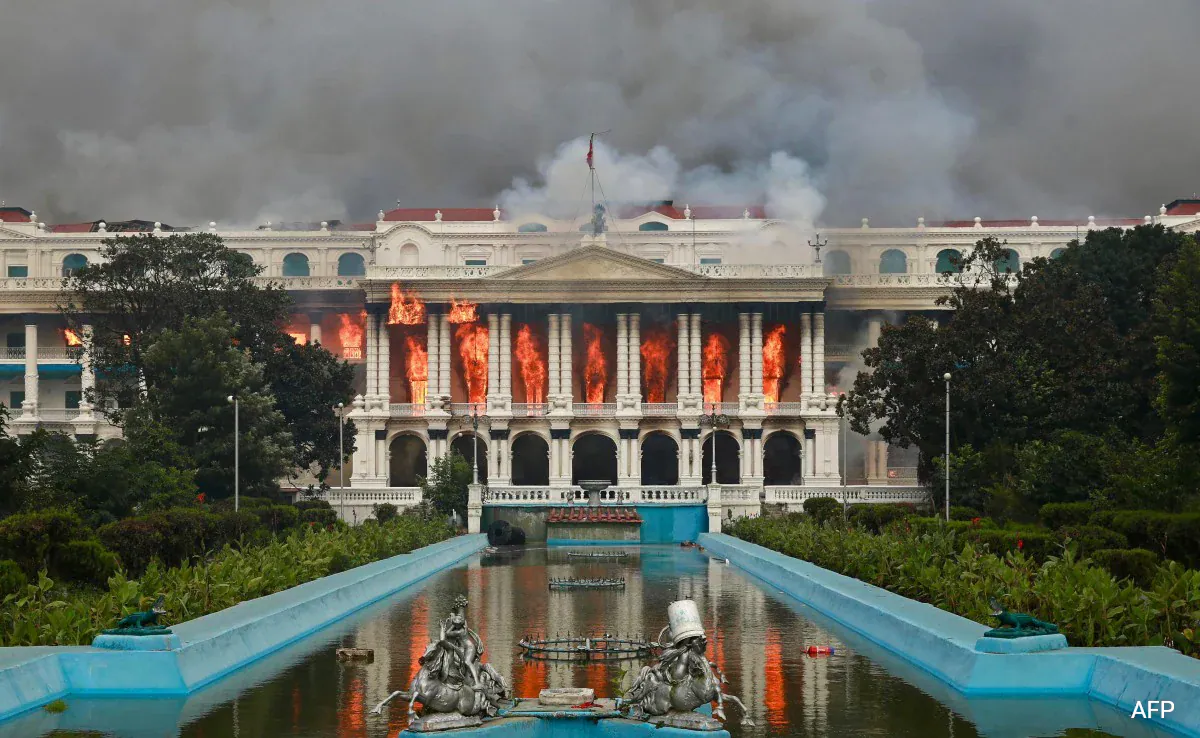
Singha Durbar, the main administrative building for the Nepal government, in Kathmandu set ablaze by Nepali youth protesters on September 9.(AFP)
If the first part was about my own journey with violence, this second part must turn outward. What unsettles me most today is not just history’s lessons but the way violence is erupting across our neighbourhood, and how, all too often, it is celebrated by those who should know better.
Sri Lanka, 2022
Sri Lanka’s Aragalaya, “the struggle,” rose out of desperation during the economic collapse. Within months, the Rajapaksa dynasty, once untouchable, was driven from office: Mahinda resigned in May and Gotabaya fled in July. Crowds stormed their homes, occupied the presidential palace, and turned the swimming pool into a symbol of supposed liberation. To many outside observers, and to many of my liberal friends in India, this looked like democracy at its finest, the people reclaiming their country from a corrupt family that had bled it dry.
Yet what unsettled me was not that the Rajapaksas fell (they had indeed ruined the nation) but that they were toppled by a mob. Violence had become the pathway to power, and however much the new leader, Anura Kumara Dissanayake, seems steadier and more decent, the legitimacy of his government is already stained by the means of its birth. If we accept violence when it places in power someone we like, and denounce it when it elevates someone we do not, then we are not really condemning violence at all. We are merely choosing sides in whose service it operates. That is not a principled position. It is a dangerous inconsistency, and one that leaves democracy vulnerable to the same fury that yesterday looked liberating but tomorrow may look ruinous.
Bangladesh, 2024
The quota protests began over university and government job policies but soon swelled into nationwide unrest. By the end, more than a thousand were dead, tens of thousands injured, and thousands more imprisoned. What struck me was not only the scale of the violence but the speed with which it was romanticised. Having been both an observer of politics and, more recently, a participant in it, I know that so-called spontaneous uprisings almost never are. They demand money, organisation, and intent, and there is always someone who benefits from the chaos. And so, while young people lay in the streets, my liberal friends far away posted triumphant messages, seeing in the flames the cleansing of corruption and oppression. I could not join them, because what I saw was not justice but vengeance, not democracy renewed but democracy undermined by its own impatient children.
Arab Spring, 2011 (a reminder)
And if you think this is only a South Asian affliction, remember the Arab Spring. In 2011, it was hailed worldwide as the great awakening of the Arab world, the moment when people rose against entrenched rulers and claimed freedom for themselves. My liberal friends shared poetry, slogans, and images of Tahrir Square as if history itself had turned a corner. Yet what followed was not democracy but disarray. In Egypt, the movement was quickly seized by the Muslim Brotherhood, and what began as a cry for liberty collapsed into fresh authoritarianism. Elsewhere too, the uprisings left behind rubble rather than renewal. The romance of rebellion blinded many to the reality that mobs rarely build what they destroy. That lesson unsettled me then, and it unsettles me even more now as I watch similar fires being fanned closer to home.
Nepal, 2025
This year it is Nepal’s turn. In September a sweeping social media ban triggered mass protests across Kathmandu. Security forces opened fire, killing at least 19 people and injuring more than 300. Curfews were imposed, tanks rolled into the capital, and within days the prime minister was forced to resign. The headlines christened it a “people’s movement,” and my liberal friends passed around videos of jubilant crowds as proof that democracy still lives in South Asia. But I cannot share their enthusiasm, because I know from long experience that such uprisings are rarely as spontaneous as they appear. They require money, organisation, and intent, and I strongly suspect that Nepal’s turmoil is not only homegrown. With India’s right-wing establishment eager to score points in its shadow-boxing with China, I would not be surprised if funds, whispers, and encouragement have flowed across the open border from Uttar Pradesh into Nepal. For men like Shah, Doval, and Jaishankar, this would be a grand game of proxies. For the young Nepalis dying in the streets, it is no game at all.
So when I am asked to celebrate Kathmandu burning as democracy reborn, I cannot. I see not renewal but the old story repeating itself: what rises through flames is almost always consumed by them. What begins in anger ends in exhaustion, leaving Nepal weaker and more divided, and its institutions further hollowed out by the very violence that claimed to save them.
India, 2026?
I know India’s institutions are compromised, that courts, media, and police have been bent to the will of those in power, that elections are no longer the clean contests they once pretended to be. I despise the Modi–Shah regime with every fibre of my being, and I fervently hope they are one day arrested and tried for their many abuses. But even that hatred cannot make me embrace a revolution born in blaze and fury. Such revolutions do not deliver justice; they deliver rubble, and rubble, though momentarily cathartic, does not build democracy.
So I stand apart. Observing. Even commenting. But not necessarily agreeing. And certainly not celebrating. That isn’t because I do not think there is any pain simmering behind the protests, but because I cannot believe that mobs and Molotovs, riots and revolutions, or unrest and uprising will ever bring us closer to justice. It is like a military general who deposes a democratically elected, but corrupt government. Disagreeing with him does not mean I stand with corruption. On the contrary. I believe that such a coup, using undemocratic means, is the highest form of corruption.
With this, I must pause again. If this part has been about them, our neighbours, their revolutions, the romance and the ruin, then the final part must be about us. About how we, the liberals and the idealists, too often let ourselves be swept away by slogans, songs, and street theatre, forgetting that real change is rarely forged in fire. It grows through patient, imperfect, institutional work that endures beyond chants and crowds. That is where we must go next.