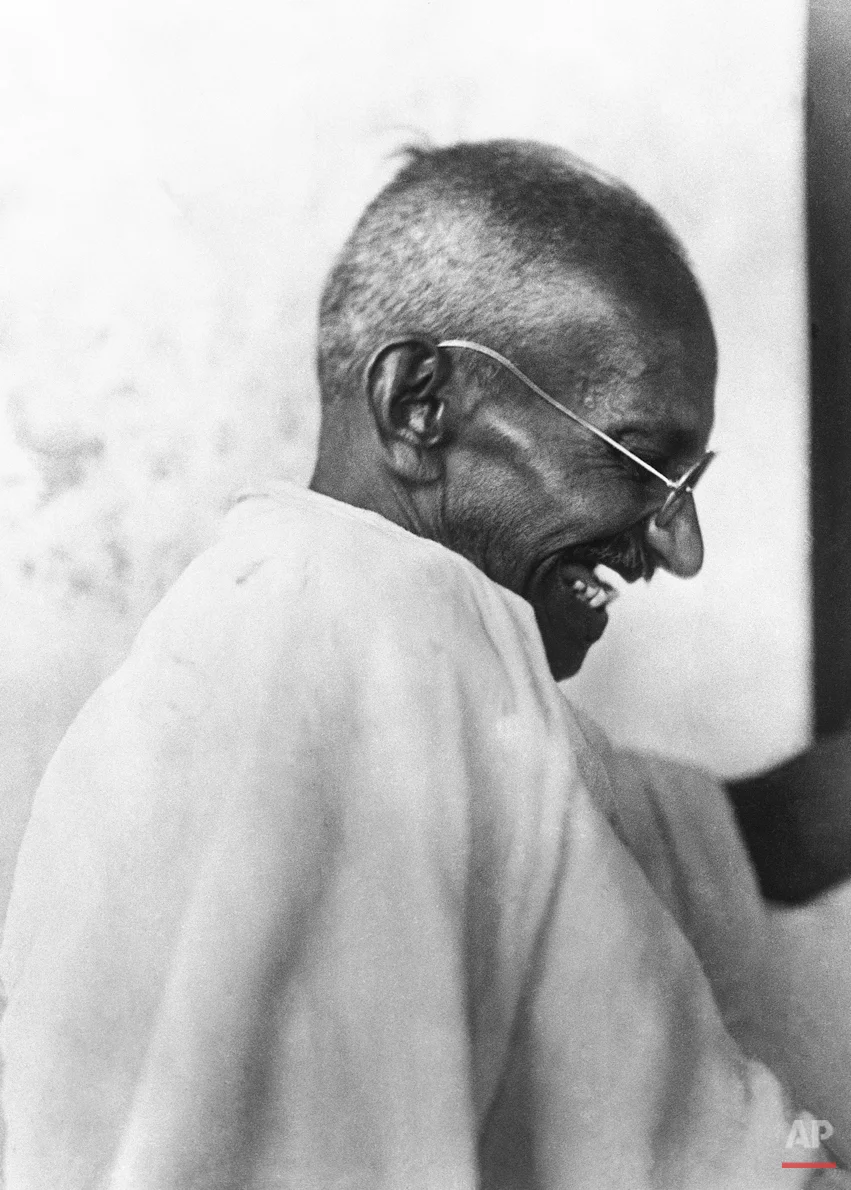
Mahatma Gandhi laughing around April 23, 1930. (AP Photo)
If the first part was about me, and the second about them, then this third must inevitably be about us. Because it is too easy to look at Sri Lanka or Bangladesh or Nepal and shake our heads, to talk loftily of other people’s mobs and other people’s mirages, without acknowledging how vulnerable we are to the same temptations here at home.
I remember August 2011 as clearly as if it were yesterday. On 16 August, Anna Hazare began his dramatic hunger strike at Ramlila Maidan, dramatic not in the sense of high courage but in the sense of theatre, more drama than substance, and within hours India Against Corruption was the new gospel. Friends of mine, good and sensible people, took leave from their jobs (and, I suspect, of their senses) to travel to Delhi. Those who stayed behind wore white caps that proclaimed Main Bhi Anna and spoke of him as if he were some kind of modern Gandhi. They sat glued to the television, breathless with excitement at the possibility of wiping corruption clean off the subcontinent, and worshipping at the altar of the new prophets, Arvind Kejriwal and Vinod Rai, reporting to their God, Anna.
I was not with Anna. On 19 August 2011, barely three days after the fast began, I wrote a post explaining why. To place a Lokpal above Parliament, to grant unelected men the authority to override elected representatives, struck me as profoundly undemocratic. It was not a cleansing of corruption; it was the subversion of democracy itself. And yet those words, then, sounded like heresy. People who had known me for years could not believe I was standing apart. But I had already seen enough to know that mobs, however righteous their slogans, rarely leave democracy stronger than they found it.
In hindsight, of course, we know what came next. The BJP and the Hindutva ideology had been around for decades, from the Ramjanmabhoomi agitation to the Rath Yatra, from the cow protection movements to the steady cultivation of grievance politics. But what India Against Corruption did was soften the ground, sour the air, and tilt the mood of the nation toward rage against institutions and disdain for politics itself. And, as I have observed elsewhere, no agitation of that scale is ever truly spontaneous. It takes money, organisation, and intent, and I have often wondered whether forces inimical to India’s democratic stability found it convenient to fan those flames. Out of that atmosphere, Narendra Modi emerged not as a fresh force but as the most ruthless beneficiary, presenting himself as the answer to a problem that the movement had itself sharpened. What my liberal friends once celebrated as revolution gave us instead the most authoritarian regime India has seen in decades. And yet even today, many of them do not make the connection.
This is why I remain suspicious whenever the streets are hailed as democracy’s true home, whenever we are told that only a revolution can save us. Because I know how quickly a “people’s movement” becomes the seedbed for demagogues, how easily the romantic cry of purity corrodes institutions, how inevitably the slogans of liberation turn into instruments of control. And this is why, much as I despise Modi and Shah, much as I long to see them arrested, tried, and held accountable, I cannot bring myself to wish for their downfall in a blaze of revolution. I want them undone by the very institutions they have corrupted, because only then will those institutions be restored. Anything else, however cathartic in the moment, will only hollow out our democracy further.
And here I must state it plainly, lest there be any ambiguity. I am, at heart, both a pacifist and a democrat. I abhor the Modi–Shah regime with every fibre of my being, I despair at how they have infected and subverted every institution of democracy that might have been used to vote them out, I long for the day when they stand trial for their crimes. Yet even so, I cannot abandon my conviction that violence is never the answer. I cannot bring myself to cheer at the thought of their downfall through mob fury or revolutionary upheaval. What I do stand for is something very different. I stand with those who believe that love, not hate, must be the guiding force of politics. I stand with the spirit of the Mohabbat ki Dukan that Rahul Gandhi has tried to build, however imperfectly, because it offers a vision of protest that is non-violent, inclusive, and humane. The only public demonstrations worth defending are the non-violent kind, rooted in love rather than vengeance, seeking not to burn down institutions but to reclaim and rebuild them. That, to me, is not weakness or naivety, but the strongest possible rejection of the poison that has been allowed to seep into our politics.
And if anyone thinks this insistence on non-violence is naïve, I would remind them of our own history. Yes, there were revolutionaries like Bhagat Singh, Subhas Chandra Bose, and countless others who believed that bombs, assassinations, and armed struggle were the only way to shake the empire, and their sacrifice cannot and should not be belittled. They fought with courage, they inspired generations, and their place in our national story is secure. But even here, what we remember most is not the violence they committed but the ideals they embodied. Ask anyone what Bhagat Singh is remembered for, and it is not a list of names he killed. It is his fasts in jail to win rights for prisoners, his insistence that he be recognised as a political prisoner, his refusal to write mercy petitions, his atheism and socialist thought, his searing letters to his parents and the colonial state. That is his legacy. And Netaji too, while he raised an army and called Indians to arms, is remembered not so much for the battles of the INA as for his dream of a government in exile, Arzi Hukumat-e-Azad Hind, his call of Jai Hind, his Azad Hind Fauj singing Kadam Kadam Badhaye Ja, his clarion demand for khoon in return for azaadi, and his rallying cry of ‘Chalo Delhi’. Their violence is part of the story, yes, but what endures in our memory is their vision, their sacrifice, their moral courage.
This is not accidental. It is who we are. In our epics, we do not remember Arjun as our greatest hero, though he was the mightiest warrior of Kurukshetra, and the protagonist in every way of the war. We instead remember Krishna, the charioteer, philosopher, guide, and friend. In the Ramayana, we do not venerate Ram for killing Ravan (for that was indeed his, and Ravan’s, destiny) but for being Maryada Purushottam, the just king, the loyal husband, the obedient son. In our traditions, bhakti has always inspired an equal, if not more, devotion than shakti. Even Chhatrapati Shivaji Maharaj, whom we rightly admire for his valour in battle, is remembered even more for his just treatment of his praja, his respect for women, his dream of swaraj, his brilliance in administration, his guile and intelligence in diplomacy. It is these qualities, not the blood spilt in war, that make him one of the greatest Indians to have lived. Any general can kill and rule our bodies. Only a Chhatrapati can rule our hearts.
And that, finally, is my point. Our culture, our memory, our deepest instincts, have always privileged vision over violence, character over carnage, love over hate. That is why Gandhi’s Ahimsa could move millions, why his Satyagraha could humble an empire.
Nor is this merely about Gandhi. Around the world, history shows us that justice endures when it is channelled through institutions, not mobs. South Africa’s Truth and Reconciliation Commission in 1996, however imperfect, sought not revenge but truth, and left behind a framework for healing. The Nuremberg Trials of 1945–46 and the Tokyo War Crimes Tribunal of 1946, though victor’s justice in many ways, still gave the vanquished lawyers, hearings, and a place in the record, a recognition that even monsters are owed a process. These were not perfect solutions, but they were far closer to justice than any lynching in a public square.
That is why I take pride in India. Nathuram Godse was tried in open court. Satwant Singh and Kehar Singh, who assassinated Indira Gandhi, were hanged in 1989 after a full judicial process. The assassins of Rajiv Gandhi, Nalini Sriharan, Murugan, Santhan, Robert Payas, Ravichandran, and Perarivalan, spent three decades in prison before the Supreme Court ordered their release in 2022. Even Ajmal Kasab, caught on camera during the 2008 Mumbai attacks, was defended by court-appointed lawyers, tried in a special court, and only then executed in 2012. Due process is our inheritance. Yes, it is my privilege to believe in it, but it is also my pride.
Detractors of this method will say that it is not possible in today’s world. I would like to remind them that they said that during Gandhi’s time too. They will say it is too difficult and inconvenient, that it will take too long and call for too much sacrifice, and that it will be painful. I know. And yet, I choose that path. For it is the only moral path for me today.
You see, for me, the test is simple. Any movement that will last, that will be sustainable, that will offer the possibility of peace rather than just the intoxication of vengeance, must be rooted in Gandhian principles of resistance. It must stand on the foundations of love. Unlike the Arab Spring, the Tulip Revolution, the Rose Revolution, the Orange Revolution, the Velvet Revolution, or whatever other poetic label we attach to uprisings that flare in fire and fade into chaos, Gandhian Satyagraha promised not only resistance but also reconciliation. It offered not just a toppling of power but a rebuilding of society on more humane terms. These “springs” and “revolutions,” however beautiful the banners, have almost always been rooted in hate and anger, and therefore, they carry within themselves the seeds of their own decay. Gandhi’s way, however frustratingly slow, gave us not just freedom but also a promise of peace. That is what I choose, and what I insist upon even now.
And this, finally, is where I draw my line. I would far rather shout and live by Gandhi’s Karo ya maro, the call of 1942, the cry to “Do or Die” in the Quit India Movement, than by some twisted version of it that says Karo ya maaro, do or kill. The first carries the willingness to suffer, to sacrifice, to lay one’s life down in the service of truth; the second carries only the hunger to hurt, to maim, to avenge. One is rooted in love, the other in hate. One builds movements that can sustain peace, the other leaves behind rubble and resentment. For me, there can be no ambiguity about which side of that divide I stand.