In the long and winding history of India’s post-Independence engagement with the world, few relationships have been as fraught, as revealing, or as stubbornly cyclical as that with China. From the starry-eyed idealism of the Nehruvian years to the media-saturated stagecraft of Narendra Modi’s diplomacy, we have, it seems, perfected the art of arriving at the same strategic cul de sac, only by entirely different routes.
Let me state at the outset that I am a Nehruvian. I hold Jawaharlal Nehru in very high esteem. Among the architects of modern India, he remains, to my mind, a giant, intellectually, politically, and morally. Even in his own time, he stood taller than most. In comparison to the pygmies who populate the leadership ranks today, he remains a figure of immense vision and courage. His understanding of history, literature, diplomacy, and science was unparalleled among his contemporaries. And yet, even I must concede that Nehru was a flawed genius.
His Achilles’ heel, if one must name it, was precisely his morality. Unlike others, I do not see that as a vice. Intent matters. Means matter. A moral frame, especially in public life, is not a weakness in itself. But in geopolitics, only the outcome is recorded as history. And here, Nehru’s insistence on morality, his belief that global affairs could be shaped by decency and goodwill, left India exposed. We continue to suffer the consequences of that idealism.
His mistake, particularly in foreign policy, was to believe that personal charisma, of which he had it in spades, could substitute for hard-nosed influence. That belief was not only naive, but in the Chinese context, catastrophic.
Much has been written, some with admiration, some with barely disguised contempt, about Nehru’s foreign policy instincts. Idealistic, moralistic, and driven by a deep commitment to building a post-colonial, multipolar world, Nehru’s approach sought to place India not merely on the map, but at the heart of a new global ethic. His belief in Panchsheel, his willingness to recognise Chinese sovereignty over Tibet, and his advocacy for China’s inclusion in the United Nations were all emblematic of this moral vision.
But morality, it turns out, is not a substitute for strategy. The fatal flaw in Nehru’s China policy was not that it lacked conviction, but that it conflated ethical intent with geopolitical realism. The forward policy on the border, predicated on the assumption that China would not react with force, was not only a gross miscalculation but a wilful refusal to see that brotherhood, however loudly proclaimed, does not trump hard power. The 1962 war was not merely a military defeat; it was the collapse of a worldview.
Yet, for all its failure, Nehru’s error was born of reading too many books, not too few. He believed in a rules-based international order, even if he was ultimately wrong about how it would be enforced. His mistake was tragic, not farcical.
Which brings us to the present.
At the recently concluded SCO Summit in Tianjin, Prime Minister Modi met Xi Jinping for the nineteenth time. One might be forgiven for expecting something concrete from such an extensive personal engagement, perhaps a diplomatic breakthrough, a strategic trade-off, or even a public statement that acknowledges Indian concerns over territorial integrity, the LAC, or the relentless militarisation of the Himalayan frontier.
Instead, we received a now-familiar serving of diplomatic word salad: ancient civilisations, shared destinies, constructive partnerships. There were no deliverables of any substance. No shift on Arunachal Pradesh. No curtailing of cross-border terrorism through Chinese influence on Pakistan. No pressure on trade imbalances. No clarity on the so-called border villages mushrooming ominously across the Chinese side. Even the resumption of rare earth and pharmaceutical exports from China, touted as a takeaway, comes with no guarantees.
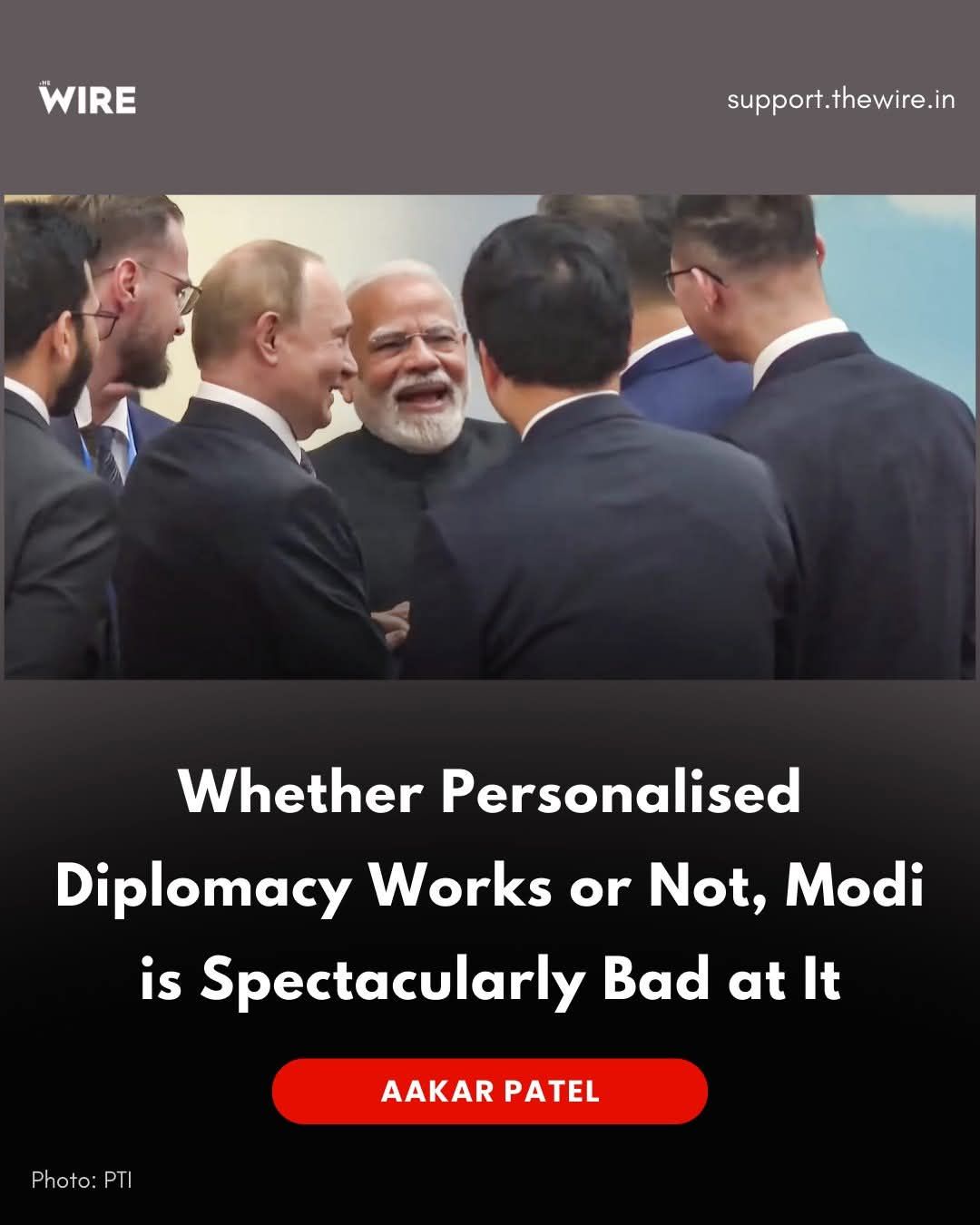
Worse still, the optics, long considered Modi’s strong suit, betrayed India’s position rather than bolstered it. The image of the Indian Prime Minister nestled uncomfortably between a beaming Vladimir Putin and a confident Xi Jinping appeared less like a trilateral assertion of multipolarity and more like a diplomatic rebound, with India playing the spurned partner seeking relevance. For a government that has excelled in crafting imagery, this particular tableau was oddly tone-deaf, almost pitiable.
And let us be honest. Narendra Modi is no Nehru. He lacks the vision, the depth, the learning, and the long-term imagination. He lacks curiosity. He lacks grace. His foreign policy is a patchwork of Instagram diplomacy and WhatsApp patriotism, with very little to show by way of hard outcomes. His missteps are not born of overreach, but of ignorance. Not tragic, but farcical.
Of course, foreign policy can be personal. And to pretend that statecraft has ever been entirely divorced from the personalities at the helm would be naive. But the contrast between Nehru’s tragic miscalculation and Modi’s theatrical misfire could not be starker. One came from idealism untethered to reality; the other, from optics untethered to substance.
There is a philosophical metaphor that comes to mind. Imagine two individuals declaring that reading books is pointless. One arrives at that conclusion after studying a hundred of them, struggling with their contradictions, and finding their truths inadequate to lived experience. The other never opens a single one, and dismisses them wholesale. The words may be the same. The minds behind them are not.
And so, too, with India’s two most personalistic foreign policies.
Both have brought us to similar impasses: weak strategic leverage, few friends of consequence, and a neighbour whose ambitions grow unchecked. But there is a difference, a meaningful one, between getting lost after misreading the map and getting lost because one never bothered to read it at all.
And that, right there, is the tragedy. Not just that we have lost our way, but that we are now led by someone who believes maps are for the weak, that image is stronger than substance, and that foreign policy is best conducted with drone shots and hashtags. The world is not watching an emerging power; it is watching a spectacle. And increasingly, it is turning away, not out of fear, but embarrassment.
Because when the Prime Minister of India bursts into uncontrollable laughter at solemn international forums, it does not read as charm or ease. It looks like confusion. Nervousness. The laugh of someone who has not understood the subtext, or perhaps even the text, and is buying time with performance. It is the laugh of a man who thinks he has cracked a joke, and now awaits his reward. A reward that never comes.
Worse, it is the unmistakable posture of the Indian uncle at a family function, having delivered an inappropriate quip, he stretches out his palm, eager for a low-five of validation. And when none comes, he lingers, hand aloft, in a silence so thick it bruises. That is the image India risks today. We are not at the high table. We are standing beside it, laughing too loudly at our own joke, hand outstretched, and no one reaching back.
Thank you, Anshu Dash for inspiring me to write this slightly more elaborate piece than my previous one.
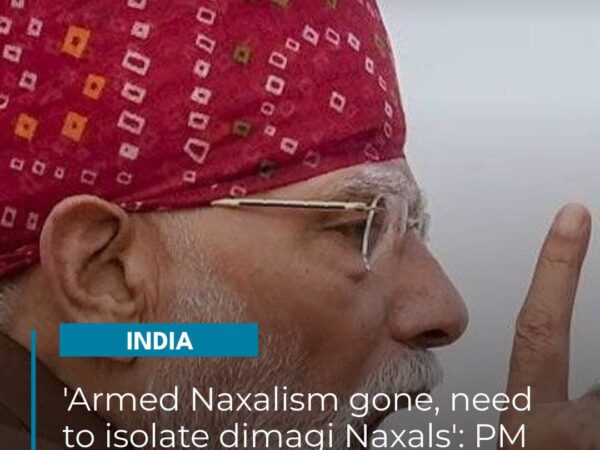
Image: TheWire.in