
Article 3 of the “Patriotism in Three Acts” Series
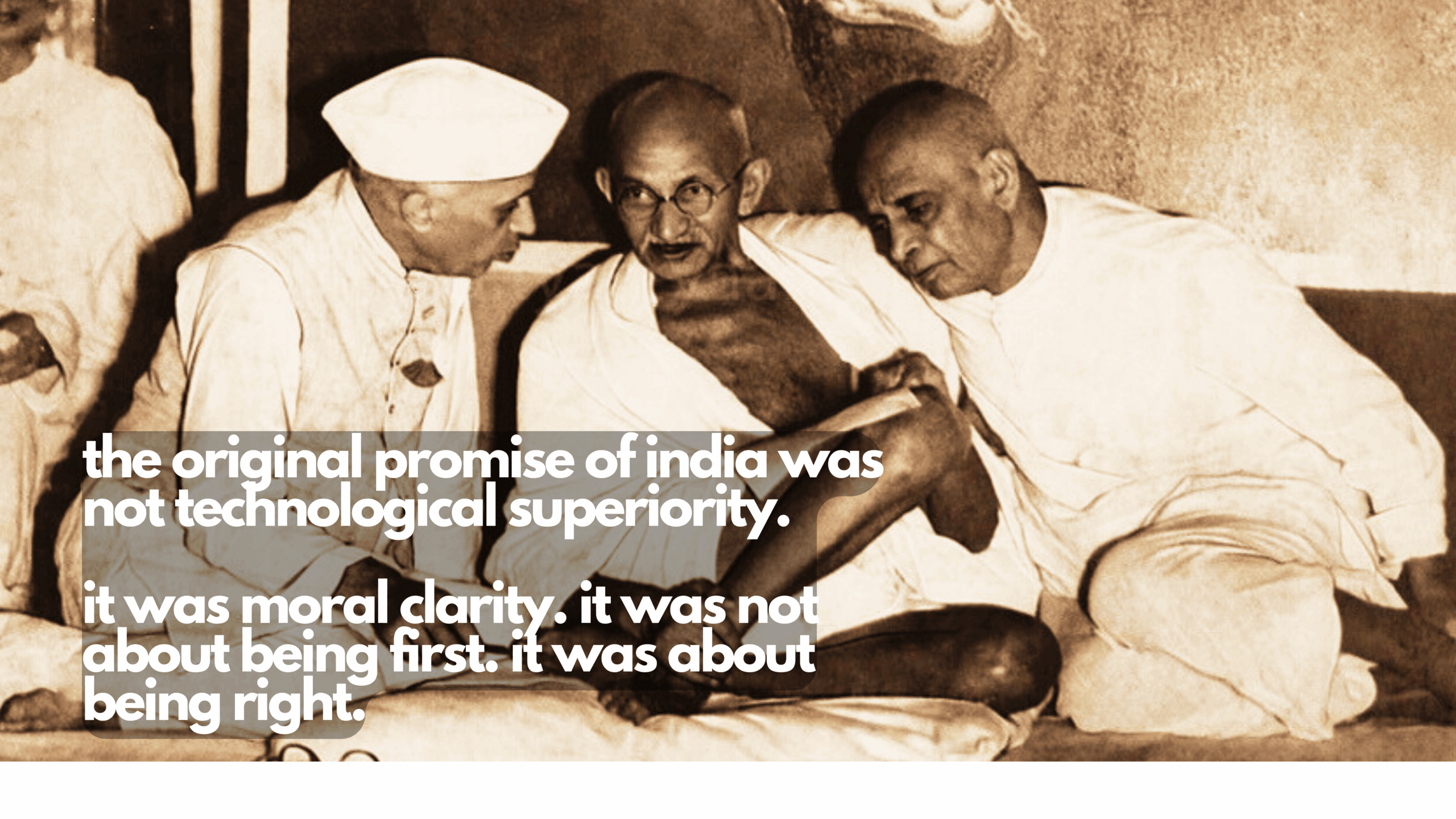
“A nation that forgets what it stands for will eventually stand for anything. And eventually fall.”
This is the third and final part of a series that began with a simple question: why do those who glorify the military rarely feel compelled to join it? That was Article 1: “Flags Without Fighters.” In Article 2, “The Hollow Arsenal,” I examined the deepening crisis in India’s military preparedness, focusing on vacant ranks, a changing theatre of war, and a generation that is simultaneously being radicalised and underprepared.
Today, I take a step back. Away from the barracks and the recruitment offices. To ask a more fundamental question: What kind of country are we preparing to defend? And why are we so ready to go to war in the first place?
⸻
The India We Inherited
The India that was envisioned by the generation of Gandhi, carried forward by Nehru, Ambedkar, Patel, Azad, and others, was not an accident of cartography. It was a philosophical project. India was meant to be an idea: plural, principled, peace-loving, and rooted in justice.
In that imagination, the nation’s strength did not lie in its ability to dominate neighbours or build nuclear stockpiles, but in its moral compass, its civilisational depth, and its democratic character. It was meant to be a beacon for the post-colonial world: an example of how a remarkably diverse, extremely impoverished, deliberately broken, newly liberated country could chart an independent course without becoming a pawn in global power games.
India’s foreign policy reflected this. Non-alignment was not fence-sitting. It was a position of strength. Of saying no to both Washington and Moscow when doing so served our principles. It was Panchasheel, solidarity with Palestine, resistance to apartheid, leadership in the Non-Aligned Movement, and a refusal to join military pacts even at the cost of aid.
Our domestic policies, too, mirrored this moral imagination. Economic planning was not merely a technocratic exercise, but an ethical one. The objective was not just growth, but justice. We built ration systems to feed every Indian, established public sector enterprises to protect against exploitation, and erected tariff walls not out of xenophobia, but to give our fledgling entrepreneurs and farmers a fighting chance. Affirmative action became a constitutional commitment. Education was treated as a right, not a privilege, with institutions like IITs and IIMs envisioned not just as centres of excellence, but as engines of equity. From the All India Institute of Medical Sciences to the Indian Council of Agricultural Research, from Khadi and Village Industries to ISRO, the project was not just modernisation, but inclusion.
Health, housing, sanitation, even cinema, each became part of a larger social contract. The India we sought to build was not a marketplace. It was a society. One where the poorest were not invisible, where capital did not dictate morality, and where ambition was tempered by empathy. We did not always succeed, but we always aspired. And that aspiration was rooted not in identity, but in ideals.
Even our military posture reflected restraint. India has almost never initiated aggression. We went to war in 1971 only after ten million refugees poured into our borders and the genocide in East Pakistan reached unbearable proportions. That was not conquest. It was humanitarian obligation. We intervened in Sri Lanka, not to annex territory, but to try to broker peace (with disastrous consequences). We went to Maldives to reinstall a democratically elected government. We have never had territorial ambitions that we needed violence to fulfil. Our army has been called a defence force for a reason.
⸻
The India We Have Become
That moral compass, which once guided India’s postcolonial rise, rooted in principle, clarity, and idealism, has, over the past decade, been quietly abandoned in favour of a transactional, muscular nationalism. It is a nationalism that confuses decibel and snark for depth, equates photo-ops and hugs with policy, and treats diplomatic alignment not as an expression of belief, but as a matter of barter.
We now supply drones to Ukraine through private firms like SSS Defence, even as we continue purchasing S-400 missile systems and discounted crude oil from Russia, sidestepping Western sanctions. We maintain defence partnerships with France, from whom we buy Rafale jets, and simultaneously procure Heron drones and Spike missiles from Israel, all while reiterating our historic support for Palestine in global forums. We abstain from United Nations resolutions condemning Russia’s invasion of Ukraine, including the March 2022 General Assembly vote and subsequent Human Rights Council motions, yet speak earnestly of sovereignty in the Indo-Pacific and of maritime freedoms in the South China Sea. We hosted Israeli Prime Minister Benjamin Netanyahu in 2018 with brass bands and a tri-services guard of honour, even as we issued NAM communiqués reaffirming the two-state solution.
We praise non-interference while partnering with Myanmar’s junta, Egypt under al-Sisi, and Saudi Arabia under Mohammed bin Salman, regimes notorious for jailing dissenters, bulldozing constitutions, and suppressing minorities. At home, we proclaim ourselves the Mother of Democracy. Abroad, we close ranks with autocrats, so long as pipelines, arms, or trade routes remain open. And all this is explained away through the euphemism of “strategic autonomy,” a phrase that once embodied principled neutrality but now more often serves as camouflage for moral incoherence.
Strategic autonomy, when animated by principle, commands respect. When anchored in silence, ambiguity, and opportunism, it invites distrust.
Of course, realpolitik is not a crime. All sovereign nations hedge and recalibrate. But India was once something more than just another actor in the balance-of-power game. We were the conscience of the decolonised world, an unapologetic voice for the occupied, the marginalised, the stateless. Today, we are more echo than exemplar. What was once moral leadership has given way to marketplace logic. And while such ambiguity may offer short-term advantages, it comes at a long-term cost: the erosion of a republic that once aspired not only to be powerful, but to be good.
Today, the question animating our foreign and military policy is no longer “what is in India’s enlightened national interest; what must we do to be what we must be?” but “what will look good on a noisy television debate with people shouting at each other, in a sweeping drone shot with inspirational music, at an election rally read off a teleprompter, or as a WhatsApp forward that begs to be re-forwarded to save the nation?” The armed forces, once resolutely above the political fray, are now wheeled out in election campaigns. Foreign policy, once rooted in institutional memory and civilisational clarity, is now driven by mood swings, cults of personality, and the promise of a photo finish.
The result? India stands in limbo. No longer the steadfast champion of the Global South, nor a fully trusted member of the liberal democratic world. We have alienated neighbours, courted transactional allies, and bartered away the very ideals that once gave our diplomacy its depth. We now shake hands with anyone, provided the camera angles are good, the laughter sufficiently loud, and the slogans resound with just enough nationalist fervour to distract from the silence of our conscience.
⸻
What We Risk Losing
This shift is not without cost. When we reduce foreign policy to trade deals and military purchases, we lose moral credibility. When we embrace regimes that jail dissenters and bomb civilians, we lose the ability to speak for justice.
India once had the standing to talk peace. To broker resolutions. To send peacekeepers. Today, we are mostly seen as another buyer in the arms bazaar, or worse, another player in the global authoritarian axis.
And while we continue to invest in weapons and alliances, we fail to invest in the deeper foundations of national security: strong institutions, vibrant democracy, informed citizens, and a clear sense of what India stands for.
Because in the end, the strength of a nation is not measured only by the sharpness of its weapons, but by the sharpness of its purpose.
⸻
What We Must Reclaim
It is not naive to believe that India can be strong and principled at the same time. It is only naive to believe we can be strong without being principled.
We must reclaim the soul of our republic. Not by going back to a romanticised past, but by reviving the ideals that once made us a respected voice in the world.
Our defence forces are not mercenaries of the ruling party. They are custodians of a constitutional order. And that order must inform our diplomacy, our alliances, and our strategic posture.
Let us build partnerships, yes. Let us modernise our military, yes. Let us assert ourselves, certainly. But let us also ask: What are we asserting? For whom? And towards what end?
Because if the answer is power for its own sake, we will find ourselves powerful but hollow. And if the answer is strength without conscience, then we have already lost more than we know.
Let our patriotism, then, not be in the noise we make, but in the values we hold. Not in whom we can defeat, but in what we choose to stand for.
And let our military preparedness be not only about missiles and machines, but about memory. Of who we were, who we still are, and who we refuse to become.









Yatha Raja tatha Praja. Holds good for all societies and living forms. All stellar examples of form over substance. When the supposedly most powerful democracy in the world is held ransom by its ‘peace broking, Nobel peace prize seeking’ leader, the India we live in today that is yearning to reflect that very image will not be far behind. Human Civilization seems to be on the verge of the curve going down. The decline has only just begun. We as a civilization stand at a juncture where we stand diametrically opposite to the values that were once cherished, viz., kindness, tolerance, wisdom, and knowledge.