Article 1 of the “Patriotism in Three Acts” Series
“When the drums of war have reached a crescendo, ask not who beats them, but who marches to their rhythm.”
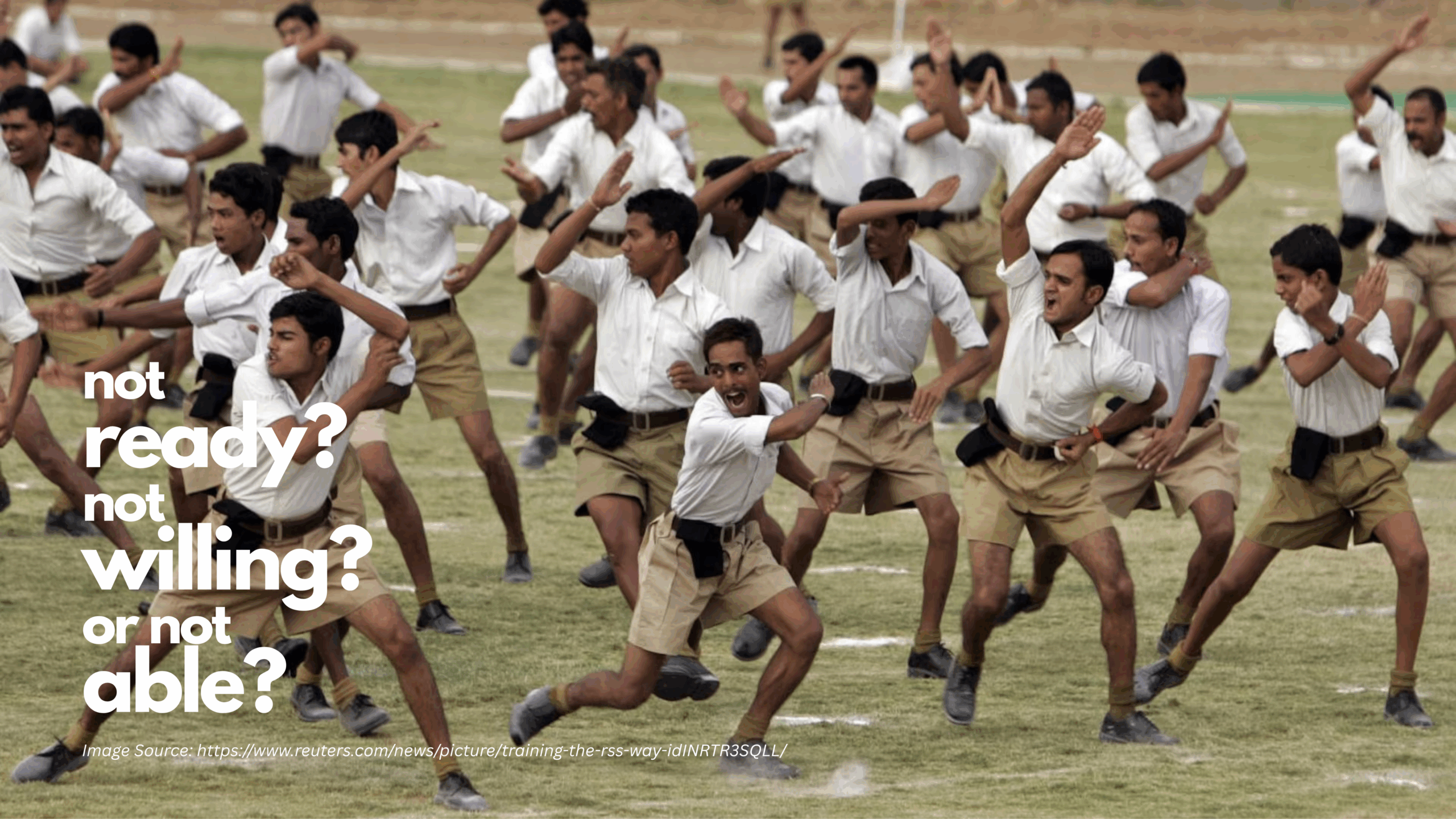
Every year, on Vijayadashami, khaki-clad men gather in thousands to march in lockstep. The Rashtriya Swayamsevak Sangh parades its cadres with sticks slung across shoulders, flags hoisted high, and speeches bristling with warlike metaphors. They speak of sacrifice, of discipline, of readiness to defend the motherland. Of battles to come: against enemies without, and traitors within.
The imagery is unmistakably militaristic. The tone, unmistakably aggressive.
And yet, when it comes to actual military service (the kind that involves real risk, real conflict, real sacrifice) there is an eerie silence.
This article is the first in a three-part series that began with a preface titled “Patriotism in Three Acts”, and will, over the coming days, explore the cracks in India’s cultural nationalism, military preparedness, and moral direction. Today’s instalment is about the theatre of devotion without duty, the gap between martial rhetoric and actual enlistment.
It is important to note that India is not at peace. Not really. We have a live border with Pakistan, a volatile Line of Actual Control with China, regular flare-ups in the Northeast, and a persistent insurgency in Kashmir. We are not Switzerland. We are not Iceland. We are not some distant island untouched by conflict. India’s army is not ornamental. It is operational. And it is dangerously short-staffed.
Which makes the performance of patriotism, particularly by organisations that model themselves on military discipline, all the more perplexing.
Why does the country’s most aggressive nationalist movement, one that never misses an opportunity to glorify the army, not contribute personnel to it in meaningful numbers?
⸻
The Curious Case of the Missing Volunteers
The Rashtriya Swayamsevak Sangh (RSS), often described as the world’s largest voluntary organisation, claims over 83,000 shakhas and some 10 million active members. In the last year alone, over 223,000 new volunteers joined its ranks, most of them in their twenties and thirties.
And yet, the Indian Army struggles to fill its ranks.
The numbers speak for themselves. The Army’s sanctioned strength is 1.348 million personnel. But only 1.248 million are currently serving. A shortfall of over 100,000. Officer ranks are particularly thin: 42,095 officers are in place, against a sanctioned 50,538. A deficit of nearly 17%.
Across the Navy and Air Force, the story is similar. In response to a question in Parliament, the government admitted there are 11,266 officer-level vacancies across the three services.
Now, India does have over 250-300 million males between the ages of 18 and 35. And it would be unreasonable to expect all of them to join the military. Most won’t. Most shouldn’t have to.
But this article isn’t about most young men.
It is about a particular kind of young man: the one who trains in RSS shakhas, who participates in VHP or Bajrang Dal drills, who poses in combat fatigues for photo-ops, who bellows for war on television debates, who romanticises the army and fantasises about martyrdom, who never misses a chance to declare that he is ready to die for the nation.
And so one must ask, gently but firmly:
Are these lakhs of young swayamsevaks, who claim to love the motherland more than anyone else, who say they are ready to lay down their lives, who train in drill formations and salute saffron flags, are they simply not willing to join the actual armed forces? Or are they unable to meet the stringent tests, physical, mental, emotional, and intellectual, that the highly professional Indian military sets before it admits anyone to its ranks? Which is it, then? A lack of courage, or a lack of calibre?
Because unlike jumla-infected election rallies, RWA uncles, and WhatsApp groups, the Indian armed forces are not interested in jingoism. They do not care for slogans. They require fitness, intelligence, discipline, and resilience. They do not admit those who merely perform patriotism. They admit those who embody it. And if this vast, self-declared army of nationalist youth cannot cross that threshold, one must wonder: what is it they truly seek? Is it the hardship of service, or simply the fantasy of valour without sacrifice?
⸻
Enlistment Is For Others
In public discourse, service has become something others do. The poor, the rural, the marginalised. For most soldiers, a job in the defence forces is a career, not a calling, regardless of what fantasies the right-wing ecosystem may peddle about heroic sacrifice and eternal glory.
But here lies the tragic irony. That same ecosystem is often populated by young men from humble, even precarious, backgrounds. Boys who come to the shakha looking for direction, discipline, and a way to matter. Boys who are sincere in their desire to serve the nation, to stand for something larger than themselves. Boys who might have made extraordinary soldiers, teachers, doctors, or builders of a republic.
Instead, they are handed lathis, slogans, and fantasies. Their energies are not directed towards defending the Constitution, engaging in public service, uplifting their communities, or even contributing to nation-building by creating wealth and employment, but towards learning fake history, believing in their own victimisation, imagining enemies, policing identities, swearing allegiance to religious nationalism, and invoking or at least fantasising about wars they will never be asked to fight. Indeed, the entire shakha experience is about reinforcing narrow identities in the worst possible way.
Meanwhile, the affluent patriots of Instagram, the Twitter warriors, and the Hindutva foot-soldiers in Polo shirts continue their seminars, startups, and saffron processions, secure in the knowledge that the real dying will be done by someone else.
This is not unique to India. But what makes it dangerous here is the intensity with which those who refuse to serve also demand the most unquestioning allegiance to symbols of service.
They shout that the army must be “above politics.” Above media scrutiny. Above the courts. Even above the Constitution. But not above marketing.
They market the military for likes and votes, but when a retired soldier demands pension parity or protests for disability benefits, these same voices fall silent, or worse, sneer. The very jawans they raise to mythic status are routinely mistreated in practice, then discarded after discharge. We have seen veterans baton-charged by police for demanding One Rank One Pension. We have seen hunger strikes by former officers met with bureaucratic indifference. We have seen the office of the Chief being consistently reduced in the order of protocol. We have seen their most revered influencers mock the canteen and liquor benefits military personnel get. We have seen them threaten veterans with death and their families with rape for merely voicing their opinion (oftentimes professional) on social media.
They claim to honour the soldier. But it is not the soldier’s life they respect. It is only his death. His image is sacred. His reality is disposable. Political expediency rules supreme. The soldier is simply another tool towards achiving their political goals. Once used, he can go to hell.
⸻
Slogans as Substitutes
This culture of performance has infected our idea of patriotism so thoroughly that substance is now suspect. To serve silently is less valuable than to shout loudly. To act quietly is less powerful than to posture theatrically.
And so, patriotism is now measured not by enlistment or constitutional compliance or civic duty, but by how many times one uses the word Bharat, how often one shares images of dead soldiers, or how angrily one demands proof of someone else’s loyalty.
In this environment, even peace becomes treason. Even nuance becomes weakness. And the call to actually serve one’s country, by joining the forces, teaching in rural schools, working in public health, is seen as secondary to the optics of nationalism.
⸻
The Fork in the Road
This series is not an attempt to shame anyone for choosing not to enlist. Military service is not compulsory in India, nor should it be. But it is a mirror.
When a nation deifies its soldiers while ignoring their material realities, when it floods its culture with war imagery while fleeing from actual enlistment, when it rewards rhetorical nationalism and punishes critical thought, it ceases to be a democracy in spirit, even if it remains one in form.
This is a fork in the road.
We can continue treating patriotism as spectacle. Or we can begin to treat it as service.
Not just in the armed forces. But in all the invisible, unglamorous, unInstagrammable places where a nation is actually built: classrooms, hospitals, polling booths, courtrooms, factories, labs, warehouses, farms.
Because true patriotism is not what you chant when you’re comfortable. It’s what you do when it costs you something.
And until we close the gap between flags and fighters, our nationalism will remain exactly what it is now: a costume.