A while back, I wrote that the Indian National Congress needed 62 years of bruises, bans, betrayals, prison terms, confiscated printing presses, reorganised committees, exhausted volunteers, quarrelsome elders, reconciled leaders, and a stubborn moral force that refused to die before independence finally arrived. I wrote that if a movement that large and that ambitious took more than half a century to prevail, then supporters declaring defeat after 11 years of electoral exile have entirely forgotten the temperament of their own political ancestors. A decade is not collapse. It is not exile. It is not even a proper setback. It is merely the kind of pause that often comes before the next act in Indian politics.
Under that reflection appeared a single-line question that looked innocent at first glance, but on closer inspection, was anything but.
“Who was Allan Octavian Hume 😀”
I knew exactly what the question meant. I knew exactly what the questioner was trying to insinuate. He was not genuinely curious about whether I knew the founder of the Indian National Congress, the ICS officer, the reformist thinker, or the so-called “Pope of Indian Ornithology”. He wanted to point out that the INC’s origins were foreign, as if that fact alone somehow damns its present legitimacy. He was playing the right wing’s favourite game, the “Gotcha Style of Debating”, which relies on punchlines and innuendo rather than facts, thought, substance, structure, argument, or even blistering rhetoric. The insinuation was that Hume being British magically delegitimises a century of freedom struggle powered not by wealth or weapons but by moral force. That because he helped convene the Congress, the entire movement must have been conceived in colonial deceit, and if something can be shown to be cursed at birth, they are cursed for life (or indeed, in the philosophy of the snarky questioner, lives).
I could have answered quickly.
Yes, I know who he was.
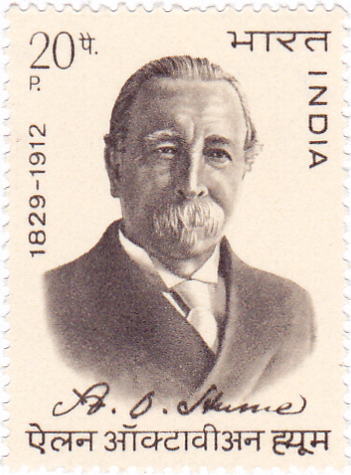
He was a deeply empathetic and upright man who said of himself,
I look upon myself as a Native of India.
He was the founder of the Indian Telegraph Union to ensure news about India reached England and Scotland without interference from colonial officials.
He was the man who published The Old Man’s Hope in 1886, examining poverty in India and arguing that charity would never solve our suffering because the colonial system was draining India’s wealth. He insisted the only remedy was unity and representative government. His wish, as expressed in that essay, was to die knowing India is on the path to freedom.
He was the man honoured with a commemorative stamp in 1973 and with a special cover released in 2013. By India Posts.
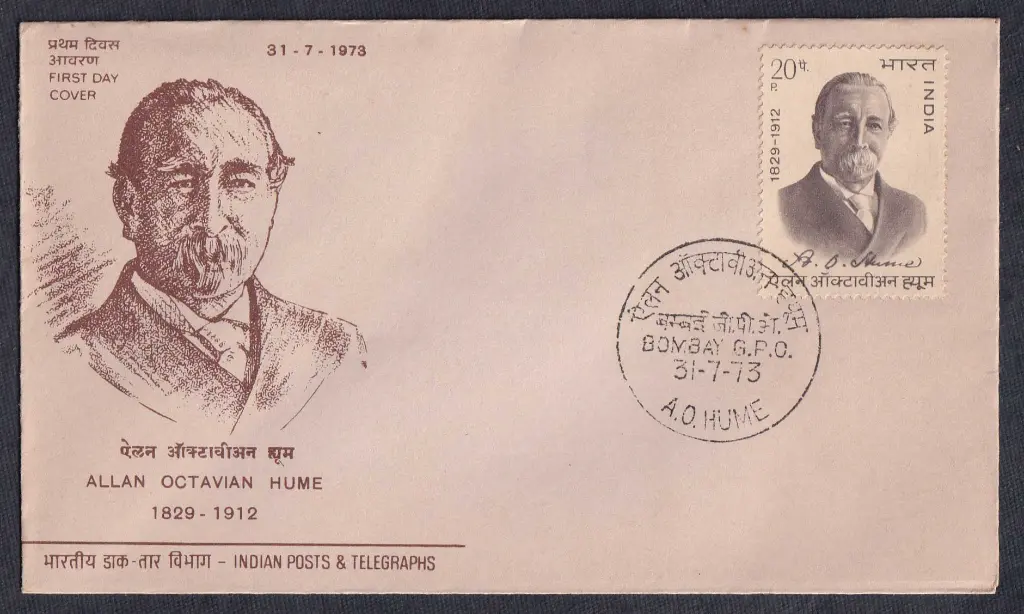
He was the man who wrote the poem “Awake”:
Sons of Ind, be up and doing,
Let your course by none be stayed;
Lo! the Dawn is in the East;
By themselves are nations made!
And no, he was not a British agent. If you still believe that, I will not call you gullible. I will simply offer you a white marble mausoleum from the mid-seventeenth century, slightly used, on the banks of a drying river in Agra, at a special rate, only for you.
But the deeper issue here is the deliberate confusion about India, about the Congress, and about the political imaginations that have spent decades trying either to shrink it or rewire it. The Congress cannot be understood with the vocabulary of purity or the vocabulary of imported revolutions. It was built by neither.
The right wing has always depended on the fantasy of a pure India, a pure civilisation, a pure ancestry, a pure origin. This fantasy collapses the moment one reads the genetic record, the linguistic record, the cultural record, or even the culinary record. Every one of them tells the same story. India is not a sealed vault. India is a meeting point. A crossing. A collision. A marketplace of influences. A civilisation shaped by arrivals, borrowings, reinventions, accommodations, arguments, migrations, conversions, resistances, coercions, and compromises. There is nothing pure about it, and that is precisely its strength.
Which is why the acceptance of Hume rattles them. Because the Congress did not treat him as a colonial virus that needed containment. It treated him as a man who believed India deserved political organisation.
And if Hume troubles them, they should prepare themselves for the rest of the list. The Congress had George Yule, a Scotsman, presiding in 1888. Wedderburn, another Scot, presiding twice. Henry Cotton, an English liberal, presiding in 1904. Alfred Webb, an Irish Quaker, presiding in 1894. It embraced Annie Besant and her leadership of the Home Rule movement. It followed Charles Freer Andrews as a moral compass. It protected B. G. Horniman when the Raj deported him for exposing the truth about Jallianwala Bagh. It welcomed Mirabehn, Sarala Behn, Stokes, Spratt, and Keithahn without the slightest insecurity.
Why do I list these names? Because this inclusiveness irritates the right wing. It reminds them of their own failed attempt to capture the Congress from within. There was a time when the earliest Hindu right formations believed they could bend the party, commandeer its symbols, inject exclusivity into its bloodstream, and turn the national movement towards a narrower vision. Then Gandhi arrived. He took the symbols they recognised, the language they believed they owned, and redirected all of it towards pluralism. He wrested the platform back. He shifted the moral centre. He refused to let them steer the movement into sectarian waters. They retreated, defeated not by expulsion but by irrelevance, and eventually modelled their own organisations on the most toxic ideology available to them in their time: fascism. That humiliation still festers, which is why they now pretend the Congress is foreign. It is easier to invent impurity than confront failure.
Their obsession with purity, nourished by the caste system they protect and propagate, blinds them to the reality of India’s diversity, even as they chant “Vasudhaiva Kutumbakam” without understanding the first thing about what it means on the ground.
The left wing, meanwhile, misreads the Congress from the opposite end. It is not anxious about the foreign. It idolises it. It chants the names of Marx, Lenin, Mao, and Che with priestly devotion. It imports doctrine as if India were a laboratory awaiting revolution. It insists that dialectical theory must be poured into Indian soil even when the soil refuses. It forgets that every major left movement in India eventually slipped into violence or vanished into theory because India does not surrender to ideological purity. Telangana. Naxalbari. The jungle insurgencies. All of them learned that India changes revolution faster than revolution changes India.
They speak of the subaltern, the Marxist’s elegant Latin label for people who would simply call themselves labour, people who have no idea they are now conceptual exhibits. And they do this while throwing around Entfremdung, Bourgeoisie, Dialectical Materialism, Historical Materialism, Praxis, and Proletariat in cafés as young dreamers or in club lounges and ‘centres’ as older theorists, wondering earnestly why the subaltern refuses their condescending patronisation.
Yet they persist in imagining the Congress as an old house waiting to be remodelled into a socialist fortress. They see Nehru’s social democracy and imagine unfinished Marxism. They see Gandhi’s moral politics and imagine pre-revolutionary discipline. They see alliances and imagine ideological conquest. But the Congress knows India better. It knows that India prefers argument to doctrine, persuasion to coercion, change in waves rather than ruptures. It absorbs ideas, not decrees. It reforms through moral force, not terror.
This is why the left will fail to appropriate the Congress just as surely as the right failed to conquer it. The Congress always returns to the centre because India always returns to the centre, the living centre where contradictions negotiate coexistence without annihilating one another.
If you look honestly at the Congress, you see not a party but a civilisation assembled in a political frame. Parsis like Naoroji, Mehta, and Madam Cama. Muslims like Maulana Azad, Kidwai, Zakir Husain, Asaf Ali, Saifuddin Kitchlew, and Khan Abdul Ghaffar Khan. Dalits like Jagjivan Ram. Women like Sarojini Naidu, Kamaladevi Chattopadhyay, Vijayalakshmi Pandit, and Sucheta Kriplani. “Foreigners” like Besant, Andrews, Horniman, Mirabehn, Sarala Behn, Stokes, Spratt, and Keithahn. Hindus of every caste. Atheists, agnostics, theosophists, technocrats, peasants, lawyers, revolutionaries, conservatives, reformers, socialists, and those who resist every label as well as those to whom every label applies.
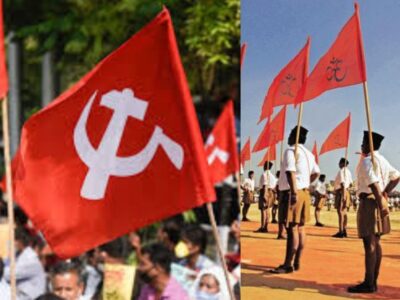
The Congress has never asked where your grandparents were born. It asks what India means to you and how much of yourself you are willing to give it. Nehru’s Bharat Mata, Gandhi’s talisman, Bose’s “Jai Hind”, all come together to confound saffron, green, and red by refusing to be any one colour.
This is why the Congress has outlived every attempt to shrink it.
Too mixed for the right wing, which demands purity.
Too rooted for the left wing, which demands revolution.
It behaves like India behaves, not like its critics, opponents, or slippery well-wishers would prefer.
And this brings us back to the river. The Congress flows like a river that begins as a small idea, gathers tributaries from everywhere, carries silt and memory from places it never ruled, widens into a vast current, and remains unmistakably Indian through every twist and turn. You can block such a river for a season. You can divert a channel. You can stand on the banks in a dry spell and shout victory. But monsoons do not accept political instructions, and rivers do not wait for permission to become themselves again.
Which is why, in this present moment when the river appears low, I do not see decline. I see rhythm. I see cycle. I see the patience of a civilisation older than every ideology currently shouting for attention.
And so when someone asks, “Who was Allan Octavian Hume 😀”, I do not hear a clever provocation. I hear a misunderstanding of a country that has never cared about purity, never bowed to imported orthodoxy, never reduced identity to ancestry. I hear the fear of mixture, the discomfort with plurality, the longing for a simpler, tidier India that never existed.
Because if purity is your measure, India will always disappoint you.
If imported doctrine is your measure, India will always elude you.
But if you understand that this civilisation is built of tributaries rather than fences, then the presence of Hume or Besant or Andrews or Mirabehn is not a scandal. It is living proof that India has never been afraid of those who come here with sincerity. It has only ever been cautious of those who mistake insecurity for identity.
And this is the truth the right and left cannot stomach.
Hume’s birthplace did not matter to India.
His passport did not matter.
His skin colour did not matter.
His ancestry did not matter.
He called himself Indian.
He worked for India’s freedom.
He made India his karmabhoomi.
And if this principle unsettles the right wing, it is only because it explains their decades-long fixation with Sonia Gandhi. Her presence rankles them for the same reason Hume’s does. Not because she lacks legitimacy, but because she embodies a version of India they cannot comprehend, one in which belonging is earned through commitment, not ancestry, and in which the river accepts all who step into it with sincerity.
For the Congress, that has always been the only test that matters.
Which is why a British founder never weakened the Congress. Nor India.
And why an Italian-born leader never did either.
Because neither of them were seen as outsiders based on where they were born.
They were judged by their thoughts, their words, their actions, and their choices.
You see, people’s birthplaces do not weaken this nation.
Narrow minds do.