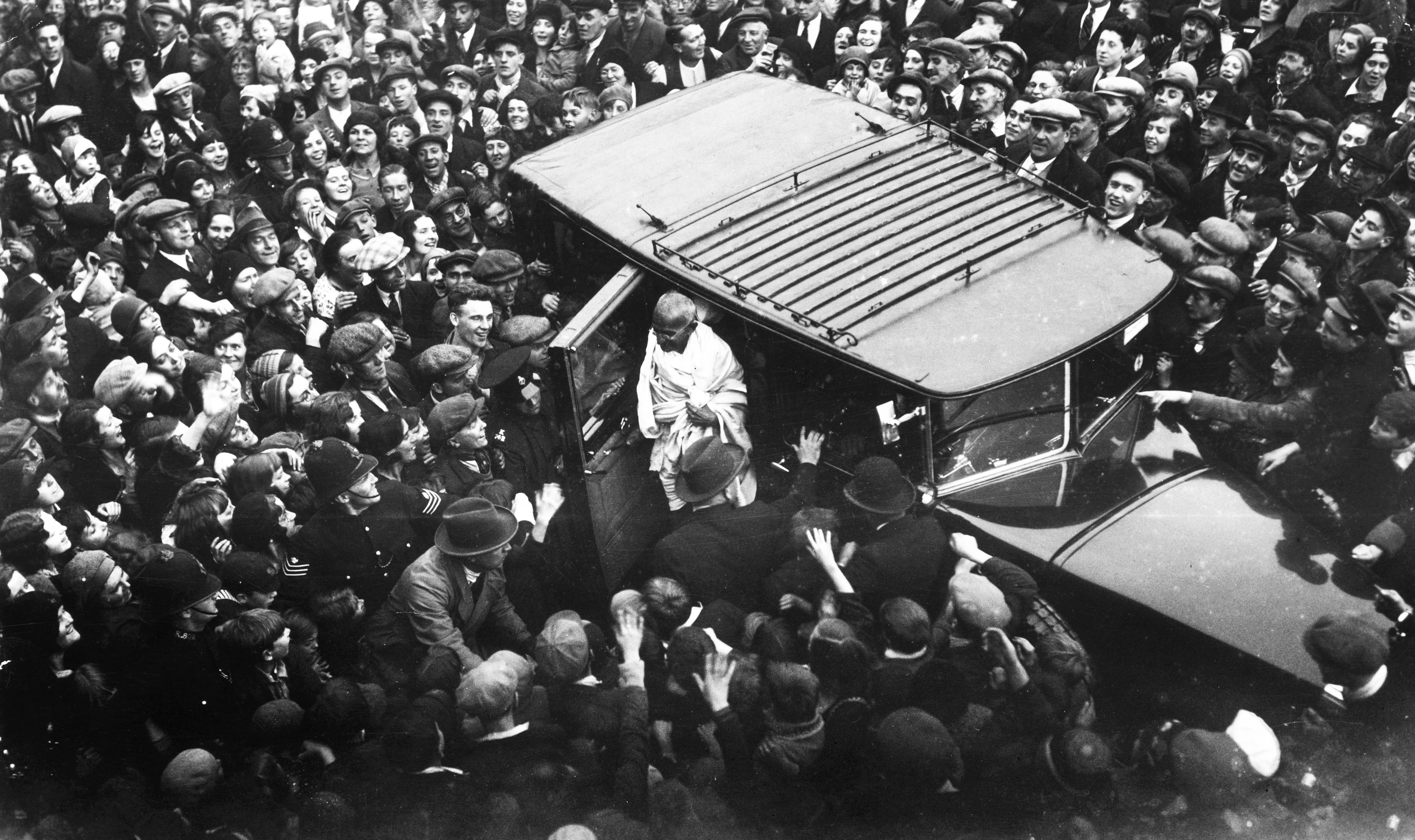
I wrote recently (this morning, in fact, on social media) that the Gandhi we must remember is not the monk with his eccentric obsessions about technology or sex or caste or race, but the political Gandhi, the strategist, the organiser, the man who took the poorest of peasants and the most ordinary of labourers and turned them into instruments of resistance against the mightiest empire of the day, the man who understood that salt could be more dangerous than bullets, that handspun khadi could rock the entire edifice of imperial textile industry, that refusing to cooperate could wound a state more grievously than bombs or guns ever could, and on his birth anniversary today, the 2nd of October, it bears repeating that this is the Gandhi who matters, this is the Gandhi who altered the course of history, and this is the Gandhi whom his enemies, past and present, neither forgive nor forget.
And yet, like clockwork, the gleeful little chorus appears, waving their clippings and their Twitter epiphanies, piping, “But did you know Gandhi was racist, did you know he was casteist, did you know he had some odd views about sex,” as though they have unearthed a secret scroll somehow overlooked for a century.
Really? Are you quite sure that Nelson Mandela, who studied Gandhian method and called him a sacred warrior whose courage made imprisonment a price worth paying for truth and justice, somehow missed your discovery; are you telling me that Martin Luther King Jr., who judged non-violent resistance the only morally and practically sound method open to the oppressed, simply did not understand the man; are you claiming that Nehru, who walked beside him for decades, Patel, who built a republic on foundations Gandhi helped lay, Bose, who named brigades after him even while disagreeing with him, and Tagore, who called him “Mahatma” when others still said “Mohandas,” all misread him while you, a lower division clerk in the pest control department at the Surat Municipality, or a television talking head celebrity famous for being famous and saying rude things to shock people on air, or a social media influencer with a hundred thousand followers and an ego the size of an elephant, you alone have stumbled upon the real truth? The truth that seems to be hidden from all else but you, the sole, singularly enlightened one.
Or perhaps your solitary wisdom also eclipses Albert Einstein, who considered Gandhi the greatest political genius of his time; the Dalai Lama, who has for years described Gandhi as a singular moral compass for modern civilisation; Richard Attenborough, who spent decades bringing Gandhi to the screen because he believed the man distilled the twentieth century’s conscience; Desmond Tutu, who invoked Gandhi when warning that an eye for an eye leaves everyone blind; Barack Obama, who has repeatedly said Gandhi profoundly shaped his thinking and America’s civil-rights imagination; Ho Chi Minh, who openly called himself and his comrades followers of Gandhi, directly or indirectly; Al Gore, who in his Nobel lecture placed Satyagraha, the truth-force Gandhi named and wielded, at the heart of democratic renewal; and Romain Rolland, that European colossus who saw in Gandhi another Christ, a prince of peace in an age drunk on power.
My friend, your arrogance would be comic if it were not so transparent, for what you are engaged in is not critique but misdirection; you stitch together a straw-man Gandhi out of his acknowledged – no, cross that – self-acknowledged flaws, out of remarks bounded by their contexts or times, out of ideas he himself often amended or shed, and then you thrash this effigy, lighting it on fire and dancing around it like a crazed madman, and congratulate yourself on bravery. Yet what you reveal is not a flaw in Gandhi’s character but a flaw in your own conscience, your own intent, your own fear of the Gandhi who mattered, which is the political Gandhi, the Gandhi who confronted empire with cloth and salt and moral stubbornness, by simply walking or refusing to take food, by speaking softly and using the big stick he carried only to support himself, the Gandhi who awed the rich, inspired the poor, and frightened the powerful so thoroughly that even his enemies agreed that mere argument would not suffice and elimination would be required.
Let us be clear, then: it was not his views on sex or modern machinery or caste or race that his followers admired and his enemies feared, it was his politics, it was the method by which he converted weakness into strength, private conviction into public leverage, scattered voices into a choir that could split glass; they understood, better than you do, that he was a force to reckon with, dangerous not because of what he wore or did not wear at night but because of what he could move millions to do at dawn, which is precisely why you killed him, or rather imagined that you had killed him, only to find that bodies die and ideas do not, which is why you have had to keep trying to kill him again and again, in effigy and in ink, with slander and shoe-polish, with bullets through portraits and paint across statues, with speeches and tweets and pamphlets and little polemics, and every time you try, you discover that Gandhi is still there, still taller than your pygmies. 
And why, you ask, this persistence; because there is nothing of your own to set beside him, because you were absent when the freedom struggle was fought, because you were nowhere to be found when the cry of Quit India rang out, because you found it convenient to join hands with the Muslim League (yes, the same one that formed Pakistan not much later) in 1937 when Congress resigned on principle, because you birthed the very two-nation logic you now pretend to despise (ha!), because for decades after independence you could not be bothered to fly the national flag, because your cupboards are bare and legacies empty and shelves stocked only with small men and smaller ideas, and therefore the only way to make your pygmies seem taller is to try and hack at the ankles of a giant.
But reality, tiresome thing that it is, refuses to bend itself to your insecurities; it will not adjust to your preferred version, it will not accommodate your resentment, it will not yield to the dull ache of your inferiority complex or small reproductive organs, or both. It is you who must adjust to reality, to the indisputable fact that Gandhi is not the fragile straw man you keep erecting, not the pervert or the racist or the cateist or the flawed human you insist he is, nor the frail old man you shot point blank with three bullets on 30th of January 1948, not the statue you desecrate, not the portrait you shoot bullets at, not anything, in fact, that is within your limited and stunted comprehension, but the political storm, the unstoppable force, the phenomenon who continues to be read, cited, emulated, and argued with, but most importantly, practised, by the people who actually do politics, who have done time and taken risks and shouldered responsibility, from Mandela and King to Ho Chi Minh and Tutu, from Obama and Gore to the Dalai Lama and Attenborough, from Einstein and Rolland to Russell and Camus, from Nehru and Patel to Shastri and Vinoba, from Bose and Tagore to Suu Kyi and Capitini, leaders and thinkers across generations and continents who have said so, written so, acted so, over decades and in public.
And the reality, since we are speaking plainly, is that you are a puny Lilliputian throwing darts at Gulliver; no matter how many darts you throw, he strides, immense and undiminished, across the world’s stage, straddling both space and time, with scant regard to your tiny pricks (and yes, I intend that pun). You rage because you know this, because you tried to kill him and failed, because you keep trying to kill him and keep failing, because you will go on trying to kill him and you will go on failing, as he stands, calmly, inconveniently, triumphantly, in your way, but without even noticing your microscopic presence.
So today, on the 2nd of October, spare me your “Did you know?” trivia; the world knew, the practitioners knew, the giants knew, and even his enemies knew, and they acted accordingly; the only one who does not know, apparently, is you.
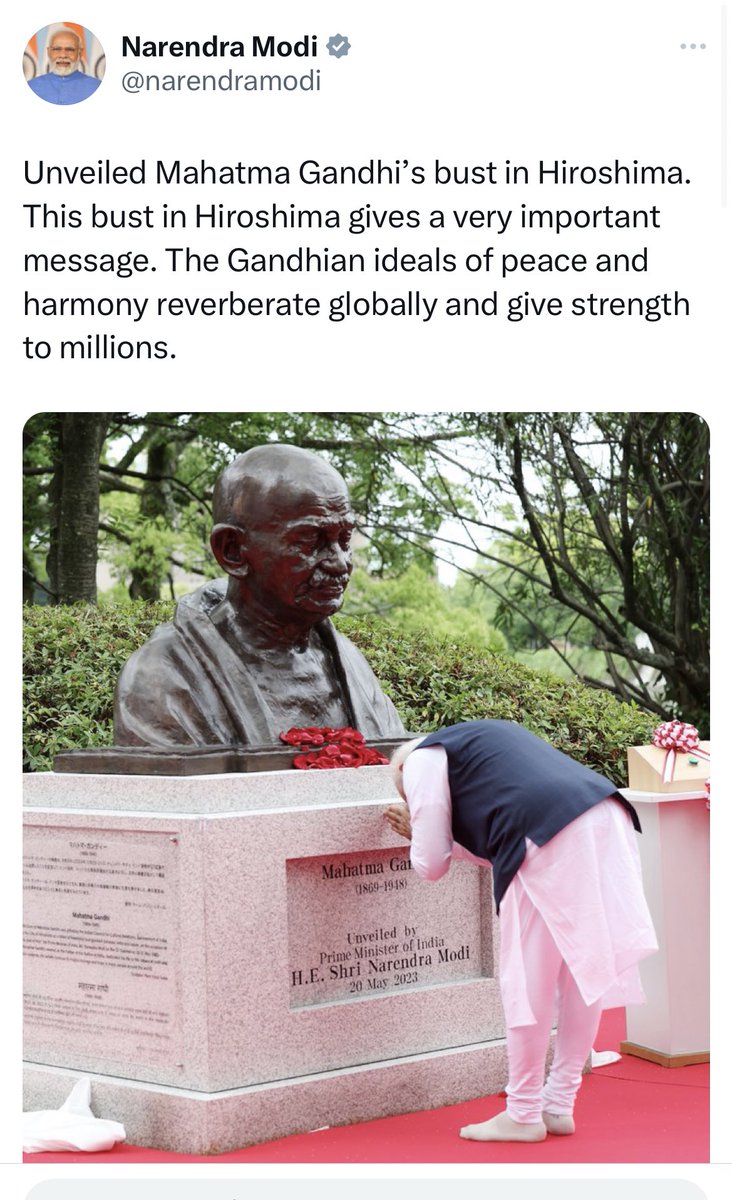
P.S.: Curiously, when you step outside India and need to speak of India to impress an audience, to tug at their heartstrings, to invoke a sense of respect for the nation and its culture, you do not talk of your pygmies, you talk of India as the land of Gandhi; you unveil plaques and inaugurate statues of Gandhi in foreign parks, you fold your hands and bow before his likeness, you recite lines about non-violence and moral courage, you rent his name like a tuxedo for a state dinner to acquire, for a few hours, a veneer of respectability you have not earned, and then you come home and resume defacing the very man whose borrowed halo you wear abroad. There’s a word for people like you, but I would not want to commit violence, even if verbal, on you. I am, you see, a Gandhian.