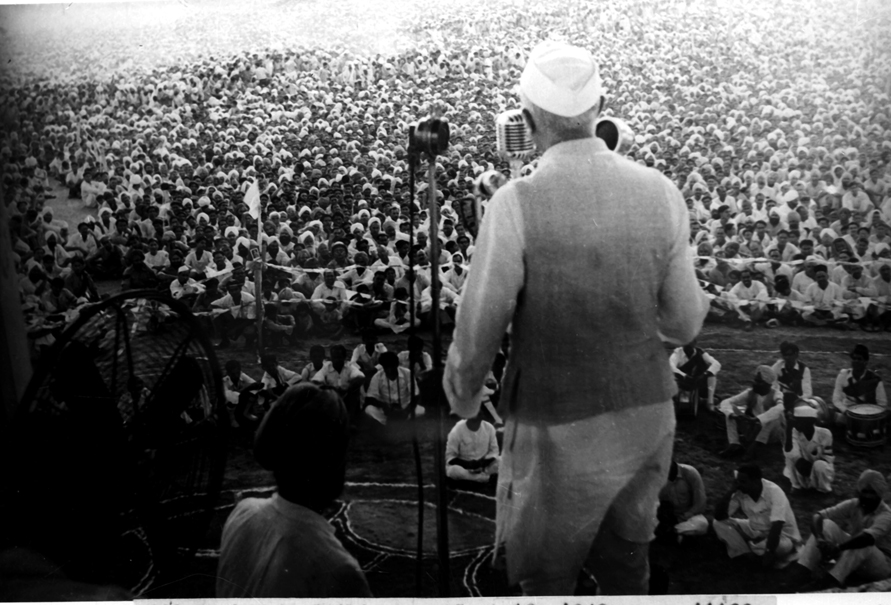
The Hon’ble Pandit Jawaharlal Nehru, Prime Minister of India, addresses a mammoth public meeting at Ludhiana on 18th September, 1949, during his tour of the East Punjab.
It has become something of a parlour game in our times to heap scorn upon the choices made at independence, to suggest with the benefit of perfect hindsight that if only Jawaharlal Nehru had embraced the shiny virtues of capitalism, India would have been a Singapore by the 1970s, a Silicon Valley by the 1990s, a regional power by 2025, and “Vishwaguru” by 2047. It is a seductive little fantasy, and, like most seductive fantasies, it has very little to do with reality. For if one wishes to judge Nehru, one must first inhabit his circumstances, his intellectual inheritance, and the very air he breathed, rather than ours.
Nehru was born in 1889 into a household that was itself the product of generations who had seen India humiliated and hollowed out by the East India Company, and then by the Raj that succeeded it. His father, Motilal, was born in 1861, and his grandfather before that, Gangadhar Nehru, born in 1827, was a contemporary of men who remembered the Company’s rapacity in the flesh. These were men whose eyes had seen an India stripped of her wealth, her industries reduced to relics, her people yoked into famine-producing taxation and servitude. For the young Nehru, the past was not an academic curiosity but a dinner-table presence. To be shaped by such memories was inevitable. He could no more think of capitalism as benign than one might think of arsenic as a harmless condiment.
I myself, born in 1972, a mere twenty-five years after independence, can attest to the weight of memory. My father was born in 1947, my grandfather roughly a quarter-century before that, and I have known not only his contemporaries, but also heard stories of my great-grandfather’s time. Freedom fighters were not remote figures in textbooks, but men and women still alive, their names spoken in the present tense, their sacrifices narrated at gatherings, their memories almost tangible. To grow up in such proximity to the past is to understand how powerfully it shapes one’s worldview. If I, with my relatively late vantage point, could still feel the immediacy of that inheritance, how much more so Nehru, born in 1889, who would have lived within the echo of India’s first war of independence in 1857, been schooled under Macaulay’s imperial education system, seen the impact of the newly introduced Indian Penal Code, witnessed King George V’s grand Delhi Durbar in 1911, and grown up hearing about the rapacious loot of the East India Company. His world was not theoretical history, but living memory, and it left its indelible mark on the choices he later made for India. The difference, of course, is that my recollections come from a time when the republic had already been born and was struggling to find its feet, whereas Nehru’s memories were forged in the furnace of subjugation itself. If even I can feel how memory colours my judgements, how unreasonable it is to expect Nehru to have seen capitalism as a friend rather than the very mask of his oppressor.
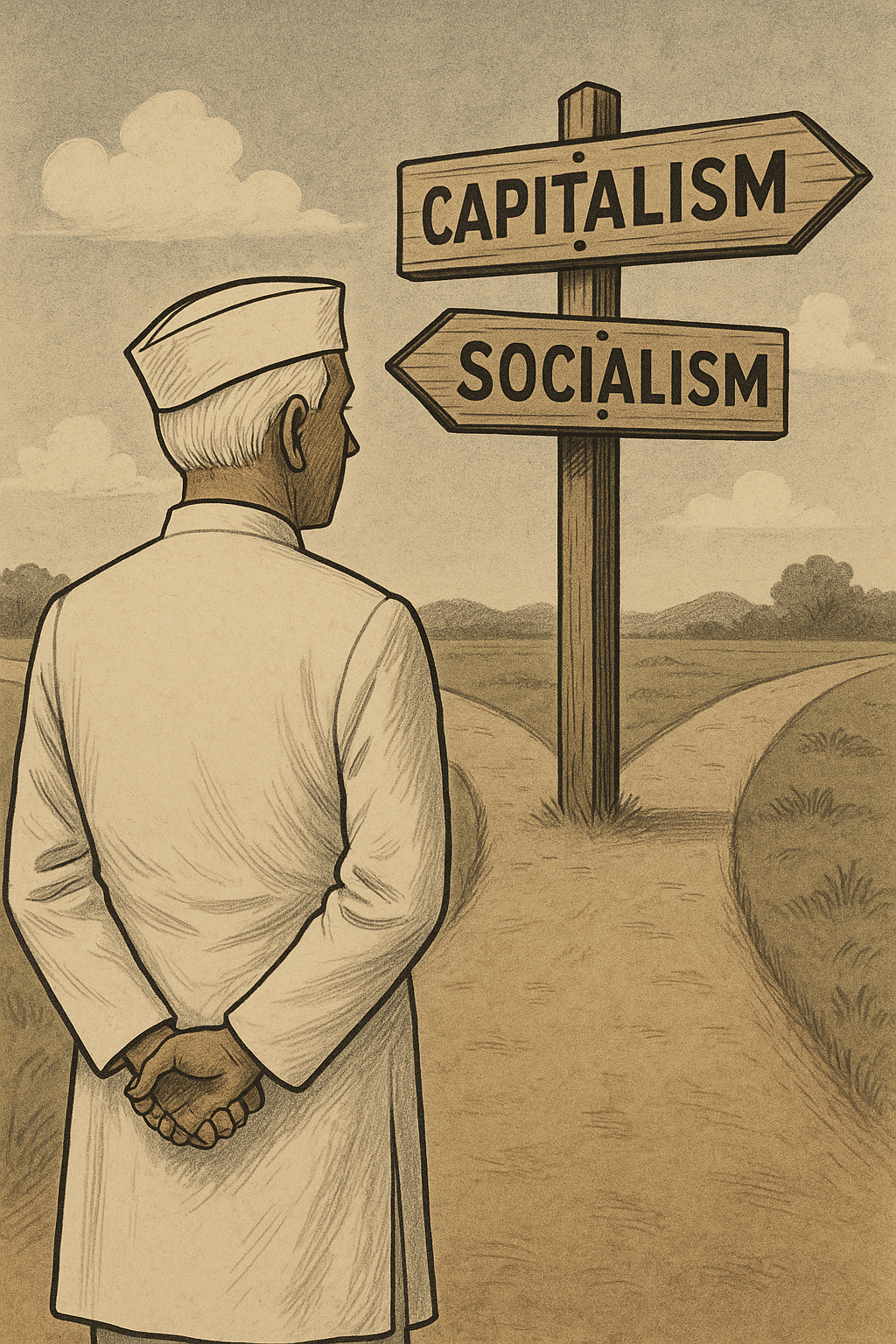
The East India Company had, after all, been the purest expression of capitalism: a corporation with a royal charter, shareholders clamouring for profit, and the full might of an empire at its disposal. It pillaged Bengal’s resources after Plassey in 1757, bled dry entire provinces, and left behind, not prosperity, but poverty so abject that it continues to echo in the very bones of the republic. When one has grown up hearing the stories of famine and degradation wrought by the merchant’s ledger and the soldier’s bayonet working in perfect tandem, it is not surprising that one would find capitalism to be an ideology of evil. And when one is then asked, in 1947, to choose an economic path for a desperately poor and riven land, is it any wonder that one leans towards socialism? Whether or not an alliance with the United States, or an embrace of capitalism, might have yielded benefits in the long run is not the point. The point is that, given his circumstances and inheritance, there was no real choice but for anyone in Nehru’s position to move in the opposite direction.
Consider, for a moment, the material inheritance of that republic. In 1950, India’s GDP per capita was a paltry ₹265 (in 1950 Indian Rupees), scarcely above subsistence. Life expectancy at birth stood at 32 years, with women barely crossing thirty, and infant mortality was a staggering 146 per 1,000 live births. Female literacy was under 9%, while total literacy was a meagre 18.3%. The first Union Budget after independence set total expenditure at just ₹197 crore, of which nearly ₹93 crore (47%) went to defence. Partition had bled the nation, and war in Kashmir had devoured its purse. The revenue estimated was only ₹171 crore, leaving a deficit of ₹26 crore before a single school or hospital was funded. Subtract defence, and the Finance Minister was left with a mere ₹3.07 per Indian for everything else, education, health, industry, irrigation, welfare, roads, science, and culture. To call these slim pickings would be generous; they were starvation rations dressed up as accounts.
It is worth pausing here to note that the very word “socialism” is a loaded one. Its proponents hear in it promises of equality, social justice, a welfare state where no one slips through the cracks, affirmative action, subsidised education and healthcare, and an even ground on which to compete. Its detractors, however, equate it with communism, the abolition of private wealth, and the loss of individual freedom and agency. What Nehru envisioned through the Five-Year Plans was not a Soviet command economy, but a welfare state that did not trust private capital to build national wealth and resources, and so turned instead to the state to subsidise agriculture, health, and education, and to reserve opportunities for the marginalised. That this was seen as ideologically closer to communism than to the American model of capitalism was perhaps inevitable, even if the truth, as the British NHS or American social security attest, is more complicated.
The world Nehru surveyed in his formative years seemed to confirm his prejudice against unbridled markets. The twentieth century’s first half was an object lesson in the might of industry. The First World War, and more dramatically the Second, were not won by agrarian societies, but by the factories, steel mills, and oil refineries of the great powers. The USSR, for all its brutality, had risen from backwardness to superpower status on the back of forced industrialisation. The USA’s victory was powered by Detroit’s assembly lines, and Texas’s oil fields. Even Britain, once the workshop of the world, would have collapsed under Hitler’s bombs had it not been propped up by American steel and Soviet blood. In such a world, for a newly independent India to imagine surviving without industrialisation would have been folly of the highest order.
But industrialisation required capital, technology, and a coherent national push. To entrust this to private enterprise in 1947 India, where private enterprise had meant the mill-owners of Bombay and the zamindars of Bengal, would have been tantamount to signing away the republic’s future. To Nehru’s mind, and quite reasonably so, capitalism had already brought India to its knees. To put one’s faith in it again would have been like returning to a doctor whose prescriptions had nearly killed the patient. Socialism, by contrast, promised a role for the state in commanding scarce resources, directing investment, and building the steel plants, dams, and scientific institutions that could yank India into the modern age. It was less an ideological indulgence than a practical necessity, even if it came laced with ideological fervour. Thus were born the flagships of the Second Five-Year Plan: Bhilai, Rourkela, and Durgapur, steel plants erected not as monuments to vanity but as insurance policies against irrelevance.
Nor was this a purely economic calculus. Disease stalked the land. The memory of the 1918 influenza pandemic, which killed between 10 and 20 million Indians, was still raw. Smallpox claimed hundreds of thousands every year, India accounting for the majority of global cases until its eradication in 1977. Diphtheria, cholera, and polio maimed and killed by the hundreds of thousands, with vaccines either not yet scaled or not yet distributed. A political class raised on mass graves and epidemic wards could hardly be expected to genuflect before laissez-faire, which had left such public health to chance and charity.
Critics often point, with a kind of triumphant glee, to the economic liberalisation of 1991 as proof that Nehru was wrong, as though history were a neat school examination with capitalism as the answer at the back of the book. But this ignores the obvious: Nehru did not live in 1991. He lived in 1947, in a country with empty coffers, staggering illiteracy, and an agrarian economy still haunted by the ghost of Bengal’s famine. To expect him to divine the fall of the Berlin Wall or the rise of Silicon Valley is not merely unreasonable, it is malicious. It is to pretend that history has an answer key, when in fact history is a river, always flowing, never frozen, its course altered by rocks we cannot yet see.
Indeed, even our smug certainty that capitalism has “won” ought to be tempered by humility. The Soviet Union lies in ruins, yes, but who can say that the American model will reign supreme a century hence? Already, the Chinese hybrid of communist authoritarianism and market dynamism challenges the old binaries. In a hundred years, perhaps it will be dismissed as hollow too, and some new Indian synthesis of democracy, socialism, and markets will seem the obvious choice, or even an African federation of city-states might be hailed as the next great leap in human governance. The future mocks our certainties. Why, then, do we insist on mocking Nehru for lacking ours?
The truth is that Nehru chose socialism not because he was naïve, but because he was acutely aware of the wounds his country bore. He sought healing, not profit. He erred, yes, as all mortals do, but he did not have the luxury of foresight that hindsight so smugly provides us. Given his inheritance, his context, his memories, his nation’s wounds, there was no real alternative.
Anyone in his place, you, me, or any other, would have chosen the same. If you claim that you would have chosen differently, you are either a clairvoyant or deluded, probably the latter. If you claim to be the former, tell me how your own life choices have worked out so far. You see my point now?