This is a short (Bazinga!) essay about why certain debates around God refuse to die, why I find most of them boring, and which questions I would actually like to hear debated instead. It is not a defence of atheism, nor an attack on belief, nor an attempt to convert anyone. It is an attempt to tidy up a conceptual mess that keeps resurfacing in public life, usually with great confidence and very little clarity.
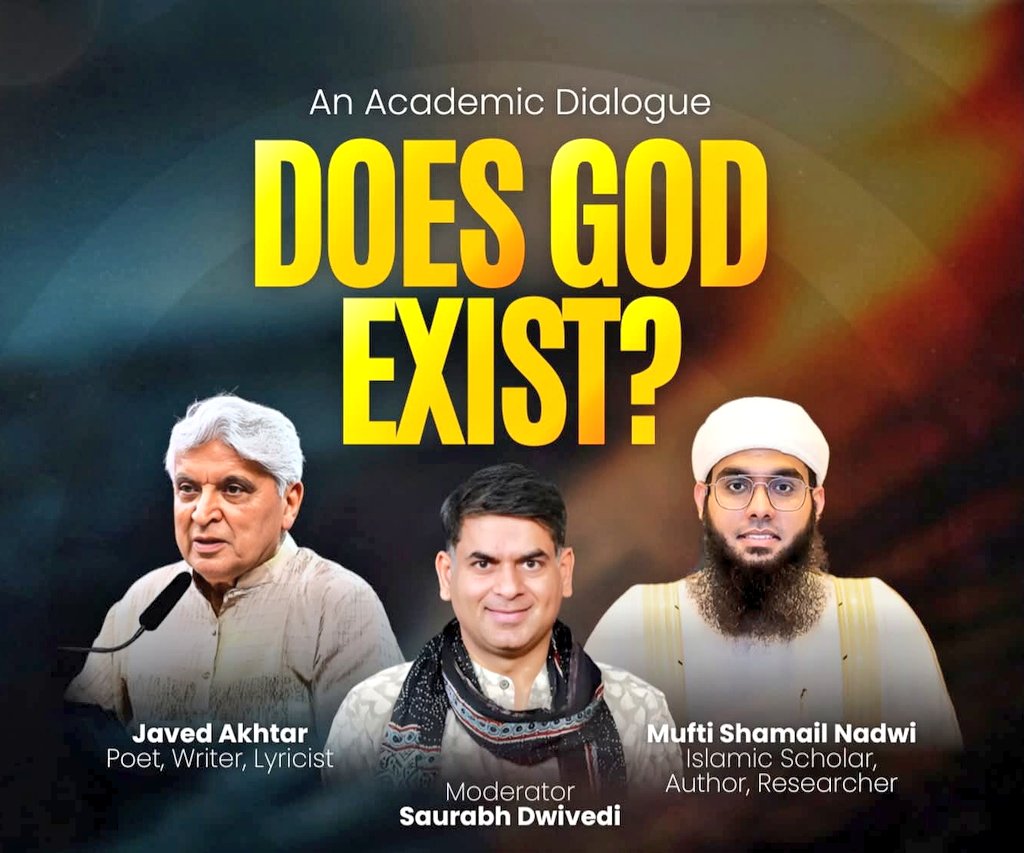
The immediate context is the recent debate between Javed Akhtar and Mufti Shamail Nadvi, framed, as these things almost always are, around the question Does God exist? Because people know that I write about atheism, religion, and belief, and because I am known to enjoy thinking aloud about such things, I was asked what I thought of the debate. My honest answer was that I found it boring. Not offensive, not irritating, not even particularly frustrating. Just boring.
That has nothing to do with the intelligence or eloquence of the participants, and everything to do with the fact that debates about whether God exists are no longer worth having. Most of the supposed “gotcha” questions that surface in these exchanges have already been examined, answered, dismantled, and reassembled by scientists, philosophers, historians, sociologists, poets, writers, and political thinkers over many decades. Even the more fashionable arguments have long since exhausted their intellectual utility. This is not an attempt to re-litigate them. It is an attempt to explain why the debate itself is epistemically uninteresting.
Claims & Confessions
I have been circling this conclusion for a long time, ever since the first atheist stirrings took root in me, and I even wrote about it more than a decade ago. The core distinction is simple, but persistently ignored. There is a difference between a claim to knowledge and a confession of belief, and confusing the two is what keeps this entire conversation artificially alive.
A claim to knowledge says, I know.
A confession of belief says, I believe.
These are not interchangeable statements. When someone says, “I know God exists,” they are making a public claim about reality. Claims to knowledge come with baggage. They demand evidence that is repeatable, falsifiable, and open to independent verification across time, distance, and perspective. When someone says, “I believe God exists,” they are describing how they choose to organise their life. That belief may be emotionally anchored, culturally inherited, morally meaningful, or psychologically comforting, but it is not answerable to scientific scrutiny.
Gnosticism Explained
This is where the distinction between Theism and Gnosticism matters, and where most public debates quietly derail. Theism, properly understood, is a confession of belief. A theist says, I believe there is a God, and orders their life accordingly. Gnosticism, by contrast, is a claim to knowledge. A gnostic says, I know.
In the context of God, Gnosticism is an invalid, irrational, and frankly rather silly position to take. It asserts certainty where none is available, confidence without evidence, and access to ultimate reality without the means to justify that access. There is no repeatable, falsifiable, independently verifiable evidence that can sustain claims to knowledge about God. None has ever existed.
The only valid, rational, and sane position with respect to knowledge is agnosticism. To say I do not know whether God exists is not a retreat. It is the only position that respects both logic and intellectual honesty.
The Strawman
This is precisely where the familiar strawman enters. To keep the debate alive, the gnostic theist quietly invents a symmetrical opponent. The atheist is recast as a gnostic atheist, someone who supposedly says, I know that God does not exist. Two opposing claims to knowledge are then placed on the table, and a theatrical contest is staged.
But the symmetry is false. The opposite of “I know” is not “I know the opposite”. The opposite of “I know” is “I do not know”. If one party claims to know that God exists, and the other rejects that claim, the second party is not obliged to produce a counter-claim to knowledge. The burden of proof lies entirely with the person asserting certainty.
Once this is understood, the debate collapses. Not because atheists have won or theists have lost, but because claims to knowledge about God are unsustainable, while belief remains a free and personal choice, bounded only by consent.
Belief and Life
That distinction matters, because belief is not trivial. A believer may choose to organise their entire life around the belief that a God exists. That belief may shape their morality, their sense of right and wrong, their rituals, their clothing, their food, their festivals, their prayers, their understanding of suffering, and their relationship to death and meaning. It may give structure to grief, reassurance in uncertainty, and a framework within which they attempt to live a good life.
A non-believer does not require God for any of this. An atheist may organise their life around empathy, reason, shared human experience, social responsibility, and ethical reflection without reference to divine authority. They may arrive at morality without commandments, at compassion without fear of punishment, and at purpose without promises of reward. Both of these ways of living are entirely legitimate. Both are coherent. Both are defensible.
The only point at which either becomes immoral is when belief or non-belief is enforced. History has shown us, repeatedly, that coercion is the real crime, whether it comes from religious states that demand belief or atheist regimes that forbid it. My objection has never been to belief or disbelief. It has always been to the violation of consent.
Once this is clear, the question Does God exist? becomes dull. It is settled in the only way such questions can be settled. Nobody knows.
Possibility Question: Could?
And once we stop pretending that anyone does, far more interesting questions come into view.
The first is not does a God exist, but could a God exist. This is not theology but metaphysics. It asks whether reality itself could plausibly be constructed, simulated, or initiated by some form of intelligence, not anthropomorphic, but structural. Ideas like the simulation hypothesis, deism, or what is sometimes called Einstein’s or Spinoza’s God belong here. The claim is modest. There is a non-zero probability that we inhabit a constructed reality. If the reasoning is coherent, I have no difficulty accepting the possibility.
What makes this inquiry refreshing is not that it promises answers, but that it demands no allegiance. Nobody kills for this idea. Nobody moralises dissent. It is a debate in which people can afford to be wrong, and therefore can afford to listen.
Normative Question: Should?
The second question is more unsettling. Not could a God exist, but should a God exist. This is not about truth but about outcomes. About human well-being, social cohesion, moral frameworks, and long-term survival. It is possible that belief in God has helped many individuals live calmer, more purposeful lives. It has structured grief and absorbed suffering. Denying that would be dishonest. But individual comfort is not the same as collective flourishing, and short-term solace is not long-term health.
So the question widens. Were societies better served by belief than disbelief? Did God improve cooperation, reduce violence, enhance resilience, or merely entrench power and sanctify hierarchy? This tells us nothing about whether God exists. It tells us what belief does. And that is precisely why the question is worth asking.
Storytelling Species
The reason these questions never go away has very little to do with metaphysics and a great deal to do with anthropology. Humans survived not because we were uniquely cruel or uniquely intelligent, but because we learned to cooperate, and cooperation at scale requires shared narratives. Before writing and printing, knowledge travelled through stories and myths. Religion was not an accident. God was an anchor for shared stories, a coordination tool.
Over time, we replaced God with other myths: nations, ideologies, markets, human rights, secular humanism. None of these are written into the universe. All of them are socially powerful. They are evolutionarily stable strategies, moral equilibria that hold until conditions change.
The Only Gods
Future generations may look back at our own certainties with embarrassment. Even secular humanism may appear parochial or incomplete. Perhaps history does not move in a straight line at all, but oscillates within survivable bounds.
If that is the case, then gods, nations, rights, and ideologies are not facts about the universe. They are tools we made under constraints we barely understand, enabling nothing more, and nothing less, than survival.
Which brings us back to the only questions that ever mattered. Not does God exist, a question that collapses the moment claims to knowledge are examined, but could a God exist, and should a God exist.
Everything else is noise.
There are no Gods.
But us.