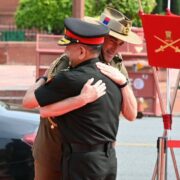
Yesterday, I wrote about a photograph of the Indian Army Chief welcoming his Australian counterpart with a hug during an official visit. Both men were in uniform. I felt it was inappropriate, unprofessional even, for the military to break with established protocol in such a public, official setting. The optics, I argued, matter, and precedent matters even more.
In response (on this post on other social media), someone commented that there was nothing wrong with breaking tradition if both parties agree; after all, protocols can be changed, and new traditions created, consent being paramount. I hastened to correct them before I realised that this is not just about one incident or one photograph. It is about how we, as civilians, often misunderstand what “tradition” means in a military context.
In civilian life, tradition is often viewed with suspicion. Progressive, liberal thinking encourages us to question it: just because something has always been done does not mean it is right, or that it should continue. And in many spheres of life, that is a healthy approach. Strategic thinking in the armed forces, too, allows for questioning, debate, and adaptation, because strategy benefits from ideas tested in the crucible of disagreement.
But at the tactical level, where the leather meets the mud, hesitation kills. When you are holding a post under fire or pressing forward in an assault, you cannot pause to weigh the merits of an order. You cannot afford to doubt your superior. In such moments, obedience must be instant and unquestioning. That is not because soldiers lack intelligence or will, but because the consequences of delay or dissent can be catastrophic, for themselves, their comrades, the mission, and their country.
This is why military traditions matter. Saluting, smart and disciplined drill, extreme obsession with turnout, polish, haircuts, and uniforms, maintaining hierarchy and protocol, exchanging prescribed greetings, and such traditions and customs are not empty rituals. They are habits embedded so deeply that they become muscle memory, ensuring that discipline and respect for the chain of command are automatic and preserved even under extreme stress.
In peacetime, these traditions may appear quaint or ceremonial, even somewhat stiff and unnecessary. But in the battlefield, they help hold the line.
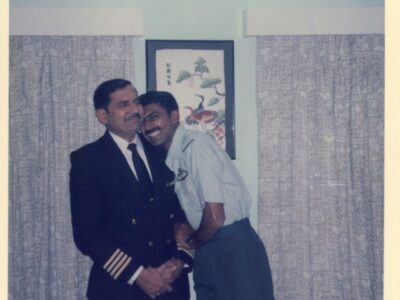
Which brings me back to the idea of “consent”. In uniform, the “parties” are not the individuals. They are the ranks, and by extension, the institutions they represent. As my father, an officer of the Indian Air Force, often told us while we grew up in cantonments: “You do not salute the man, you salute the rank.” That rank is not personal property; it is the visible embodiment of the entire service, its authority, and its traditions. Consent to alter protocol must therefore be institutional, not personal. And in the military, such changes are made only after deliberate consideration, because the ripple effects touch every level of the organisation. Both in peace. And in war.
Of course, traditions can and do evolve. But in the armed forces, change comes slowly, and for good reason. These are not quaint relics. They are part of the machinery that wins wars. And keeps us safe.
Let us be circumspect in applying peacetime standards to people we expect to kill and die for this very peace.
P.S.: That does not mean that laws, or even morality, must be seen as different or inapplicable for the men and women in uniform. Just that we must consider the context in which we apply these.